Physics AI is not a model you call through the API. It is a capability, announced on 27 May 2026, inside Mistral's enterprise offering for industrial engineering.
It comes from the acquisition of Emmi AI, an Austrian company specialised in the field. On 23 May 2026 Mistral announced it had entered into a definitive agreement to acquire Emmi AI, that is the official wording, and it is not the wording of a closed transaction. The team, more than thirty researchers and engineers, joins Mistral's Science and Applied AI teams in May 2026.
No model name, no licence and no pricing have been published to date. This page therefore explains the idea, not a product sheet.
The problem: physics is slow to compute
An aircraft, a car, a turbine, a processor package, all of them obey physical laws we know how to write down. Those laws take the form of partial differential equations. They are, as Mistral's announcement puts it, the language of physics: they describe how fluids flow, how structures deform, how heat moves.
Knowing how to write the equations is not enough. You have to solve them, and you do not solve them by hand. The method, unchanged for decades, is to chop the object into millions of tiny pieces and compute what happens in each one. That is what a solver does, CFD for fluids, FEM (finite element method) for structures.
The result is exact. It is also painfully slow.
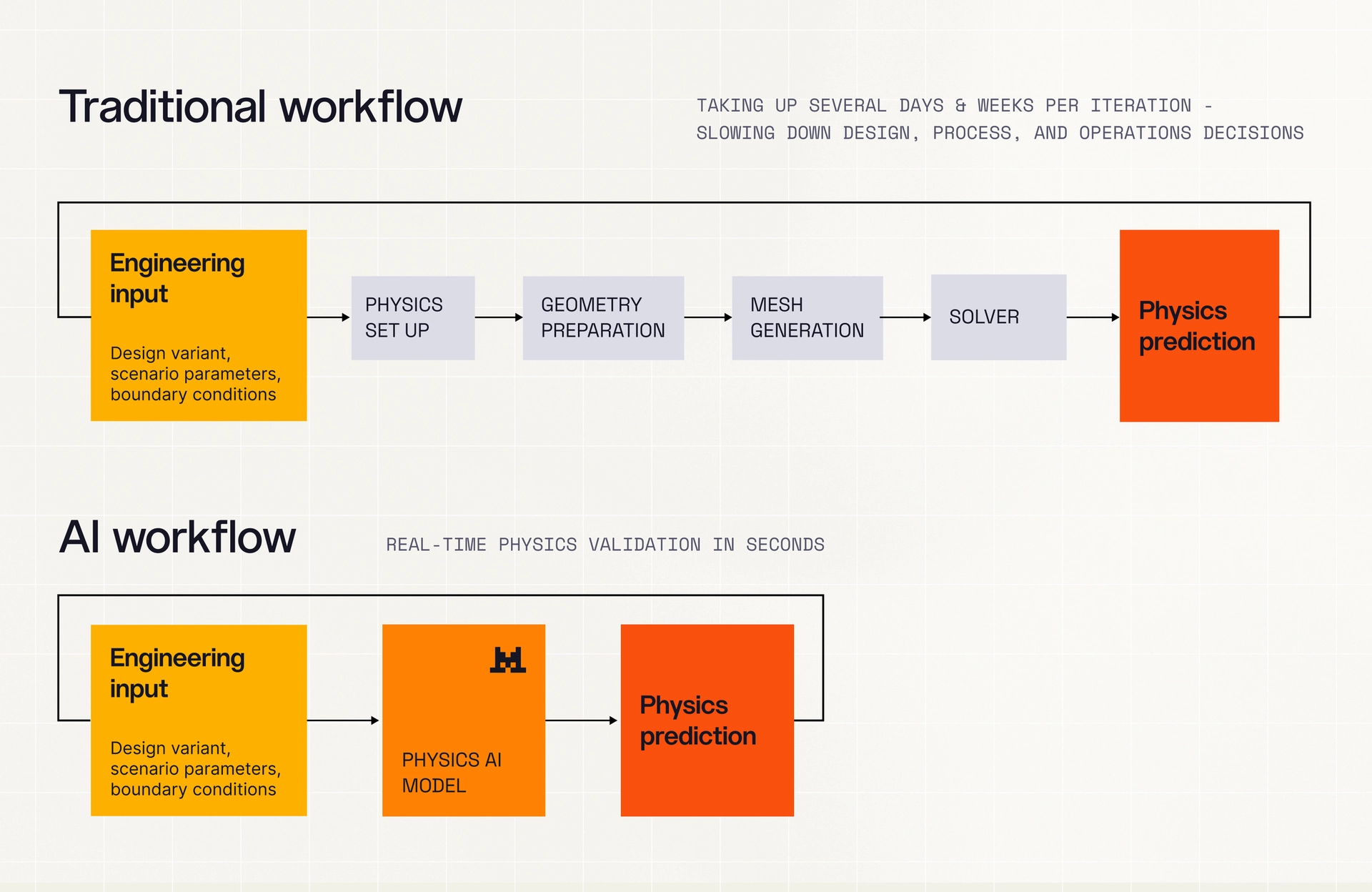
The official announcement walks through the whole chain: prepare the CAD geometry, discretise it into a mesh, configure the boundary conditions, queue the run on an HPC cluster, wait.
Two figures are worth keeping, as Mistral states them: hours to weeks of compute time per design variant. And one deflating observation: a CFD or FEM workload in 2026 looks much the same as it did in 2006.
Then there is money. HPC capacity, solver licences and specialist expertise all gate how many simulations you are allowed to run.
The consequence is what Mistral calls a structural problem, and it is the heart of the matter. Engineers iterate on a handful of designs when they should be exploring thousands. Many teams settle for good enough, because optimal is unaffordable in compute and in calendar time.
Put differently: the quality of the computation is not what is wrong. What is wrong is the number of iterations you can afford.
The trick: learn the answer instead of recomputing it
The idea fits in one sentence. Since classical solvers have already produced, over the years, thousands of simulation results, you can train a model on those results, and then ask it to predict directly what the solver would have said.
This is called a surrogate model. Mistral's own definition: a class of models that learn from physics solver outputs and predict physical behaviour directly from geometry and boundary conditions, or even from measurement data. The model produces the full physical fields in a single forward pass, on the order of seconds, on a single GPU.
An experienced engineer looks at a drawing and says, in three seconds, that it will vibrate right there. She computed nothing. Over a career she has seen enough similar parts and enough computed results for her intuition to have become reliable.
Nobody signs off a certification on that intuition. But everybody uses it to throw out the bad ideas before launching the computation, which is where most of the work is saved.
A surrogate model is that intuition, industrialised and put in numbers. It does not replace the computation. It decides what deserves to be computed.
The point not to miss: the model comes before the solver, it does not replace it
This is where the announcement is most careful, and it is exactly the point a non-engineer gets wrong if left to guess. Mistral takes the trouble to say what physics AI is not:
- it is not a replacement for first-principles solvers in every regime;
- it is a step change in throughput for the vast majority of design-loop iterations, with traditional solvers reserved for verification and edge cases;
- it is not a large language model trained on simulation data: the architectures, the training objectives and the evaluation regimes are fundamentally different;
- it is not a regression on a single geometry.
The right image is proofreading. The model drafts fast and in volume; the solver reads and signs. Nobody removed the signature. What was removed is the wait between each draft.
Generalisation: one model for a whole family of parts
The last item on that list deserves unpacking, because it separates a gimmick from a tool.
The point of the approach, Mistral says, is geometric and parametric generalisation: one model serving an entire design family, not one model per part.
The distinction is decisive. If you had to retrain a model for every geometry, you would merely have moved the cost around: training would replace simulation and you would gain nothing. What makes the approach useful is that once the model is trained on a family (engine housings, say, or wing profiles) it answers on variants it has never seen.
What it unlocks
The announcement describes three uses, and they read well because they follow a product's life.
| Stage | What becomes possible |
|---|---|
| Product design, the car body, the wing, the chip package, the motor | Thousands of variants explored in the time one simulation used to take; models that propose candidates rather than only scoring them; simulation moved earlier and usable beyond specialists |
| Tooling and process design, moulds, dies, fixtures, process settings | Tooling geometry and process parameters optimised together rather than in sequence; manufacturing defects predicted before a single tool is cut |
| Real-time digital twins, a turbine, a power grid, a battery | Continuous physics predictions on live sensor data; what-if scenarios on running assets, without taking them offline |
The third case is the least obvious and possibly the most interesting. The announcement flags a problem that is rarely stated out loud: once a product is in operation, engineers lose the physical insight they had at design time, because the solvers that produced it are too slow to keep up with live data. A model that answers in a second can run continuously.
The research underneath
On the same day, Mistral published a page listing the work this capability rests on. It comes from the Emmi AI team and Johannes Kepler University Linz, and all of it is public. That is worth knowing: this is not an industrial secret that appeared overnight, it is a research line pursued since 2024.
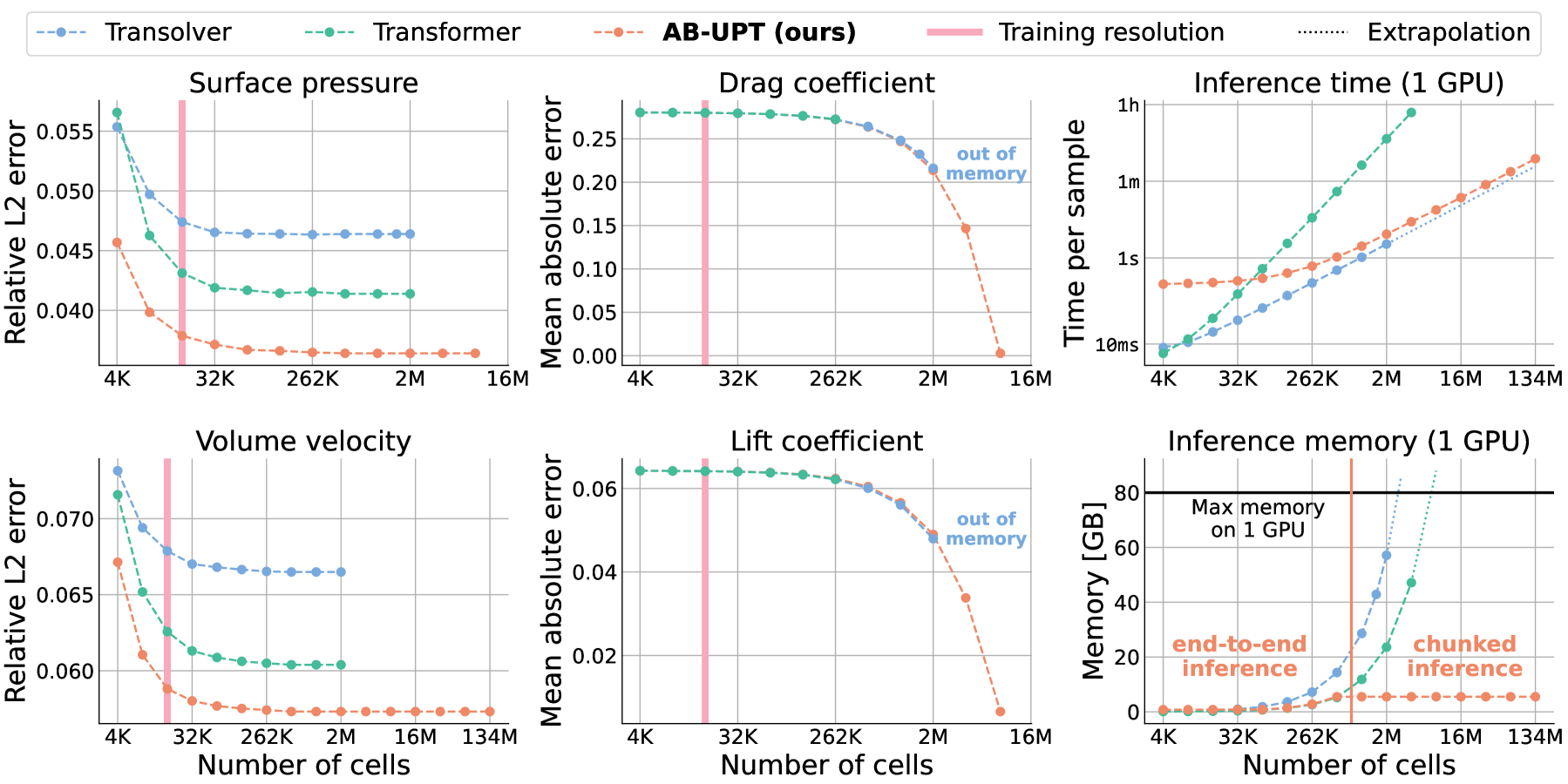
Universal Physics Transformers: A Framework For Efficiently Scaling Neural Operators NeuralDEM, Real-time Simulation of Industrial Particulate Flows AB-UPT: Scaling Neural CFD Surrogates for High-Fidelity Automotive Aerodynamics Simulations via Anchored-Branched Universal Physics Transformers GyroSwin: 5D Surrogates for Gyrokinetic Plasma Turbulence Simulations Going with the Speed of Sound: Pushing Neural Surrogates into Highly-turbulent Transonic RegimesTwo numbers from those pages give the real scale. AB-UPT handles raw geometry, with no remeshing, at 9 million surface cells and 140 million volume cells on a single GPU. And the dataset published in December 2025 on three-dimensional wings in the transonic regime holds around 30,000 samples, each with its own geometry and inflow conditions.
That second number tells you most of what you need to know about the economics. To train a model that will stand in for thousands of simulations, you first have to have run tens of thousands. The cost did not vanish. It was paid once, up front.
Who uses it
Three industrial partnerships are documented on Mistral's own pages, and together they map the territory well.
ASML (the Dutch lithography equipment maker, and since the Series C a cornerstone shareholder in Mistral) is applying Mistral's AI across its product portfolio, its research and development and its operations, to shorten time to market for higher-performance lithography systems.
Airbus is working with Mistral to embed ethical and trustworthy frontier AI across its aerospace operations, from design to flight, under strict security and sovereignty requirements.
BMW Group is the case most directly tied to physics: the carmaker and Mistral are jointly developing industry-specific models for crash simulation, combining BMW's proprietary datasets and engineering expertise with Mistral's AI capabilities.
Read the BMW sentence closely: the model is built from the carmaker's proprietary datasets.
That is the defining economic feature of this whole field, and it is contractual before it is technical. A surrogate model is worth only as much as the solver results it was trained on, and inside an industrial group those results are among the most closely held assets there are. Decades of crash computations, test campaigns, and correlations between computation and reality.
The questions that follow are the ones a legal department should ask first:
- who owns the trained model built on customer data, and what happens to it when the contract ends;
- may the supplier reuse what it learned at one customer to serve a competitor, a particularly live question when two carmakers buy the same capability;
- where does training run, given that the data here is not documents but the engineering know-how itself;
- what evidential weight does a model prediction carry in a certification file, when the announcement itself reserves verification for the classical solver.
The architecture Mistral describes (deployed where the customer needs it, integrated with their environment, fully under their control) answers the third question. It does not answer the other three, which are negotiated. Read alongside Sovereignty and On-premise deployment.
Why it matters
There is something in this announcement more interesting than one more product.
For three years, generative AI has been applied to what humans write: text, code, images. Physics is not written by humans, it is computed. That is a different regime: there is a ground truth, produced by a solver, and therefore an unambiguous way to measure whether the model is right. A text can be elegantly wrong without anyone noticing. A pressure field cannot.
That makes the field both easier to evaluate and more demanding. And it explains the line Mistral uses to justify the deal: physics deserves its own frontier AI models.
For the rest, this is the story of every throughput gain. When an operation drops from hours to seconds, it is not the same operation done faster. It is a different way of working. You stop testing the three ideas you believe in and start testing the thousand you would never have thought of, and the classical solver no longer does the searching. It does the concluding.
In one sentence: the solver is still the judge, but it no longer runs the investigation.