Workflows was released in public preview on 27 April 2026. It is a native component of Studio, not a separate product. The Python SDK v3.0 is publicly available (uv add mistralai-workflows).
The original announcement still refers to Le Chat: the product was renamed Vibe on 28 May 2026. This page uses the current name.
The problem: a gulf between the demo and production
Mistral states the diagnosis in one sentence: enterprises have access to capable models; what they lack is a way to run them reliably in production.
The symptoms listed in the announcement are eloquently ordinary:
- pipelines that work in a notebook and fail silently in production, leaving no trace;
- long-running processes that cannot survive a network timeout;
- multi-step operations that need human approval mid-execution, with no mechanism to pause and resume;
- systems that offer no way to verify they are still doing what they are supposed to, once deployed.
Put another way: the demo succeeds because somebody is watching and it lasts three minutes. Production fails because nobody is watching and it lasts three hours, a thousand times a day.
Building all of that yourself is, Mistral says, months of complex work, and it means stitching together bricks from different tools: inference, agents, connectors, observability, each with its own interfaces and formats.
The governing idea: durable execution
This is the concept to grasp, and it states simply.
Take an automated process chaining ten steps: read a document, call a model, query a database, wait for an approval, write a result. At step eight, the server restarts.
Without durable execution, everything is lost. The program remembers nothing. The first seven steps (which cost compute, called billed services, perhaps already sent an email) must be redone entirely. And if the incident recurs, you never finish.
With durable execution, every completed step is recorded as it goes. When the process dies, another one picks up at the last validated step. The first seven are not replayed.
A notary has a deed signed page by page, initialling as they go. If the session is interrupted, you resume at the initialled page: nobody starts the deed again from the beginning.
An ordinary program behaves like someone who read the whole thing aloud without initialling anything: the slightest interruption forces a restart, and nothing proves where you had got to.
Durable execution is the initialling.
Mistral sums it up usefully: developers can focus on writing business logic instead of writing recovery logic. That is a considerable shift of effort, in enterprise systems, error-recovery code is often the majority of the code written.
Under the hood: Temporal
Workflows is built on Temporal, an open-source durable execution engine that Mistral notes powers orchestration at Netflix, Stripe and Salesforce. So this is not a home-grown invention: it is a proven industry component that Mistral has extended for AI workloads, streaming, payload handling, multi-tenancy, and observability the core engine does not provide out of the box.
Processes are written in Python. The Mistral SDK handles retry policies, tracing, timeouts, rate limiting and human-in-the-loop through decorators and single-line configuration. What the developer writes is business logic and nothing else.
Human approval: one step, one line
This is the feature that matters most for sensitive uses, and it is worth seeing how it behaves.
Inside an automated chain, the call wait_for_input() puts the process on pause. What then happens:
- the workflow stops for as long as it takes, consuming no compute;
- the reviewer is notified;
- they respond from Vibe, from a webhook, or from any connected surface;
- the workflow resumes exactly where it stopped.
People often assume inserting a human check into an automation is easy. It is not, and the usual failure takes two forms.
The process stays open and spins: it burns resources for the hours, or days, the reviewer takes to answer, so in practice you give them a short deadline, and the check becomes a formality rushed through.
Or the process stops and a second one is launched after approval: the thread is lost, and the link between the human decision and the execution that followed is no longer established by the system but reconstructed by hand.
A durable pause mechanism removes both. The reviewer gets the time they need at zero cost, and their approval is recorded inside the same execution as what precedes and follows it. A human check that leaves a verifiable trace is precisely what documentary compliance regimes require, and precisely what most automations lack.
Observability
Every branch, every retry, every state change is recorded in Studio. Mistral's phrasing is explicit: if a decision needs to be investigated months later, the full timeline is there to show how it was reached. Studio presents the execution as a structured timeline you can drill into at any level of detail, down to individual traces, with native support for OpenTelemetry (the open standard for tracing distributed systems).
On top of that come the enterprise guardrails: workspaces that keep teams and projects separated, and role-based access control (RBAC) that enforces those rules consistently.
The split architecture: the sovereignty argument
This is the point not to miss, and it is as much a legal matter as a technical one.
The deployment separates two planes:
| Where it runs | What it holds | |
|---|---|---|
| Control plane | At Mistral | The Temporal cluster, the Workflows API, Studio, the orchestration: who does what, in what order, with what history |
| Workers (data plane) | In your environment, on your Kubernetes, via a separate Helm chart | The actual execution of steps and the processing of data |
Workers connect back to the central cluster through secure credentials. The consequence, as Mistral puts it: your data and business logic stay within your perimeter. Deployment can be cloud, on-premises or hybrid, right where your critical services live.
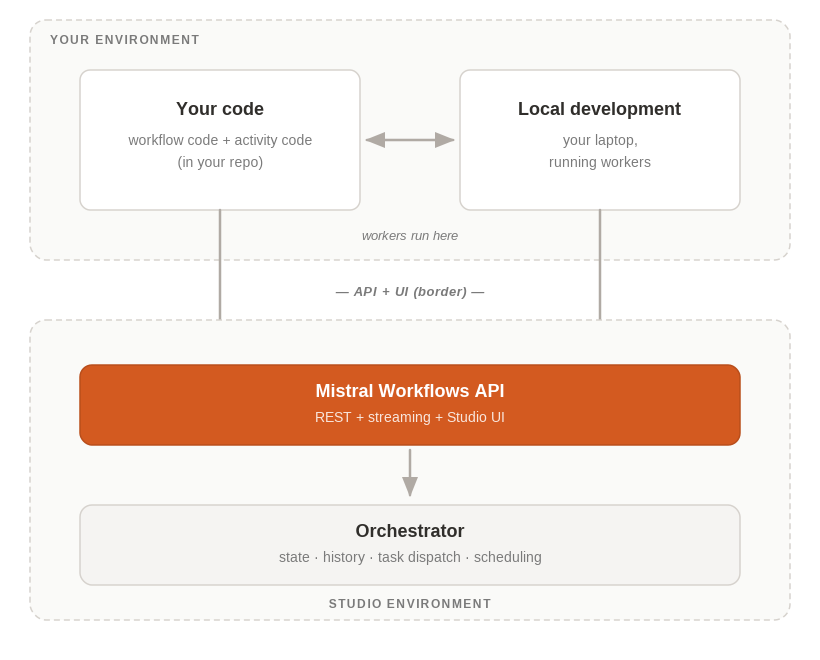
The distinction is that of the conductor and the musicians. The conductor knows which piece is being played, which bar you are on, and who comes in next. They are not holding the instruments.
Translated into compliance terms: what leaves your premises is the sequencing, step 4 succeeded, step 5 is awaiting approval. What does not leave is the content processed, the client file, the identity document, the contractual exhibit.
This dispenses with no analysis: orchestration metadata is not nothing, and the applicable regime depends on what actually ends up in the execution log. But the architecture makes the question askable, which is not the case with a service hosted end to end by a third party. Read alongside Sovereignty and On-premise deployment.
What it looks like in practice
Mistral describes three production uses, each illustrating one of the three properties.
Cargo release (durability). A single cargo release can involve customs declarations, dangerous goods classifications, safety inspections and regulatory checks across several jurisdictions; a missed step means cargo stuck at port and a possible compliance breach. The workflow validates every incoming shipping document against customs rules, checks for anomalies, flags whatever needs a human sign-off, waits for approval, then releases the cargo.
Document compliance checking (auditability). A KYC review, extracting identity documents, verifying them against sanctions lists and politically-exposed-person databases, cross-referencing regulatory requirements across jurisdictions, producing a structured risk assessment with supporting evidence, takes hours of analyst time per case. With Workflows, Mistral says, the review takes minutes, and every step appears in a timeline you can drill into.
Support triage (correctability). Incoming tickets are analysed, categorised by intent and urgency, and routed automatically. The requirement specific to this case is the interesting one: automated routing will get things wrong, and what you then need is to see why a ticket was routed as it was, and to fix it at the workflow level, without retraining a model.
Organisations cited as users include ASML, ABANCA, CMA CGM, France Travail, La Banque Postale and Moeve.
Who writes, who triggers
One last, structuring distinction. Engineers write workflows as code. Business teams trigger them from Vibe, without writing a line, or by webhook, or from any connected surface. Every step stays traced in Studio, whoever pressed the button.
This is Mistral's answer to a permanent tension in enterprise automation: a process must be written by the people who can program it and triggered by the people who know when it should run.
In one sentence: Workflows gives AI processes what double-entry bookkeeping gave to accounts, a step-by-step record that survives the incident, allows a pause, and leaves a history you can open months later.