The Flaw in LoRA That QLoRA Fixes
LoRA (Low-Rank Adaptation) removes the cost of gradients and optimizer states, but it leaves the heaviest item untouched: the frozen model still has to be loaded whole into the graphics card's memory.
Do the arithmetic for a 65-billion-parameter model. In 16 bits, i.e. 2 bytes per parameter, its weights take GB. The most common datacentre cards cap at 80 GB: even with LoRA, you need two.
QLoRA's idea (Quantized LoRA): keep the frozen model in a heavily compressed format, 4 bits per parameter, i.e. half a byte, four times less, while holding the LoRA adapters at 16 bits so learning quality is not hurt.
Here is the split, worth keeping in mind for the rest of the page:
| Format | Status | |
|---|---|---|
| Base model | NF4, 0.5 bytes per parameter | frozen, never updated |
| LoRA adapters (matrices A and B) | BF16, 2 bytes per parameter | learned |
| Activations, gradients passing through the frozen layers | BF16 | recomputed on every pass, nothing is kept |
So the frozen weights are compressed; what you learn is not. And gradients do pass through the quantized layers (they simply do not stop there) on their way to updating the LoRA matrices only.
QLoRA: Efficient Finetuning of Quantized LLMs (Dettmers et al., 2023)The Three Technical Innovations of QLoRA
1. NormalFloat on 4 bits (NF4)
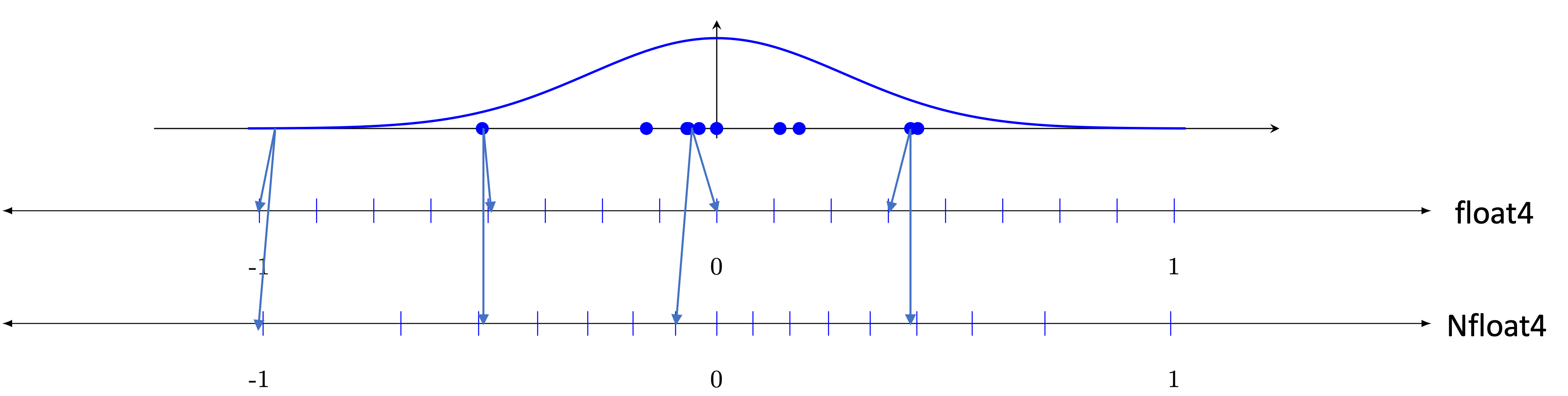
NF4 is a 4-bit number format designed for neural network weights. Four bits means only possible values: the whole art lies in picking which sixteen.
The observation behind it: pre-trained weights roughly follow a normal distribution, a bell curve centred on zero. Most weights sit near zero; extreme values are rare.
In ordinary 4-bit quantization (INT4), the 16 levels are spread evenly across the value range, like the marks on a ruler. That wastes them: many land in the tails of the distribution, where there are almost no weights at all.
NF4 puts the 16 levels at the quantiles of the normal distribution: each level covers an equal share of the distribution, so the ticks bunch up near zero and spread out towards the ends. The paper calls this format "information theoretically optimal" for normally distributed weights.
The gain costs nothing in memory: NF4 occupies exactly what INT4 or FP4 would, half a byte per weight. Only the placement of the 16 ticks changes.
2. Double Quantization
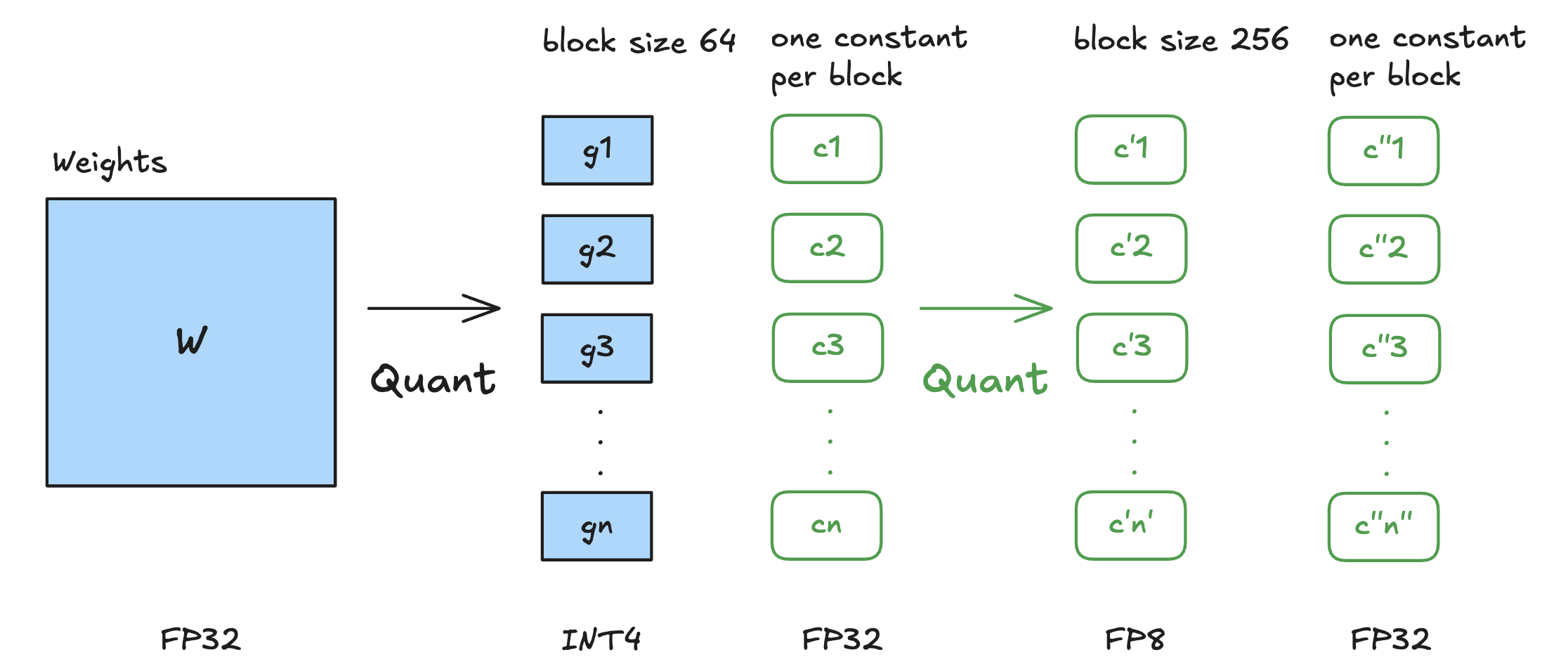
Compressing to 4 bits is only possible block by block, with one scaling constant per block: a factor saying what to multiply the 16 ticks by to recover the real magnitude of that block's weights. Without it, there is no way back to the true values.
Work out the extra cost. A block holds 64 weights and its constant is stored in FP32, i.e. 4 bytes, i.e. 32 bits. Spread over the block's 64 weights:
Half a bit added to 4 bits is a 12.5% overhead. Far from negligible.
QLoRA's trick: quantize the constants themselves. They are grouped by 256 and stored on 8 bits instead of 32, keeping one second-level constant per group of 256. The count becomes:
About 3.2% overhead instead of 12.5%. These are the paper's own figures. On a 65-billion-parameter model, the 0.373 bits per weight saved amount to GB.
3. Paged Optimizers
What this targets is not average memory, QLoRA's optimizer states are tiny, since only the LoRA matrices have any. It is the spikes: at certain moments in training, notably when a long sequence comes through, memory demand jumps and the card runs out. One spike is enough to kill a twenty-four-hour run.
So QLoRA uses paging between the graphics card and main memory: when space runs short, optimizer states are moved out to the computer's RAM and brought back when needed again. The paper's abstract puts it plainly: paged optimizers "to manage memory spikes".
The technique rests on unified memory in CUDA (Compute Unified Device Architecture, NVIDIA's computing platform), which moves data page by page between card and main memory automatically, much as an operating system pushes to disk the memory pages it does not need right now. Nothing to write in your code.
Concrete Impact on Memory
Take the 65-billion-parameter model again and count, method by method, in bytes per parameter.
| Method | Breakdown | Total | Hardware needed |
|---|---|---|---|
| Full fine-tuning, 16-bit + AdamW | weights 2 + gradients 2 + optimizer 8 = 12 bytes | GB | a cluster of cards |
| LoRA, frozen model in 16 bits | weights 2 bytes, the rest negligible | 130 GB + adapters | two 80 GB cards |
| QLoRA, frozen model in NF4 | weights 0.5 bytes | 33 GB of weights, 41 GB measured in total by the paper | one 48 GB card |
| QLoRA on a 7-billion-parameter model | weights 0.5 bytes | 3.5 GB of weights, 5 GB measured by the paper | one consumer card |
The 780 GB and the 41 GB are the paper's own numbers; both fall out of the bytes-per-parameter count.
The point not to miss: LoRA alone does not reduce the memory needed to load the model. It removes the gradients and the optimizer states, which takes 780 GB down to 130, but the frozen model's 130 GB stay. It is 4-bit quantization that divides those by four.
Fine-Tuning Quality: The Surprise
The paper argues that QLoRA in NF4 matches the quality of 16-bit fine-tuning. We put no percentage on the gap: the figures in circulation do not correspond to any single measurement in the paper, which compares across several datasets and several model sizes.
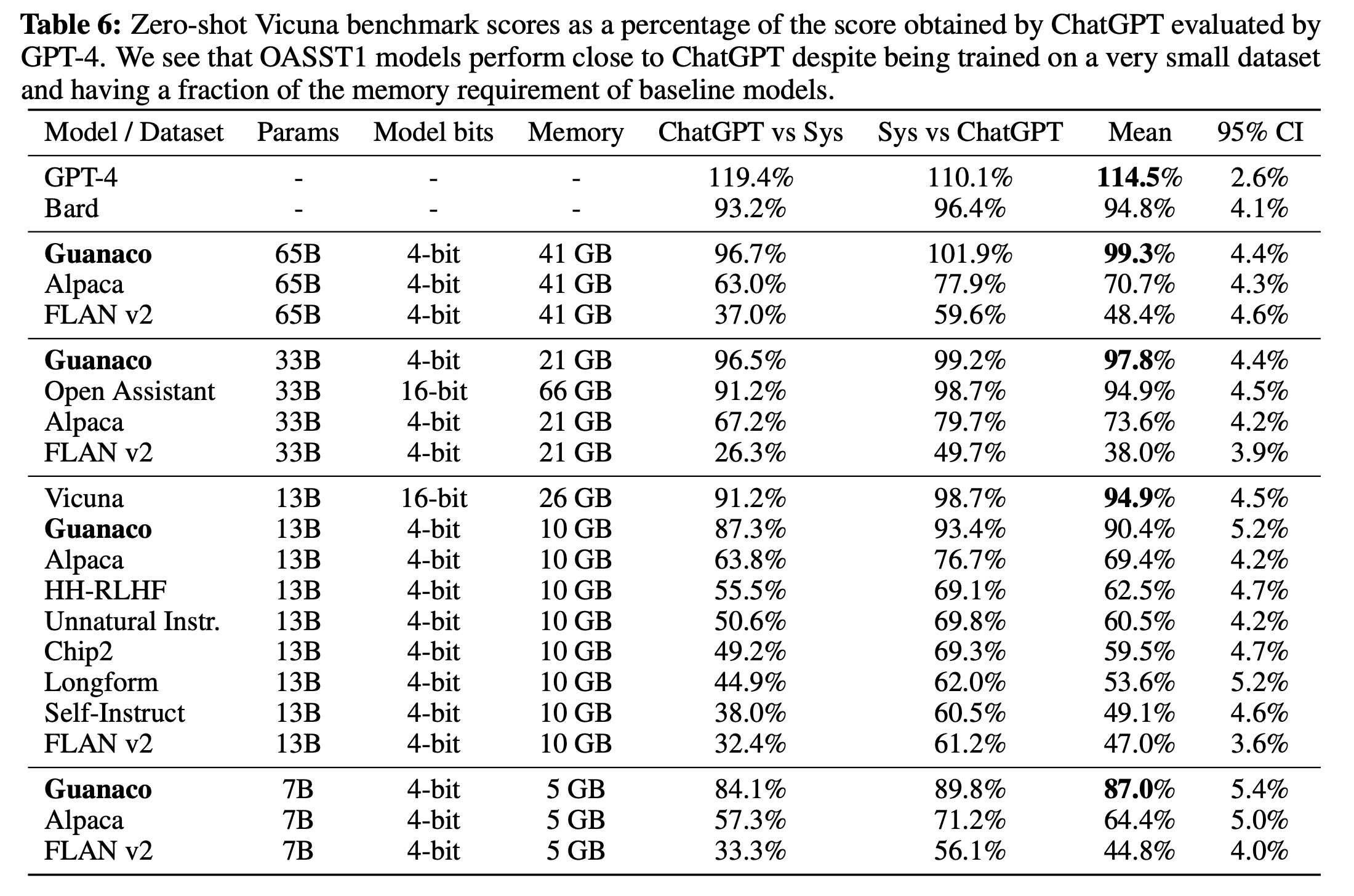
To back the claim, the authors produced Guanaco, a family of models fine-tuned with QLoRA on the OASST1 dataset (Open Assistant version 1, a corpus of conversations annotated by volunteers).
Guanaco 65B reaches 99.3% of ChatGPT's level on the Vicuna benchmark, after twenty-four hours of fine-tuning on a single graphics card. That is the figure from the paper's abstract, and it is what convinced the community.
One qualification matters for reading that number: the evaluation is automatic. Both models' answers go to a judge model, GPT-4, which picks the better one. The paper also runs a human evaluation, and explicitly defends GPT-4 judging as a cheap approximation of it, an approximation, not an equivalent.
Practical Implementation
QLoRA is perfectly integrated into the Hugging Face ecosystem via bitsandbytes and PEFT:
from transformers import AutoModelForCausalLM, BitsAndBytesConfig
from peft import LoraConfig, get_peft_model

# 4-bit quantization configuration
bnb_config = BitsAndBytesConfig(
    load_in_4bit=True,
    bnb_4bit_quant_type="nf4",
    bnb_4bit_compute_dtype=torch.bfloat16,
    bnb_4bit_use_double_quant=True,
)

# Load the quantized model
model = AutoModelForCausalLM.from_pretrained(
    "mistralai/Mistral-7B-v0.1",
    quantization_config=bnb_config,
    device_map="auto",
)

# Apply LoRA
lora_config = LoraConfig(r=16, lora_alpha=32, target_modules="all-linear")
model = get_peft_model(model, lora_config)
Four settings, one per innovation: load_in_4bit turns on compression, nf4 picks the NormalFloat format over an evenly-spaced one, bfloat16 fixes the format the arithmetic is done in (weights are decompressed on the fly for each multiplication), and double_quant enables double quantization. Those four lines divide the base model's memory by four, not total memory, which also holds the activations.
Practical Tips
The Compute Format
Weights are stored in 4 bits, but every multiplication happens in a wider format, after decompression on the fly. That compute format is what you choose here. Both candidates occupy 2 bytes, but they spend their bits differently:
- BF16 (brain floating point on 16 bits): fewer significant digits, but a range of representable values as wide as FP32's. This is the recommended choice, because a tiny or enormous gradient never collapses to zero or blows up to infinity. Needs an Ampere-generation card or newer.
- FP16: more significant digits, narrower range, so more prone to overflow. Reserve it for older cards with no BF16 support.
The Adapter's Rank
With QLoRA you can afford a higher rank than with plain LoRA. The reason is purely arithmetic: the adapter weighs a few dozen megabytes where the frozen model weighs dozens of gigabytes. Going from r = 16 to r = 64 quadruples an already negligible item. Take the room.
Rounding a weight to one of 16 values loses information, and the loss is irreversible: the base model will never recover its exact values. The adapter can learn to compensate for part of it during fine-tuning, but not to undo it.
For tasks where numerical precision matters a lot, 8-bit or 16-bit fine-tuning may do better. Measure on your own task before concluding.
Impact on the Ecosystem
QLoRA was the trigger for the democratization of fine-tuning. Before it, adapting a multi-billion-parameter model demanded professional hardware. After it, one consumer card handles a 7-billion-parameter model, and a single 48 GB card handles a 65-billion one.
The consequence: thousands of practitioners with no access to a cluster started fine-tuning models. QLoRA became the default entry point.
The next step is DoRA, which attacks quality rather than memory: LoRA's correction blends a change in the weights' magnitude with a change in their direction, and DoRA separates the two.
1. Which specific weakness of LoRA does QLoRA's quantization fix?
2. Why does NF4 place its 16 levels at the quantiles of the normal distribution rather than at regular intervals?
3. In QLoRA, what exactly gets compressed to 4 bits?
4. What is QLoRA's double quantization?
5. 4-bit compression loses information about the original weights. Can the adapter get it back?