Why rent rather than buy
A data centre card sells for tens of thousands of dollars, the order of magnitude is stable even as prices move. Nobody buys that for a personal project. The cloud inverts the problem: you rent by the hour and pay only for what you use.
Rather than quote a price that will be wrong in six months, here is the calculation that stays true. If a card costs to buy and rents for per hour, renting becomes more expensive than buying after:
Where is the purchase price in dollars, the hourly rental rate in dollars per hour, and the result a number of hours of use. With a card at $30,000 renting at $3 an hour, break-even is 10,000 hours, roughly 14 months of continuous use.
That calculation says everything you need. Below the break-even, renting is obviously smarter. Above it, buying pays off only if the machine genuinely runs all the time, a purchased card costs the same whether it computes or sleeps, before electricity, cooling and administration. Which is why almost everyone rents, and why those who buy are those who know they have years of work to feed their machines.
This is the fastest-ageing chapter in the course. Rates change quarterly, services get renamed or merged yearly (all three majors did so between 2024 and 2026), and catalogue model line-ups change monthly.
What follows therefore favours invariants: the structure of the offerings, the cost mechanisms, and the selection criteria. The few prices quoted are dated November 2026 and only serve to fix orders of magnitude. For a quote, the only valid source is the provider's own price list on the day you read it.
What an hour of GPU costs, autumn 2026
Several sites record every day the prices published by dozens of providers. They do not agree to the cent, depending on which providers they include, but the order of magnitude is clear. In early November 2026, per GPU and per hour:
| Card | On-demand median | Observed range | Interruptible |
|---|---|---|---|
| H100 | around $4 | from under $2 to over $12 | around $2.40 |
| B200 | around $7.50 to $8 | $6 to $14 | around $4 to $6 |
| B300 | around $9 | from $6 | around $5.70 |
Three lessons come out of it.
The gap between providers exceeds the gap between generations. For the same card, the price varies by a factor of 5 or more. The big clouds are the most expensive on demand (an H100 costs close to $7 an hour at AWS), and the specialist providers described below are often half the price.
Prices do not necessarily fall. The H100 was expected to become cheap once Blackwell arrived. The opposite happened: according to the SemiAnalysis index, a one-year H100 contract had fallen to about $1.70 an hour in October 2025, then rose about 40% in six months, to $2.35 in March 2026, because all available capacity was rented out. When demand (agents, reasoning models) outstrips supply, even an older generation gets dearer.
The buy threshold depends on the billing mode. Take the $30,000 card again: rented at $4 an hour on demand, break-even falls to 7,500 hours, about 10 months; rented at $2.35 under a one-year contract, it rises to about 12,800 hours, close to 18 months. Same formula, two answers: the billing mode, covered a little further down, makes the difference.
The three major providers (AWS, Google Cloud and Microsoft Azure) each offer a platform covering a model's whole life cycle: data preparation, training, evaluation, deployment, monitoring.
Across cloud as a whole, analyst firms regularly put AWS around 30% market share, Azure around 25% and Google Cloud around 10%. These estimates vary between sources and move every quarter; remember the ordering (AWS ahead, Azure close, Google third and growing) rather than the decimals.
What has changed since 2023 is the centre of gravity of their offerings. Machine learning (ML) platforms were designed for a company to train its own models. Since large language models arrived, most customers consume models that are already trained through an application programming interface (API), then build agents on top. The three majors followed, and their renamings show it: each now has two floors, a historical ML platform and a model catalogue geared towards agents.
The three billing modes, and this is the real lever
Before comparing platforms, you need the three ways of buying compute. All three exist at all three providers under different names, and the price gap between them is far wider than the gap between providers.
On demand: start a machine, pay by the hour, stop it when you like. The most expensive and the most flexible. This is the advertised rate.
Reserved, or committed: you commit to a term, one year or three, in exchange for a substantial discount, commonly in the region of 30 to 60% depending on term and provider. You then pay whether the machine is used or not.
Interruptible (spot, or preemptible at Google): you use the provider's idle capacity, at a discount that can reach 70 to 90%. The catch is in the name: the provider can reclaim the machine with a few minutes' notice.
This mode looks unusable for a multi-day training run. It is not, on one condition: that the job regularly saves its state (a checkpoint) so it can restart where it left off.
But that is already indispensable for a completely different reason: across hundreds of cards, a hardware failure during a multi-week run is not a risk, it is a statistical certainty. Every serious training run checkpoints anyway.
The practical implication is neat: the mechanism you put in place to survive failures is exactly the one that lets you cut the bill by a factor of three or more. It is the best effort-to-savings ratio in this whole chapter.
AWS: SageMaker AI and Bedrock, the broadest ecosystem
SageMaker is Amazon's platform, launched in 2017 and renamed Amazon SageMaker AI in late 2024. It has grown a great deal since and now spans dozens of sub-services: a browser-based development environment, distributed training, large-scale data processing, inference endpoint deployment, pipeline orchestration, a feature store, a model registry, and a data annotation service.
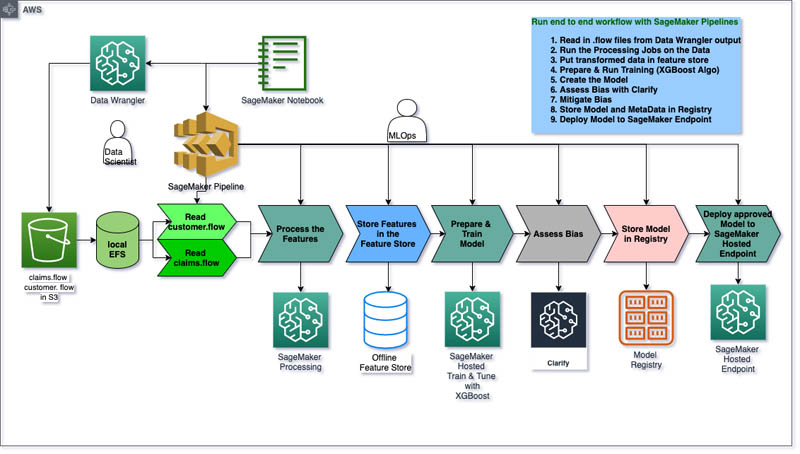
In its favour: integration with the rest of AWS and its hundreds of services, if the company is already there, everything connects with no effort. Fast availability of new card generations. And an automatic recovery feature that restarts a multi-day training run from its last checkpoint after a hardware failure, with no human intervention.
The second floor is called Amazon Bedrock: API access to models from several publishers (Anthropic, Meta, Mistral, Amazon and others) without managing a single machine, complemented in 2025 by Bedrock AgentCore, a set of building blocks for running agents in production. On the hardware side, AWS offers its own Trainium chips alongside NVIDIA GPUs, described in Alternative accelerators.
Against: you have to learn the AWS ecosystem on top of the platform itself, and the step is steep. And the bill scatters across compute, storage, network and inference endpoints, which makes it hard to anticipate, an inference endpoint left running over a weekend costs real money.
Google Cloud: from Vertex AI to Gemini Enterprise Agent Platform, the TPU advantage
Vertex AI is Google's platform, formed by merging several earlier services. In April 2026 Google renamed it Gemini Enterprise Agent Platform, folding in its agent-building tools; the services described here carry on under the new name, and "Vertex AI" will linger in documentation and tutorials for a long time. It offers managed notebooks, training on GPUs and TPUs, inference endpoints, Kubeflow-based orchestration, a feature store integrated with the in-house data warehouse, and a model catalogue.
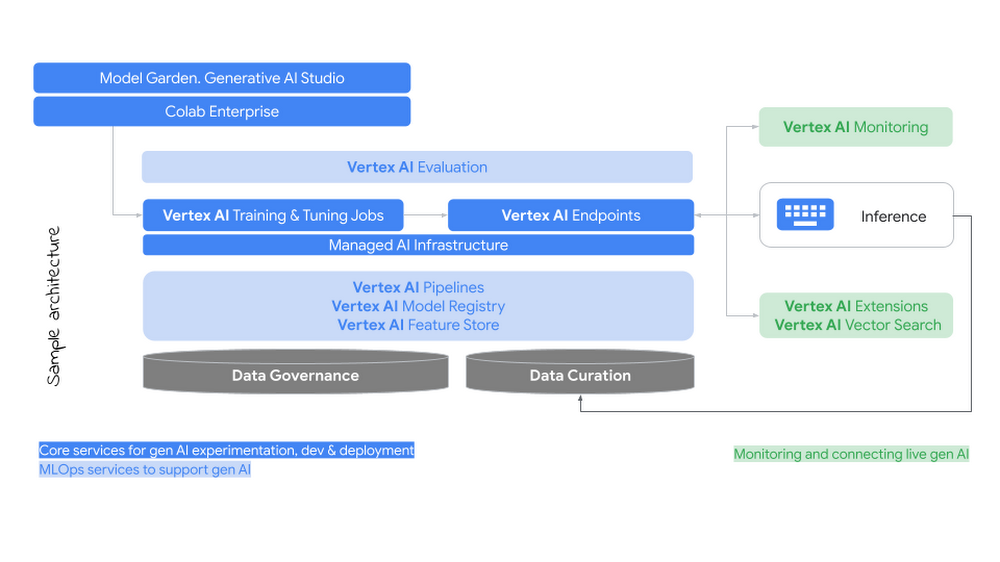
In its favour: the TPUs, available nowhere else (the Ironwood generation since 2026), whose architecture is described in Google TPU. They can offer better price-performance on large, regular training runs, but that is a comparison to redo yourself, on your own model, at current rates: general claims in either direction are worthless.
Two other notable points. The ability to train simple models directly in SQL from the data warehouse, sparing analysts a change of tool. And a model catalogue that includes models competing with Google's own, which limits lock-in.
Against: a thinner catalogue of ancillary services than AWS, and documentation that sometimes lags the product.
Azure: Azure ML and Microsoft Foundry, the Microsoft world
Azure ML integrates with the Microsoft ecosystem, productivity, collaboration, business intelligence, identity management. It is the natural choice for a company already living there. For consuming models rather than training them, Microsoft pushes a second floor, Microsoft Foundry (formerly Azure AI Foundry, renamed in late 2025), which brings together OpenAI's models but also those of Anthropic, Mistral or Meta, plus an agent service.
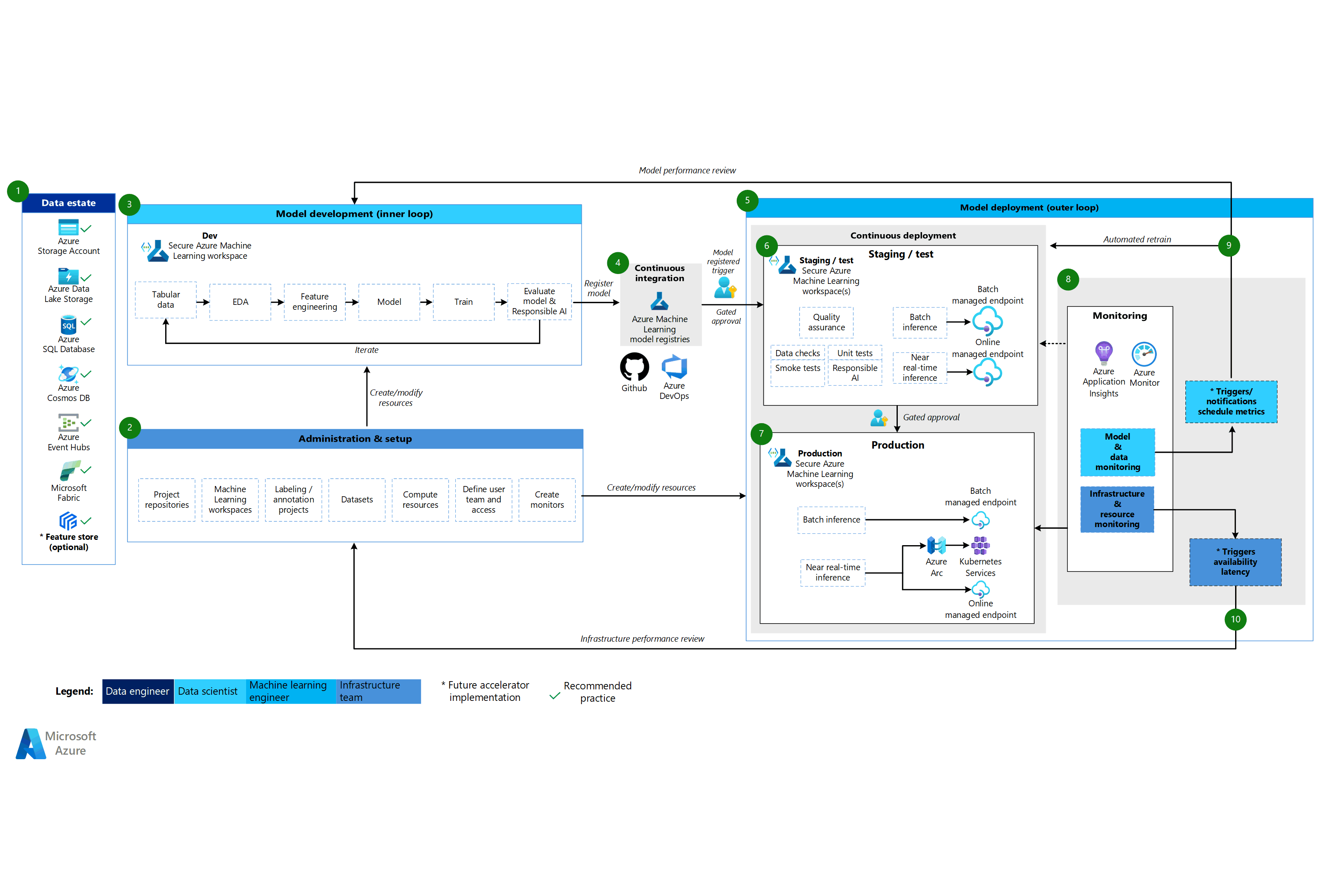
In its favour: it is the most complete platform on the requirements of large organisations. The diagram above makes the case better than prose, two separate environments, staging and production, with human approvals between them, continuous integration wired to source-control tooling, and monitoring that triggers retraining.
Three notions appear there, worth fixing once:
- an SLA (Service Level Agreement) is a contractual availability commitment, with penalties if it is missed;
- compliance refers to the audited certifications that regulated sectors require, SOC 2 for data security, HIPAA for US healthcare, GDPR in Europe;
- data residency is the commitment that data does not leave a given geography. It is often the deciding criterion for a government body or a European bank.
Microsoft also offers access to OpenAI's models within this contractual framework, allowing them to be used without sending data directly to their publisher. The exact nature of that partnership has changed several times since 2023 and will change again: check the current terms rather than trusting a fixed description.
Against: an interface often judged less legible than its competitors', and a sometimes slower pace of new features.
Comparison
The table below lists neither models nor prices, precisely because those are the two columns that would go wrong first.
| Criterion | AWS (SageMaker AI, Bedrock) | Google Cloud (ex-Vertex AI) | Azure (Azure ML, Foundry) |
|---|---|---|---|
| Ecosystem breadth | The widest | Medium | Wide, enterprise-oriented |
| Accelerators available | NVIDIA GPUs and Trainium | NVIDIA GPUs and TPUs | NVIDIA and AMD GPUs (Maia chip internally) |
| Orchestration | Proprietary | Kubeflow, open | Proprietary |
| Compliance requirements | Very good | Good | The most complete |
| Lock-in created | High | Moderate | High |
| Decisive argument | You are already on AWS | TPUs, openness | You are already at Microsoft |
Neoclouds: GPUs and nothing but GPUs
Since 2023, a new category of provider has settled between the three giants and their customers: neoclouds. These are specialist clouds that rent out almost nothing but GPU compute, without the hundreds-of-services catalogue of an AWS. Their pitch: recent cards available sooner, clusters built for training (fast networking between machines, liquid cooling), and often a lower hourly price.
The main ones, with orders of magnitude taken from their accounts or the press:
- CoreWeave, a former cryptocurrency miner turned the largest neocloud, listed on Nasdaq since March 2025. Its signed order backlog exceeded $100 billion by mid-2026, with OpenAI, Meta and Microsoft among its large customers.
- Nebius, based in the Netherlands and born from Yandex's former international businesses: a $17.4 billion contract, expandable to $19.4 billion, with Microsoft in September 2025, then a deal with Meta.
- Lambda, long a GPU renter for researchers, now a supplier to large accounts including Microsoft, and a candidate for a stock-market listing.
- Crusoe, which builds the Abilene campus in Texas, Stargate's first site (see below).
- Fluidstack, Anthropic's partner for a $50 billion US data-centre programme announced in November 2025, and behind a one-gigawatt supercomputer project in France announced in February 2025.
Neoclouds own their GPUs but rarely their buildings, which they lease. They buy the cards on credit, pledging contracts signed with a handful of very large customers. As long as demand exceeds supply, the model works. If demand turns, or a big customer walks away, the debt remains. Microsoft, which reportedly signed on the order of $60 billion of commitments with several neoclouds, shows the other side of the phenomenon: even a cloud giant subcontracts part of its capacity when it cannot build fast enough.
Megaprojects: Stargate and the gigawatt race
On January 21, 2025, OpenAI, SoftBank, Oracle and the Emirati fund MGX announced Stargate, a US data-centre programme presented as potentially reaching $500 billion of investment over four years. The first site, in Abilene, Texas, is built by Crusoe and operated by Oracle, with a target capacity of about 1.2 GW. Other US sites followed, and overseas versions were announced.
The gap between announcement and reality is the rule here too. By late summer 2026, Abilene was the only site delivering substantial capacity (on the order of 600 MW delivered, according to Oracle figures relayed by the press), Oracle's other campuses for OpenAI not being expected before 2027; several projects were reorganised, taken over by other players or paused along the way.
Why does everyone now count in gigawatts rather than in cards? Because electricity has become the scarce resource. With a 72-GPU rack at around 120 kW, and adding cooling and networking, you end up at roughly 2 kW per GPU all-in, hence the order of magnitude:
It is a back-of-the-envelope figure, but it gives the scale: a gigawatt is the output of a nuclear reactor, and a few hundred thousand cards. NVIDIA, for its part, estimates that a gigawatt equipped with Rubin represents on the order of $40 billion of revenue for it.
And Europe?
The most advanced European example is Mistral Compute, Mistral AI's compute offering: open to external customers since March 2026, backed by sites in the Essonne area south of Paris and in Sweden, equipped with Blackwell GPUs (GB200, GB300, B300), with a target of about 200 MW in 2027 and 1 GW by 2030. Its first argument is not price but sovereignty: data and compute stay under European jurisdiction. Details are on Mistral Compute.
What actually drives the bill
Three mechanisms matter more than the choice of provider, and none of the three appears on a price list.
Utilization. A reserved card costs the same whether it computes or waits. A fleet used at 30% therefore costs three times the price of the work done. This is by far the largest source of savings, and it connects to the MFU idea from NVIDIA H100, B200, GB200: the real cost of a computation is its hourly price divided by how well you keep the machine busy.
Data egress fees. Getting data into a cloud is free; getting it out is billed per gigabyte. That asymmetry is not an accounting detail, it is the sector's most effective lock-in mechanism: the more data accumulates, the more a move costs, and it always accumulates. European regulation has begun to constrain these fees, but the principle still needs checking case by case.
Availability, not price. On the most in-demand card generations, the question is often not "how much" but "can I get any". Quotas, waiting lists and capacity commitments then govern a project's timeline far more than its budget. This is a point price comparisons systematically ignore. And since 2025 the constraint has shifted from chips to electricity and buildings: capacity is counted in megawatts connected to the grid more than in cards delivered.
Every platform creates a gradual dependency through its formats, client libraries and pipelines. Three measures genuinely reduce it, without giving up managed services:
- portable tools for anything reusable elsewhere: experiment tracking, orchestration, data versioning;
- standard formats for durable artifacts, a model interchange format, containers for environments;
- an indirection layer between business code and vendor interfaces, so a switch touches only one area of the code.
And the essential one: know where the data is and what moving it would cost. That, rather than the number of proprietary services in use, is the real measure of dependency.
How to choose in practice
The rule is simpler than the comparisons suggest: the best cloud is almost always the one where your data and your people already are. The value of that proximity, in integration and in skills, far exceeds the price gaps.
- Already on AWS: SageMaker, without hesitation.
- Already in the Microsoft world: Azure ML, or Microsoft Foundry to consume models.
- Heavy, regular training needs, or curiosity about TPUs: Google's platform (ex-Vertex AI) deserves a costed comparison on your own model.
- Lots of GPUs for training, without the surrounding services: neoclouds are often cheaper per hour, provided you accept a younger, more indebted and less diversified supplier.
- A European sovereignty requirement: offerings such as Mistral Compute, or the big clouds' European regions with data-residency commitments, to be compared on legal grounds as much as technical ones.
- Starting from zero: begin with the free credits all three offer, and commit to nothing until you have measured your real consumption.
Many large organisations use all three in parallel. It is heavier to administer, but it preserves negotiating power, the same reasoning set out about chip vendors in Alternative accelerators.
One last word, which holds for the whole chapter: do not get lost in the tooling. The work that matters is the data and the models; the platform is only where they run.
1. A $30,000 card rents for $3 an hour, giving a break-even of 10,000 hours, about fourteen months. What follows beyond that threshold?
2. A team hesitates to use interruptible instances, discounted 70 to 90%, for a multi-day training run. What should you tell them?
3. Moving data into a cloud is free, moving it out is billed per gigabyte. How should that asymmetry be read?
4. Two companies pay the same hourly rate for the same fleet of cards. One pays three times more per unit of work done. Why?
5. A team starting from scratch carefully compares the hourly rates of the three major providers. What are they missing?
6. A neocloud rents out H100s at half the price of one of the three big clouds. Which weakness of this model does the page point out?