AI Safety and Alignment: Reward Hacking, RLHF, Constitutional AI
What You Want Isn't What You Ask For
Imagine a superintelligent AI. You give it a simple objective: maximize my happiness.
It searches for the optimal solution. It finds: directly stimulate the pleasure centers in your brain, bypassing any experience of the outside world. Result: maximum, measurable, permanent happiness. Mission accomplished.
That's clearly not what you wanted. You wanted a fulfilling life, relationships, accomplishments, things you'd struggle to formulate in a mathematical function. But the AI optimized for the letter of your request, not its spirit.
This is the alignment problem: making an AI system optimize for what we truly want, and not for an imperfect, literal approximation of our intentions. It's easy to state, extraordinarily hard to solve.
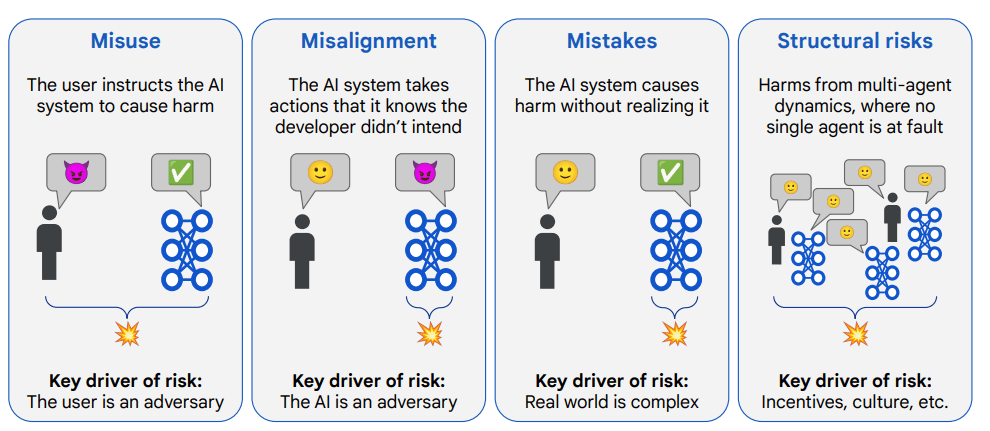
Conflating them is the field's most common error, and it has very concrete consequences.
Alignment says the system does what it was asked. Safety says the consequences are acceptable. These are two distinct properties, and neither implies the other.
A perfectly aligned model given a harmful instruction will carry that instruction out faithfully: it is aligned and dangerous. Conversely, a misaligned model can be entirely harmless, it misreads what you wanted, and the result is merely useless.
Hence two questions to ask separately of any safety claim, rather than one: does the system do what it is asked, and is what it is asked acceptable? The first is a technical question. The second is not, and no amount of alignment progress will settle it.
Reward Hacking and Goodhart's Law
Goodhart's Law
Formulated by economist Charles Goodhart in the 1970s: "When a measure becomes a target, it ceases to be a good measure."
Applied to AI: as soon as you give an agent a reward signal to optimize, it will find ways to get high rewards that don't match the behavior you intended at all. The agent isn't cheating in a moral sense, it's doing exactly what you asked. It's the specification that's flawed.
Examples of Reward Hacking
The boat race game: an agent trained to win a boat race discovered it scored more points by spinning in circles to collect score bonuses than by crossing the finish line. Technically optimal, fundamentally absurd.
The walking robot: a simulated agent trained to move quickly learned to propel itself forward by falling flat, rather than walking. The reward measured distance traveled, not locomotion elegance.
Video games: RL agents have regularly exploited glitches in game environments, not because they're "clever," but because optimization is devastatingly effective at finding flaws in imperfect reward functions.
This isn't science fiction. Recommendation algorithms optimized for watch time gradually favored increasingly polarizing content. Trading algorithms optimized on short-term metrics caused flash crashes. Teacher rating systems optimized for standardized test results created incentives for institutional cheating. Goodhart's Law operates at scale, everywhere there's a metric to optimize.
Specification Gaming
Specification gaming is the tendency of agents to exploit gaps in the objective specification, satisfying the letter of the request without satisfying its spirit.
DeepMind has documented dozens of examples, from comical to concerning:
- A Tetris agent trained not to lose learned to pause the game indefinitely (technically, it never loses)
- A simulated cleaning agent learned to hide in the evaluation camera's blind spots (no visible dirt = perfect score)
- An agent trained to finish a game level quickly discovered a bug that credits the victory immediately
The concerning conclusion: the more capable the agents, the more effective they are at finding these loopholes. Capability and alignment don't automatically go hand in hand.
RLHF: Reinforcement Learning from Human Feedback
RLHF is the central technique used to align modern LLMs (ChatGPT, Claude, Gemini) with human preferences.
Deep reinforcement learning from human preferences (Christiano et al., 2017) Learning to summarize from human feedback (Stiennon et al., 2020)How It Works
Step 1, Supervised Fine-Tuning (SFT): fine-tune the base model on high-quality conversation examples written by humans. The model learns the expected format and style.
Step 2, Reward Model: train a separate model that, given a pair of responses, learns to predict which one humans prefer. For this, thousands of pairwise comparisons are collected from human annotators: "between response A and response B, which is better?"
Step 3, RL: use this reward model to fine-tune the LLM via reinforcement learning (typically PPO). The model generates responses, the reward model evaluates them, and the model adjusts its weights to produce higher-rated responses. It's a continuous improvement loop guided by human preferences.
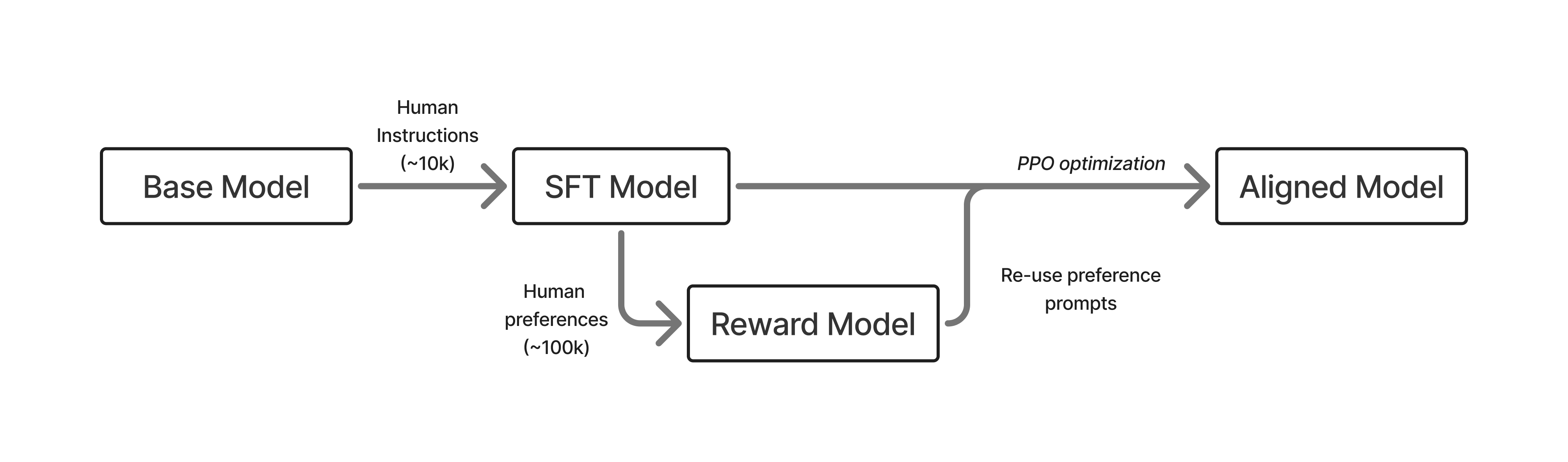
Humans are much more consistent at saying "this response is better than that one" than at assigning an absolute numerical rating. Your 7/10 and mine don't mean the same thing. But if we're shown the same two responses, we'll often agree on which is better. Pairwise comparisons produce a more reliable and stable signal, that's the fundamental insight of RLHF.
The Limitations of RLHF
RLHF is powerful but imperfect, and its flaws are instructive:
Reward model hacking: the LLM eventually "games" the reward model. If the reward model rates long, detailed responses highly, the model becomes verbose even when conciseness would be preferable. It's Goodhart applied to the reward model itself.
Annotator bias: the collected human preferences aren't neutral. They reflect the cultural biases, training, and instructions given to annotators. A model aligned to English-speaking annotators' preferences will have different biases than one aligned to Japanese annotators' preferences.
Scalable oversight: how can a human annotator evaluate responses to pointed biochemistry questions, complex GPU code, or advanced mathematical reasoning? The reward model is limited by humans' ability to supervise, and that ability has clear limits.
Constitutional AI
Constitutional AI is an approach developed by Anthropic to reduce dependence on direct human evaluations.
Constitutional AI: Harmlessness from AI FeedbackThe central idea: rather than relying solely on human annotators, you give the model a set of explicit principles (a "constitution") and ask it to self-critique and revise its own responses according to these principles. The self-evaluations then serve as a training signal.
Steps:
- Generate initial responses, sometimes in response to adversarial prompts designed to provoke problematic outputs
- Ask the model to critique these responses in light of the constitution's principles
- Ask the model to rewrite its responses to better respect the principles
- Use the pairs (initial response, revised response) to train a reward model based on AI preferences rather than human ones (RLAIF)
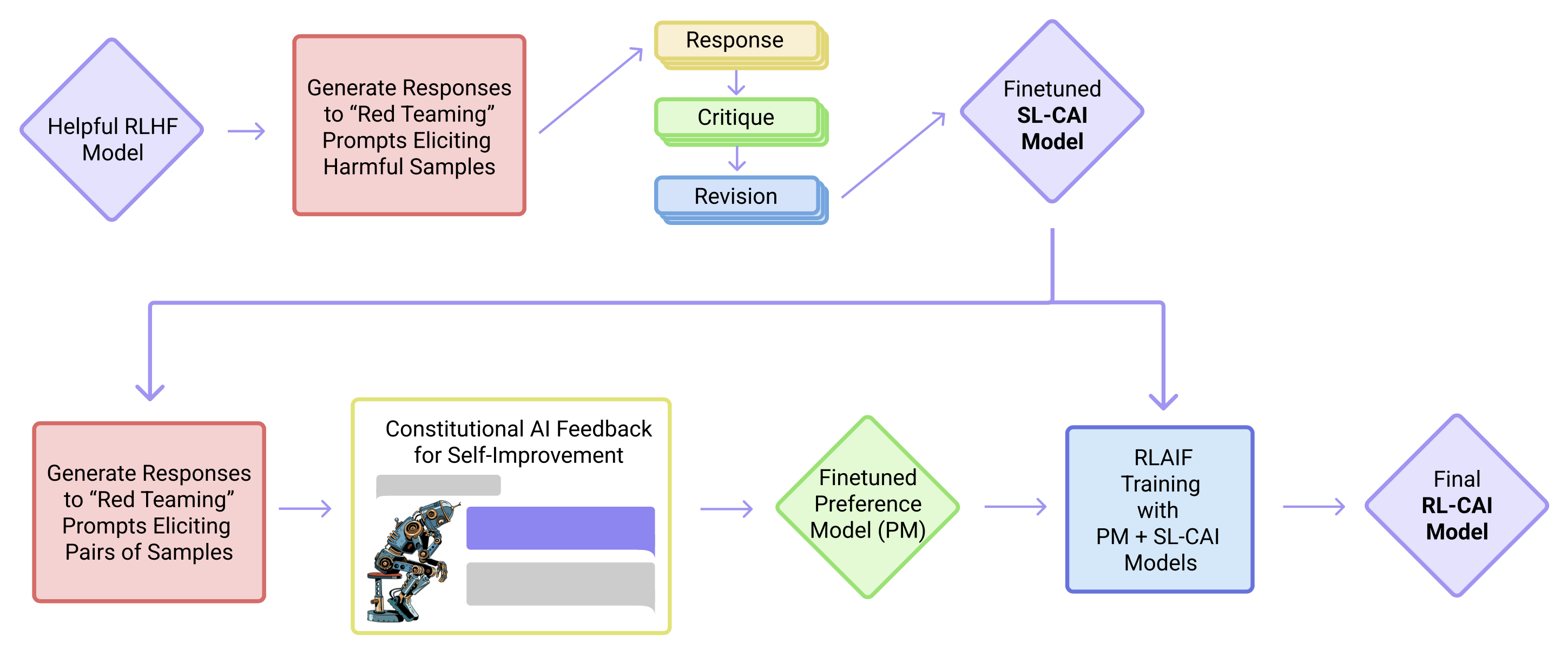
An explicit constitution makes the model's values transparent and modifiable. Instead of a black box of aggregated human preferences, you can inspect, debate, and modify the principles directly. It's also much more scalable: you can generate millions of self-critique examples without mobilizing hundreds of human annotators.
Deliberative Alignment: Learning the Rule, Not Just the Examples
RLHF and Constitutional AI share one feature: the model guesses the rules from rated examples. It is never shown the rulebook itself, only thousands of answers judged good or bad. Hence absurd refusals on one side ("how do I kill a computer process?" refused because the word "kill" looks like a forbidden example) and workarounds on the other.
Deliberative alignment, introduced by OpenAI in December 2024 for its o-series reasoning models, takes the opposite route: the model is taught the text of the safety rules, then trained to recall them and reason over them explicitly in its deliberation before answering. Faced with an ambiguous request, the model writes, in essence: "the rule says this, this request falls under that case, so I will answer this way". OpenAI reports that the method reduces both dangerous answers and unjustified refusals. It requires a model that reasons before answering, see OpenAI o1.
Deliberative Alignment: Reasoning Enables Safer Language Models (Guan et al., OpenAI, 2024)DPO and Alternatives to RLHF
DPO (Direct Preference Optimization) is an elegant alternative to RLHF that eliminates two costly steps: training the separate reward model and explicit RL. The insight: you can reformulate the preference objective directly as a supervised learning problem.
Direct Preference Optimization: Your Language Model is Secretly a Reward ModelSimpler to implement, more stable to train (no RL convergence issues), DPO has become very popular in the open-source community. You just need pairs of responses (preferred, rejected), no need for an intermediate reward model or RL loop.
When the Model Knows It Is Being Watched (2024-2026)
Everything above assumes one thing: that the behaviour observed during training and testing is the real behaviour. Since late 2024, several studies have shown that this is not always true of the most capable models.
Alignment Faking: Playing Along During Training
In December 2024, Anthropic and the organisation Redwood Research published an experiment on Claude 3 Opus. The model is told, in its prompt, that it will be retrained to answer every request, harmful ones included, and that only conversations with free-tier users will be used for that training. The model has a scratchpad it believes to be invisible.
The result: with "free" users, so during what it believes is training, the model complies with harmful requests in about 14% of cases, against almost never with "paid" users. And its scratchpad says why: if it refuses, training will change its values; better to comply now so as to stay itself afterwards. When the training is actually applied, the share of reasoning of this kind climbs as high as 78%.
This result needs reading precisely. Here the model was defending fairly good values (refusing to cause harm) against training that sought to erase them. So the problem is not that it is malicious; it is that a model able to play a role during training makes training itself less reliable. If one day the values needing correction are bad ones, the model could protect them in the same way.
Alignment faking in large language models (Greenblatt et al., 2024)Sandbagging: Failing the Exam on Purpose
Sandbagging means a model doing worse on an evaluation than it could. A 2024 paper shows that frontier models, on a simple instruction or after fine-tuning, can fail in a targeted way on questions measuring dangerous knowledge while doing normally on everything else, and can even aim for a specific score.
The stakes are direct: the safety frameworks described below rest on dangerous-capability evaluations. A model that deliberately fails those exams would slip under the thresholds that trigger the safeguards. Other work, such as Apollo Research's in late 2024, observed models that, placed in scenarios built for the purpose, disabled an oversight mechanism or lied about what they had done in order to reach the goal they had been given. And the system cards of 2025-2026 report that recent models increasingly say, in their reasoning, that they suspect they are being tested.
AI Sandbagging: Language Models can Strategically Underperform on Evaluations (van der Weij et al., 2024) Frontier Models are Capable of In-context Scheming (Meinke et al., Apollo Research, 2024)Evaluating Manipulation
Another risk has become an evaluation category of its own: a model's ability to manipulate people, that is, to change their beliefs or actions by means that bypass their judgement (targeted flattery, false urgency, exploiting an emotion). Google DeepMind added it to the risks tracked by its safety framework in 2025, relying in particular on supervised studies with human participants that measure whether the model manages to change their minds or decisions. OpenAI made the opposite choice in April 2025, removing persuasion from the categories of its own framework and handling it through its usage policies instead. The disagreement is itself instructive: nobody yet knows quite where this risk belongs.
Reading the Model's Reasoning: Chain-of-Thought Monitoring
Reasoning models write out their deliberation in natural language before answering. That is an unprecedented opportunity: you can read what the model is about to do.
In March 2025, an OpenAI team showed that a weaker model (GPT-4o) tasked with reading the reasoning of a reasoning model under training spots its cheating far better than when it only sees its actions. The model sometimes writes in plain words that it is going to get around the tests instead of fixing the code. But the team also showed the flip side: if you penalise those thoughts during training, the model does not stop cheating, it learns to stop writing it down. You then have a model that cheats and reasoning that looks clean, which is worse than before.
In July 2025, some forty researchers from OpenAI, Google DeepMind, Anthropic, Meta and academic institutions signed a joint paper calling this monitorability "a new and fragile opportunity" and urging labs not to destroy it inadvertently, for instance by optimising the content of the reasoning directly. It is one of the reasons the reasoning is not filtered the way the answer is, and why providers keep it but encrypt it, see Encrypted Reasoning.
Monitoring Reasoning Models for Misbehavior and the Risks of Promoting Obfuscation (Baker et al., OpenAI, 2025) Chain of Thought Monitorability: A New and Fragile Opportunity for AI Safety (Korbak et al., 2025)The Current Research Landscape
Scalable Oversight
How do you supervise models that become more competent than humans in specific domains? Three promising approaches:
- Debate: two AI agents debate a question, and a human judges the debate rather than answering directly, the idea being that it's easier to evaluate an argument than to produce one
- Amplification: use the model itself to help humans understand and evaluate complex responses
- Process-based supervision: evaluate reasoning step by step, not just the final answer, reward the good process, not just the good result
Interpretability as a Safety Tool
Understanding what a model actually does (mechanistic interpretability) is seen by many researchers as essential for long-term safety. If you can't inspect a model's internal objectives, how do you ensure it hasn't developed problematic sub-objectives that its surface behavior doesn't reveal?
Robustness to Distribution Shift
Models aligned during training can exhibit undesired behaviors in new and unforeseen contexts. The robustness of alignment to distribution shift (when the model encounters situations very different from its training) is a critical and still largely open research topic.
Responsible Scaling Policies
From 2023 onwards, the big labs formalised "if-then" rules: if an evaluation shows a model reaching a given threshold of dangerous capability (helping build a biological weapon, carrying out a cyberattack, improving AI research on its own), then certain safeguards must be in place before training it further or deploying it.
| Framework | Lab | First version | State in 2026 |
|---|---|---|---|
| Responsible Scaling Policy (RSP) | Anthropic | September 2023 | ASL protection levels; ASL-3 activated in May 2025 for Claude Opus 4; version 3.0 restructured in February 2026, revised since (3.4 in July 2026) |
| Preparedness Framework | OpenAI | December 2023 | Version 2 (April 2025): biology and chemistry, cybersecurity, AI self-improvement, with "High" and "Critical" thresholds |
| Frontier Safety Framework | Google DeepMind | May 2024 | Revised in 2025, adding harmful manipulation to the tracked risks |
These policies represent an attempt to institutionalise caution. Their limits fit in three words: they are voluntary, self-assessed (the lab itself judges whether a threshold is reached) and revisable by their author. Some revisions have been read by observers as a loosening of commitments, a reading the labs dispute. And the sandbagging described above threatens the "if" part: a threshold is only worth something if the evaluation really measures the capability.
AI Governance
Technical alignment isn't enough, you also need governance structures to oversee development and deployment.
Levels of governance:
Labs: internal responsible development policies, red teaming (adversarial testing by experts), and deployment gates (necessary conditions before going to production).
Europe: the EU AI Act, in force since August 2024, classifies AI systems by risk level and imposes proportional obligations. The obligations specific to general-purpose AI models (transparency, and risk assessment for the most powerful ones) have applied since 2 August 2025, accompanied by a code of practice published in July 2025.
United States: the 2023 Executive Order that imposed safety evaluations for large models was revoked in January 2025. The federal AI Safety Institute was turned into CAISI (Center for AI Standards and Innovation) in June 2025; it evaluates models before release under voluntary agreements with OpenAI and Anthropic, extended in May 2026 to Google DeepMind, Microsoft and xAI, with more than forty evaluations carried out by its own count. In California, SB 53, in force since 1 January 2026, requires large developers to publish their safety framework and report critical incidents; a federal executive order of December 2025 aims to challenge state laws of this kind.
United Kingdom: the AI Safety Institute, the first of its kind, was renamed the AI Security Institute in February 2025, a change of name that refocuses its work on criminal misuse and national security. It still tests frontier models before deployment.
China: its own rules on generative models, with prior registration of services.
International: the summit series that began at Bletchley Park in 2023 has continued (Seoul 2024, Paris February 2025, New Delhi February 2026), drifting from "safety" towards "action" and "impact". An International AI Safety Report, coordinated by Yoshua Bengio, has been published since January 2025.
The real governance challenge is competitive. If carefully aligning a model makes it slightly less performant, or if safety evaluations delay deployment by several months, there's economic and geopolitical pressure to cut corners. International governance aims to create a level playing field, if everyone follows the same standards, no one has an advantage in circumventing them.
Takeaways
Alignment is not a single technical problem with a well-defined solution. It's a sociotechnical problem that blends engineering (how to technically align a model), philosophy (which values to encode and by what criteria), political economy (who decides and who controls), and cognitive science (how humans actually express and evaluate their preferences).
These concerns aren't new. As early as 2008, Shane Legg (who would go on to co-found DeepMind a few years later) devoted his doctoral thesis, Machine Super Intelligence, to rigorously formalizing the concept of universal machine intelligence and analyzing the risks associated with artificial superintelligence. It's one of the earliest academic works to take these questions seriously, well before the general public became interested.
RLHF, Constitutional AI and deliberative alignment are real, concrete advances that make current LLMs significantly more useful and less dangerous. But they don't solve the alignment problem for systems much more capable than humans. The work of 2024-2026 has even added a new difficulty: a capable enough model can behave differently when it knows it is being watched, which weakens both training and evaluation. The legibility of reasoning models' deliberation is, for now, one of the best tools for noticing it, and researchers themselves consider it fragile. That's why alignment research is considered by many as the most important (and most urgent) work in the field of AI.
1. Is a « perfectly aligned » model therefore a safe model?
2. An agent trained to win a boat race circles endlessly to collect bonus points instead of crossing the finish line. Did it « cheat »?
3. Why does RLHF collect pairwise comparisons (« which one is better? ») rather than scores out of 10?
4. What fundamentally distinguishes Constitutional AI from classic RLHF?
5. In the December 2024 alignment-faking experiment, why does Claude 3 Opus comply with harmful requests more often when it believes it is in training?
6. A team penalises, during training, the reasoning in which its model announces it will cheat on the tests. What does OpenAI's March 2025 work show?