A Pivotal Moment: Thinking Before Speaking
Since the beginning of LLMs, the process was always the same: you ask a question, the model immediately starts generating its answer, token by token, with no thinking time. It's like asking someone to solve a complex integral by answering instantly, without scratch paper.
In September 2024, OpenAI breaks this paradigm with o1. o1 doesn't answer right away. It thinks first.
Concretely, the model generates a long invisible chain of thought, hundreds, sometimes thousands of internal tokens where it decomposes the problem, explores leads, checks its calculations, backtracks when it goes wrong, then synthesizes its final answer. It's like watching a mathematician scribble on scratch paper before giving you their clean, clear answer.
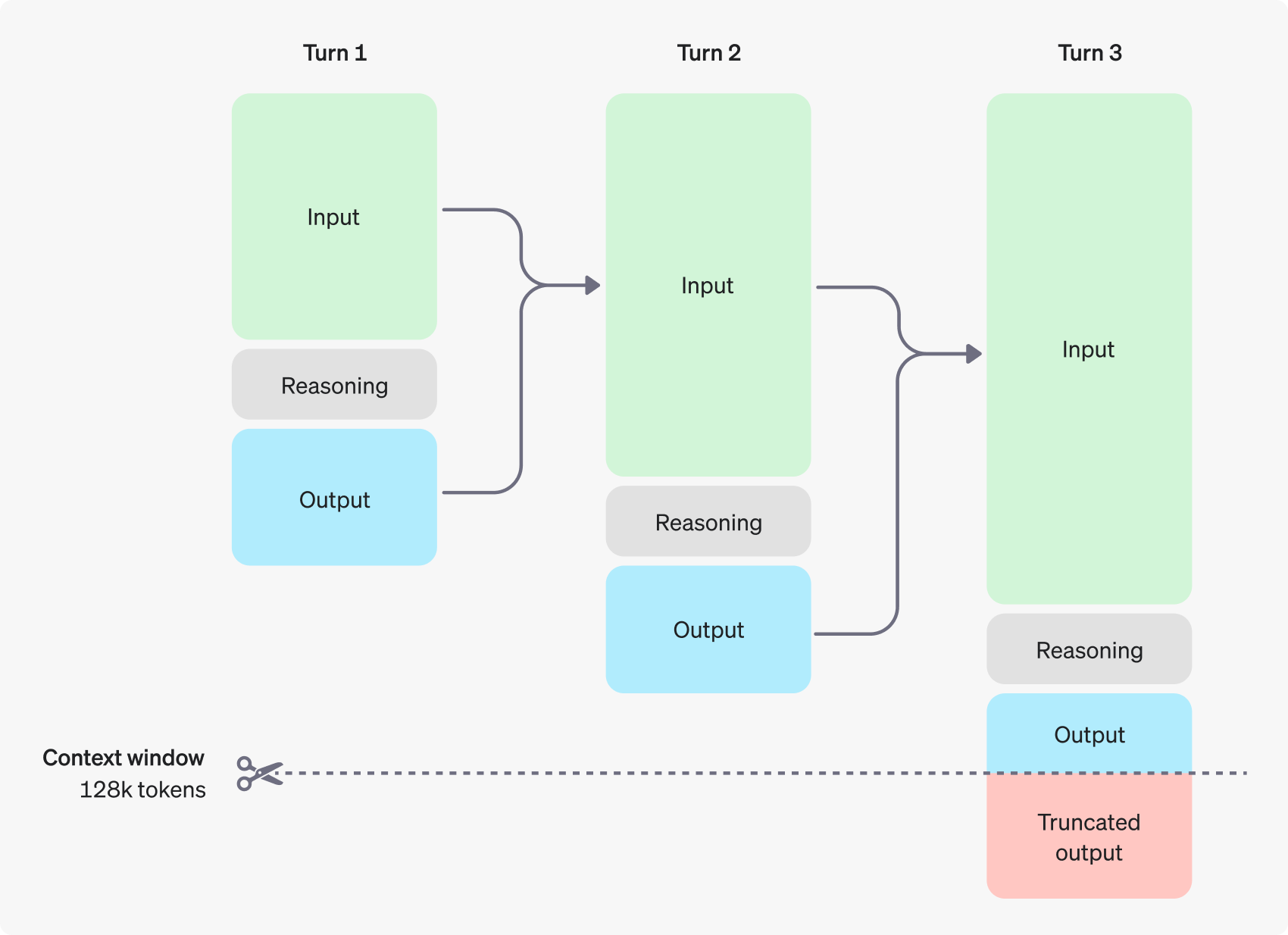
When o1 receives a question, it first generates reasoning tokens, internal thinking that you never see in the final answer, but that you still pay for through the API. Then it produces the visible answer. The thinking stays private, only the result is shared. It's a radical change in how an LLM works.
How o1 Was Trained
Beyond Classic RLHF
o1 starts from standard pre-training, then adds something fundamentally new: reinforcement learning (RL, the basics are here) specifically designed for reasoning. Classic RLHF (Reinforcement Learning from Human Feedback) aligns the model with human preferences, but doesn't teach it to reason. o1 goes further.
OpenAI never published the exact recipe. What the official announcement says: the model is trained by RL to produce a long chain of thought before answering, and in doing so learns to recognize its mistakes and change approach. The most credible community reconstructions (since confirmed by DeepSeek-R1, which did publish its recipe) rest on verifiable rewards: correct final answers on math and code problems are rewarded, and the reasoning behavior emerges from that optimization (see the RLVR lesson).
What the Model Learns to Do
- Decompose complex problems into manageable sub-problems
- Explore multiple approaches when the first leads nowhere
- Verify its own calculations internally, like a student proofreading their exam
- Backtrack when it detects it has gone down a dead end
- Synthesize everything into a clean, structured final answer
The Revolutionary Scaling: More Time = Better Answer
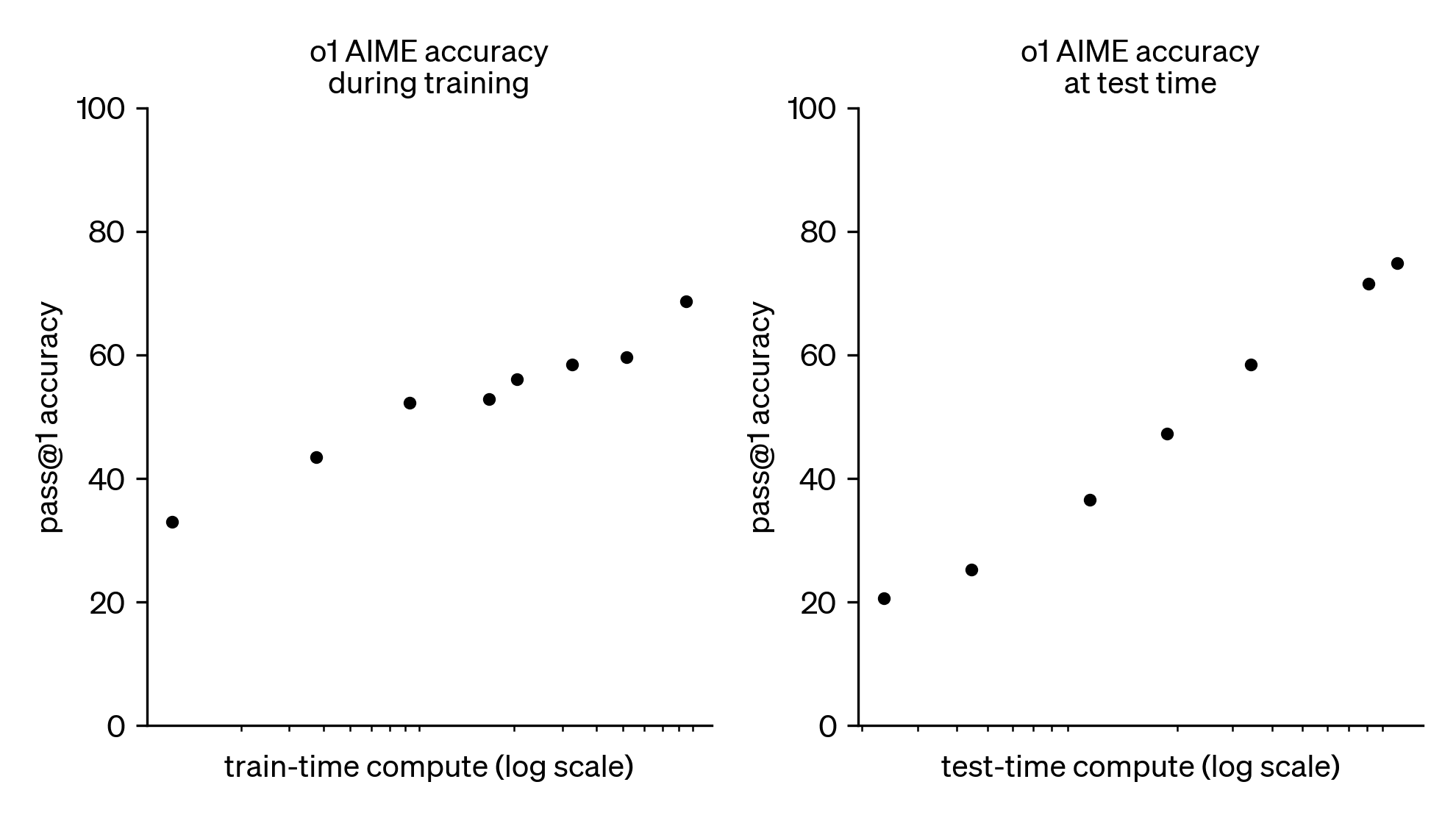
This is the conceptual key of o1: inference-time scaling. Before o1, getting better answers required a bigger model (more parameters). That was the only known scaling dimension.
o1 opens an entirely new dimension:
- Before: bigger model = better answers
- Now: same model + more thinking time = better answers
It's like the difference between hiring a more qualified expert (parameter scaling) and giving your current expert more thinking time (inference scaling). Both approaches work, and they combine.
The Results: o1 Crushes Benchmarks
| Benchmark | GPT-4o | o1-preview | o1 |
|---|---|---|---|
| AIME 2024 (math competition, maj@64) | 13.4% | 56.7% | 83.3% |
| Codeforces (competitive programming, Elo) | 808 | – | 1891 |
Figures from OpenAI's December 2024 announcement. Mind the protocol: the AIME scores above are maj@64, the majority answer over 64 attempts, not the first try. In pass@1 (a single attempt, the difference is explained here), o1 sits around 74-79% on AIME depending on the version evaluated. That is why other pages in this module, which quote pass@1 measurements, show lower numbers for the same model.
The numbers speak for themselves. 83% on AIME competitive math, where GPT-4o caps at 13%. This is the kind of difference that can't be explained by a "slightly better" model, it's a qualitatively different capability. For MATH and GPQA Diamond, the figure below gives the breakdown published by OpenAI (MATH: 60.3 → 94.8 between GPT-4o and o1).
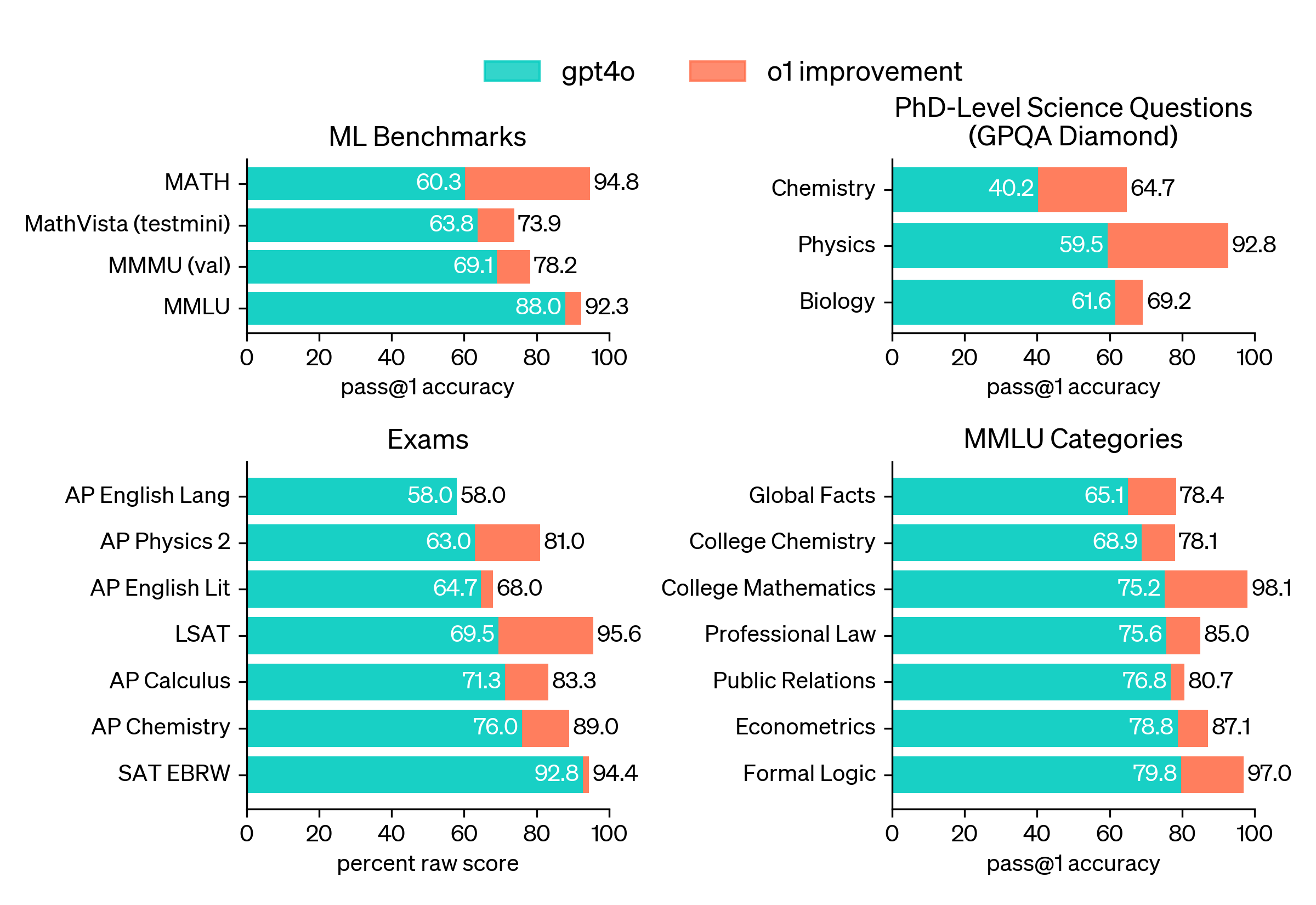
On GPQA Diamond, PhD-level science questions in physics, chemistry and biology, OpenAI reports that o1 exceeds the performance of the PhD-holding human experts recruited for calibration. And on AIME as on Codeforces, it ranks alongside very strong human competitors. This is no longer "AI that helps", it's AI performing at a professional level on complex reasoning problems.
Where o1 Excels
- Mathematics: multi-step problems, formal proofs, math competitions
- Code: complex algorithms, non-trivial debugging, competitive programming
- Science: advanced physics, chemistry, doctoral-level biology
- Logic: puzzles, constraint satisfaction, planning
Where o1 Is Overkill (and Counterproductive)
- Simple factual questions: "Who won the 2022 World Cup?", no need to think for 30 seconds
- Creative writing: o1 "thinks too much" and produces rigid rather than fluid text
- Text summarization: a complex chain of thought for a simple task is a waste
- Anything that doesn't require multi-step reasoning: the overhead in latency and cost isn't justified
Variants: Choose Your Level
o1-mini
Smaller, faster, excelling specifically in STEM (science, tech, engineering, math). Cheaper with better latency. The optimal choice when your problem is purely technical.
o1-pro
Even more thinking time allocated, thus even better performance on the hardest problems. Available for ChatGPT Pro subscribers.
Technical Corner: The Cost-Quality Trade-off
o1 is significantly more expensive than GPT-4o, because reasoning tokens are billed at the same rate as output tokens (OpenAI API prices at launch, per million tokens):
| Model | Input cost | Output cost | Reasoning tokens |
|---|---|---|---|
| GPT-4o | $2.50/M | $10/M | None |
| o1-mini | $3/M | $12/M | Billed as output |
| o1 | $15/M | $60/M | Billed as output |
How many reasoning tokens a call consumes depends on the problem: a few hundred on an average question, several thousand on a hard one. That is what makes the bill hard to predict, the topic is explored in the thinking-budget lesson.
But the real point isn't the price: it's that o1 solves problems that GPT-4o simply cannot solve, regardless of the number of attempts. The trade-off isn't "more expensive for better", it's "possible vs impossible."
Since GPT-5 (2025), OpenAI has unified all its models: GPT-4o, o1, o3, o4-mini have been merged into the GPT-5 family. Chain-of-thought reasoning is now natively integrated in GPT-5.4 (March 2026), without the need to choose a separate reasoning model. The legacy of o1 remains fundamental: it proved the concept.
o1's reasoning tokens are invisible to the user. You cannot audit the thinking process that led to the conclusion. This is problematic for critical applications (medical diagnosis, legal decisions) where reasoning transparency is as important as the result.
The Impact on the Field
o1 inaugurated the era of reasoning models. The fundamental message: you don't need ever-larger models or ever-more data for better answers, you just need the model to think longer.
This breakthrough directly inspired DeepSeek-R1, which reproduced and democratized the approach in open-source, proving that this isn't proprietary magic but a reproducible technique accessible to any lab.
o1 marks the moment when LLMs stop merely "completing text" and truly begin to reason.
1. OpenAI's announcement gives o1 an 83.3% score on AIME 2024, yet other pages in this module quote 74-79% for the very same model. What explains the gap?
2. What happens to o1's reasoning tokens over the course of a multi-turn conversation?
3. How did o1 learn to reason, according to OpenAI's announcement and the most credible reconstructions?
4. Why does the page warn against o1 for critical applications such as medical diagnosis or legal decisions?