Who chooses whom? The fundamental routing dilemma
Let's go back to our medical practice with 8 specialists. All the patients arrive in the waiting room. The crucial question: who decides who treats whom?
In the first approach, called Token Choice, it's the patient (the token) who chooses. They look at the 8 available specialists and select the 2 who seem most relevant for their problem. "I have chest pain, I want the cardiologist and the internist."
The second approach, called Expert Choice, inverts the logic: it's the doctors (the experts) who examine the entire waiting room and each select the cases that best match their expertise. The cardiologist takes the 5 patients who appear to have heart problems, the dermatologist takes the 5 patients with skin symptoms.
These two philosophies have profound implications on model quality, load balancing across experts, and computational efficiency. Understanding their respective trade-offs is essential for designing (or simply understanding) modern MoE architectures.
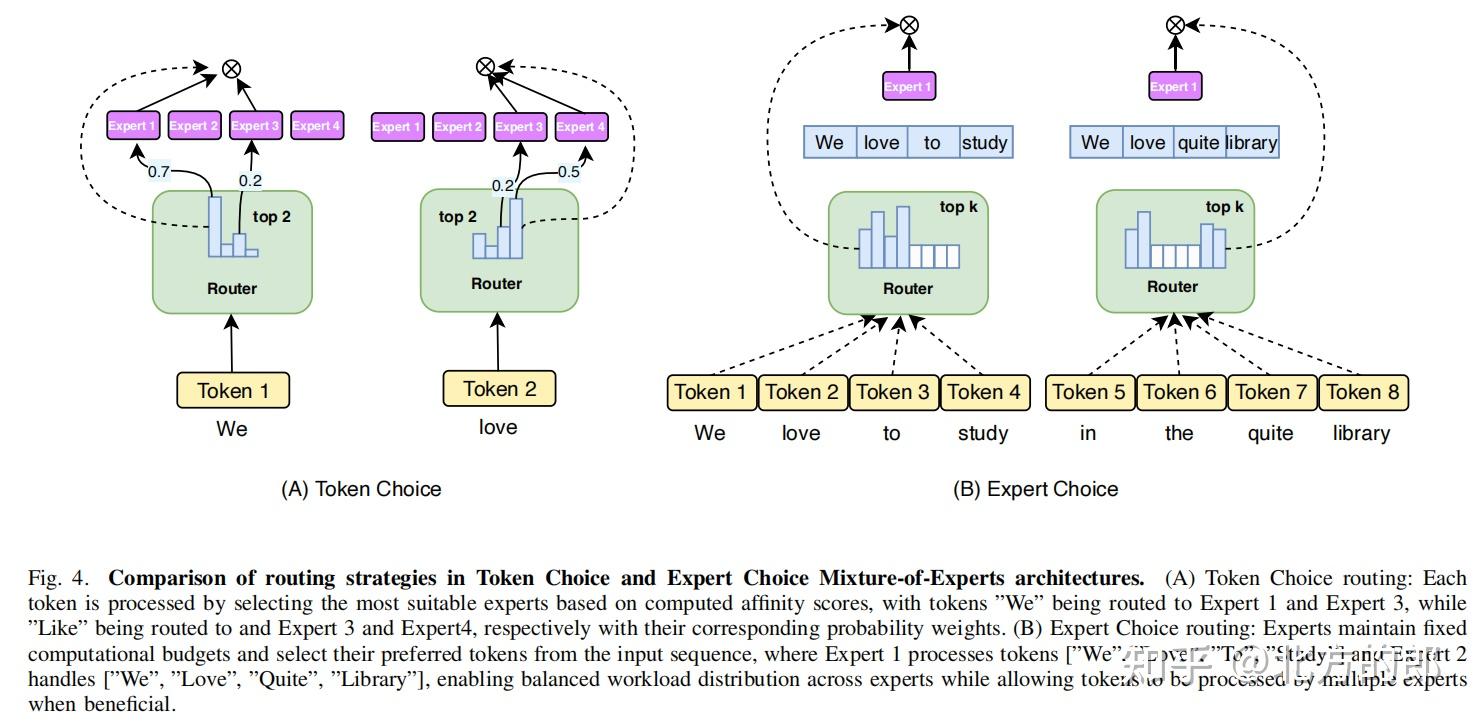
Token Choice Routing: the patient chooses their doctors
How it works
This is the historical approach, used by Mixtral, Switch Transformer, and Grok. For each token, the gating network (a small neural network dedicated to routing) computes an affinity score with each expert, then selects the top K:
The router starts by computing an affinity score between the token and each expert, applying a softmax over a linear projection:
Here, is the representation of the token being routed (a vector computed from the current text), and is the router's weight matrix, a learned parameter, frozen after training. Their product yields one score per expert, which the Softmax converts into percentages summing to 1.
It then selects the K experts with the highest scores:
The implementation is simple and well understood. Each token gets exactly K experts, no more, no less. The computational cost per token is therefore perfectly predictable, which simplifies hardware optimization.
The big problem: routing collapse
Without a regulation mechanism, the router naturally converges toward a lazy solution: it sends the vast majority of tokens to the same 2-3 "favorite" experts. The other experts, underused, never improve, which further reinforces the router's bias toward the popular experts. It's a vicious cycle called routing collapse.
Without a balancing loss (the auxiliary penalty added during training to punish imbalances, see the MoE lesson), a MoE model can easily converge to a situation where 2 experts receive 80% of all tokens and the other 6 share the scraps. This is catastrophic: 75% of the model's parameters become essentially useless. The auxiliary balancing loss mitigates this problem, but it creates its own trade-off, forcing balancing sometimes means sending a token to a less relevant expert, which slightly degrades quality.
Token Dropping: when an expert is saturated
When a very popular expert exceeds its capacity factor (the maximum token quota it can process in a batch), excess tokens are either abandoned (dropped) or routed via a residual layer without going through an expert. This is problematic because the model has no guarantee that dropped tokens are the least important ones. A key verb or a decisive number could be dropped, silently degrading quality.
Expert Choice Routing: the doctors choose their patients
The perspective inversion
Mixture-of-Experts with Expert Choice RoutingIntroduced by Zhou et al. at Google, Expert Choice completely inverts the logic. Instead of each token choosing its experts, each expert examines all tokens in the batch and selects the K tokens it wants to process:
Term by term: is the matrix stacking the representations of all tokens in the batch (values computed from the current text), and is the learned weight vector of expert . Their product gives this expert's affinity score with every token; the expert keeps the best-scoring ones.
The result is elegant: every expert processes exactly the same number of tokens. Balancing is perfect by mathematical construction, without needing any auxiliary loss.
The concrete advantages of Expert Choice
- Guaranteed balancing: every expert processes exactly its quota. No overload, no underutilization. The number one MoE problem is solved by design
- Zero token dropping: all tokens are processed (some by more experts than others, but none are abandoned)
- No auxiliary loss: training is simplified and the quality/balancing trade-off disappears
In Expert Choice, a token can be selected by 0, 1, 2, or several experts. Simple, frequent tokens (articles, prepositions, common words) tend to receive less expert attention, while complex tokens (rare technical terms, unusual proper nouns, ambiguous grammatical structures) receive more. The model naturally allocates more computation to difficult cases, it's a form of adaptive computation that emerges without being explicitly programmed.
The deal-breaking flaw: autoregressive inference
Expert Choice has a major problem for generative LLMs. During token-by-token generation (as in ChatGPT), there's only a single token in the batch at each decoding step. How can an expert "choose among batch tokens" if there's only one? The selection mechanism degenerates completely.
Expert Choice is excellent for training (processing entire sequences in parallel) and for encoding long prompts (prefill), but it doesn't work as-is for token-by-token autoregressive generation. Adaptations are needed: hybrid routing (Expert Choice during prefill, Token Choice during generation), processing in token chunks, or a pure fallback to Token Choice at inference.
Direct comparison
| Aspect | Token Choice | Expert Choice |
|---|---|---|
| Balancing | Requires an auxiliary loss | Guaranteed by design |
| Token dropping | Possible (tokens lost) | Impossible |
| FLOPs per token | Fixed (exactly K experts) | Variable (0 to N experts) |
| GPU implementation | Simple and optimized | More complex (irregular indexing) |
| Autoregressive compatible | Yes, naturally | No, requires adaptations |
Alternative and hybrid approaches
Research hasn't stayed stuck on these two options. Several approaches attempt to combine the advantages of both, or explore radically new directions.
DeepSeek's auxiliary-loss-free balancing
DeepSeek-V3 found a particularly elegant solution. Each expert receives a dynamic bias that adjusts automatically during training: when an expert is too heavily solicited, its bias decreases (it becomes less attractive in routing scores); when it's underused, its bias increases. It's pure Token Choice, but with a built-in thermostat that maintains balance without the quality trade-off inherent in auxiliary losses.
Soft MoE (Google)
Soft MoE eliminates discrete routing (send a token to an expert: yes or no) and replaces it with continuous routing. Tokens are combined into "slots" via learned weights before being sent to experts. Each expert processes a fixed number of slots, each slot being a weighted mix of multiple tokens. This avoids the discontinuity of binary routing while maintaining sparsity. Easier to differentiate for gradients, but conceptually more complex.
Hash Routing: radical simplicity
The most minimalist approach: assign tokens to experts via a deterministic hash function. No learned routing network, no parameters to train, perfect balancing guaranteed by the statistical properties of the hash. The downside is obvious: the expert assigned by the hash isn't necessarily the most competent for that token. It's an extreme trade-off between simplicity and quality.
Hierarchical routing
For architectures with a very large number of experts (256, 512, or more), single-level routing becomes computationally expensive (you need to score each expert). Two-level routing solves this problem: first choose a group of experts, then choose the expert within the selected group. With 256 experts arranged in 16 groups of 16, you only score 16 groups and then 16 experts, 32 evaluations instead of 256. The cost drops from N to roughly the square root of N (twice over, strictly speaking), which becomes significant with hundreds of experts.
For a generative LLM (GPT, LLaMA, Mistral type), Token Choice with Top-2 and a dynamic balancing mechanism like DeepSeek's is the best current trade-off. For pure encoding tasks (embeddings, classification, summarization without generation), Expert Choice offers significant advantages. The golden rule: avoid the classic auxiliary loss whenever possible, it systematically creates a quality/balancing trade-off that modern approaches know how to bypass.
Impact on expert specialization
The type of routing directly influences how experts specialize during training:
- With Token Choice, experts tend to specialize by semantic domain: one expert becomes good at medicine, another at code, another at literary French. Specialization follows content
- With Expert Choice, specialization tends to happen by difficulty level or syntactic type: some experts specialize on easy tokens (common words, basic grammatical structure), others on complex and rare tokens
Both forms of specialization are useful, but for different reasons. Token Choice produces interpretable experts (you can say "this expert is the code specialist"), while Expert Choice produces more efficient computation allocation. Research on optimal routing is a very active field, new approaches continue to emerge regularly.
1. What is the fundamental difference between Token Choice and Expert Choice?
2. Why does Expert Choice need no balancing auxiliary loss at all?
3. Why is Expert Choice a problem for token-by-token text generation?
4. In Expert Choice, what happens to a very common token, such as an article or a preposition?