Kimi Linear and Kimi K3: KDA, Linear Attention at Scale
From research paper to frontier model in nine months
In late October 2025, Moonshot AI (Beijing, maker of the Kimi chatbot) published a research paper: Kimi Linear. In mid-July 2026, the same team released Kimi K3: the first open model to reach 2.8 trillion parameters, with native vision and a one-million-token context window, built on the paper's mechanism. It is the most complete public demonstration that linear attention holds up at frontier scale.
Kimi Linear: An Expressive, Efficient Attention ArchitectureKDA: Kimi Delta Attention
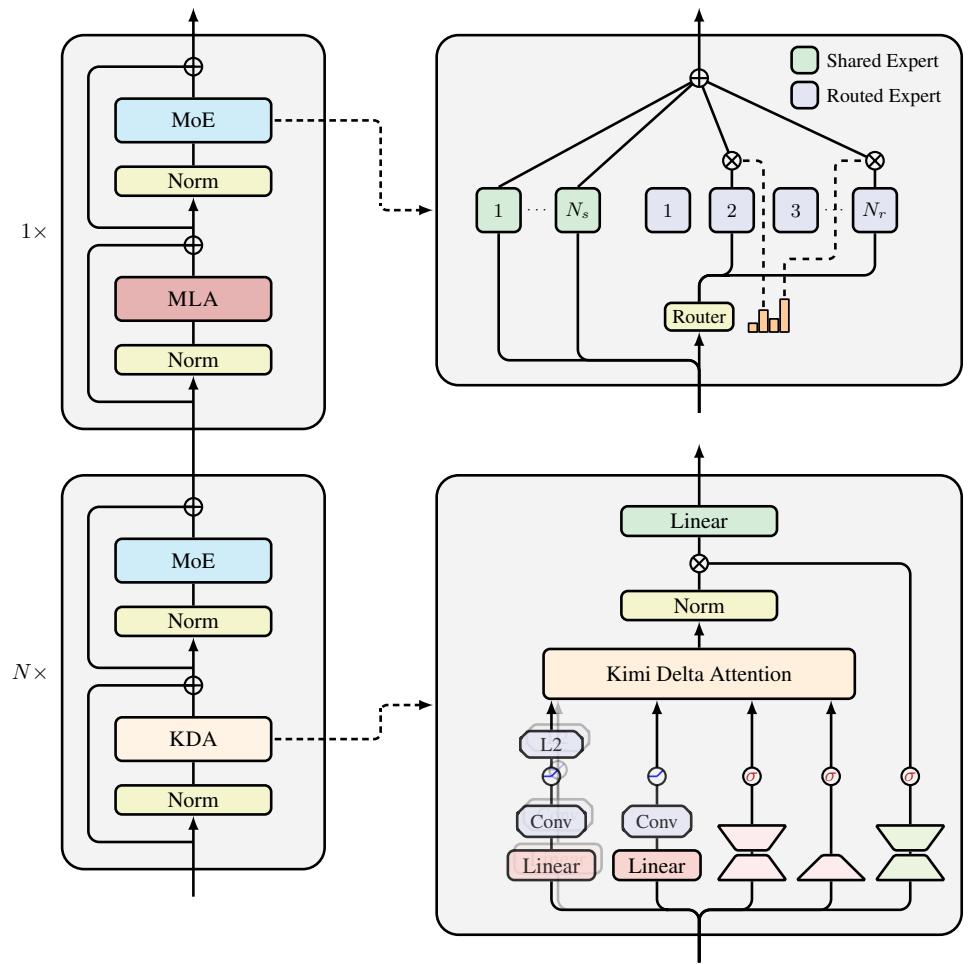
The heart of the matter is KDA (Kimi Delta Attention), a linear attention built on the delta rule (see the Gated DeltaNet lesson), with one distinctive feature: the diagonal gate.
Recap from the previous lesson: Gated DeltaNet erases-then-writes (delta rule) and decays its memory with a scalar gate, a single forgetting coefficient per token, uniform across the whole memory. KDA replaces that single coefficient with one coefficient per channel: each dimension of the memory forgets at its own pace. Some channels hold information for a long time (a proper name, an instruction), others empty quickly (passing details). Mathematically, this is a multiplication by a diagonal matrix, hence "diagonal gate", or fine-grained gating in the paper.
A linear layer's memory is small and precious. Uniform forgetting is wasteful: either you forget too fast (and lose durable information), or too slowly (and the memory saturates). Per-channel forgetting lets the model itself learn which dimensions serve as long-term memory and which serve as scratch space.
The 3:1 hybrid with MLA
A linear layer alone remains approximate at exact recall. Kimi Linear and Kimi K3 are therefore hybrid: roughly 3 KDA layers for every 1 full-attention layer of the MLA type (Multi-head Latent Attention, the compressed attention popularized by DeepSeek, see the MLA lesson). The KDA layers stream through the text at constant cost; the MLA layers, placed at regular intervals, give the model back exact access to any token in the context.
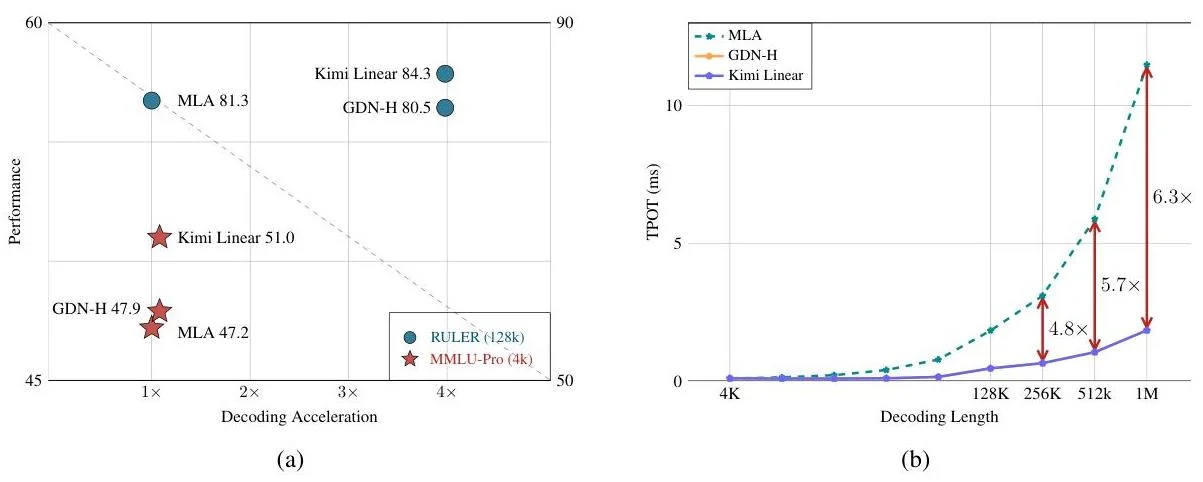
Numbers reported in the Kimi Linear paper, with an identical training recipe against a full-MLA model: better performance on all evaluated tasks, KV cache reduced by about 75%, and decoding up to 6× faster at a one-million-token context (6.3× in the paper's figure).
Kimi K3: scaling it up
K3 adds a series of efficiency building blocks on top of KDA:
- Very sparse MoE: 2.8 T total parameters, but only 16 of 896 experts activated per token, via a recipe called Stable LatentMoE.
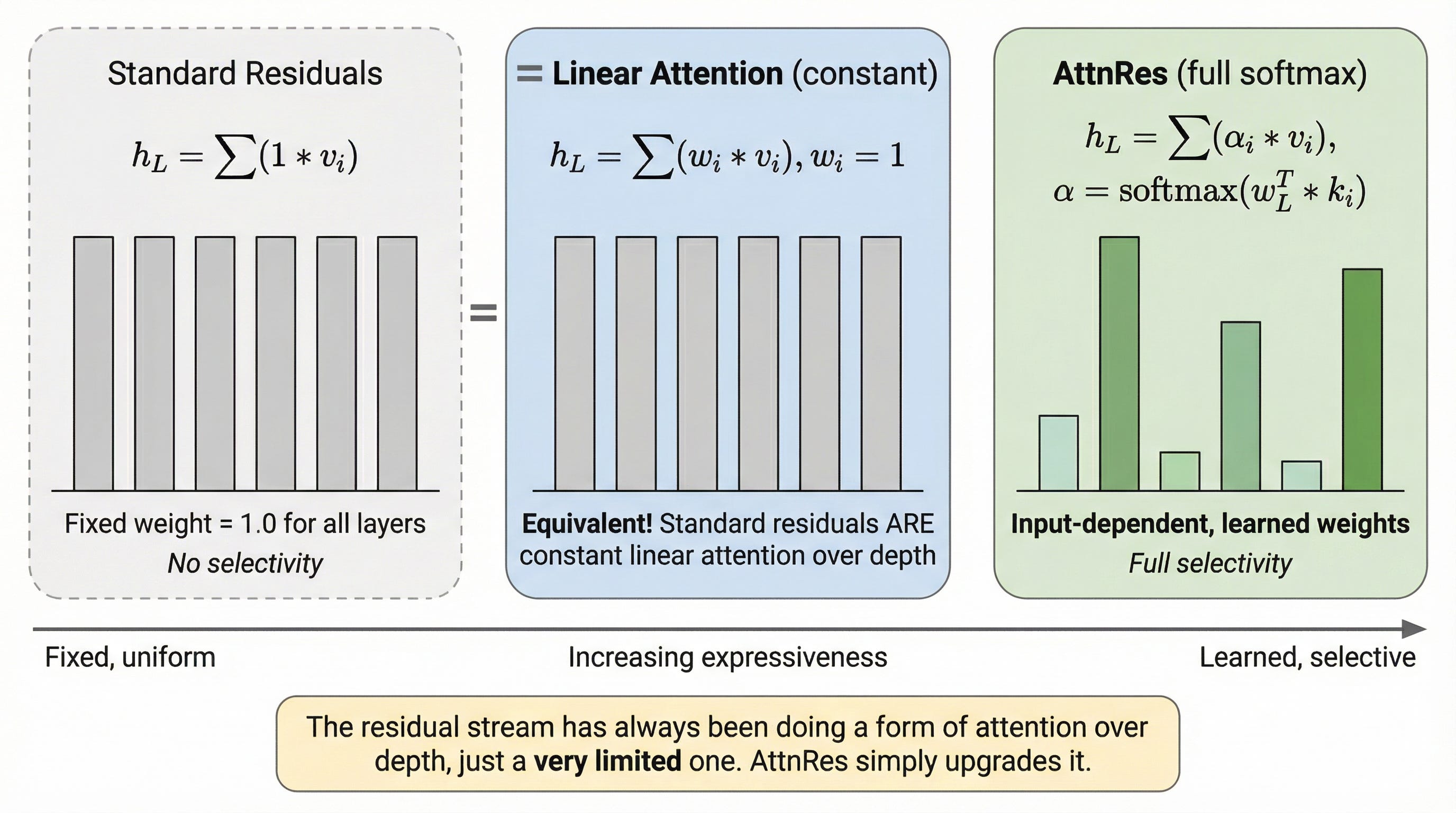
- Attention Residuals (AttnRes): cross-layer shortcuts that selectively retrieve representations across depth instead of accumulating them uniformly, the technical report claims about 25% higher training efficiency for under 2% extra cost.
- MXFP4 quantization: weights stored in 4 bits, which is what makes a model this size deployable.
Moonshot reports roughly 2.5× better overall scaling efficiency than Kimi K2: for the same compute budget, the model converts compute into capability more effectively. The weights are released as open source.
Linear attention (2020) → DeltaNet: parallelized delta rule (2024) → Gated DeltaNet: + scalar gate (NVIDIA, 2024, adopted by Qwen3-Next) → KDA: + diagonal gate (Kimi Linear, 2025) → Kimi K3: KDA at 2.8 T parameters (2026). Every link in the chain is public and documented.
Why it matters
Until 2025, linear attention was confined to research papers and mid-size models; doubt persisted about whether it would hold at very large scale. Kimi K3 largely settles that debate: a frontier, open, multimodal model with a million-token context, in which three quarters of the attention layers are linear. The trio "delta rule + diagonal gate + 3:1 hybrid" is becoming an industry standard, and the basic vocabulary for reading any recent technical document about hybrid architectures.
Key takeaways
- KDA = delta rule + per-channel forgetting (diagonal matrix), one notch finer than Gated DeltaNet's scalar gate.
- Kimi Linear/K3 = ~3:1 hybrid: KDA layers for speed, MLA layers for exact recall.
- Results: KV cache −75%, decoding up to ~6× faster at 1 M tokens, quality at or above full attention.
- Kimi K3 (July 2026, open source, 2.8 T parameters) proves the recipe holds at frontier scale.
1. What sets KDA apart from the Gated DeltaNet mechanism it derives from?
2. Why do Kimi Linear and Kimi K3 keep one full MLA attention layer for every three KDA layers, instead of going fully linear?
3. The paper reports decoding 4.8 times faster at 256,000 tokens, and 6.3 times faster at one million. Why does the gap grow with context length?
4. Kimi K3 boasts 2.8 trillion parameters, yet only 16 of 896 experts work on each token. What does this illustrate?