The dirty secret of attention
Attention is amazing. It's the heart of Transformers, it's what allows GPT to understand that in "the cat sleeps on the couch," the word "sleeps" is related to "cat" and not to "couch." But attention has a dirty secret: it's a memory hog.
Why? Because to compute attention, you have to create a score matrix that compares every token with every other token. For a sequence of 4096 tokens, that gives a matrix of 4096 x 4096 = 16 million numbers. Double the sequence? You need 4 times more memory. This is what's called complexity: memory explodes with the square of the sequence length.
This is largely why models of the GPT-3 era were limited to 2048 tokens. Not because GPUs weren't powerful enough to do the computations, but because those huge intermediate matrices made long sequences prohibitively expensive in memory.
And that's where Flash Attention comes in, developed by Tri Dao at Stanford in 2022:
FlashAttention: Fast and Memory-Efficient Exact Attention with IO-AwarenessThe brilliant insight? The problem is not the computation. GPUs are computation monsters. The real problem is moving data around in memory. And Flash Attention solves exactly that, without any approximation. The result is mathematically identical, just much faster and much more memory-efficient.
Understanding the problem: your GPU has two types of memory
To understand Flash Attention, you first need to understand how GPU memory works. And the perfect analogy is that of a desk and a warehouse.
Your GPU has two types of memory:
- SRAM (Static Random Access Memory, etched directly on the compute chip): this is your desk. Tiny (~20 MB on an A100), but incredibly fast (~19 TB/s bandwidth). Everything on your desk, you can access instantly.
- HBM (High Bandwidth Memory, sitting next to the chip): this is your warehouse. Huge (~80 GB on an A100), but much slower (~2 TB/s). Every time you need something from the warehouse, you have to walk over to it, find the right box, and come back to your desk.
The speed difference? SRAM is about 10 times faster than HBM. And that's where things get stuck.
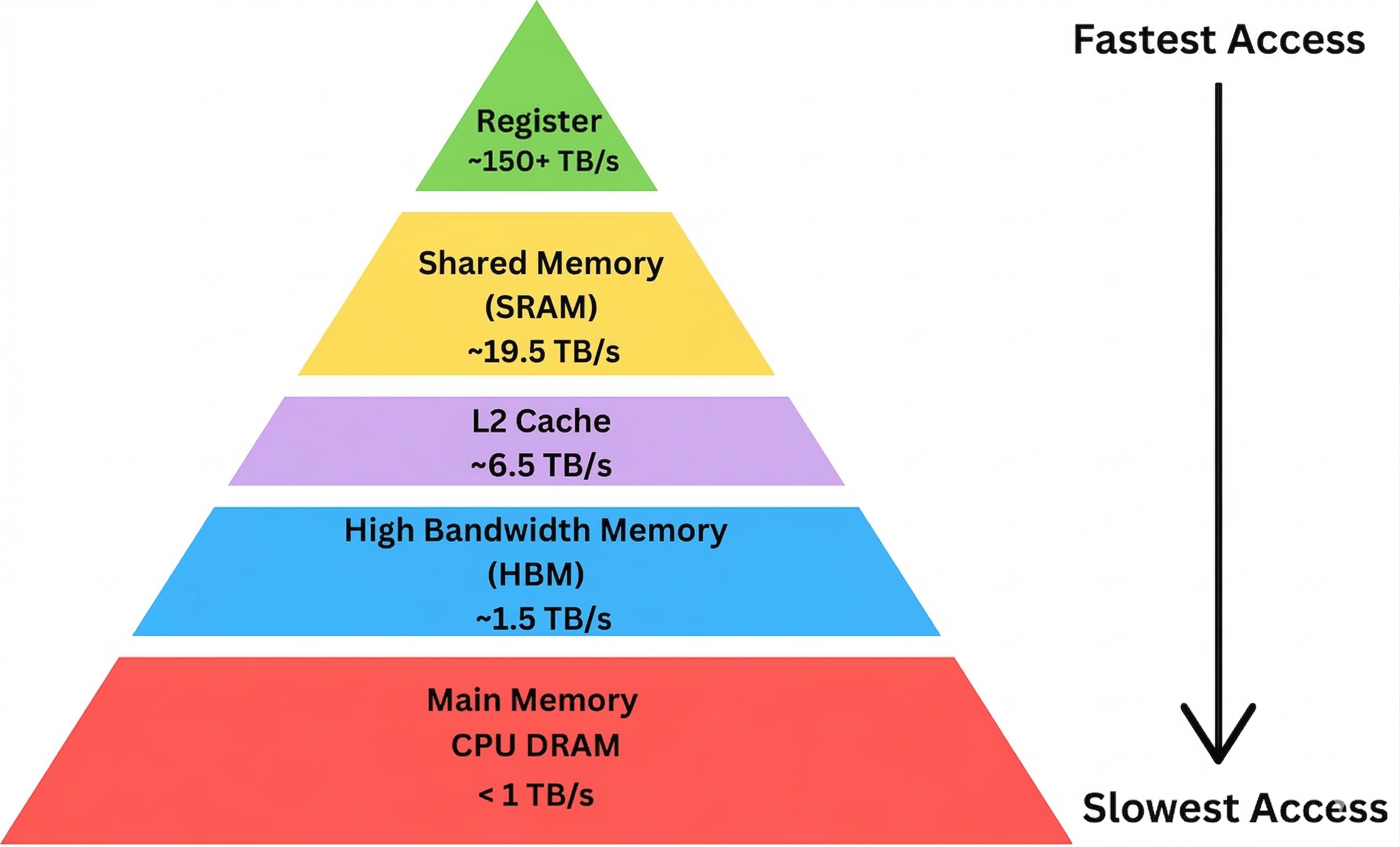
Modern GPUs are so powerful in terms of computation that they spend more time waiting for data to arrive from HBM than actually doing the computations. It's like an ultra-fast chef who spends 80% of their time fetching ingredients from the pantry instead of cooking.
How standard attention wastes memory
Let's look concretely at what happens with the naive implementation of attention. We have three matrices: Q (queries), K (keys), and V (values). Here are the steps:
Step 1: Read Q and K from HBM (the warehouse) → compute the score matrix → write S to HBM (back to the warehouse).
Step 2: Re-read S from HBM → apply softmax to get → re-write P to HBM.
Step 3: Re-read P and V from HBM → compute the output → write O to HBM.
See the problem? We make six round trips to the warehouse for a single attention computation. And the worst part is that we store in HBM this huge matrix of size (where is the sequence length) just to re-read it two seconds later. It's like printing a 16-million-page document, storing it in the warehouse, then immediately going to fetch it to read it.
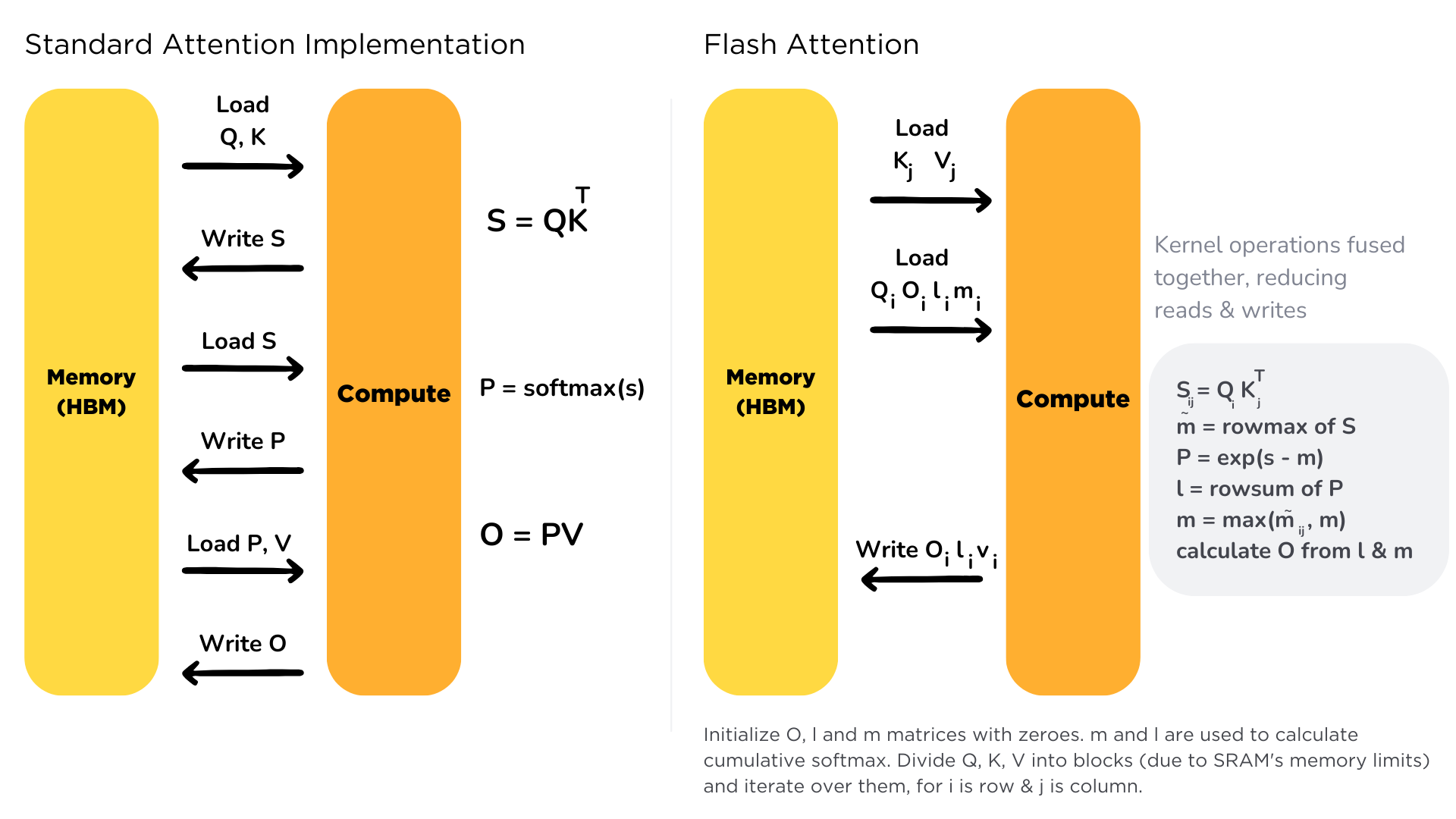
On an A100 GPU, compute operations (FLOPS, floating-point operations per second) are so fast that the GPU spends the majority of its time moving data between HBM and SRAM. Standard attention is what's called "memory-bound": it's limited by memory, not by compute power.
The solution: working in blocks (tiling)
The core idea of Flash Attention is simple and elegant. Going back to our cooking analogy:
Imagine you're preparing a banquet for 200 people. Standard attention is putting all the ingredients for all the recipes on the counter at the same time. Result: you run out of space and spend all your time moving things around.
Flash Attention is the smart chef who works in batches: they take out the ingredients for 10 servings, cook them, put things away, then move on to the next 10. Their counter never overflows.
Concretely, Flash Attention splits the Q, K, V matrices into small blocks that fit in SRAM (the desk). And it does all the computation directly in SRAM, without ever writing the full attention matrix to HBM.
Here's how it works:
- Load a block of Q into SRAM
- For each block of K and V:
- Load the K and V block into SRAM
- Compute the piece of the attention matrix directly in SRAM
- Apply a partial softmax and accumulate the result
- Write only the final result to HBM
The attention matrix never exists in its entirety. It's computed in pieces in SRAM and immediately consumed. It's as if the chef tasted each ingredient as they went along without ever piling everything up on the counter.
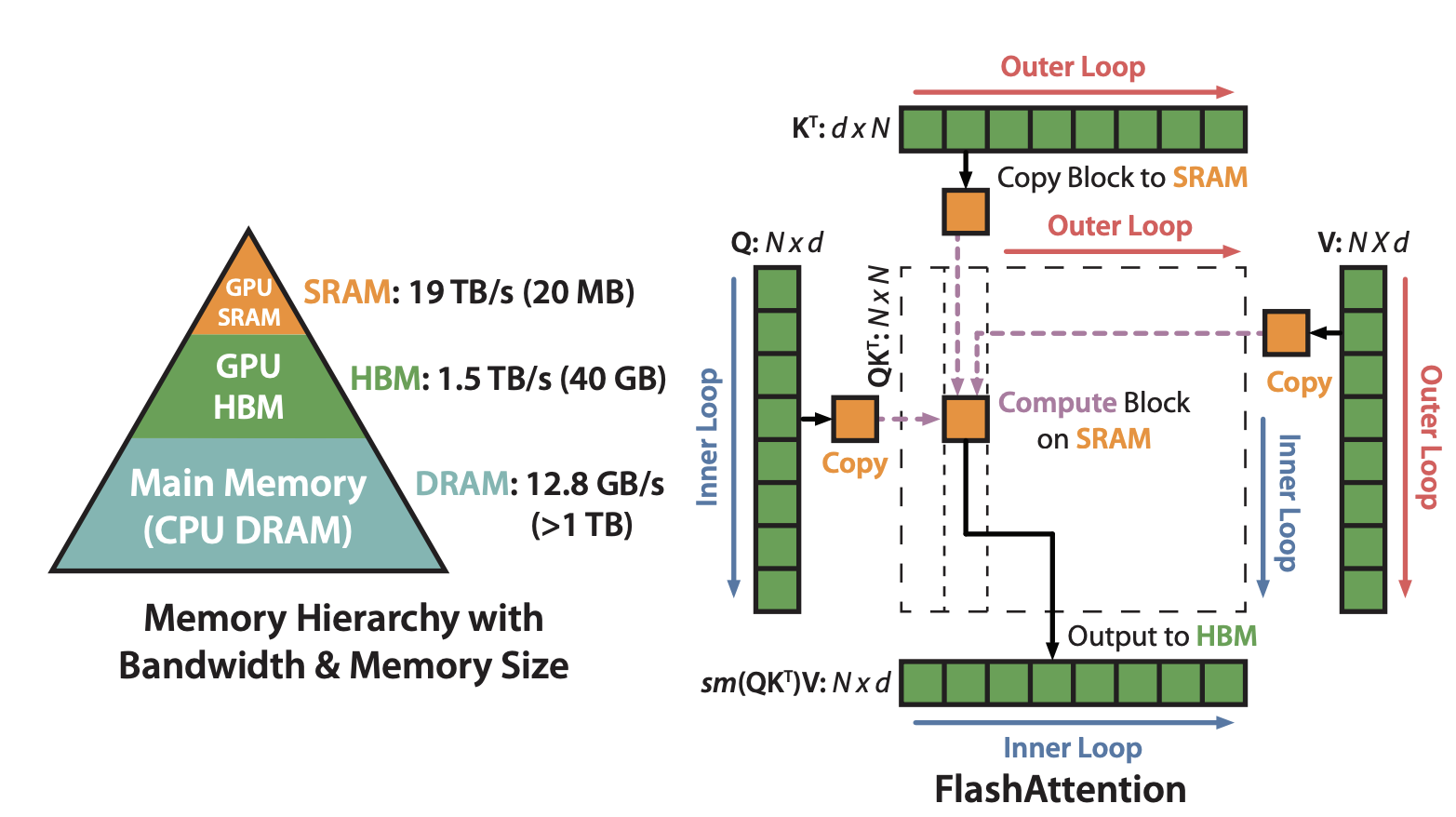
Flash Attention is called "IO-aware" (input/output aware). This means the algorithm is designed with the cost of memory transfers in mind. It deliberately does a bit more computation (which is almost free on a GPU) to do much fewer HBM ↔ SRAM transfers (which are expensive). It's an extremely winning trade-off.
The magic trick: online softmax
There's a catch with tiling. Softmax is the operation that transforms attention scores into probabilities. And to compute a softmax, you normally need the entire row of scores at once. Why? Because the softmax divides each exponential by the sum of all exponentials in the row:
If you work block by block, you don't yet know the complete denominator when you process the first block. How do you handle that?
The incremental softmax trick
Flash Attention uses online softmax, an algorithm that allows computing the softmax exactly and incrementally. The idea: you maintain two statistics across blocks:
- : the running maximum of the scores (for numerical stability)
- : the running sum of the exponentials
With each new block, you update these statistics:
In plain terms: keeps the maximum of scores seen so far (for numerical stability, you subtract the max before the exponential to avoid astronomically large numbers). accumulates the sum of exponentials (the softmax denominator). The factor is a correction: if the new block contains a score higher than all previous ones, you need to readjust the already-done computations to account for this new maximum.
This is not an approximation. The result of online softmax is mathematically identical to the standard softmax computed over the entire row. You get exactly the same numbers, down to the bit. The only difference is that you never needed to store the entire row in memory.
Technical corner: IO complexity
For the curious, here's why Flash Attention is optimal in terms of memory transfers.
Standard attention does reads/writes to HBM (where is the sequence length and the dimension). The term comes from materializing the attention matrix.
Flash Attention reduces this to where is the SRAM size. The authors prove this is optimal: no exact attention algorithm can do fewer HBM transfers. In practice, since , the number of transfers is drastically reduced.
Concrete results: before vs after
Let's look at the numbers, because this is where it gets impressive.
Speedup
The paper's numbers, measured end-to-end on real training runs:
- BERT-large (512-token sequences): training 15% faster than the speed record of the time (MLPerf 1.1)
- GPT-2 (1K-token sequences): training 3x faster than the standard HuggingFace implementation
- Long-Range Arena (1K to 4K sequences): 2.4x faster than standard attention
The longer the sequence, the more advantageous Flash Attention becomes. This makes sense: the bigger the matrix would be, the more we gain by never materializing it.
Memory
With standard attention, required memory grows as . With Flash Attention, it grows as , meaning linearly: doubling the sequence doubles the memory instead of quadrupling it. In practice, at an equal memory budget, you can train on sequences several times longer on the same hardware, the paper shows, for instance, GPT-2 trained with a 4K context as fast as standard GPT-2 with a 1K context.
This memory reduction doesn't just make inference faster. Most importantly, it allows you to train models with much longer contexts. And a model trained on longer sequences better understands long-range relationships in text. It's a virtuous cycle.
The backward pass: recompute rather than store
During training, you also need to compute gradients (the backward pass). Normally, you'd keep the matrix in memory for the backward. But this matrix is , and that's exactly what we want to avoid.
Flash Attention makes a smart choice: it only stores the online softmax statistics ( and , a few numbers per row) and recomputes block by block during the backward. Yes, that means we redo computation. But remember: on a modern GPU, computation is almost free compared to memory transfers. This trade-off is a clear winner.
Causal masking: a free bonus
For autoregressive models (like GPT), a causal mask is applied: each token can only "look at" previous tokens. In the attention matrix, this means the entire upper triangular part is zero.
Flash Attention handles this natively by skipping entirely masked blocks. If a block falls entirely within the masked zone, it's not computed at all. Result: since half of the matrix is masked (the whole upper triangle), you save roughly 50% more computation for autoregressive models.
The impact: Flash Attention changed everything
Flash Attention isn't just another technical optimization. It's a fundamental change that had repercussions across the entire ecosystem:
- Extended contexts: before Flash Attention, models were stuck at 2K-4K tokens. After, we moved to 32K, 128K, then millions of tokens. Long-context models wouldn't exist without Flash Attention.
- Faster training: up to 3x on GPT-2 in the paper, which translates directly into lower training costs.
- Universal standard: today, Flash Attention (or a direct descendant) is used by virtually all open models (Llama, Mistral, Qwen, DeepSeek...) and closed labs use optimizations of the same kind.
- Integrated everywhere: available directly in PyTorch (
torch.nn.functional.scaled_dot_product_attention), Hugging Face Transformers, xFormers (Meta), and many other libraries.
Flash Attention continued to evolve. Flash Attention 2 (2023) brought better parallelism and an additional ~2x speedup. Flash Attention 3 (2024) leverages Hopper GPUs (H100) with even more advanced techniques like asynchronous pipelining. The fundamental principle remains the same: minimize memory transfers.
The fundamental lesson
Flash Attention teaches us something profound about optimization in deep learning: it's not always about reducing the number of operations. Sometimes, it's about knowing where those operations happen.
An algorithm that does more computation but keeps its data in the right place in memory can be 10 times faster than an algorithm that's "optimal" in number of operations but spends all its time moving data around. On modern GPUs, understanding the memory hierarchy isn't a luxury: it's the key to performance.
Flash Attention has become a foundational component of modern LLM infrastructure, and its impact will continue to be felt as sequences get longer and models get bigger.
1. Flash Attention makes attention much faster. What does it change about the result of the computation?
2. Why is standard attention said to be memory-bound on a modern GPU?
3. How does tiling avoid materializing the L × L attention matrix?
4. The softmax normally needs the entire row of scores, for the denominator. How does Flash Attention compute it block by block?
5. During the backward pass of training, the matrix P = softmax(S) is needed for the gradients. What does Flash Attention do?