From Flash Attention 1 to Flash Attention 2
Flash Attention 1 had solved the fundamental problem: making attention linear in memory through tiling (block-by-block computation). But in terms of raw GPU utilization, there was still a lot of performance left on the table: per the paper, Flash Attention 1 reached only 25-40% of the GPU's theoretical compute throughput, most compute units remained idle.
Flash Attention 2, published by Tri Dao in 2023, tackles precisely this problem. The result: 50-73% of theoretical throughput on A100, by optimizing parallelism and work distribution within the GPU.
FlashAttention-2: Faster Attention with Better Parallelism and Work PartitioningKey optimizations
Reducing non-matmul operations
To understand this optimization, you need to grasp a crucial point about modern GPUs. GPUs like the A100 or H100 have Tensor Cores, specialized units for matrix multiplications (matmul for short). On an A100 they deliver 312 tera-operations per second, versus 19.5 for the general-purpose cores (called CUDA cores, after NVIDIA's programming platform): a factor of 16 (312 ÷ 19.5). All other operations (additions, scalar multiplications, comparisons) run on those much slower classic cores.
Imagine a 16-lane highway (the Tensor Cores) reserved for matrix multiplications, and a single-lane country road (the CUDA cores) for everything else. The highway throughput is enormous, but if your computation constantly alternates between the highway and the country road, you waste a ton of time on exits and entrances.
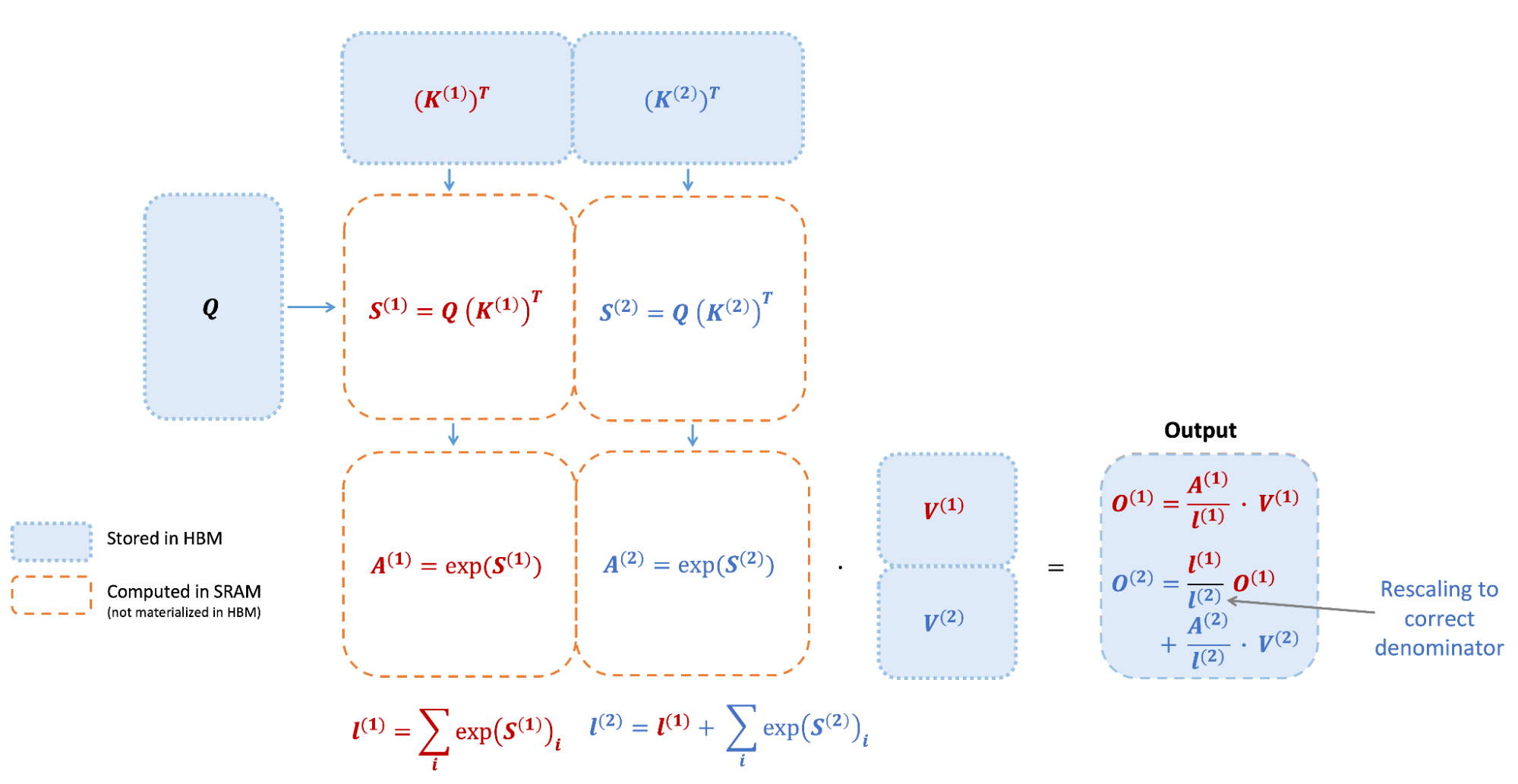
Flash Attention 1 contained rescaling operations (online softmax correction) interleaved with matmuls. These back-and-forth trips between Tensor Cores and CUDA cores wasted time. Flash Attention 2 reorganizes the computation to group rescaling operations and minimize these interruptions in the inner loop.
Parallelism on the sequence dimension
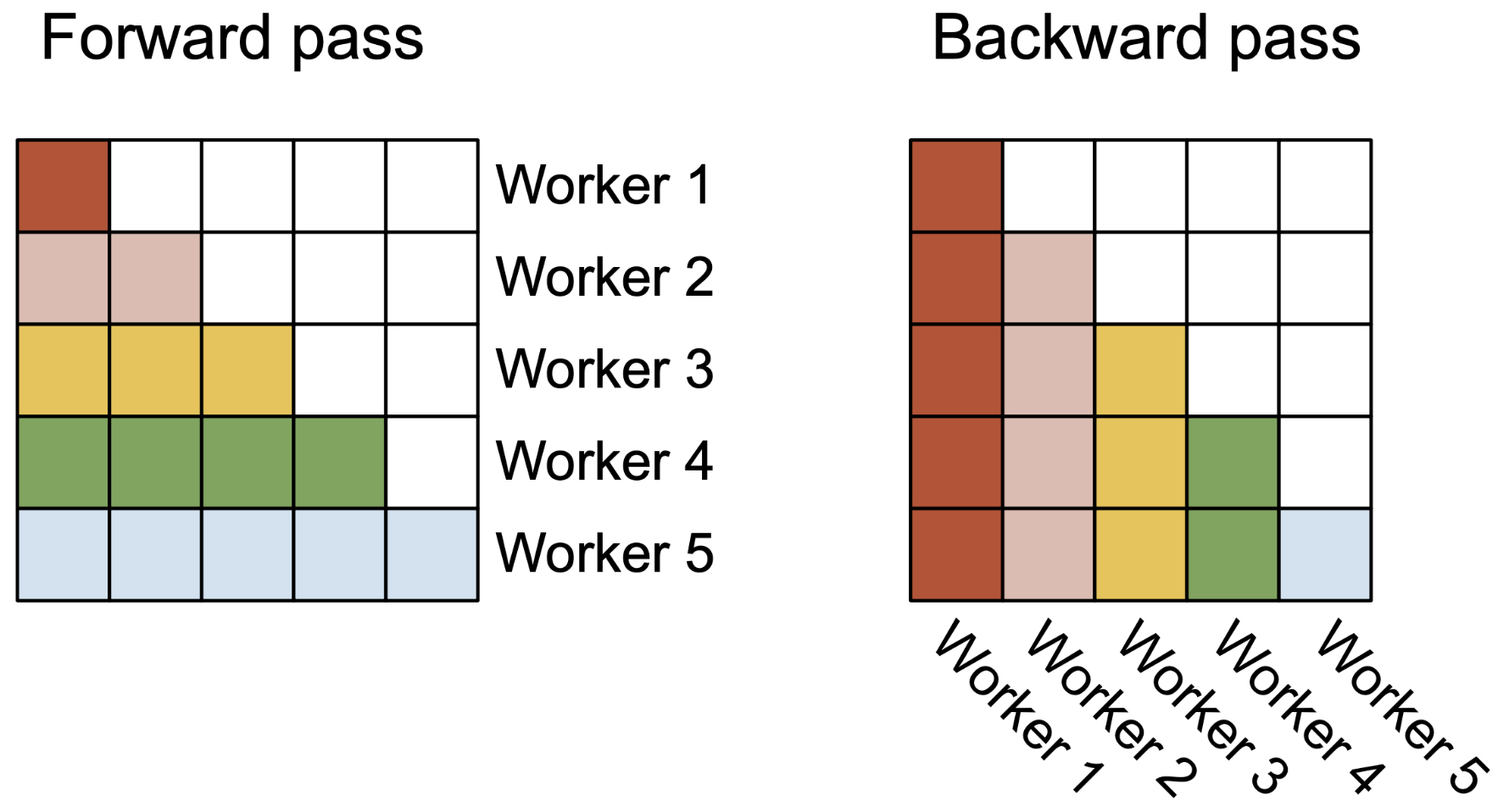
In Flash Attention 1, the outer loop iterated over K/V blocks and the inner loop over Q blocks. This is natural, but it limits parallelism when the number of attention heads isn't enough to keep all the GPU's streaming multiprocessors busy.
Flash Attention 2 reverses the loops: the outer loop iterates over Q blocks, the inner over K/V. This seemingly minor change allows parallelizing on the sequence dimension in addition to the head dimension. Result: the GPU is better saturated, especially for models with few attention heads or long sequences.
Work partitioning between warps
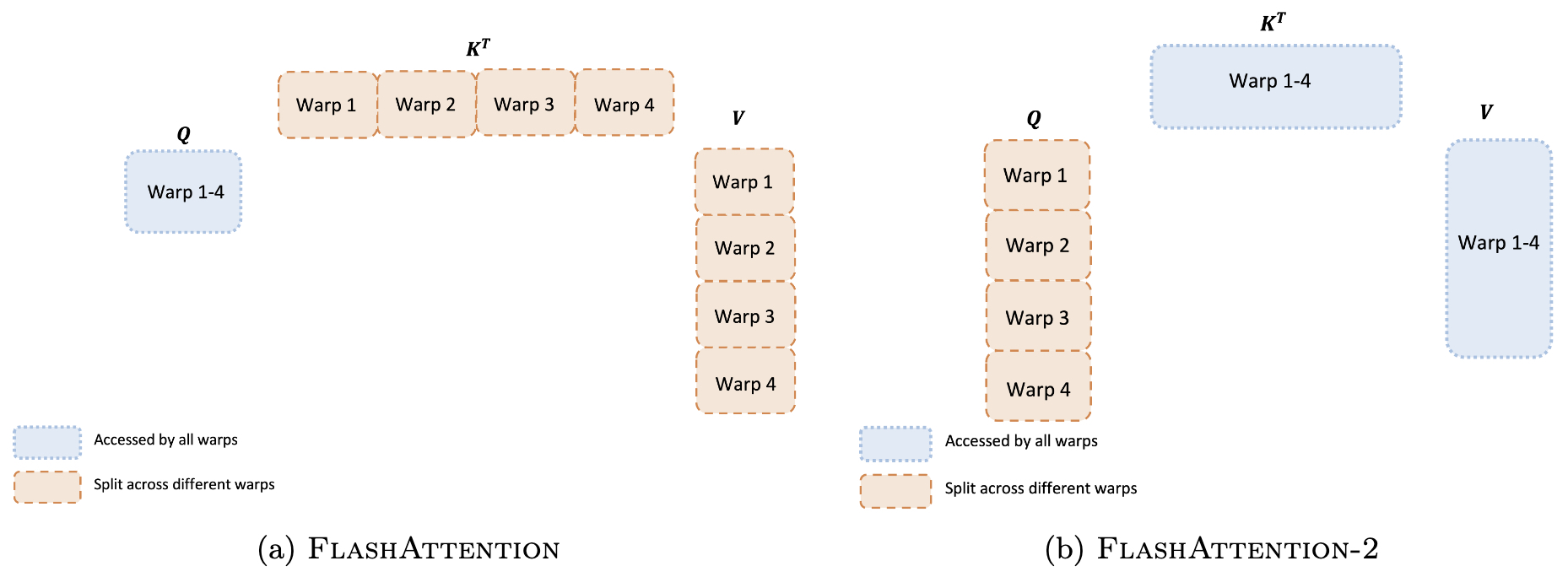
A GPU threadblock contains several warps (groups of 32 threads that execute in parallel). How work is distributed between warps has a direct impact on performance.
Flash Attention 1 partitioned K and V across warps, which required costly synchronization after each block (warps had to combine their results). Flash Attention 2 partitions Q across warps, allowing each warp to work independently on different rows of the output. Result: no more intra-block synchronization needed, each warp advances at its own pace.
Performance results
Speedup compared to Flash Attention 1
| GPU | Speedup FA2 vs FA1 | % of theoretical throughput reached |
|---|---|---|
| A100 (FP16) | ~2x | 50-73% |
| A100 (BF16) | ~2x | 50-73% |
Comparison with standard attention
Orders of magnitude measured in the paper on A100, in TFLOP/s (tera floating-point operations per second, the GPU's "speedometer"):
- Standard PyTorch attention: a few dozen TFLOP/s
- Flash Attention 1: ~120 TFLOP/s
- Flash Attention 2: up to ~225 TFLOP/s
- Theoretical A100: 312 TFLOP/s (FP16)
Flash Attention 2 is several times faster than standard attention and reaches up to 73% of the hardware's theoretical maximum (225 ÷ 312).
Scaling with sequence length
An important point: Flash Attention 2 maintains near-constant throughput in TFLOP/s even for very long sequences, thanks to efficient tiling. Where standard attention explodes in memory and time, FA2 stays stable.
The paper measures up to a 1.3x end-to-end speedup when training GPT-style models compared to Flash Attention 1, roughly 72% of each A100's theoretical power used across the whole training run, not just on the attention. This isn't just an academic optimization: it translates directly into GPU cost savings and the ability to iterate faster on experiments.
Optimized causal masking support
Skipping masked blocks
In causal attention (each token only sees previous tokens), roughly half the blocks in the attention matrix are entirely masked (future tokens). Flash Attention 2 detects these blocks and skips them completely: half as many blocks to compute, hence an additional ~2x speedup for causal attention compared to bidirectional attention.
Custom masks
Version 2 also supports custom masking patterns (like sliding window attention) via user-defined masking functions, offering significant architectural flexibility.
Multi-GPU and variable-length support
Variable-length sequences
In practice, batches contain sequences of different lengths. Flash Attention 2 handles this efficiently via a packing (varlen) format: sequences are concatenated end-to-end and start/end indices indicate the boundaries. No more need for costly padding.
Variable head dimensions
Support for non-standard head dimensions (not just 64 or 128), giving more freedom in model architectural design.
Ecosystem integration
PyTorch SDPA
SDPA (scaled dot-product attention, PyTorch's standard attention function): Flash Attention 2 is the default engine behind torch.nn.functional.scaled_dot_product_attention on compatible GPUs. In practice, if you're using a recent version of PyTorch on an Ampere or newer GPU, you're already benefiting from FA2 transparently.
Hugging Face
Hugging Face Transformers models automatically enable Flash Attention 2 when the package is installed, via the argument attn_implementation="flash_attention_2". Adoption is virtually transparent for the user.
Flash Attention 2 requires recent NVIDIA GPUs (compute capability 8.0 or higher, NVIDIA's chip-generation index): Ampere (A100, A10G, RTX 3090/4090) or Hopper (H100). Older GPUs (V100, T4) cannot use FA2's optimizations, although FA1 remains available for them.
Improved backward pass
Training is a forward pass followed by a backward pass. Flash Attention 2 applies the same optimization principles to the backward:
- Increased parallelism on the sequence dimension
- Better warp partitioning
- Optimized softmax rematerialization (recompute rather than store)
The backward pass reaches up to 63% of theoretical throughput per the paper, markedly better than Flash Attention 1. This is crucial since the backward pass is often the training bottleneck.
Impact and adoption
Flash Attention 2 has become a foundational and nearly universal component in training and inference of modern LLMs. Its massive adoption has contributed to extending context windows (from 2K to 128K+ tokens), significantly reducing training costs, and generally accelerating research in NLP (Natural Language Processing).
The hardware-aware optimizations it embodies (designing algorithms based on specific hardware capabilities) have become an essential design paradigm in deep learning.
Flash Attention 2 laid the groundwork for the optimizations exploited by Flash Attention 3 on Hopper GPUs (H100/H200), which introduce new hardware features like asynchronous pipelining and FP8 support. These advances are detailed in the next section.
1. Flash Attention 1 had already fixed the memory problem. What problem remained, which Flash Attention 2 attacks?
2. Why are non-matmul operations, such as the rescaling divisions, so expensive on a modern GPU?
3. Flash Attention 2 reverses the loops: the outer loop now walks the blocks of Q instead of K/V. What does that buy?
4. Why does Flash Attention 2 partition Q across warps, rather than K and V as version 1 did?