Two things have changed since the first version of this page.
The name. "La Plateforme" was the original name of the developer offering launched in February 2024. The official documentation now calls it Studio (console at console.mistral.ai). The API, the keys and your code have not moved: only the wrapper changed. We keep the historical title here because plenty of contracts and technical annexes still refer to it.
The catalogue. The April 2026 clear-out removed a large share of the models listed in the previous version of this page (Mistral Large 2, Pixtral Large, Magistral, Devstral 2). The table below has been rebuilt from the official model list.
Fine-tuning through the API is no longer a live feature: its documentation has moved into the "deprecated features" section. See Fine-tuning API.
La Plateforme: your entry point to Mistral
La Plateforme is Mistral's API. Launched in February 2024, it lets any developer reach Mistral models from code, with a free mode to get started and per-token pricing to scale up.
The crucial point: the API is OpenAI-compatible. If you already have code calling ChatGPT, switching to Mistral means changing two things: the base URL (https://api.mistral.ai/v1) and the API key. The rest of your code stays put. That is exactly what the official migration guide describes.
Available models
The list below follows the official "Models overview" page as of July 2026. Prices are those shown on the API pricing page, per million tokens.
| Model | API identifier | Licence | Input / output (per million tokens) |
|---|---|---|---|
| Mistral Medium 3.5 | mistral-medium-3.5 | Modified MIT | 1.5 / 7.5 |
| Mistral Large 3 | mistral-large-3 | Apache 2.0 | 0.5 / 1.5 |
| Mistral Small 4 | mistral-small-4 | Apache 2.0 | 0.15 / 0.6 |
| Ministral 3 14B | ministral-3-14b | Apache 2.0 | 0.2 / 0.2 |
| Ministral 3 8B | ministral-3-8b | Apache 2.0 | 0.15 / 0.15 |
| Ministral 3 3B | ministral-3-3b | Apache 2.0 | 0.1 / 0.1 |
| Codestral | codestral | Premier | 0.3 / 0.9 |
| Mistral Embed | mistral-embed | Premier | 0.1 on input |
| Mistral Moderation 2 | mistral-moderation-2 | Premier | see pricing page |
Beyond text models, the catalogue also carries OCR 4 and OCR 3 (billed per page), the Voxtral audio family (Mini Transcribe 2, Mini Transcribe Realtime, TTS, Small, billed per audio minute or per thousand characters), Codestral Embed for code embeddings, and Leanstral 1.5, an agent specialised in formal proof engineering in Lean 4.
The three general-purpose models (Medium 3.5, Large 3 and Small 4) all advertise a 256K token context window and are multimodal (text and image in).
Mistral's pricing page adapts what it displays to the visitor's country. The figures above are the ones we read on the page in US dollars. If you are billed in euros, check the amounts from your own console before building a budget on them.
Identifiers ending in -latest (for example mistral-small-latest, mistral-ocr-latest) always point at the current version of a model. Handy for prototyping, risky in production: behaviour can shift under your feet on update day. For a system whose outputs you must be able to justify, pin a dated version.
The Mistral API follows the same shape as OpenAI's (same message structure, same parameters). Migrating from ChatGPT? Change the base URL and the API key, and you are done. Frameworks such as LangChain and LlamaIndex support Mistral natively, which makes it simpler still.
Retired models: what no longer exists
An important point for anyone reviewing a contract or a technical annex: several heavily cited 2024-2025 models are no longer served by the API.
| Retired model | Retirement date | Stated replacement |
|---|---|---|
| Mistral Medium 3.1 | 31 August 2026 | Mistral Medium 3.5 |
| Mistral Small 3.2 | 31 July 2026 | Mistral Small 4 |
| Mistral Large 2.1 | 31 May 2026 | Mistral Medium 3.5 |
| Mistral Large 2.0 | 30 March 2025 | Mistral Large 3 |
| Mistral 7B v0.3 | 30 March 2025 | Ministral 3 8B |
| Mixtral 8x22B | 30 March 2025 | Mistral Small 4 |
| Voxtral Mini Transcribe | 31 May 2026 | Voxtral Mini Transcribe 2 |
If a contract or a technical schedule names one of these models, it names something the supplier no longer offers. This is precisely the kind of clause that deserves a generic wording ("the most recent general-purpose model in the range") rather than a name carved in stone.
Free mode and paid plan
The admin documentation describes two API plans:
- Free: you create API keys and consume within the limits shown on the "Limits" page of your workspace. No card required.
- Scale: the pay-as-you-go plan. It unlocks paid usage and higher limits.
Mistral no longer publishes limit figures in its public documentation: the exact values that apply to you are displayed in your own console. So do not size a system on a number you found in a blog post.
Getting started: go to console.mistral.ai, create an account, generate an API key, fire your first request.
Pricing: pay for what you use
The business model is simple: you pay per token consumed, with no fixed subscription.
The pricing logic:
- Input tokens (your prompt) cost less than output tokens (the generated answer). That makes sense: generating text takes more compute than reading it.
- Heavier models cost more per token. Careful, though, this is no longer a simple Small-then-Medium-then-Large staircase: since the consolidation, Medium 3.5 is the most expensive model in the catalogue, more expensive than Large 3. The name no longer tells you the price.
- Two discounts appear on the pricing page: -50% on batch processing (see Batch API) and -90% on input tokens served from cache.
- Two built-in tools are billed per call rather than per token: code execution and web search, at 30 dollars per thousand calls.
Usage limits: the mechanics
Limits are not expressed the same way for every service:
- Completion models: tokens per minute and requests per second
- Audio APIs: audio seconds per minute and per month
- OCR: pages per minute
- Documents: maximum upload file size
The values actually in force for your workspace are readable in the admin panel. HTTP response headers remain the simplest way to track consumption from code.
Key API features
Chat Completions: the main endpoint. You send a message history (system, user, assistant), and Mistral generates the continuation. In Python that is client.chat.complete().
Common parameters you will use:
temperature: controls creativity (0 = deterministic and factual, 1 = creative and varied)max_tokens: caps the response lengthtop_p: nucleus sampling to control diversitytools: define functions the model can call (see Function Calling)response_format: force a structured JSON answer (see JSON Mode)prefix: impose the opening of the assistant's answerstop: cut generation on a given word or sequence
The reasoning dial. This is the novelty of the 2026 generation: the reasoning_effort parameter sets, request by request, how much the model thinks. The documentation describes two values: high, which produces a full thinking block before the final answer at the cost of many more tokens, and none, where the model thinks minimally and that block disappears. It is supported by mistral-small-latest and mistral-medium-3-5. In practice: a single model serves both as an instant responder and as a reasoning model, depending on what you ask for.
That parameter is why Magistral vanished as a separate product. The reasoning model is no longer a different catalogue entry, it is a setting.
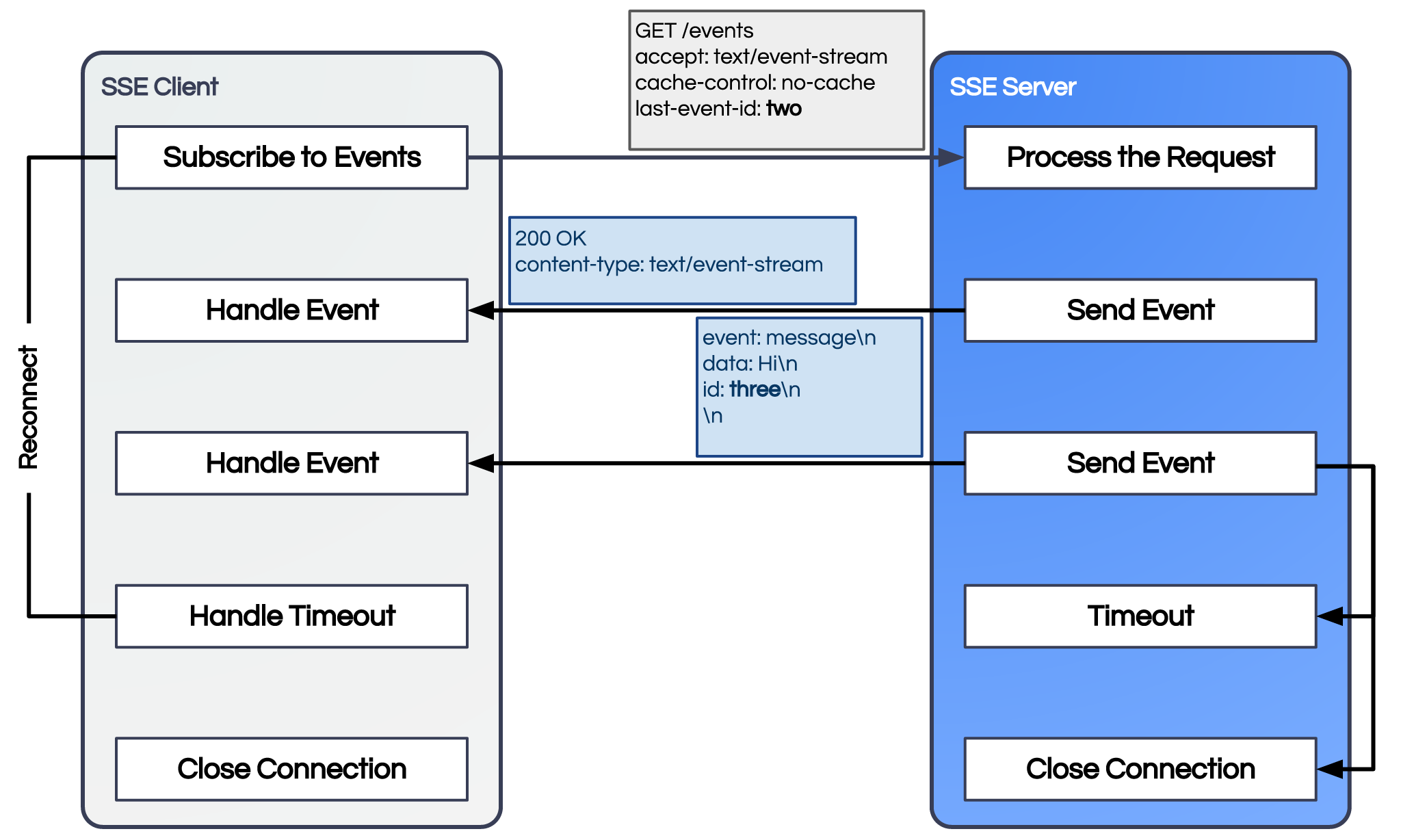
Streaming: receive the response token by token via SSE (Server-Sent Events, a real-time server-to-client protocol). Essential for real-time user experience: the user watches the answer appear progressively instead of waiting for generation to finish.
Embeddings: turn text into vectors for semantic search. The mistral-embed model produces 1024-dimensional vectors, whatever the length of the text.
Batch processing: the batch endpoint handles large volumes asynchronously at half price. It accepts completions but also embeddings, OCR, moderation and audio transcription.
Moderation: two dedicated endpoints, /v1/moderations for raw text and /v1/chat/moderations for a conversation. See Guardrails and moderation.
Official SDKs
- Python:
pip install mistralai(official SDK) - JavaScript/TypeScript:
npm install @mistralai/mistralai(official SDK) - Community libraries exist in other languages, but the documentation explicitly recommends the official SDKs.
As of late July 2026, both official SDKs are on their 2.x series: the latest published Python client is 2.8.0 (28 July 2026) and the latest TypeScript client is 2.5.0. There is no 3.0 release at this date.
Golden rule: never put an API key in public code. Not in frontend HTML, not in a GitHub repo, not in a committed config file. Use environment variables. Rotate your keys regularly. A compromised API key can burn thousands of euros of usage in a few hours.
Dashboard and monitoring
The console at console.mistral.ai is where you generate API keys, test prompts in the playground, build and deploy agents, run evaluations and track usage. It is also where you read the limits that actually apply to your workspace.
Studio is no longer a standalone product: the documentation presents it as one of Mistral's three products, alongside Vibe (the unified agent, formerly Le Chat) and Admin (the organisation's control plane).
Production best practices
Retry with exponential backoff: if you hit a rate limit (429 error), do not immediately fire another request. Wait 1 second, then 2, then 4, then 8. Exponential backoff keeps you from flooding the API.
Use the cache: input tokens served from cache are billed ten times less. If your requests share a long common prefix (a detailed system prompt, a reference document), structure them so that this prefix stays stable from one call to the next.
Right-size your timeout: configure it per use case. A short chat means a short timeout. A long generation in reasoning mode means a far more generous one, because the model produces a thinking block first.
Fallback between models: if your usual model is slow or unavailable, switch automatically to a lighter one in the range. Your application's resilience should not depend on a single entry.
Pin your versions: in a regulated setting, a -latest that changes behaviour overnight is a traceability problem. Record the dated version you use and watch the retirement calendar Mistral publishes.
La Plateforme, now Studio, remains the single access point to the Mistral ecosystem for developers. What changed in 2026 is not the API: it is the catalogue behind it, shorter and far more configurable.