Le Chat has been called Vibe since 28 May 2026. The name "Le Chat" is no longer used commercially: Mistral merged its consumer assistant and its coding tool into a single product called Vibe, and the old Le Chat became its Chat mode. Accounts, conversations, settings and subscriptions were carried over untouched, and the web address chat.mistral.ai is still where the app lives. For the product as it exists today (its three modes, its connectors, its coding agents) see Vibe. This page tells the story of the consumer assistant and its positioning against ChatGPT, because that story is what explains what Vibe became.
Why Mistral built a chatbot
In late 2023, Mistral is a model provider. You reach it through an API, meaning through code. The audience is developers, and value is measured in tokens.
The problem with that position is that it is invisible. Nobody outside the trade knows what a model provider does. Meanwhile ChatGPT is becoming a household word. A chatbot is not only a product: it is the shop window that makes a technology legible to a minister, a CFO or an intern.
Le Chat launched on 26 February 2024. The announcement was modest: a conversation interface giving access to Mistral Large, Mistral Small and a prototype called Mistral Next, with a tunable moderation mechanism and an Enterprise version for organisations. At that stage, the announcement page spelled out a limitation that reads as quaint today: the assistant could not access the internet. It answered from what it had learned during training, and nothing else.
That is the starting point. The rest of the story is about closing the gap with ChatGPT, then trying to overtake it by a different route.
The story in four steps
February 2024, an assistant that answers
A dialogue box, a model, no tools, no mobile apps. The main point was the demonstration: European models can hold a conversation.
February 2025, the overhaul that changed everything
A year later, Mistral shipped a major overhaul that turned the product into a serious competitor. Everything arrived at once:
- mobile apps for iOS and Android;
- web search with cited sources, backed by press partnerships including AFP;
- Flash Answers, very fast generation (Mistral claims up to roughly a thousand words per second), obtained by optimising its models and inference engine;
- document reading: PDFs, spreadsheets, log files, complex images, with OCR (recognising text inside an image);
- the Code Interpreter, running code in a sandbox to analyse data or draw a chart;
- image generation, handled by Black Forest Labs' Flux Ultra model;
- Canvas, a workspace where a document is written and corrected instead of scrolling past in the chat thread;
- Memories, announced at that point, so the assistant remembers a user's preferences.
On the commercial side: a generous free tier, a Pro plan at 14.99 per month with a student discount, a Team plan, and an Enterprise version then in private preview.
The copy-paste shuttle between a chat window and a word processor was one of the great time sinks of first-generation generative AI. Canvas answers that: the text lives in an editable document next to the conversation, you can ask for one paragraph to be rewritten without regenerating the rest, and you keep your own edits. Every major assistant adopted the format within a few months of one another, under different names. That is a sign it answers a real need rather than a fashion.
2025, voice, memory and connectors
The following year added three building blocks that set up what came next.
Voice first: Mistral released Voxtral, its family of audio models, and wired voice input into the assistant. You speak, it listens.
Memory next, this time shipped: the assistant remembers who you are and what you prefer from one conversation to the next.
Connectors last, with support for custom MCP servers. This is by far the most consequential of the three. Until then, the assistant only knew what you typed into it. With connectors, it can go and look in your mailbox, your code repository or your document store itself. It stops being a conversation partner and becomes a system wired into your data.
The Model Context Protocol is an open standard defining how a model calls outside tools. Its value is that integration becomes reusable: a service exposing an MCP server can be used by any compatible assistant, without writing a bespoke integration for each one.
May 2026, Work, then the rename
On 22 May 2026, Le Chat gained a Work mode able to run multi-step professional tasks, with remote agents powered by Mistral Medium 3.5.
Six days later, on 28 May 2026, the product changed its name. Le Chat became Vibe, absorbing the coding tool that already carried that name. One brand, one licence, three modes: Work, Code and Chat. Chat mode is precisely the thing described on this page.
The positioning: the European alternative
The pitch has not changed in two years, and it comes down to three arguments.
Price. The individual plan is listed at 14.99 per month, against 20 dollars per month for the equivalent individual plans at OpenAI and Anthropic. The gap is real, but it is not the main point.
Data location. Data stays on European soil, which considerably simplifies the GDPR analysis: no question of transfer outside the Union, no stack of standard contractual clauses. For a public body or a regulated sector, this is often the argument that decides.
What happens to your conversations. By default, Mistral does not use exchanges to train its models, and users can request deletion of their data. At several competitors, the equivalent is a setting you must first find and turn off.
First, "servers in Europe" and "European company" are not the same guarantee. A US provider can host in Europe while remaining subject to its own national law. That is why the criterion that matters in a serious analysis is the nationality of the entity controlling the data as much as the location of the machines.
Second, a listed price is not a comparable price. Plans differ on usage limits, included models and reserved features. Comparing 14.99 to 20 without looking at what is inside does not say much.
Comparison with ChatGPT's individual plan
| Aspect | Vibe Pro (formerly Le Chat Pro) | ChatGPT Plus |
|---|---|---|
| Monthly price | 14.99 | 20 dollars |
| Sourced web search | Yes | Yes |
| Document workspace | Yes (Canvas) | Yes |
| Custom agents | Yes | Yes (GPTs) |
| Image generation | Yes (Flux, Black Forest Labs) | Yes (DALL-E) |
| Image analysis | Yes | Yes |
| Deep reasoning | Yes, adjustable effort | Yes |
| Voice input | Yes (Voxtral) | Yes |
| Built-in coding agent | Yes (Code mode: terminal, IDE, cloud) | Partly, through a separate product |
| Data hosted in Europe | Yes | Not by default |
The verdict changed in nature between 2024 and 2026. At the start, Le Chat was catching up: fewer features, but European and cheaper. Today the difference no longer plays out on conversational features, which have converged everywhere, but on two points: where the data sits, and the fact that the coding agent is included in the same subscription rather than sold separately.
Two claims worth correcting
Two received ideas still circulate in comparison articles and deserve a flag:
"Le Chat cannot generate images." True at launch in 2024. Not true since February 2025: image generation is built in, handled by Black Forest Labs' Flux Ultra model.
"The line-up is just Free, Pro and Enterprise." There is also a Team plan, at 24.99 per user per month, designed for small teams wanting a shared workspace and central administration without going through an Enterprise contract. For a mid-sized firm or in-house legal department, it is often the right answer.
Custom agents, or the doorway to Vibe
This is the feature that best explains the product's trajectory. A custom agent is a preconfigured assistant: you give it a role and instructions, attach reference documents, choose which tools it may use, and share it with colleagues.
A concrete example for a legal department: a "contracts assistant" agent holding the in-house template library, aware of the company's negotiation policy, answering in the expected register. Colleagues query it like an internal expert without rewriting the instructions each time.
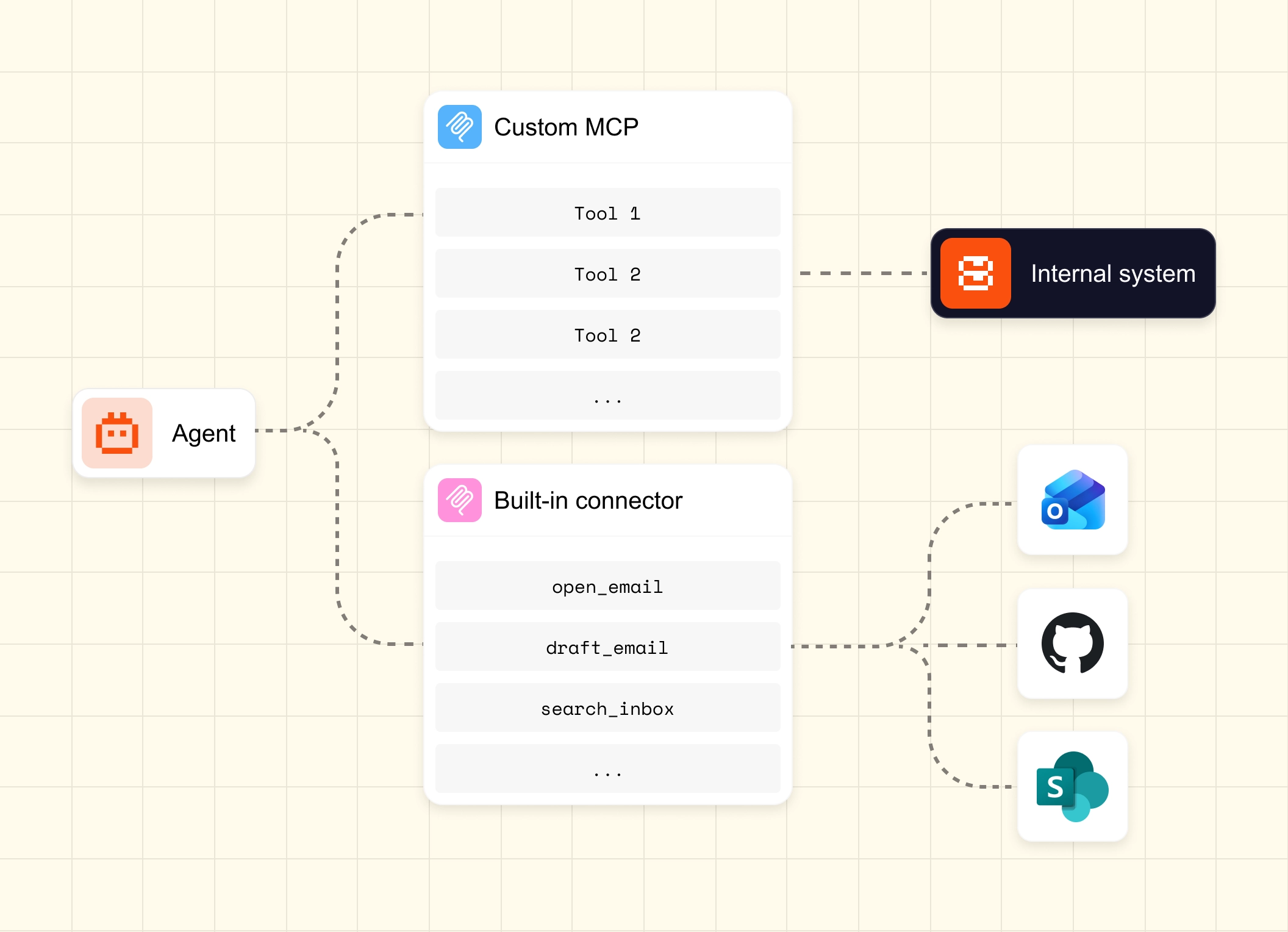
Between that agent and Vibe's Work mode there is exactly one step: the ability to act. The 2025 custom agent answers by drawing on your tools. The 2026 agent does the task, asking for your approval before sensitive actions. The rename to Vibe is therefore not mere marketing dress: it marks the move from the assistant that answers to the agent that executes.
What the rename says about the market
One last point that goes beyond Mistral. In 2026, the three major consumer assistants all made the same move within a few months of each other: consolidate their model line-ups, and turn the dialogue box into an agent wired into the user's tools. The chatbot as a standalone product, the 2023 kind, lasted about three years.
The practical consequence is simple: analyses written about "the company chatbot" age very fast. What needs assessing today is no longer the content of the answers, but the scope of data access and the power to act granted to the tool.