The Search Toolkit was announced on 28 May 2026 in public preview. Mistral describes it as a composable, open-source framework for building production search pipelines, running wherever your infrastructure runs: cloud, on-premises, edge.
The problem: you cannot fix what you cannot measure
Recall how RAG (retrieval-augmented generation) works, as set out in RAG overview. A question arrives. The system first retrieves the relevant passages from your documents, then hands them to the model, which writes the answer from those passages.
Two stages: search, then write.
Now the everyday scene. The system gives a bad answer. What does the team do? It changes the prompt. It tries a different model. It adjusts how documents are chunked. It changes the prompt again. Sometimes things improve, and nobody knows why.
What Mistral's announcement says, and it is the central idea of this page: when a RAG system returns poor results, the first question is whether the fault lies with retrieval or with generation. In practice, most teams have no clean way to answer it.
Picture a junior asked to write a memo. They first go and pull the papers from the archive, then they write.
The memo is bad. Two possible causes, each calling for a different fix:
- they pulled the wrong papers, no point teaching them to write better;
- they had the right papers and made poor use of them, no point reorganising the archive.
As long as you only look at the finished memo, you cannot tell. You have to open the file they brought back and check, independently of what they wrote from it, whether the right papers were in there.
The Search Toolkit's evaluation module is exactly that: opening the file.
The second problem is more mundane: plumbing. Mistral puts it bluntly, teams building retrieval systems spend more time assembling infrastructure than improving search quality. Ingestion needs one set of tools, retrieval another, evaluation, if it happens at all, a third, each with its own interface and its own assumptions about what a document is. The reported result: weeks of integration work before a single query can run against your own data.
The trick: all three stages in one framework
The Search Toolkit brings the three modules under a shared configuration interface. Replace the indexer, swap the retriever, add an evaluator: the rest of the pipeline adapts.
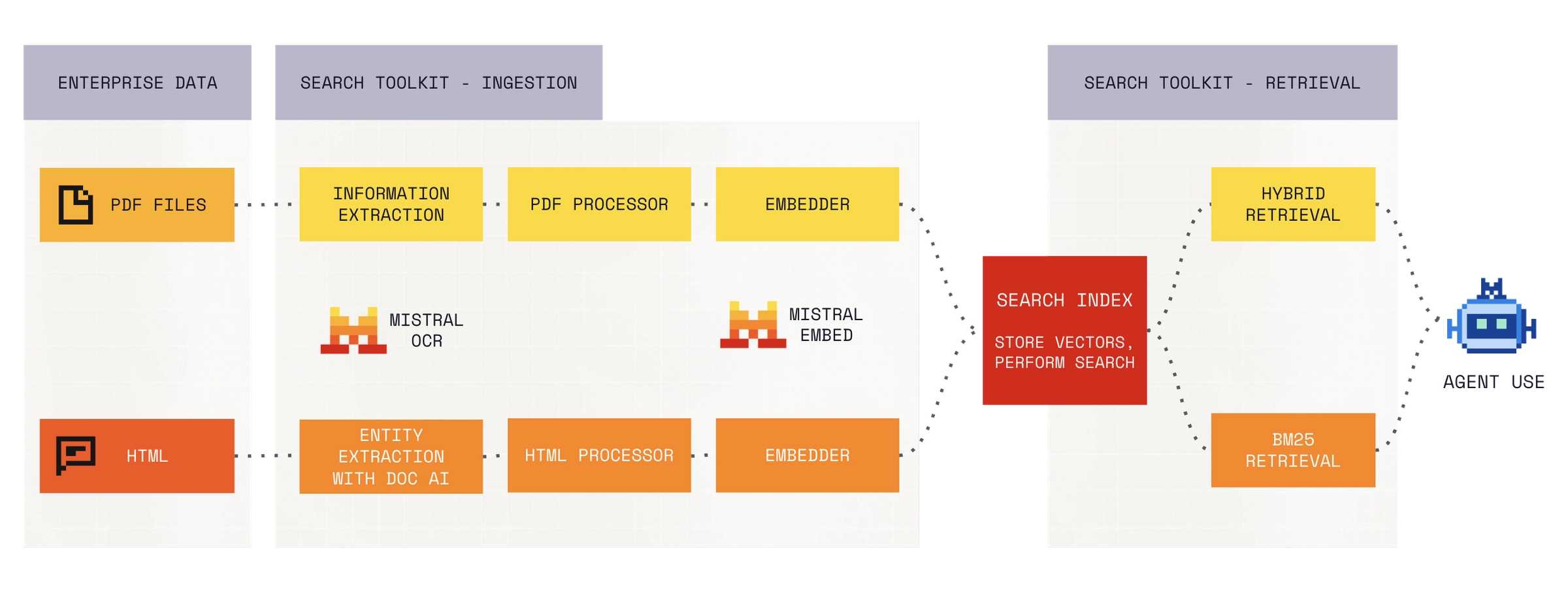
1. Ingestion, turning documents into an index
This is the preparation work. The module reads your sources, whatever they are, parses the documents (extracting the text, which is anything but trivial for a PDF), chunks them, computes their embeddings and indexes them.
Chunking deserves a word. An 80-page contract is not searched as a single block: you cut it into passages of reasonable size, because it is a specific passage, not the whole document, that you want to find and hand to the model. Chunking strategies are configurable, and unusual document formats plug in through a standard adapter interface.
This module also addresses the problem Mistral states in a line that will ring true in any large organisation: most companies do not have a search problem, they have a dozen. Internal wikis, ticketing systems, document repositories, file storage, codebases: each source has its own structure, its own metadata, and needs different processing to index well. You end up either with isolated indexes that cannot be searched together, or with a brittle in-house layer that becomes a maintenance burden of its own. The Search Toolkit offers processing and indexing patterns that are common to all source types, so adding a source does not mean rebuilding the pipeline.
On embeddings (those lists of numbers that stand for the meaning of a text) see Mistral Embed and Text embeddings. On extracting the text from the documents in the first place, a problem in its own right, see Mistral OCR.
2. Retrieval, three ways to search
This is the core, and it turns on three terms. The page Retrieval methods develops them; here is the gist in plain language.
BM25, or search by words. This is sparse retrieval, the direct descendant of classical search engines. It compares the words in the question with the words in the documents, giving more weight to rare words ("encumbrance" counts far more than "the") and correcting for document length. It is fast, transparent, and unbeatable on exact terms: a case number, an article reference, a proper name. Its weakness: it understands nothing. Search for "termination" and a document that only ever says "ending the contract" will slip past it.
Dense retrieval, or search by meaning. Every passage is turned into a vector encoding its meaning, and so is the question. You then look for the nearest vectors. "Termination" and "ending the contract" end up neighbours, with no word in common. Its weakness mirrors the other's: it is fuzzy on exact terms and can miss a precise reference it judges "semantically close" to ten others.
Hybrid, or both at once. Run both searches and combine the results. This is the configuration that nearly always wins in enterprise settings, for an easy reason: professional documents are full of exact jargon and of synonyms. The Search Toolkit ships all three and makes each configurable, and the starter template is set up for hybrid retrieval by default.
Search for "non-compete clause in contract FR-2019-0447".
Dense retrieval will bring back every non-compete clause in your database, not necessarily the one in the right contract, since "FR-2019-0447" means nothing to it. BM25 will find the right contract instantly by its reference, but will miss a clause drafted under the heading "post-contractual duty of loyalty".
You need both. That is the whole argument for hybrid retrieval, and it is why a law firm sits almost always in the worst case of either method taken alone.
3. Evaluation, the module that changes things
The built-in metrics are recall, precision, MRR and NDCG. They run against your own test sets, with your own relevance judgments, letting you compare retriever configurations side by side and track quality across releases.
| Metric | What it answers, in one sentence |
|---|---|
| Recall | Of all the papers that should have been found, what share made it into the file? |
| Precision | Of all the papers brought back, what share was actually useful? |
| MRR | How far down does the first good paper appear? First place scores 1; second, 1/2; fifth, 1/5. |
| NDCG | Are the good papers near the top? The most refined measure: it accounts for how relevant each paper is and penalises a useful one the further down it is buried. |
They answer different questions, and a concrete case shows it.
An engine that returns a hundred passages for a question has probably brought back the right ones: excellent recall, dismal precision, and the model that has to write drowns. An engine that returns just one, very confidently, has perfect precision and poor recall: it will miss the exception buried in an annex.
MRR tells you whether the user finds what they need immediately, that is what matters for a search box. NDCG tells you whether the overall ordering is sound, that is what matters when a model is about to read the top five results. You do not pick one metric: you watch all four, because moving one at the expense of the others is far too easy.
The natural sequel to this module is RAG evaluation.
Under the hood, and how to try it
The underlying indexing engine is Vespa, an open-source search engine. You start locally with Docker, from a project template Mistral provides (gh:mistralai/search-starter-app), which ships pre-configured Vespa indexing, hybrid BM25-plus-vector retrieval, and sample data.
Mistral cites one production use: CMA CGM uses the Search Toolkit together with Voxtral to help journalists detect fake news, on a pipeline that processes audio from three distinct sources and returns an alert within about fifteen seconds end to end.
Indexed search and live data are two different things
A useful distinction the announcement is careful to draw. An agent needs two routes to enterprise information:
- an index, to search a large corpus of documents precisely and at low latency, that is what the Search Toolkit provides;
- connectors, to fetch the current state of a source system (a CRM, a code repository, a productivity tool) through MCP, that is what Studio provides.
The index knows what was written. The connector knows what is true right now. Both are needed, and conflating them is a classic source of error.
What the Search Toolkit is not
Three clarifications, to avoid misunderstandings.
It is not a turnkey RAG. The tool stops at retrieval. It does not write the answer, does not choose the model that will write it, and does not evaluate what gets written. That scoping is entirely deliberate, and it is where the value lies: by cleanly separating the two halves of the problem, it makes each one measurable.
It is not another search engine. The engine is Vespa. The Search Toolkit is the assembly and measurement layer on top of it.
It is not a hosted service. It is open-source software you run wherever you like, including entirely on your own premises, with no outbound call. For a confidential corpus, that is a difference in kind, not in degree.
Since then: Agentic Search (August 20, 2026)
The Search Toolkit measured and assembled; Agentic Search changes how searching itself works. Instead of the classic one-shot scheme (a query, some passages, an answer), the model runs a multi-step retrieval loop with five tools over the existing index: search, open (a document), navigate (within it), read (a precise region), and grep (an exact pattern). It can therefore do what a person does with a binder: open the report, go to the right appendix, check the figure in the table, cross-check against a second document.
The claimed gap is largest exactly where one-shot retrieval fails, on long, table-heavy documents: on FinanceBench (questions over financial filings), Mistral reports a jump from 26.7% to 86% correct answers; on the multi-document questions of OfficeQA Pro, from 6.3% to 51.9%. These are vendor numbers, to be read as such, but the order of magnitude says something: one-shot retrieval does not narrowly miss these questions, it is structurally unable to answer them, because the answer requires navigation.
Agentic Search is available through the Search Toolkit and in Libraries (Studio and Vibe), in the cloud and on-premises.
Why it matters
Technically, the Search Toolkit contains no new idea: BM25 is decades old, dense retrieval and quality metrics are standard. Its value lies elsewhere, it makes measurement mandatory and easy, where it used to be optional and painful. That kind of shift changes a profession's habits far more reliably than a new algorithm does.
For Mistral, it is a coherence brick: the company sells models, a governance platform and agents. An enterprise agent is only as good as its document search; publishing that foundation as open source, runnable on-premises, feeds directly into the argument set out in Sovereignty.
On sensitive documents, the payoff is very concrete. When a document system misses a piece of evidence, the question is not "did the model hallucinate?" but "was the piece in the file at all?". An evaluation module that measures the engine's recall, independently of the writing, produces exactly the record you need to answer: here is what the system was able to find, here is what it actually found, and here is the date. Mistral explicitly names legal filings among the domains where general-purpose retrievers struggle with specialised terminology.
In one sentence: the Search Toolkit puts ingestion, retrieval and evaluation in one framework, and its real contribution is the third module, knowing whether the fault lies in what was searched for or in what was written from it.