The problem: your features are everywhere and inconsistent
ML model features are its input variables. For a fraud detection model, that might be "average transaction amount over the last 7 days," "number of transactions in the last hour," "distance between purchase location and usual address."
In real-world companies, without centralized management, it's chaos:
- Massive duplication: three different teams compute the same "7-day average amount" feature with three slightly different implementations. Result: three incompatible versions of the same thing.
- Training-serving skew: the feature is calculated one way during training (batch Python on Spark) and another way in inference (real-time Java service). The results differ subtly. The model receives data it never saw during training.
- Non-reproducibility: impossible to reconstruct exactly the features used by a model deployed 6 months ago
- Prohibitive latency: recomputing all features for each real-time inference request is too slow for a service that needs to respond in 50ms
It's the classic nightmare: your model has 95% accuracy in offline evaluation, but 80% in production. Why? The computation logic of a feature differs between the batch training pipeline (Python/Spark) and the real-time inference service (Java/Go). The model receives slightly different inputs in production, and its performance collapses with no visible error in the logs.
What exactly is a Feature Store?
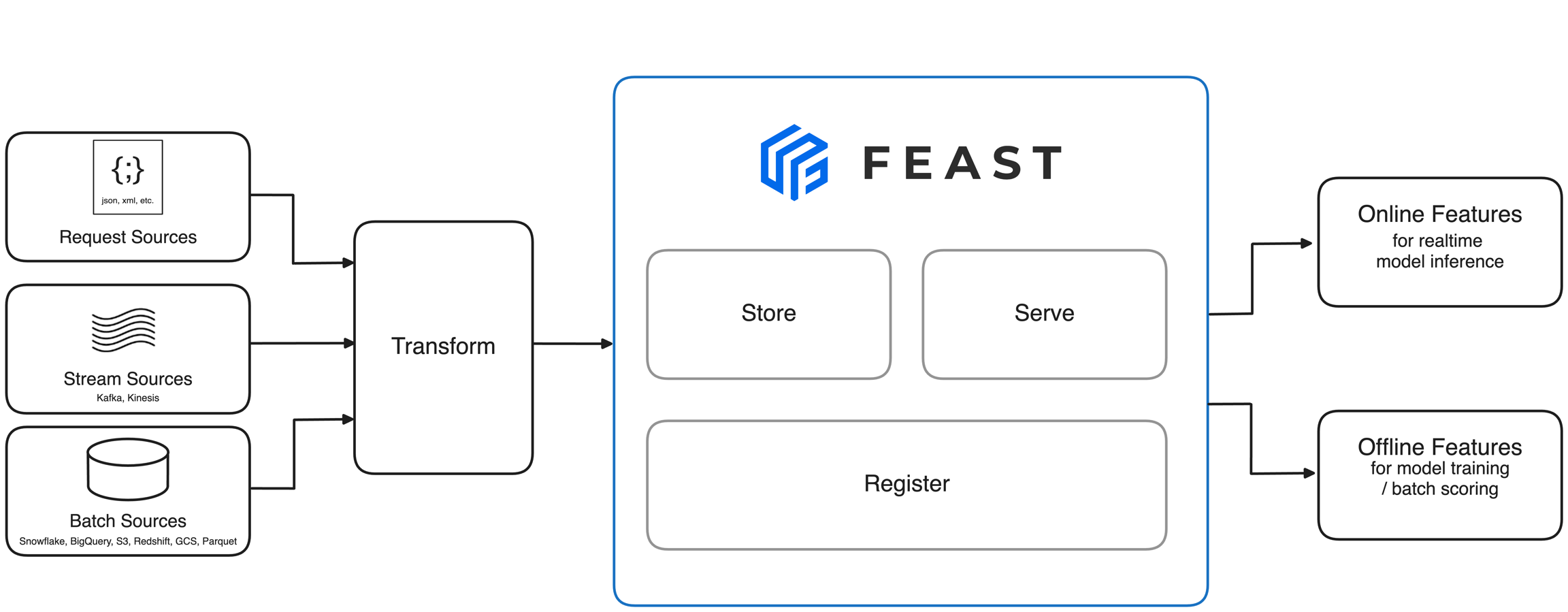
A feature store is a centralized system that manages the entire feature lifecycle: definition, computation, storage, and serving. Its fundamental goal is to guarantee that the same features, computed the same way, are served consistently for both training (batch) AND inference (real-time).
Typical architecture
- Definition and transformation: each feature is defined once, with its computation logic. A single source of truth.
- Dual storage:
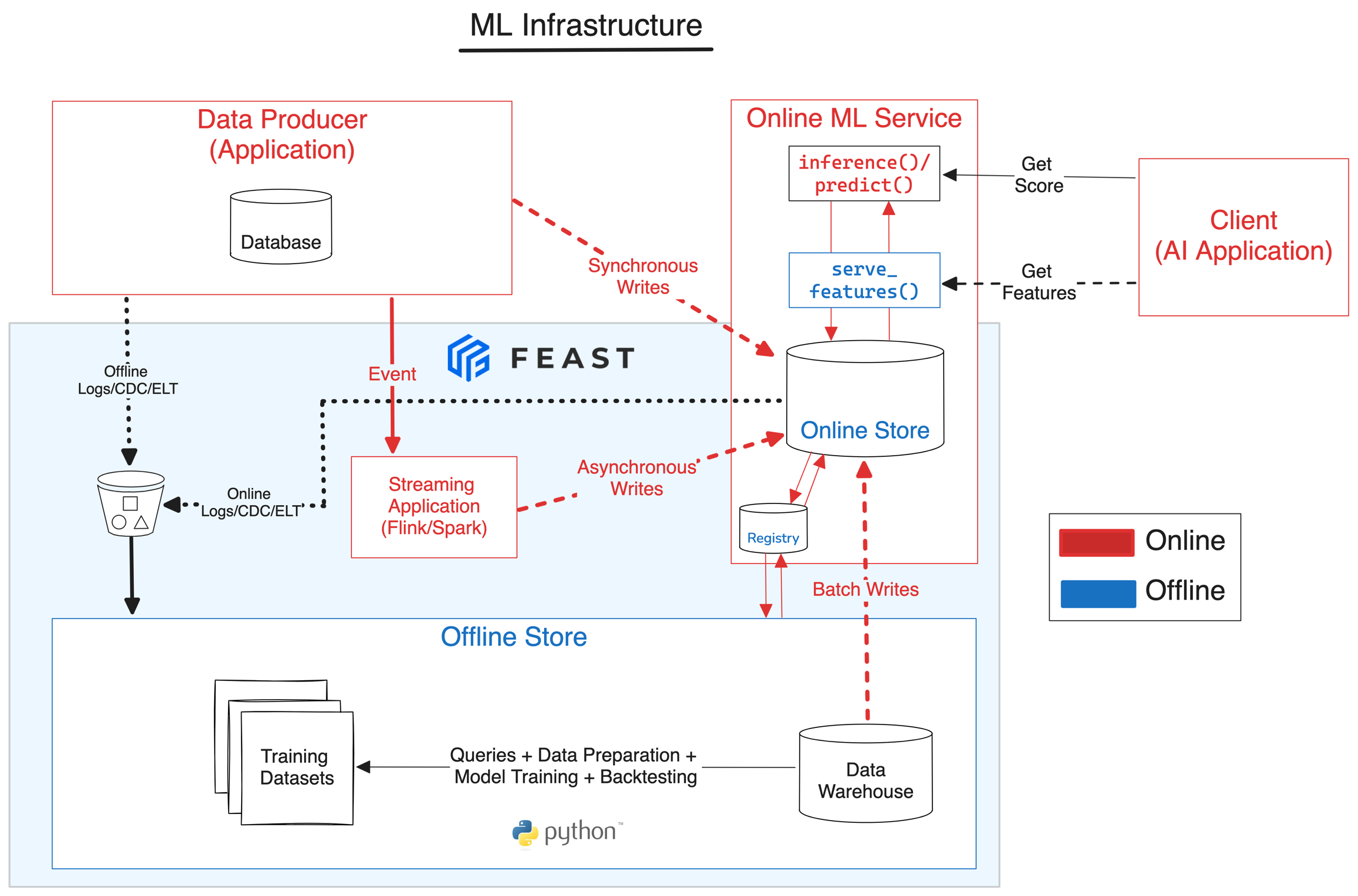
- Offline store: a data warehouse (BigQuery, Snowflake, Parquet) for batch training. Contains the complete history.
- Online store: an ultra-fast cache (Redis, DynamoDB) for real-time inference. Contains only the most recent values.
- Unified serving: a single API retrieves features, whether for building a training dataset or serving a real-time prediction
Key concepts to master
- Feature: a computed variable with an explicit name, e.g.,
avg_transaction_amount_7d - Feature View: a logical group of features that go together (all transaction features for a user)
- Entity: the object the features relate to (a user, a product, a transaction)
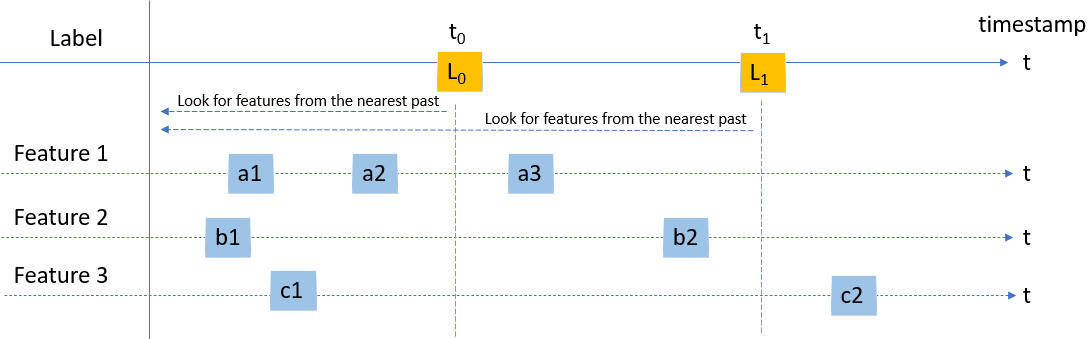
- Point-in-time join: the guarantee that you only use data that was actually available at prediction time. Without this, you have data leakage: the model "cheats" by using future information during training.
Feast: the open-source feature store
Feast (Feature Store) is the most popular open-source project in this category. Created at Gojek/Google, it's now maintained by Tecton.
Declaration and deployment
# Define your features once
@dataset
def my_features(entity_df):
    return features_from_database()

# feast apply: deploys the definition
# feast materialize: pushes values into the online store
Supported backends
- Offline store: BigQuery, Snowflake, Redshift, Parquet files, Spark
- Online store: Redis, DynamoDB, SQLite, Cassandra, PostgreSQL
- Registry: centralized catalog of all available features, consultable by all teams
Feast's strengths
- Open source and free, deployable on your own infrastructure
- Simple to start: you can begin with Parquet files + SQLite locally, with no infrastructure
- Multi-backend: switch backends without modifying your application code
- Native point-in-time join: this is the critical feature. Feast guarantees no future data leaks into your training features.
Honest limitations
- No native real-time streaming: features are materialized in batch, not computed continuously
- Materialization orchestration is your responsibility (Airflow, cron, etc.)
- Feature monitoring is basic
Feast can run with Parquet files and a local SQLite database. That's more than enough for prototyping and small teams. When the need grows, you migrate to Redis + BigQuery without changing a single line of application code. This progressiveness is Feast's strength.
Tecton: the managed feature store for the enterprise
Tecton was created by the founders of Feast (who had built Uber's internal feature store). It's the enterprise, managed, and complete version.
What Tecton adds over Feast
- Real-time transformations: continuous computation on streaming data flows (Spark Streaming, Kinesis). The "number of transactions in the last 5 minutes" feature is continuously updated.
- On-demand transformations: computed at the exact moment of the request. For example, the distance between the user's current GPS position and the store.
- Automatic orchestration: Tecton automatically schedules and executes batch (daily), streaming (continuous), and on-demand (per-request) transformations
- Complete monitoring: alerts on feature quality, data freshness, statistical anomalies
- Governance: per-feature permissions, complete audit trail, end-to-end lineage
The 3 unified computation modes
- Batch: "average transactions over 30 days," recalculated daily
- Streaming: "sum of purchases in the last hour," continuously updated
- On-demand: "current time of day," calculated on each request
The elegance of Tecton: you define the feature once, and Tecton manages all three execution modes automatically. Same source of truth, zero training-serving skew, regardless of mode.
Before feature stores, companies typically maintained three implementations of each feature: a batch Python script, a Spark Streaming job, and a Java on-demand service. Three different codebases, three sources of bugs, three risks of divergence. Tecton reduces this to a single definition.
Tecton's strengths
- Native and performant real-time streaming
- Automatic orchestration and monitoring, zero ops
- Enterprise integration (SSO, RBAC, audit trail)
- Dedicated technical support
Limitations
- Paid SaaS with significant cost (not suited for small budgets)
- Vendor lock-in: migrating away from Tecton takes work
- Overkill for small teams or projects without a real-time component
Comparison: who to choose based on your context
| Criteria | Feast | Tecton |
|---|---|---|
| Type | Open source, self-hosted | Managed SaaS |
| Batch | Yes | Yes |
| Streaming | Limited (via plugins) | Native and performant |
| On-demand | No | Yes |
| Orchestration | Manual (Airflow, etc.) | Automatic |
| Monitoring | Basic | Advanced with alerts |
| Cost | Free (+ your infra) | $$$$ |
| Ideal for | SMBs, prototyping, small teams | Enterprise, critical real-time |
Not all ML projects need one. If your model has simple features (no temporal component), no real-time serving, and you work in a small team: a classic preprocessing pipeline with Parquet files is enough. A feature store becomes valuable when multiple teams share features, when real-time is necessary, or when training-serving skew is an identified risk.
Notable alternatives
- Hopsworks: open source with native Spark and Flink, built-in feature monitoring
- SageMaker Feature Store: AWS managed, integrated with the SageMaker ecosystem
- Vertex AI Feature Store: GCP managed, integrated with Vertex AI
- Databricks Feature Store: integrated with the Databricks platform, direct access from notebooks
The trend is clear: every cloud provider and ML platform now offers an integrated feature store. The concept has proven its value and is now part of the standard enterprise ML stack.
1. A model shows 95% accuracy in offline evaluation but 80% in production, with no error anywhere in the logs. What typical cause does the page point to?
2. What is the point-in-time join for in a feature store?
3. Why does a feature store maintain two storage layers, offline and online?
4. Your small ML project has simple features, no temporal component and no real-time serving. Should you deploy a feature store?