The Idea: What If Order Mattered?
A child learns mathematics by counting first, then adding, then multiplying, then algebra. Nobody starts with triple integrals. Each simple notion is the foundation for the next.
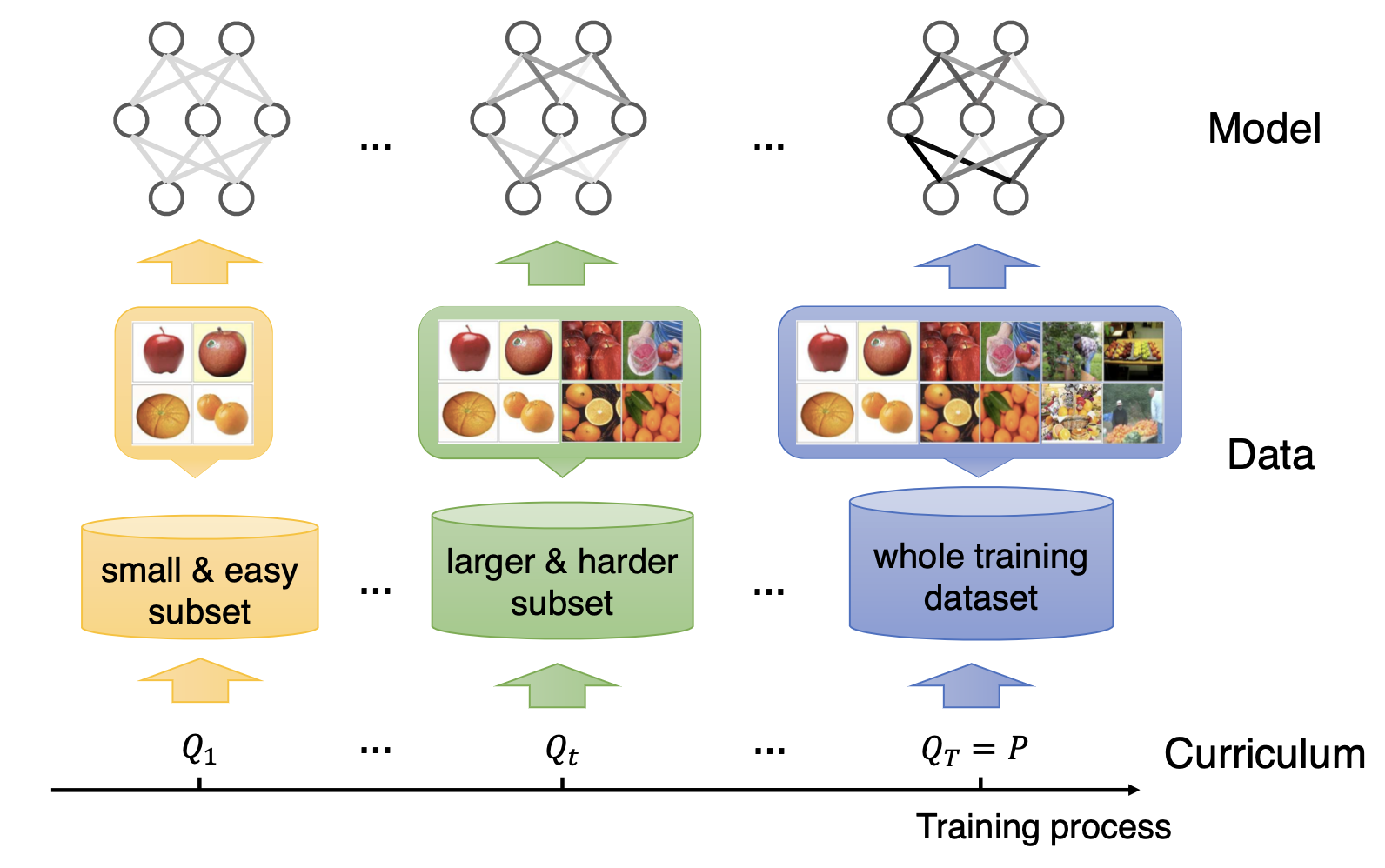
Curriculum learning applies that idea to training a network: instead of presenting examples in random order, you order them from easy to hard. Bengio and colleagues formalized it in 2009, and the appeal is immediate.
Which is exactly why caution is required. An appealing idea and a demonstrated idea are different things, and this page will spend a good deal of time on the gap between them.
What the Literature Actually Says
This result belongs at the top, not the bottom, because it changes how everything else reads.
Wu, Dyer and Neyshabur ran the most systematic study of the question: thousands of different orderings, comparing three regimes, curriculum (easy to hard), anti-curriculum (hard to easy), and random curriculum, where the size of the training set grows over time but examples are drawn at random.
Their conclusions, as the paper states them:
- on standard benchmark datasets, curricula deliver only marginal benefits;
- randomly ordered examples perform as well as or better than curricula and anti-curricula;
- which suggests that the observed benefit comes entirely from the training set size increasing over time, not from the difficulty ordering;
- curricula do deliver a real gain in two particular situations: when the training time budget is limited, and when the data is noisy. Anti-curricula deliver nothing in either case.
There is a fourth result, more unsettling still. The authors measure an implicit curriculum: even with examples presented in perfectly random order, a network learns them in a highly consistent order from one training run to the next. The network builds its own easy-to-hard progression. An explicit curriculum therefore imposes an order it would have adopted anyway.
Other work reports clear gains. On convolutional networks for image recognition, Hacohen and Weinshall observe both faster learning and better final test performance, with two different ways of sorting examples. So the overall picture is not "it does not work": it is mixed, and that word should be taken strictly.
On the Power of Curriculum Learning in Training Deep Networks (Hacohen and Weinshall, 2019)When two serious studies reach different conclusions, it is usually not that one is wrong. It is that the effect depends on conditions neither of them fully controls: the task, the noise in the data, the training budget, how difficulty is measured, the pace of introduction.
The practical consequence is sharp. There is no general answer to "should I order my data?" There are situations where a gain has been measured, and many others where nobody knows. Every general claim on this page (including the ones you would like to believe) should be read with that reservation.
It is also why figures of the form "curricula speed up convergence by 20 to 30%" are meaningless out of context: they depend entirely on the setup. On that, see how to read a benchmark.
The Real Obstacle: Measuring Difficulty
Every curriculum decomposes into two organs: a difficulty measurer, which sorts the examples, and a scheduler, which decides when to introduce what.
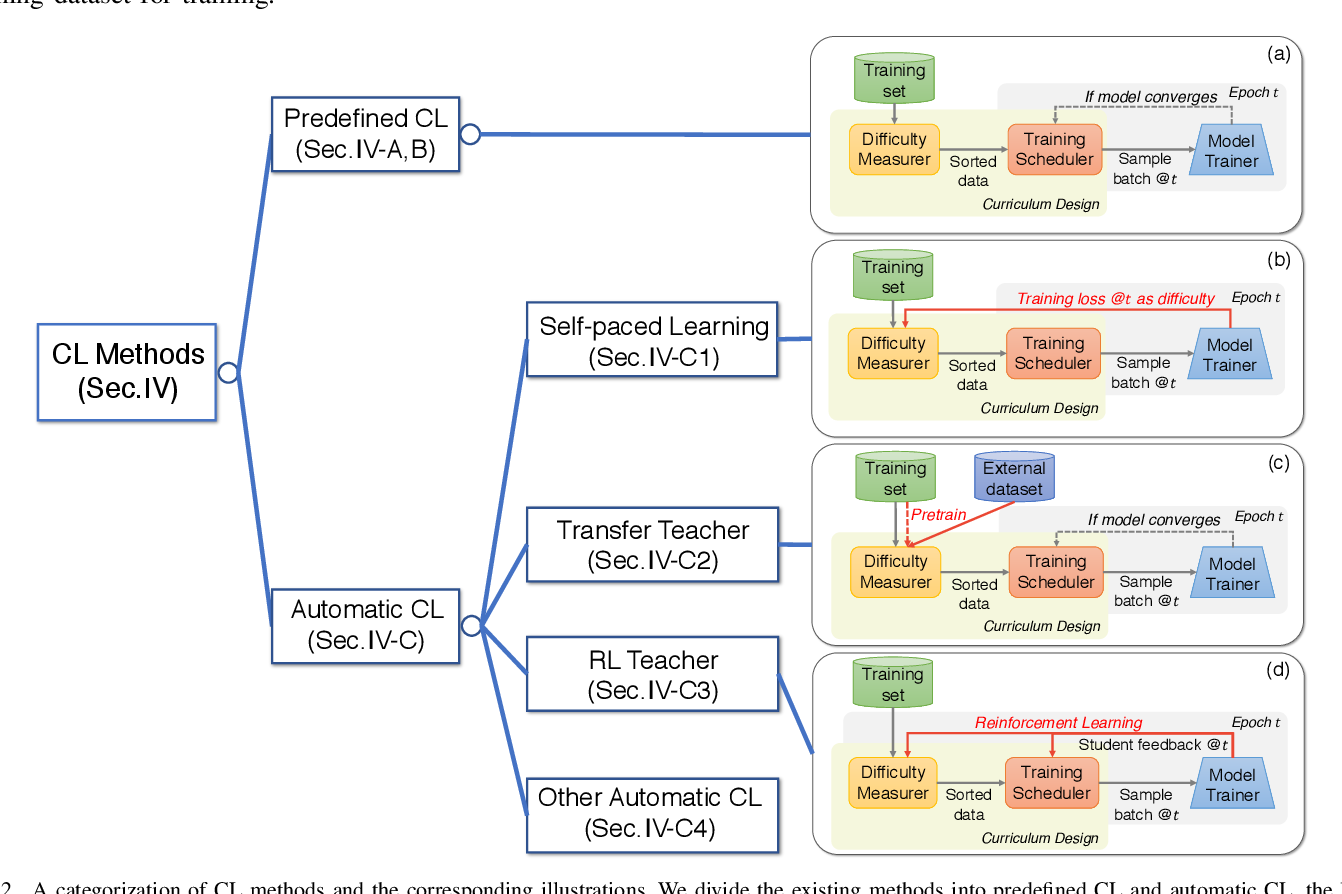
And here is the central problem, which the field's reference survey itself names as its main limitation: you have to know in advance what is hard.
That sounds harmless. It is not. If you already knew, before any training, which examples are hard for this model on this task, you would already have solved a large part of the learning problem. A curriculum does not remove the difficulty: it moves it into the measurer.
Here are the available measurers, and what each really costs.
| Measurer | How | What it displaces |
|---|---|---|
| Text length | Count the words | Nothing, but length is not difficulty: a short sentence can be hard |
| Vocabulary rarity | Proportion of rare words | Nothing, but it measures specialization, not conceptual difficulty |
| Perplexity of a reference model | Have another model read the corpus | You need that reference model, and its notion of "surprising" is not yours |
| Loss of the model being trained | Watch what it gets wrong | Circular: see below |
| An external teacher | A trained model does the sorting | You need a model already good at the task, so the problem is already solved |
Self-paced learning is the most elegant measurer on paper: the model itself defines what is hard, by flagging the examples on which its loss is high. Those examples are introduced as it becomes able to absorb them.
The circle is visible as soon as you write it out slowly. What the model gets wrong at a given moment depends on what it has been shown so far, which depends on what it got wrong before. The difficulty measure is therefore as much a consequence of the curriculum as its cause. Nothing forbids this from working, but you are not measuring a property of the data: you are measuring the state of the model.
Then add the cost. The loss on candidate documents has to be re-evaluated continuously during training, and that re-evaluation is hard to spread across thousands of machines advancing in parallel. That, far more than doubt about its effectiveness, is why the procedure is rare at large-language-model scale.
The Case Where the Difficulty Criterion Is Mechanical
There is one situation where the objection above collapses entirely, and it is worth knowing because it illuminates the rest by contrast: reinforcement learning.
In group-based reinforcement learning, you draw several answers for the same task, score each one, and an answer's advantage is its deviation from the group mean. Now watch what happens when every answer in the group gets the same score, because the task is trivial and the agent always succeeds, or because it is out of reach and the agent always fails. The deviation from the mean is zero for all of them. The gradient is zero. Nothing is learned, and that is not a pedagogical opinion: it is an arithmetic identity.
The contrast with the classical curriculum is total. Here "too easy" and "too hard" are not judgements to be estimated in advance: they are observations, made after the fact, on scores that were computed anyway. The difficulty measurer is free because it is a by-product of computing the reward.
That is why difficulty filtering is common and well-founded practice in reinforcement learning, while curricula remain contested in supervised learning. The details are on RL training infrastructure for agents, and the group-advantage mechanism on GRPO.
The Sequence-Length Curriculum: Arithmetic, Not Pedagogy
This is the most widely used variant in large-language-model training. It deserves separate treatment, because its justification has nothing to do with progressing from easy to hard.
You train on short sequences first, then lengthen them. The reason is purely a matter of accounting: the cost of the attention mechanism grows as the square of the sequence length, because every token must be compared with every other. Let us do the sum.
For a sequence of length , the number of comparisons is proportional to :
- : about 4.2 million comparisons;
- : about 67 million comparisons.
Sixteen times more for the long sequence. But mind what that factor of 16 is comparing: one sequence, not the same amount of text. The 8,192-token sequence holds four times more text. At equal text volume you need four sequences of 2,048 tokens, that is million comparisons, against 67 million. The honest ratio is therefore 4, not 16: processing one token in a context of 8,192 costs four times as much as in a context of 2,048.
That factor of 4 reads straight off the formula: . Cost per token is simply proportional to the length of the context.
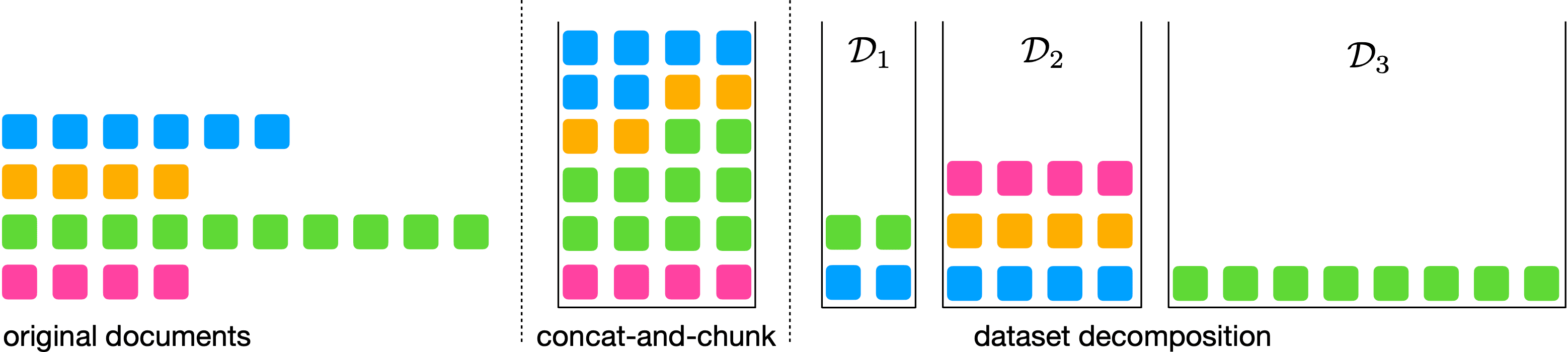
The reference work here is Dataset Decomposition. What the paper measures:
- a one-billion-parameter model with an 8,192-token context trained at the same cost as a 2,048-token-context model under the usual method;
- up to 6 times less time to reach a target accuracy;
- better scores on standard evaluations and on long-context benchmarks.
The method is not just about ordering: it changes how the corpus is cut up. The usual practice concatenates documents end to end and slices the result into fixed-size blocks, which makes choosing sequence length impossible. Dataset decomposition instead files documents into buckets by length, each bucket holding only sequences drawn from a single document. That filing, as much as the curriculum, is what produces the gain.
An Abrupt Transition Is Expensive
Jumping from 2,048 to 8,192 in one step often produces a temporary rise in loss: the model has never seen a position that distant and has to adapt. Lengthening in stages is preferable. Extending the context window itself (a distinct problem with its own methods) is covered on context extension.
The Quality Curriculum, or Final Annealing
The other widespread practice: save the best data for the end. Textbooks, clean proofs, careful code and the best-filtered corpora are held back for the last few percent of training, while the learning rate decays.
That is a curriculum in the broad sense, an order imposed on the data, but it is not a difficulty curriculum. The reasoning is different: the last data seen weighs disproportionately on the final model. This practice is covered in full on mid-training, which explains why the end weighs so much and discusses a serious objection, nobody knows how to cleanly separate the "this data is better" effect from the "this data comes last" effect.
Take away only this here: unlike the difficulty curriculum, this practice is widely adopted and its effect on loss curves is visible to the naked eye.
The Domain Curriculum
Train first on general text, then on code and mathematics, then on specialized domains. The idea is that solid general command of the language helps absorb jargon afterwards.
The risk is direct and well understood: if you abandon a domain entirely to move to the next, what was learned on it degrades. The mechanism is the same as catastrophic forgetting, and so is the remedy, keep presenting a fraction of the earlier data. Since that is exactly the problem of continual pre-training, the mechanical explanation lives there rather than here.
What To Take Away
- The idea is appealing, the results are mixed. The most systematic study finds only marginal benefits on standard datasets, and finds that a random order with growing corpus size does as well. Other work measures real gains. Both are serious; the effect depends on conditions that are poorly pinned down.
- Two situations where a gain has been measured: limited training budget, and noisy data. Outside those, caution.
- A curriculum displaces difficulty, it does not remove it. You have to know in advance what is hard. Every available measurer has a fundamental flaw: it measures something other than difficulty, it requires an already-competent model, or it is circular.
- One clear exception: group-based reinforcement learning. A group of answers all scored the same yields zero advantage, hence zero gradient, hence teaches nothing. Here the difficulty criterion is an arithmetic identity (free and not open to argument) not an estimate.
- What is actually adopted in large-model training is not a difficulty curriculum: it is the sequence-length curriculum, justified by the quadratic cost of attention, and the final anneal on sorted data, justified by the weight of the last tokens seen.
1. What does the field's most systematic study, When Do Curricula Work?, conclude about where the benefit of curricula comes from?
2. Self-paced learning lets the model define difficulty from its own loss. What is the logical flaw?
3. In group-based reinforcement learning, why does a task the agent always succeeds at (or always fails at) teach nothing?
4. Why are large language models often trained on short sequences first, then long ones?
5. How should you read a claim like curriculum learning speeds up convergence by 20 to 30 percent?