The Problem: Human Text Is Not Inexhaustible
Large language models (LLMs) are trained on quantities of text approaching the total of what exists publicly. One study tried to date the collision.
Villalobos et al. (Epoch AI) estimate the total stock of public human text (on the order of 300 trillion tokens in the version updated in 2024, with a wide margin of uncertainty), compare it against the growth in demand, and conclude that if current trends continue, models will be trained on datasets roughly the size of the available stock between 2026 and 2032, earlier if models are overtrained. We have therefore entered the forecast window.
Note three things. This is not an observation, it is a forecast, with a six-year window. It concerns public text: anything behind authentication, a paywall or a licensing contract is not counted. And the authors themselves name synthetic generation as one of the possible ways forward, so this is not a neutral source on the subject of this page.
You often read that the wall has already been hit, with a precise figure for the tokens remaining. That figure appears in no verifiable source.
Whatever the exact date, the direction is clear: good human text does not double every year, whereas training budgets do. Hence the idea of manufacturing the missing text: have one model write it, and train another model on the result.
The Mechanism, and What It Cannot Do
Start with the awkward question, because everything else depends on the answer.
A generator model produces text. That text is used to train a second model. Where does the information in that text come from?
It comes from the generator. And the generator knows only what its own corpus taught it. So the information comes, in the last analysis, from the original corpus, the very one whose limits you were trying to escape. A model does not create a new fact about the world by writing a sentence. It redistributes what it already holds.
This is the point most presentations skip, and without it the rest of the page makes no sense.
Generating 100 billion tokens from a model trained on 10 trillion tokens produces no new fact. The factual content is capped by what the generator knew. The procedure can be extremely useful, but it is not a source of information: it is a transformation of information already present.
So what is the point? Because the same information can be easier or harder to learn depending on the form it arrives in. And it is form, not content, that synthetic generation improves.
What the Procedure Actually Delivers
Three things, all real, none magical.
One. It reformats. A notion sitting in the corpus in an awkward form (a rambling forum thread, a dense paper, an uncommented code fragment) can be rewritten in a teaching form: clear statement, worked example, explanation, counter-example. The information is the same; the number of steps the student model must take to reach it drops. Work is shifted from student to teacher.
Two. It rebalances. A web corpus holds billions of pages of chatter and very few clean mathematical proofs. You can ask the generator for a thousand problems on an underrepresented topic. No knowledge was added; a proportion was corrected.
Three, and this is the only case where genuinely new information enters. It lets a verifier intervene. If the generator produces a program, you can run it. If it produces a formal proof, a proof checker can validate it. If it produces a calculation, you can redo it.
This third case is of a different kind from the first two. The generator can emit a hundred attempts without knowing which are right; the verifier (compiler, test suite, proof engine) decides. The signal "this one is correct" does not come from the model. It comes from outside. There, and only there, synthetic generation admits information that was not in the original corpus.
That is why the two domains where synthetic data works best, by a wide margin, are code and mathematics. Not because models write those best, but because they are the only two domains where correctness can be settled automatically and without argument. The same mechanism sits at the heart of reinforcement learning with verifiable rewards.
The Place of Synthetic Data in 2025-2026 Models
In 2023, synthetic data was mostly used to build instruction sets for small open models. In 2025-2026 it is present at every stage of training large models, in quantities that would have seemed unreasonable two years earlier.
| Stage | What gets manufactured | Published examples |
|---|---|---|
| Pre-training | Rewritten web pages, synthetic textbooks and exercises | Phi-4: about 40% synthetic tokens and 15% web rewrites; Nemotron-CC; Kimi K2 |
| Final pre-training phase | Math and code problems, rephrased educational text | the mid-training mixes of OLMo 2 and other open models |
| Instruction tuning | Prompts and answers, dialogues, simulated tool calls | Llama 3, Kimi K2 (a large-scale "agentic" data synthesis pipeline) |
| Preference alignment | Answers ranked by a judge model | Nemotron-4 340B: over 98% of alignment data synthetic |
| Reasoning | Verified reasoning chains | DeepSeek-R1: 800,000 examples to distil reasoning into small models |
Two trends stand out. First, the most widely used synthetic data is anchored in something real: a web page being rephrased, a problem with a known answer, code that can be run. Second, the synthetic share can be very high without removing human data: Phi-4 rereads each of its synthetic tokens a dozen or so times, but keeps more than a trillion tokens of filtered web, code and acquired sources alongside. The techniques themselves (personas, rephrasing, rejection sampling) are described on synthetic data generation.
Phi-4 Technical Report (Abdin et al., 2024) Nemotron-CC: Transforming Common Crawl into a Refined Long-Horizon Pretraining Dataset (Su et al., 2024)The Uses, One by One
Paraphrase and Rewriting
A model rephrases or summarizes existing text. Rewriting an article five times yields five variants of the same content.
This increases surface diversity, phrasing, ordering, register. It adds nothing to the substance. A legitimate use, provided you do not mistake five rewrites for five documents: to a deduplication pipeline they are near-duplicates, and data quality explains why that matters.
Mathematics and Code
The central case, for the reason above: correctness is machine-checkable. Generate problems, generate solutions, execute or verify, keep only what passes.
Microsoft made the idea famous with the Phi series and the title "Textbooks Are All You Need." The first paper's exact figures:
- phi-1 has 1.3 billion parameters;
- it is trained for 4 days on 8 A100 cards;
- on 6 billion tokens of web text selected as textbook quality plus 1 billion tokens of textbooks and exercises generated by GPT-3.5;
- it reaches 50.6% pass@1 on HumanEval and 55.5% on MBPP. Both are collections of small Python programming exercises where a proposed solution is graded by running it against tests. (MBPP: Mostly Basic Python Problems.)
Two caveats. First, this is Python code only, on two code benchmarks, the domain most favourable to the procedure, and the result does not automatically extend elsewhere. Second, the closeness between generated exercises and the exercises of an evaluation set fed a public debate about contamination; the authors address it, but not to everyone's satisfaction. On that risk generally, see how to read a benchmark.
Instruction Data
This is by far the largest use today. Instruction tuning needs tens of thousands of prompt-and-response pairs. Having humans write them is expensive; having a model write them costs almost nothing.
- Self-Instruct: start from a handful of hand-written prompts, ask the model to invent new ones on that pattern, then to answer them, then filter.
- Evol-Instruct, used by WizardLM: start from a simple prompt and ask the model to complicate it in steps.
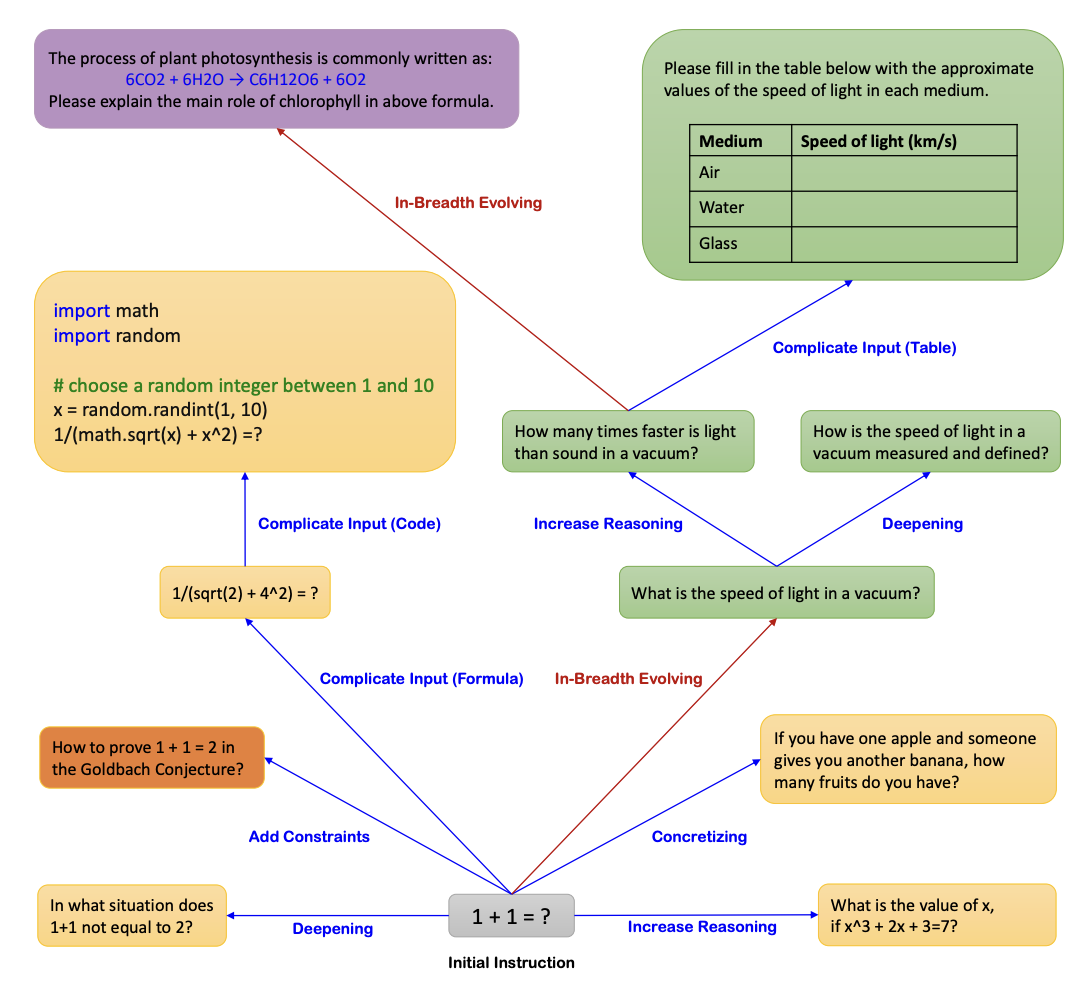
Here the opening remark pays off: these procedures do not teach the student model new knowledge. They teach it a conversational format, how to answer a question, in what order, at what level of detail. That is precisely what instruction tuning is supposed to install, and it is why synthetic data works so well for it.
Distillation
A large model produces answers; a small model learns to reproduce them. Covered in detail on distillation.
Proprietary model providers forbid, in their terms of use, using their models' outputs to train a competing model. That clause explains an observable practice: the cascading distillation chains of the open community, where each team distils from an open model rather than from a commercial interface. The conflicts it has caused are told further down.
Preference Data
Preference alignment needs pairs of the form "this answer is better than that one." Those can be manufactured:
- the model produces several answers to one question;
- a judge model (sometimes the same one) ranks them;
- you keep the best and the worst as a training pair.
This underpins the methods covered in DPO in practice. The weakness is visible with the naked eye: the ranking is produced by a model, with that model's preferences. A judge that likes long answers will manufacture a preference set that rewards length.
Verified Reasoning
This is the use that grew most in 2025, and it illustrates exactly the "third case" from the start: a strong model produces several complete reasoning chains for math or code problems, a verifier keeps only those that reach the right answer, and those chains train the student model. DeepSeek-R1 was used this way to produce 800,000 examples that passed a good share of its reasoning ability to much smaller models.
DeepSeek-R1: Incentivizing Reasoning Capability in LLMs via Reinforcement Learning (DeepSeek-AI, 2025)How Generation Is Done
The practical levers (precise instructions, personas to vary points of view, seeding with real data, rephrasing) are detailed on synthetic data generation. One rule sums them up: the more generation is anchored in something that exists (a real document, a verifiable problem), the less it drifts toward whatever the model merely finds probable.
Model Collapse: What Is Demonstrated, and Under What Conditions
This is the real risk of the procedure, and also the field's most frequently distorted claim. It deserves to be stated precisely.
The Mechanism
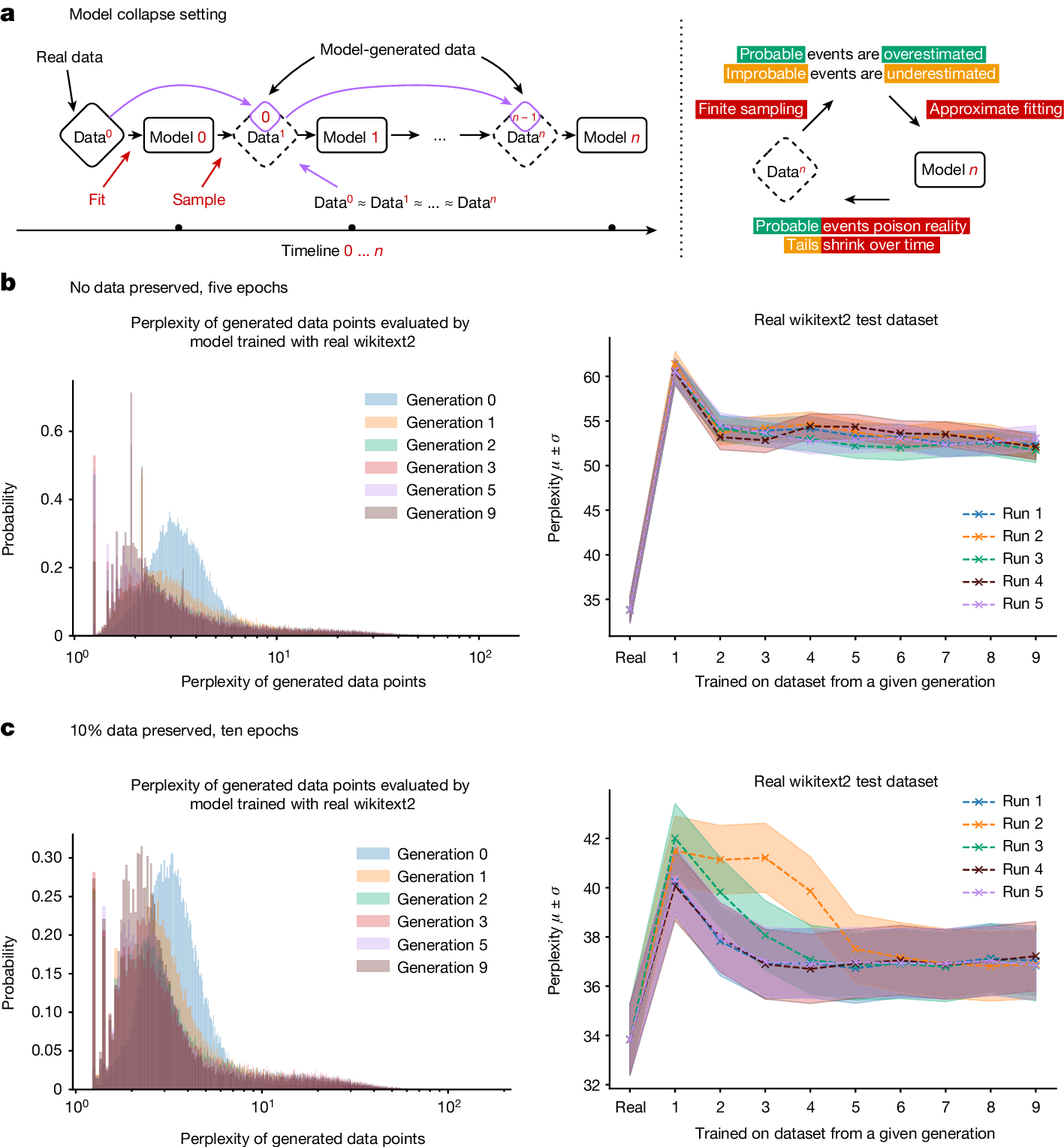
When a model writes, it does not reproduce the distribution it learned: it narrows it. Three cumulative reasons, all mechanical.
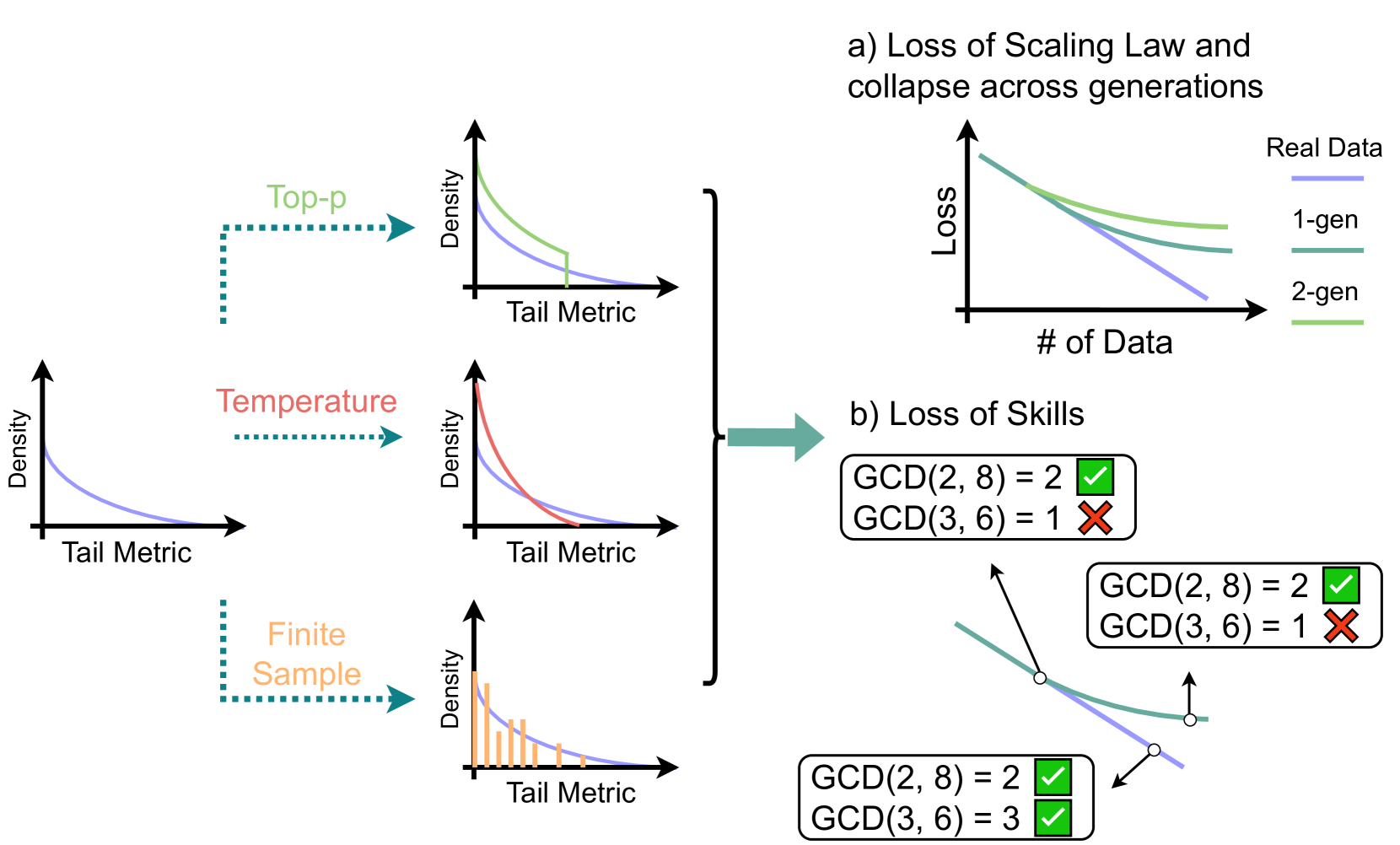
First, nobody samples raw. The tail of the distribution is cut, improbable words are forbidden (top-p sampling), differences are flattened by a temperature parameter. Those settings exist precisely to avoid odd outputs, and an odd output is often a rare one.
Second, even with no settings at all, a finite sample underrepresents rare events: that is arithmetic. An event with probability one in a million does not, on average, appear at all in a million draws. See sampling.
Third, a model learns poorly what it saw little of, so it assigns to rare things a probability lower still than reality.
The result: each round thins the tail. What was rare becomes very rare, then disappears. The centre, meanwhile, is overrepresented. This is model collapse.
The Condition That Changes Everything
Here is the point the popular version of the story almost always drops.
The Shumailov et al. experiment, published in Nature, replaces the previous generation's data at every round. Model 3 sees nothing of the original human corpus: it sees only what model 2 wrote. In that regime collapse occurs, and it is irreversible.
A later study asked the obvious question: what if, instead of replacing the data, you accumulate it, the original human data staying present at every round, with synthetic data added alongside? The measured answer: in that regime collapse does not occur. The authors first confirm Shumailov's result when data is replaced, then show that accumulation avoids it, across a range of model sizes, architectures and hyperparameters, and find the same behaviour for diffusion models and variational autoencoders.
Wrong: training on synthetic data makes models collapse.
Right: training repeatedly on your own outputs while replacing the real data at each round progressively impoverishes the distribution, until rare events are irreversibly lost. When the real data is kept and synthetic data is added alongside, the effect is not observed.
The difference is not rhetorical, it is operational. No lab works in the replacement regime, they all keep their human corpus. The dangerous regime is rather the involuntary one where the web fills up with model-written text: future crawls will contain synthetic data without anyone being able to tell which, and the real share will fall without anyone deciding it. That is where the serious concern lies, and it is also what makes pre-2022 text archives valuable.
What the Theoretical Side Adds
A third piece of work connects collapse to scaling laws: the curve that says how much you gain by adding data. Its result is a family of decay phenomena (loss of scaling, curve shift with the number of generations, un-learning of specific skills) validated by experiments on an arithmetic task and on text generation.
A Debate That Is Not Closed
Accumulation has not convinced everyone, and two late-2024 papers spell out the limits of the result.
- "Strong model collapse" (Dohmatob et al.): in a simplified theoretical setting (a regression, then checked with experiments), even a small fraction of synthetic data, around 1%, can be enough for additional data to stop improving performance, if that synthetic data is systematically off from reality. The authors also show that larger models can amplify the effect in some regimes.
- "Collapse or Thrive?" (Kazdan et al.) confirms the two known regimes, collapse when data is replaced, stability when everything is accumulated, even as the real share becomes very small, and studies a third, more realistic one: data accumulates, but each generation trains only on a fixed-size subset. Degradation is then slow and gradual rather than explosive.
An honest reading: nobody knows today which regime tomorrow's web will be in, nor how far quality filters correct the mismatch the first paper describes. What is established is the direction: keep real data, filter synthetic data, and monitor diversity.
Terms of Use and Disputes Over Distillation
One risk is neither statistical nor technical: it is contractual. Proprietary model providers (OpenAI, Anthropic, Google) forbid in their terms of use using their models' outputs to develop a competing model. This is not copyright, it is a contract clause, whose reach varies by jurisdiction and is not settled everywhere. Other licenses are permissive: Llama's allows reusing outputs under conditions, and models under MIT or Apache 2.0 licenses such as DeepSeek-R1 explicitly allow distillation (details on synthetic data generation).
These clauses have become an open source of conflict between labs:
- as early as January 2025, OpenAI told the press it had indications that DeepSeek had distilled its models, without making that evidence public;
- in February 2026, Anthropic publicly accused three Chinese labs (DeepSeek, Moonshot AI and MiniMax) of running large-scale distillation campaigns against Claude: according to the company, more than 16 million exchanges through about 24,000 fraudulent accounts, in breach of its terms. The labs named did not respond publicly to the accusations.
In practice, the response is mostly technical (detecting abnormal usage, closing accounts, limiting what the API returns) rather than judicial. And the subject connects to data access conditions in general: see opt-out and access protocols.
Filtering Is Not Optional
Unfiltered synthetic data contains factual errors, repetition, and the generator's biases in amplified form. Without filtering it degrades the model.
The tools, from most to least reliable:
- External verification, run the code, check the arithmetic, validate the proof. The only filter that brings information independent of the generator. Use it wherever the domain permits.
- Deduplication, mandatory, because a generator repeats itself far more than a human corpus does.
- Diversity, track the proportion of distinct word sequences and the breadth of vocabulary. This is the indicator that catches a narrowing distribution earliest.
- Perplexity, discard anomalous examples. Useful, but it measures what surprises a model, not what is wrong.
- A judge model, the least reliable of the five, because the judge shares the generator's blind spots. A model does not catch its own errors the way an external verifier does.
The Proportions: What Nobody Knows
Recommendations of the form "70 to 80% natural, 20 to 30% synthetic" are everywhere. Those numbers have no published source, and there is no reason a single ratio should exist: the right dose depends on the domain, the kind of synthetic data, and whether a verifier is available.
What the literature does support, without offering a number:
- never remove the real data. That is Gerstgrasser et al.'s result: what separates the safe regime from the dangerous one is the presence of the human corpus, not its percentage.
- monitor diversity across rounds, not just scores. A score can rise while the distribution impoverishes.
- prefer verifiable synthetic data over merely plausible synthetic data.
Published recipes show very different shares, by the way: near zero in some pre-training corpora, around half the tokens for Phi-4 if rewrites are counted, and most of the alignment data for Nemotron-4. Those gaps confirm there is no universal ratio.
What To Take Away
- Synthetic data creates no information about the world. The content comes from the generator, hence from the original corpus. What the procedure improves is form: reformatting, rebalancing, making a notion easier to learn.
- One exception, and it is decisive: when an external verifier intervenes (code execution, arithmetic check, proof engine) the "this is correct" signal does not come from the model. That is why code and mathematics are the domains where the procedure genuinely works.
- Model collapse is real, under one precise condition: when each generation replaces the real data with its own output. When the real data is kept and synthetic data is added alongside, the effect is not observed. Stating the threat without its condition makes it unusable.
- The real risk is not in the lab, it is on the web. Nobody trains by deliberate replacement. But future crawls will contain model-written text with no way to identify it.
- Filtering makes the difference, and not all filters are equal: an external verifier brings information, a judge model only reflects the generator.
- Synthetic data is everywhere in 2025-2026, from pre-training to reasoning, but it remains bound by contract clauses: distilling a competing proprietary model is forbidden by its terms, and it has become a source of conflict between labs.
1. You generate 100 billion tokens with a model trained on 10 trillion tokens. How many new facts about the world does that text contain?
2. Why are code and mathematics, by far, the domains where synthetic data works best?
3. What is the correct statement of model collapse?
4. Among the filters applied to synthetic data, which is the least reliable?
5. What does the Villalobos et al. study actually say about the « data wall »?
6. What do the late-2024 papers on model collapse (Strong model collapse, Collapse or Thrive?) show?