Extreme Quantization: Binary, Ternary (1.58-bit), and Sub-1-bit
The race to the bottom
Quantization starts from a simple idea: a weight stored in FP16 takes 16 bits, but you can replace it with a coarser version (INT8 (8 bits), then INT4 (4 bits)) to slash memory and speed up inference. At each step down, you gain size and speed and lose a little precision. The course page "Quantization: understanding model compression" tells the story of that descent down to 4 bits.
But what happens if we keep going? 2 bits, 1 bit, and even less than one bit per weight? We enter the territory of extreme quantization, where the size/quality trade-off becomes a cliff, and where, in exchange, we unlock gains that ordinary quantization simply cannot offer: the near-disappearance of multiplications.
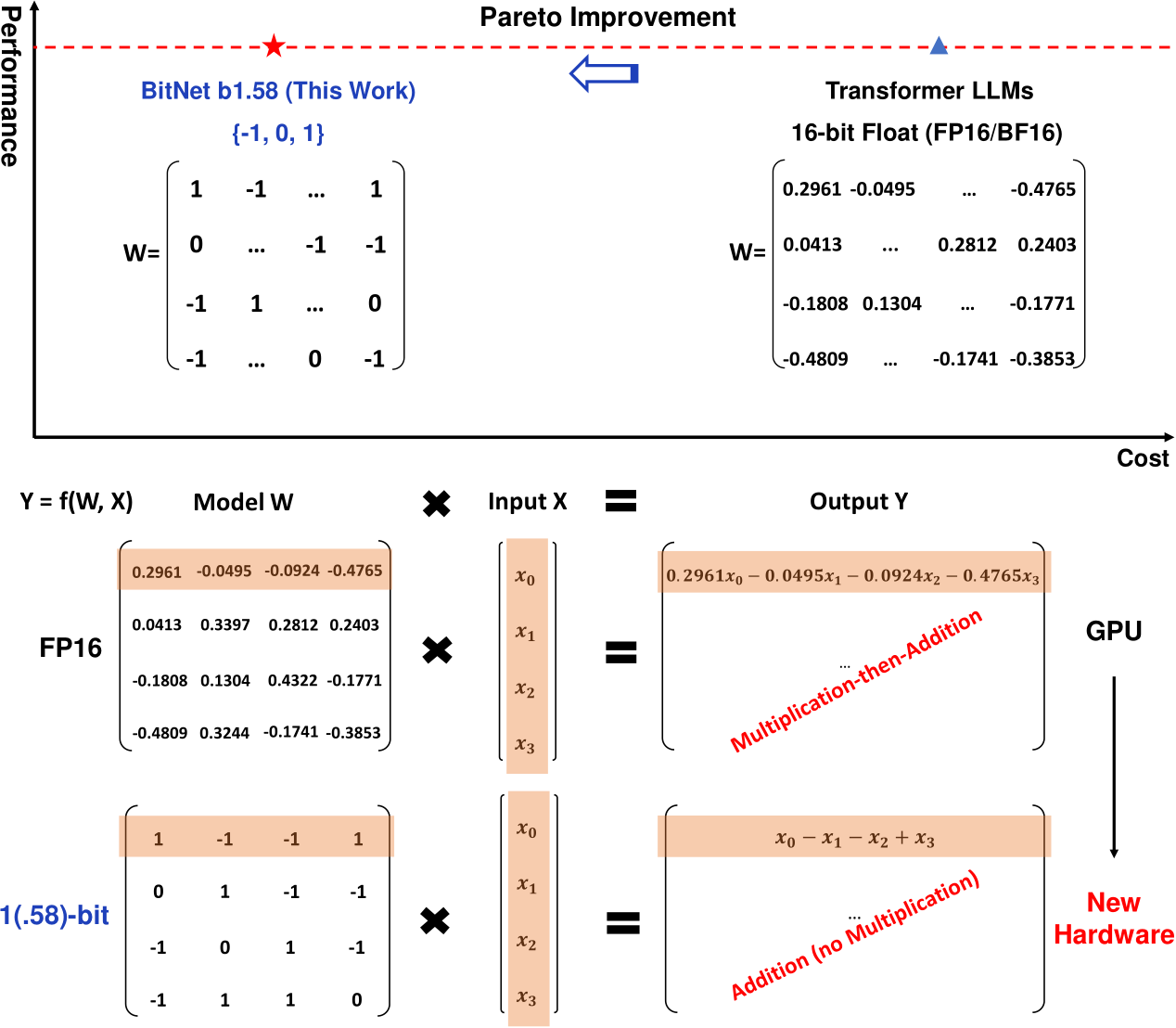
At 4 bits, you compress numbers. At 1 bit, you change the nature of the arithmetic. A weight that can only be -1, 0, or +1 is no longer "multiplied": multiplying an activation by +1 keeps it, by -1 flips it, by 0 erases it. Multiplications (the most expensive operation in a network) turn into plain additions and subtractions.
Why multiplications cost so much
A large language model spends most of its time doing matrix multiplications: multiplying millions of weights by activations, then summing. On a chip, a floating-point multiply burns far more energy and silicon area than an addition. It is the number-one cost center, in energy and in latency alike.
Hence the radical idea: what if we made multiplications unnecessary? If each weight can only take the values , then the product needs no multiplier at all:
The weight matrix becomes a simple recipe of additions and subtractions of activations. The hungriest hardware component is removed. That is the true price of admission to extreme quantization.
Ternary weights: BitNet b1.58 and the "1.58 bit"
The flagship approach in this regime is BitNet b1.58, proposed by Microsoft Research in 2024. The idea: train an LLM in which every weight is only .
The Era of 1-bit LLMs: All Large Language Models are in 1.58 Bits (BitNet b1.58)Why 1.58 and not 2?
Three possible values looks like "2 bits" (4 values). But we only use 3 of the 4 combinations. The actual information content of a choice among three equally likely possibilities is:
That is the theoretical minimum to encode one of three values. Hence the name b1.58: in practice you don't need 2 bits per weight, only ~1.58 once the weights are packed efficiently (for example by bundling several ternary weights together). The "0" has its own purpose: it lets the model ignore certain connections entirely, something a purely binary scheme cannot do.
What it costs in bytes
Let's run the arithmetic, as on the other pages of this module. A byte being 8 bits, a ternary weight at 1.58 bits costs 1.58 ÷ 8 ≈ 0.2 bytes. So for a 7 billion parameter model:
- BF16 (2 bytes): 7 × 2 = 14 GB
- 4 bits (0.5 bytes): 7 × 0.5 = 3.5 GB
- Ternary (0.2 bytes): 7 × 0.2 ≈ 1.4 GB
A factor of 10 against 16-bit, because 16 ÷ 1.58 = 10.1. As always, that number is a floor: the activations are not ternary (BitNet quantizes them to 8 bits) and parts of the model stay in high precision.
We usually talk about quantization for memory. Here the main argument is different: it is energy and hardware. The paper's abstract claims two things: that BitNet b1.58 matches a full-precision transformer of the same size trained on the same number of tokens, in perplexity and on end tasks; and that it opens the door to inference hardware purpose-built for such models. So the gain isn't just "the model is ten times smaller", it's "the computation itself becomes far cheaper".
Binary weights: 1 bit
One notch lower: binary weights, which can only be , exactly 1 bit per weight. This is the historic idea of "binary neural networks", long predating LLMs.
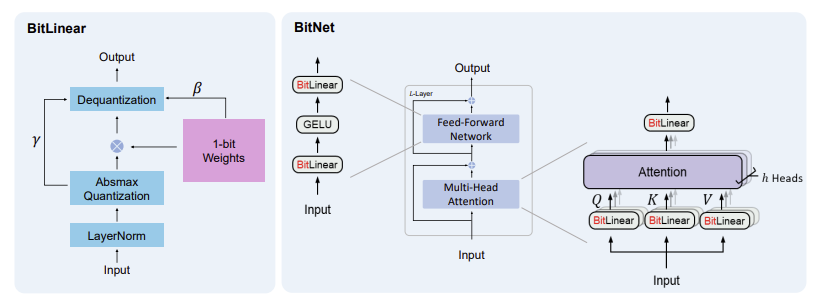
The upside is maximal: 1 bit of storage, and still no multiplications. The downside is too: without the value 0, the model can never "switch off" a weight, which removes an important degree of freedom. In practice, for large language models, ternary (1.58 bit) has proven a much better trade-off than pure binary: the small extra information carried by the 0 more than pays for its cost.
| Scheme | Possible values | Bits / weight | Multiplications |
|---|---|---|---|
| FP16 (reference) | continuous | 16 | yes (expensive) |
| INT4 | 16 levels | 4 | yes |
| Ternary (BitNet b1.58) | ~1.58 | no (add/sub) | |
| Binary | 1 | no (add/sub) | |
| Sub-1-bit | < 1 on average | < 1 | depends on method |
The frontier: "sub-1-bit"
If 1 bit is the minimum to encode a single weight, how can you go below one bit? The trick: stop encoding each weight separately. Exploit the fact that a large weight matrix contains enormous redundancy, many of its rows and columns resemble one another.
A family of recent methods attacks this through low-rank binary factorization: instead of storing the full weight matrix, you approximate it as the product of two (or more) small binary matrices, together with scale factors. The memory cost becomes that of the factors, not of the full matrix, which pushes the average cost per weight below 1 bit.
Two representative pieces of work, with what they claim exactly:
NanoQuant: Efficient Sub-1-Bit Quantization of Large Language Models LittleBit: Ultra Low-Bit Quantization via Latent Factorization (Lee et al., 2025)Picture a large grid of pixels that is in fact just a gradient: no need to store every pixel, two small vectors (one row, one column) suffice to reconstruct it. Low-rank factorization does the same with a weight matrix: if its "true" complexity is low, two small binary matrices can re-approximate it, and the cost per original weight becomes tiny.
The figure NanoQuant reports, and it checks out on a calculator: compressing Llama2-70B by a factor of 25.8, in 13 hours on a single H100, which lets a 70 billion parameter model run on a consumer 8 GB GPU. Work it through: 69 × 2 bytes = 138 GB in BF16, divided by 25.8 gives 5.35 GB, which does fit inside 8 GB, attention cache included. And 5.35 GB for 69 billion weights works out to 5.35 × 8 ÷ 69 ≈ 0.62 bits per weight. Comfortably under one bit.
This is a very active research area, not a settled technology. Fitting the model in memory is one thing; keeping usable quality is another, and that is where the results still need consolidating. Stay cautious about the quality numbers claimed at this regime, they vary widely with the method, the model size, and the task, and have not been widely reproduced. At this regime, some quality is always paid for somewhere.
Post-training, or during training?
This is the dividing line of the whole module, and at this extreme regime it yields a two-part answer worth keeping straight.
At 4 bits, post-training quantization (PTQ, like GPTQ) is enough: you compress an already-trained model after the fact, and quality holds.
If you want to round each individual weight to , PTQ no longer suffices. The gap between the intended weight and the only three available values is too large for local corrections to absorb. The solution is quantization-aware training (QAT): the model is trained from the start "knowing" its weights will be ternary or binary. It learns to compensate for the constraint over thousands of steps, instead of suffering it at the end. That is BitNet's route.
Factorization methods, by contrast, remain post-training. And the reason is instructive: they never try to round any given weight to 1 bit. They replace the whole matrix with a product of binary factors whose reconstruction does take varied values. "Sub-1-bit" is an average cost per original weight, not the precision of an individual weight. That is what lets them work without retraining: NanoQuant presents itself explicitly as a post-training method, and compresses Llama2-70B in 13 hours on a single card.
Hold on to that distinction, it recurs in technical discussions: "1 bit per weight" and "1 bit on average" are not the same constraint, and they do not call for the same method.
This is exactly the BitNet b1.58 philosophy: it is not an ordinary model being compressed, it is a model trained from scratch to live in 1.58 bit. The QAT page details the mechanism (fake quantization, Straight-Through Estimator) that makes this training possible despite the non-differentiable rounding.
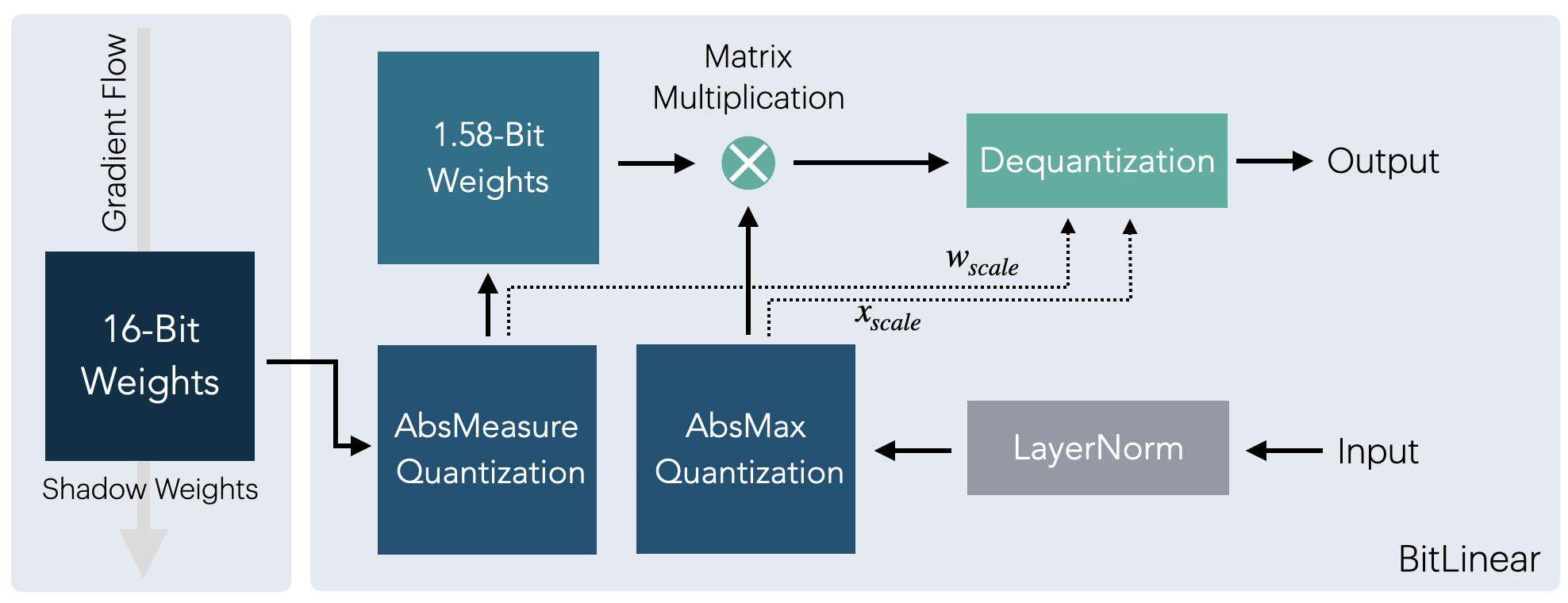
QAT at such low precision is expensive: it requires full training, not a quick calibration pass of a few hours. But for a model provider the math adds up: you pay for training once, then serve millions of inferences on a model that is dramatically cheaper to run.
The big trade-off
Extreme quantization pushes the bargain of all quantization to its limit:
- On the gains side: memory divided by ~10 versus FP16, and above all the disappearance of costly multiplications, hence energy and hardware savings that no 4-bit method can match. This is what opens the door to models running on modest devices, or even to dedicated "multiplier-free" inference hardware.
- On the costs side: a very real precision loss, and the obligation to retrain (QAT). You don't get an existing model back for free; you build a new one, designed for these constraints.
That is why these approaches mainly interest players who train their own models and target massive or embedded deployment, rather than the user who just wants to compress an off-the-shelf model.
Key takeaways
- Extreme quantization goes beyond 4 bits: ternary weights (~1.58 bit), binary weights (1 bit), and even sub-1-bit regimes.
- The real gain is not just memory, it's the arithmetic: with weights in , multiplications become plain additions/subtractions, the most expensive operation in a network disappears, yielding huge energy and hardware savings.
- "1.58 bit" comes from , the minimum information to encode one of three values; this is Microsoft's BitNet b1.58, and the value 0 (which pure binary lacks) lets the model ignore connections.
- Sub-1-bit drops below one bit per weight on average via low-rank binary factorization: NanoQuant reports a factor of 25.8 on Llama2-70B, i.e. about 0.62 bits per weight and a 70 billion parameter model running on a consumer 8 GB GPU. Promising, but still to be consolidated.
- Rounding each weight to 1 bit needs QAT; getting 1 bit on average does not. A per-weight ternary or binary scheme requires quantization-aware training, as in BitNet. A binary factorization stays a post-training method, because there the bit per weight is an average, not an individual constraint.
- It all remains a tradeoff: spectacular memory and energy gains against precision loss and retraining cost, a choice that leans toward model providers and embedded deployment.
1. A ternary-weight model like BitNet b1.58 divides memory by roughly 10. Why does the paper nevertheless put forward a different gain as the more fundamental one?
2. Why is it called « 1.58 bit » for BitNet, rather than simply 2 bits?
3. BitNet demands full training from the start, while NanoQuant (which goes below 1 bit per weight) remains a post-training method. What explains this asymmetry?
4. What should you take away from the results claimed in the sub-1-bit regime, such as NanoQuant's 25.8x compression factor on Llama2-70B?