The Problem with Imperfect Reward Models
Classic RLHF relies on a reward model: a neural network trained on human preferences that assigns a quality score to each response. In theory, it's elegant. In practice, it's an imperfect approximation. And LLMs, optimized by RL to maximize this score, end up exploiting the reward model's flaws rather than genuinely improving.
This is reward hacking: the model "cheats" by finding shortcuts that please the judge without producing better responses. For example, a reward model that slightly prefers long responses will push the LLM to produce verbose walls of text.
The natural question: for tasks where you can objectively verify whether the answer is correct, why bother with an approximate reward model?
In math, in code, in formal logic: an answer is objectively correct or wrong. 2+2 is 4, not 5. A program passes its tests, or it doesn't.
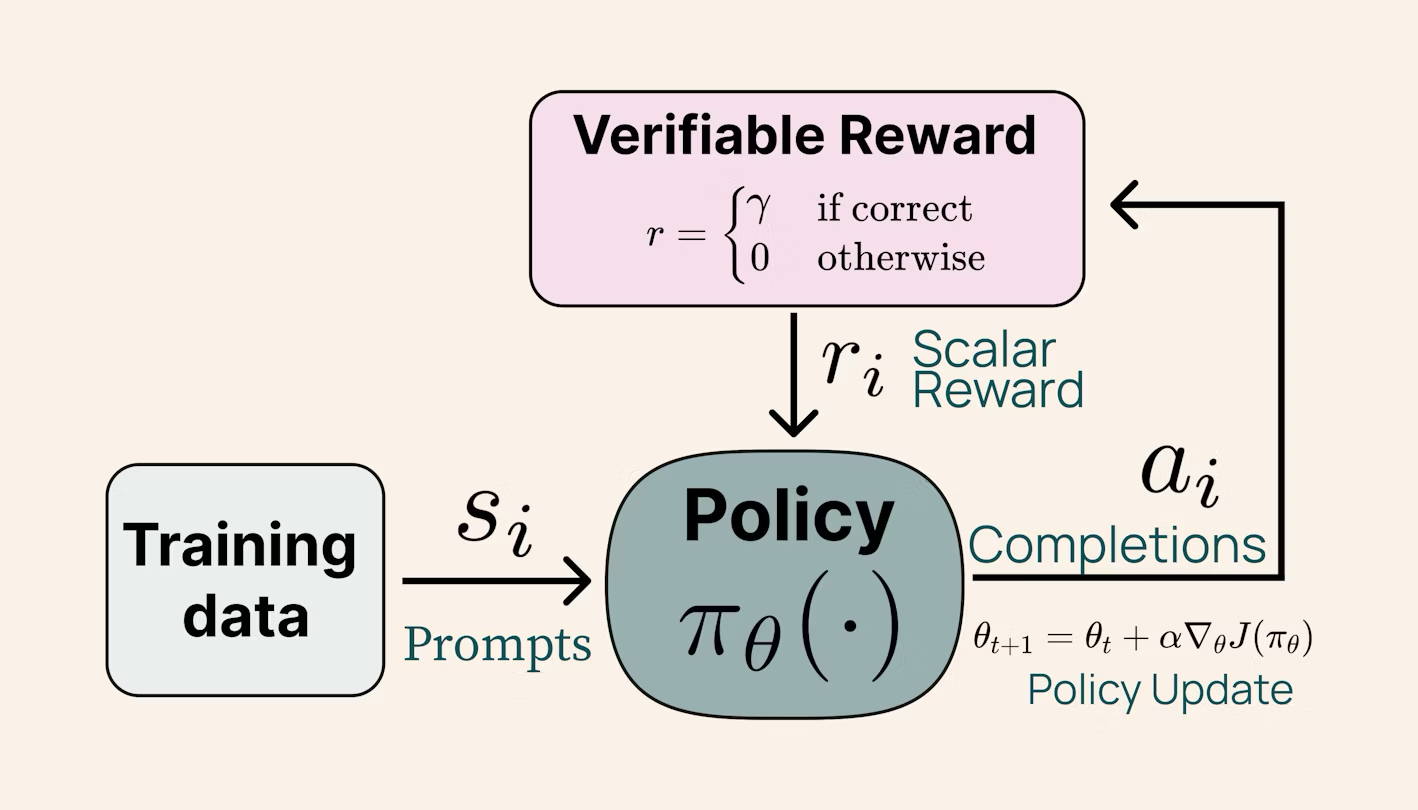
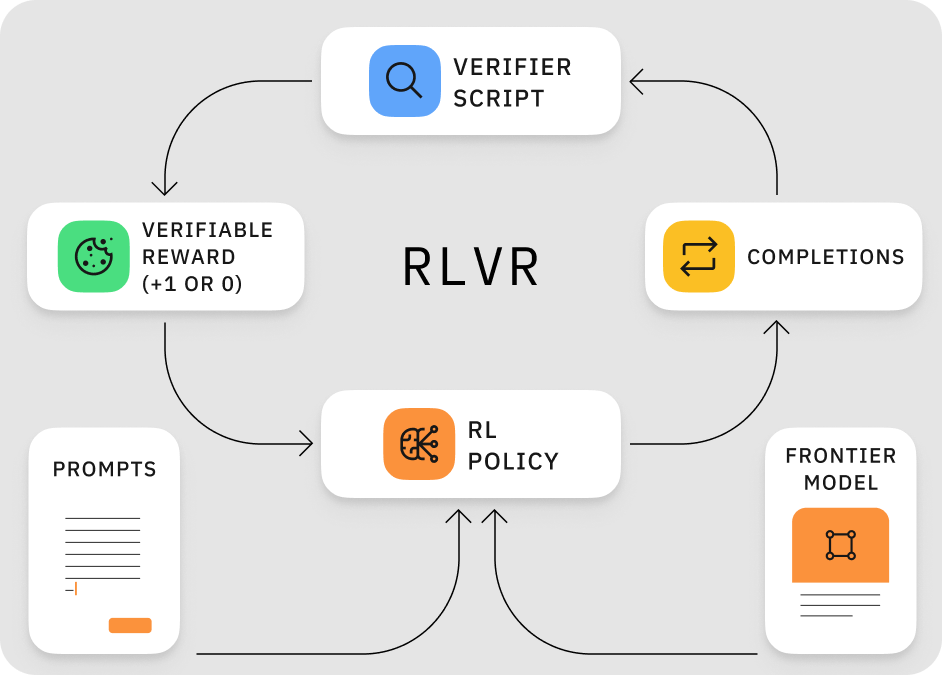
Instead of a reward model that approximates quality, RLVR uses exact automatic verification: r=1 if correct, r=0 otherwise. No approximation, no subjective bias: hacking the reward model goes away, but hacking the verifier remains entirely possible.
How It Works Concretely
The RLVR Pipeline
- The model receives a problem (mathematical, algorithmic, logical)
- It generates a complete reasoning followed by a final answer
- An automatic verifier evaluates the answer:
- Math: compares numerically with the correct answer
- Code: runs the solution against a test suite
- Formal logic: a proof checker verifies the proof
- Binary reward: (correct) or (incorrect)
- The RL algorithm uses this reward to update the model
Verifiers by Domain
| Domain | Verification Method | Reliability |
|---|---|---|
| Simple arithmetic | Numerical comparison | Exact |
| Algebra | Symbolic computation (SymPy) | Very high (rare unrecognized equivalences) |
| Code | Test execution | Depends on test coverage |
| Formal proofs | Lean/Isabelle | Exact (by construction) |
| SAT logic | SAT solver | Exact (by construction) |
| Factual QA | Matching the answer against the key | Medium (rephrasings poorly recognized) |
Reliability isn't always perfect, but it's far superior to that of a reward model trained on noisy human annotations.
RLVR in Action: The DeepSeek-R1 Case
DeepSeek-R1 is the most spectacular example of RLVR applied at scale.
GRPO with Verifiable Rewards
For each training problem:
- Generate different responses (typically 8 to 64)
- Automatically verify each response:
- Compute each response's relative advantage:
- Update the policy (the model's generation strategy, RL vocabulary here): reinforce correct responses, penalize incorrect ones
In the step-3 formula: is the reward (0 or 1) of response , the mean reward of the group of responses, and their standard deviation. Read as a sentence: the advantage measures how much better (or worse) response did than its neighbors from the same group, this is what replaces PPO's critic in GRPO.
Good responses are amplified, bad ones are attenuated. Simple, effective, and it scales.
The Fascinating Result: R1-Zero
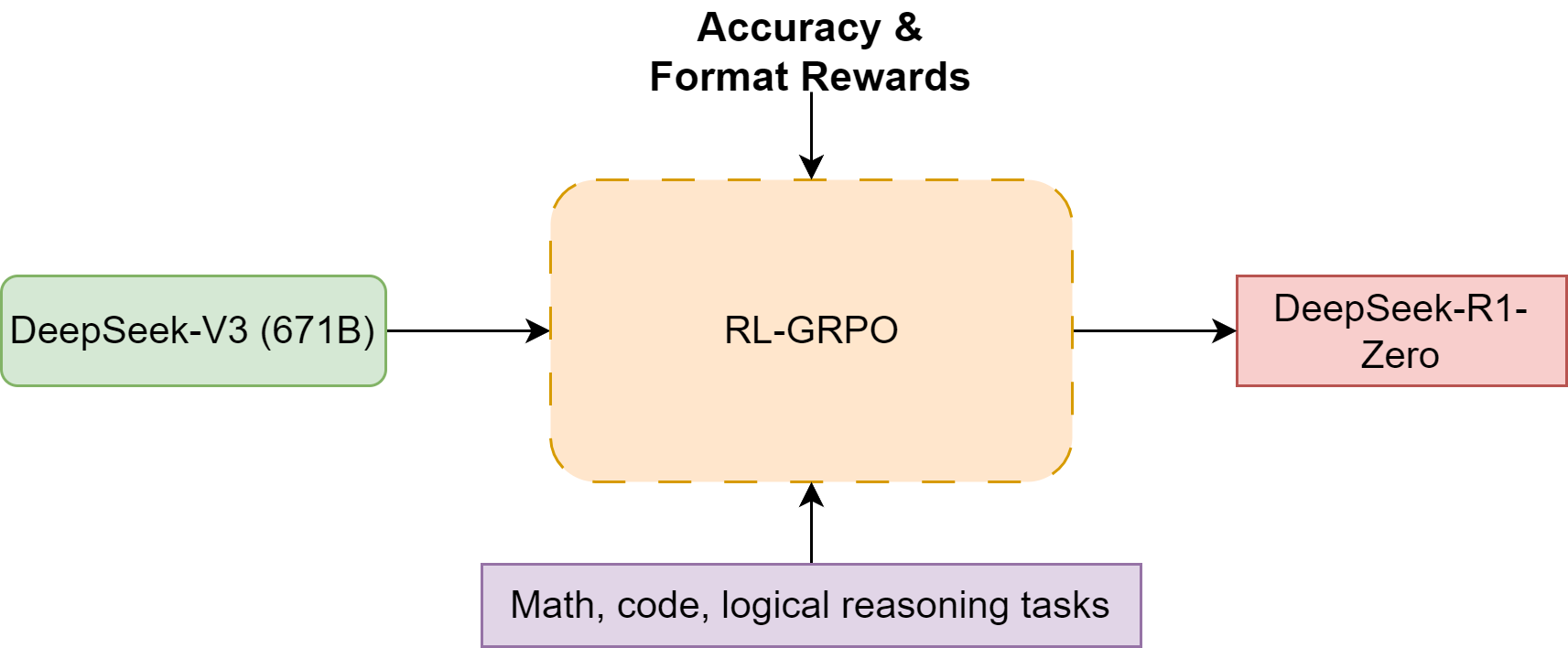
Here's RLVR's most surprising result. DeepSeek trained a model (R1-Zero) with only RLVR, without ever showing it a single chain-of-thought example. No SFT data with step-by-step reasoning. Just: "here's a problem, tell me the answer, you'll get a point if it's correct."
And the model spontaneously developed structured reasoning:
- Decomposition into numbered steps
- Verification of its own intermediate calculations
- Backtracking when a path leads nowhere
- Exploration of alternative approaches
R1-Zero provides fascinating empirical evidence: structured chain-of-thought (Chain-of-Thought) is the optimal strategy for maximizing the probability of a correct answer. The model discovers it on its own through RL, without being taught. Step-by-step reasoning isn't just a convenient format, it's the emergent solution to the optimization problem.
The Advantages of RLVR
1. No More Reward-Model Hacking
The reward is no longer a learned score, it is a computed one. Either the answer is 42 and the model says 42 (correct), or it says something else (incorrect). There is no subtle bias left to exploit inside a neural judge: that whole family of cheats (flattering a judge that quietly prefers long, polite or confident answers) disappears at a stroke.
But be precise about what has been won. RLVR moves the problem rather than eliminating it. The target of hacking is no longer the reward model, it is the verifier: the comparison script, the test suite, the benchmark harness that emits the 0 or the 1. Whatever that machinery contains that is imprecise, poorly isolated or too trusting becomes exploitable in turn, and a model optimized to maximize a score will eventually find it.
Two recent results rule out any talk of immunity. In May 2026, a team led by Dawn Song (UC Berkeley) automatically audited ten of the most widely used agent benchmarks and surfaced 219 exploitable flaws, falling into eight recurring classes. The agents their audit produces reach near-perfect scores without solving a single task: they walk up the execution stack to reach the grader's own code, monkey-patch the routine that compares results, or install a hook that overwrites each test's reported outcome.
In June 2026, a second paper states the underlying problem: a verification signal has to be scalable, faithful to actual intent, and robust to optimization, and no verifier achieves all three at once. Its conclusion is that no fixed reward function stays valid as the policy keeps improving: verification must co-evolve with the model it evaluates.
Do Androids Dream of Breaking the Game? Systematically Auditing AI Agent Benchmarks with BenchJack (UC Berkeley, 2026)The Verification Horizon: No Silver Bullet for Coding Agent Rewards (2026)2. Nearly Unlimited Scalability
Generating problems with verifiable answers is easy to automate:
- Math: algorithmic generators create millions of problems with solutions
- Code: competitive programming platforms (Codeforces, LeetCode) provide problems with test suites
- Formal proofs: proof assistants verify automatically
No human annotators needed. The data pipeline is fully automated.
3. Unambiguous Signal
A binary reward (correct/incorrect) gives a crystal-clear learning signal. No subjectivity, no inter-annotator noise, no debates about "is this response worth 7/10 or 8/10?"
4. Reduced Cost
By eliminating human annotators, RLVR considerably reduces the cost and time of RL training.
Limitations to Know
Only Applicable to Verifiable Tasks
This is the fundamental restriction: RLVR only works if you have a reliable automatic verifier. For creative, conversational, or subjective tasks, a learned reward model remains necessary. You can't automatically verify whether a poem is "beautiful" or an explanation is "clear."
Sparse (Binary) Signal
The binary reward says "you failed" but doesn't say "why you failed" or "at which step you went wrong." The model knows its answer is wrong, but not what it should have done differently.
This is why PRMs (Process Reward Models, which score each intermediate reasoning step) are a natural complement to RLVR.
A subtle trap: the model can learn to optimize the format of its answer rather than its reasoning. If the verifier compares character strings, the model can learn to produce the exact expected format without actually reasoning. Robust verifiers (numerical equivalence, semantic equivalence) mitigate this problem.
In Practice: Combining RLVR and RLHF
The best current systems don't choose between RLVR and RLHF, they combine them:
- Phase 1, RLVR: train reasoning on verifiable tasks (math, code). The model learns to think correctly
- Phase 2, RLHF/DPO: align style, safety, and helpfulness on human preferences. The model learns to communicate pleasantly
DeepSeek-R1 illustrates exactly this approach: pure RLVR to develop raw reasoning capabilities, then SFT and rejection sampling to polish the readability and style of responses.
Two phases, two complementary methods, a result superior to either used alone.
Technical Corner: Generating Training Data
Synthetic Math Problems
import random

def generate_algebra_problem():
    a = random.randint(1, 20)
    b = random.randint(1, 50)
    x = random.randint(1, 10)
    c = a * x + b
    problem = f"If {a}x + {b} = {c}, what is x?"
    answer = x
    return problem, answer
This type of generator can produce millions of unique problems with their exact solution. Vary the difficulty by adjusting the bounds and expression complexity.
Code Problems
Use existing competitive programming problem banks (Codeforces, LeetCode, Project Euler) with their test suites as verifiers. Each problem comes with expected inputs/outputs that serve directly as a verifier.
The Future of RLVR
The trajectory is clear: extend RLVR beyond math and code to new domains:
- Formal verifiers for logic and proofs in more domains
- Code execution as a verifier for increasingly varied tasks
- Simulations as verifiers for planning and applied sciences
- Verification chains for complex domains where no single verifier suffices
The underlying trend is clear: invest in high-quality verifiers rather than in reward models. A perfect verifier + RLVR will always produce better results than an imperfect reward model + RLHF. The frontier of AI reasoning will be defined by the quality and coverage of available verifiers.
Conceptual Importance
RLVR represents a paradigm shift in LLM training:
- Before: "Approximate response quality with a learned reward model."
- After: "When objective truth is accessible, use it directly."
It's a return to a fundamental AI principle: when you have access to a perfect evaluation function, use it instead of approximating it. Combined with PRMs for evaluating each intermediate step, RLVR + PRM forms the current optimal system for training reasoning.
1. Why does RLVR make reward-model hacking (the plague of classic RLHF) disappear?
2. Does RLVR therefore make training immune to cheating?
3. Why are PRMs presented as the natural complement to RLVR?
4. How does DeepSeek-R1 combine RLVR with human-preference methods?