The Revision That Shocked the Industry
January 2022. The race is clear: build ever-larger models. OpenAI has GPT-3 with 175 billion parameters. Google is training PaLM with 540 billion. Everyone is stacking parameters.
March 2022. DeepMind publishes Chinchilla (Hoffmann et al., "Training Compute-Optimal Large Language Models").
The verdict is brutal: GPT-3 is 4 to 5x too big for its amount of data.
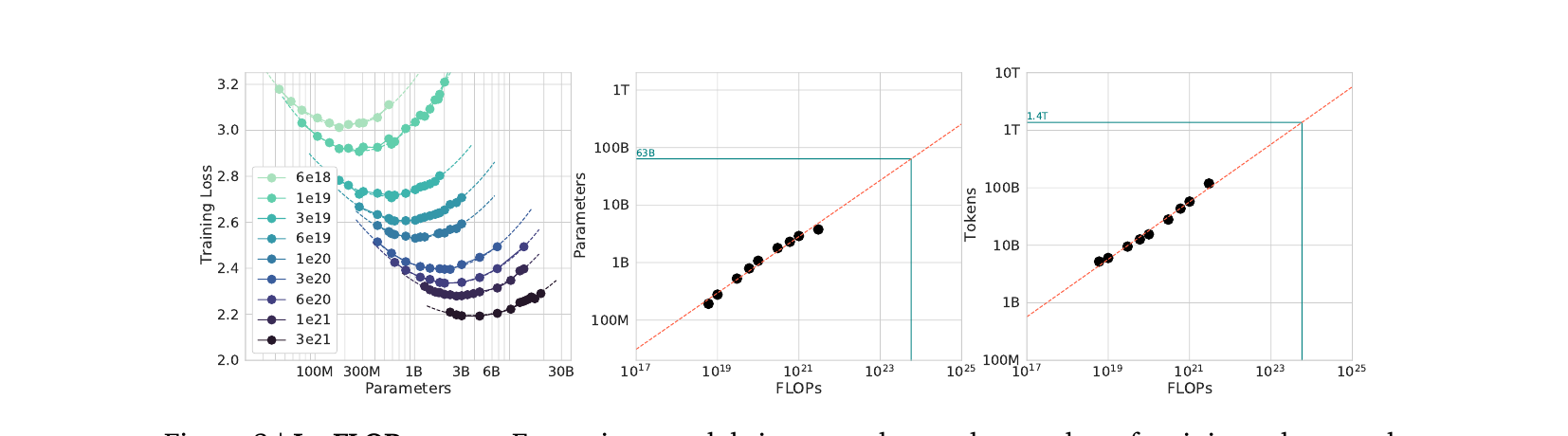
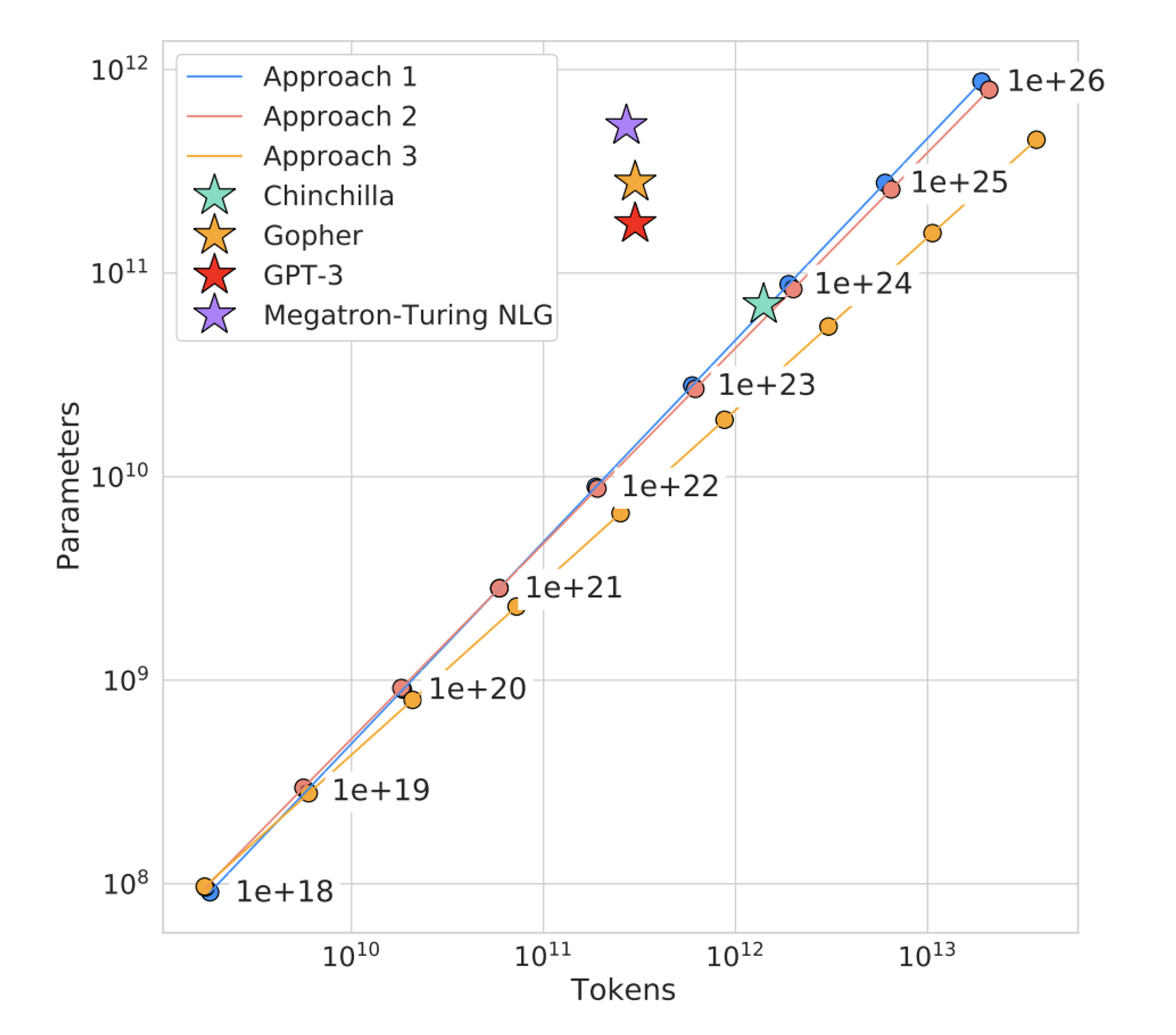
For the same compute budget (the same number of GPU operations), a 70 billion parameter model (Chinchilla) trained on 1.4 trillion tokens outperforms GPT-3 and its 175 billion parameters trained on 300 billion tokens.
The entire industry was wrong. Not about scaling, but about how to scale.
The Chinchilla rule is elegant: for a given compute budget, if you double the model size, also double the amount of training data. The optimal ratio is about 20 tokens per parameter. Models before Chinchilla? Massively undertrained on data. GPT-3 had a ratio of about 1.7 tokens per parameter. Ten times less than optimal.
The Proof: Small but Well-Fed Beats Big but Hungry
The experiment is crystal clear:
Chinchilla (70B parameters, 1.4T tokens) vs Gopher (280B parameters, 300B tokens)
Same total compute budget. Both consumed the same amount of GPU-hours. Chinchilla wins on almost all benchmarks.
A model 4x smaller, properly trained, beats a model 4x bigger but starved of data.
| Model | Parameters | Tokens | Token/param ratio | Status |
|---|---|---|---|---|
| GPT-3 | 175B | 300B | 1.7 | Very undertrained |
| Gopher | 280B | 300B | 1.1 | Even more undertrained |
| Chinchilla | 70B | 1.4T | 20 | Optimal |
The analogy is simple: imagine an athlete with huge muscles (lots of parameters) but who's only trained for 2 weeks (little data). A leaner athlete who's trained for 6 months will be better. Size isn't enough, you need the training to match.
The Immediate Impact: Everyone Changes Strategy
Chinchilla caused a strategic pivot across the entire industry:
LLaMA (Meta, February 2023): 7B to 65B parameters, trained on 1 to 1.4 trillion tokens. Directly inspired by Chinchilla. LLaMA-13B outperforms GPT-3 (175B) thanks to this optimal ratio.
Mistral: compact models (7B), massive amounts of data. The Chinchilla philosophy incarnated.
Gemma (Google): compact models, long and careful training.
The race for parameters transformed into a race for data.
Before Chinchilla, the dominant strategy was: "buy more GPUs, build a bigger model." After Chinchilla: "find more quality data." Companies with access to large quantities of quality data (Google with the web, Meta with social networks) suddenly had a different strategic advantage.
The Data Wall: An Emerging Problem
Chinchilla reveals a problem nobody had anticipated.
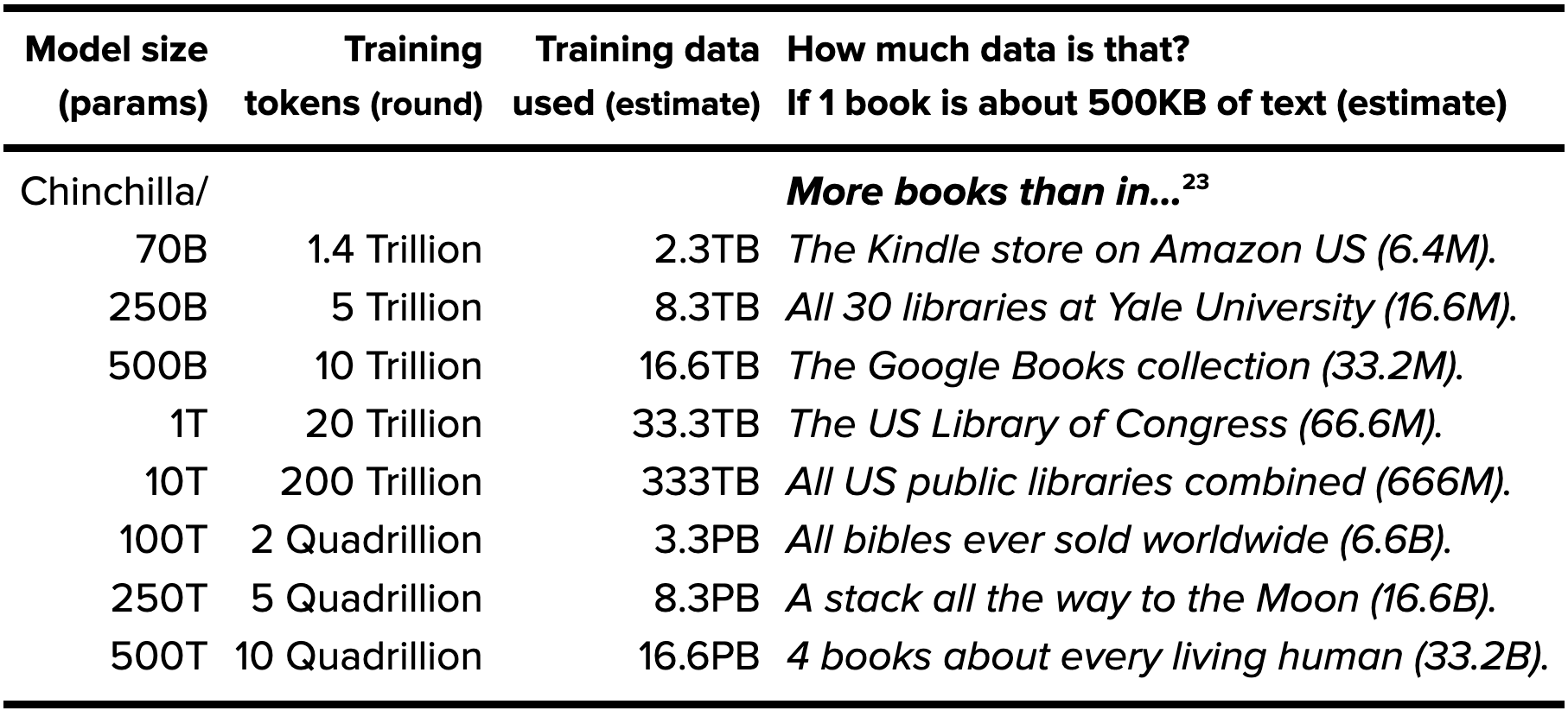
For a 1 trillion parameter model (the next logical step in scaling), the Chinchilla ratio demands 20 trillion tokens of training data.
But how much quality text exists on the internet? Estimates vary, but probably between 10 and 15 trillion tokens. We're approaching the limit.
So, what do you do when data runs out? Two strategies dominate:
Overtraining: training a model on far more data than Chinchilla recommends. LLaMA 3 (8B parameters) was trained on 15 trillion tokens, a ratio of 1,875 tokens per parameter. That's 94x the Chinchilla ratio. Why? Because for production inference, a small well-overtrained model is cheaper to run than a large compute-optimal model.
Synthetic data: using LLMs to generate new training data. GPT-5.4 generates math exercises. Claude Sonnet 4.6 produces quality dialogues. The model learns from content created by other models. It's controversial (risk of "feedback loop") but increasingly common.
Chinchilla optimizes training cost: for a given GPU budget, what model do you get? But in production, it's inference cost that dominates (the cost of running the model for each user request). A small overtrained model (like LLaMA 3 8B on 15T tokens) costs much less in inference than a large compute-optimal model (like Chinchilla 70B). That's why companies deliberately overtrain their models.
What Chinchilla Changes in Mindsets
The brute-force size race stops. The data race begins. Teams pivot toward:
- Sophisticated web filtering pipelines: cleaning and deduplicating Common Crawl, filtering low-quality content, eliminating spam
- Curated high-quality datasets: FineWeb (Hugging Face), RedPajama, Dolma (Allen AI), RefinedWeb
- Synthetic data: generating reasoning examples, math problems, dialogues
- Specialized data: source code (The Stack), scientific papers (ArXiv), books
Data has become as critical as GPUs. And unlike GPUs (which you can buy), quality data must be collected, cleaned, and validated. It's a competitive advantage that's hard to replicate.
Chinchilla is perhaps the most influential paper that nobody follows to the letter. It says: 20:1 token-to-parameter ratio. Current models? 50:1, 100:1, even 1000:1. Why? Because Chinchilla optimizes training cost, and the industry optimizes inference cost. You'd rather have a small, fast model that's cheap to run in production, even if its training is "suboptimal" in the Chinchilla sense. The paper changed the direction, but the destination has evolved.