The Equalizer: David Beats Goliath
LLaMA 13B vs GPT-3 (175B). Same performance. Or better.
13 billion parameters against 175 billion. How can a model 13x smaller rival a giant?
The answer fits in one word: data. LLaMA directly applies the lessons of Chinchilla. Instead of stacking parameters and feeding them sparingly (like GPT-3: 175B parameters, 300 billion tokens), LLaMA does the opposite: a compact model, stuffed with data (13B parameters, 1 trillion tokens).
GPT-3's token/parameter ratio? About 1.7. LLaMA's? About 77. That's 45x more data per parameter. And it changes everything.
Before LLaMA, the best LLMs were proprietary. OpenAI, Google, and Anthropic kept their models behind paid APIs. LLaMA made open-source viable for world-class models. Thousands of researchers, developers, and startups could experiment. Innovation accelerated overnight. The industry's structure changed.
Public Data Only: Reproducibility First
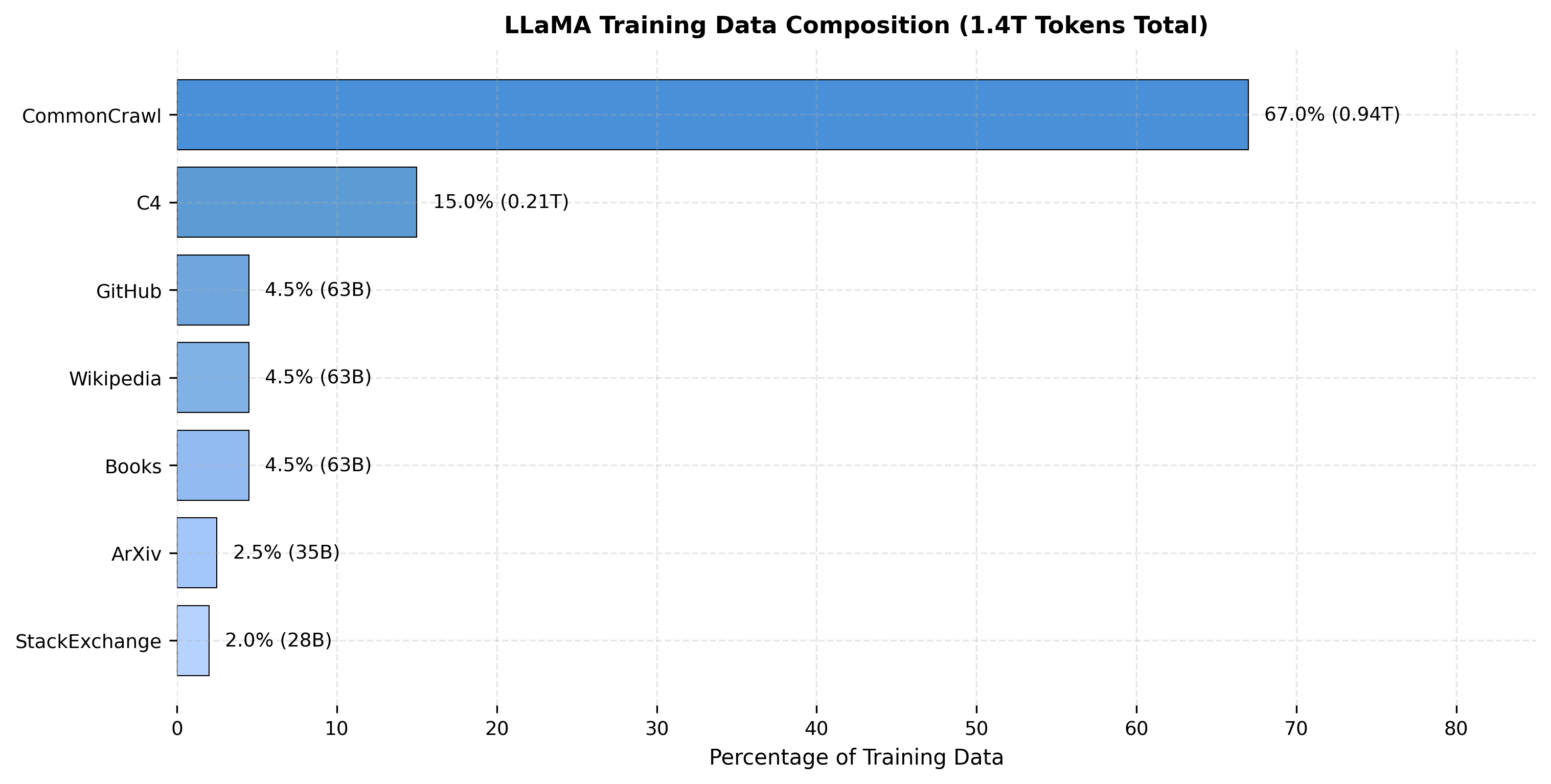
A remarkable aspect of LLaMA: Meta only uses publicly accessible data:
- Common Crawl (67%): web pages filtered and cleaned with a quality classifier
- C4 (15%): Common Crawl cleaned following Google's methodology
- GitHub (4.5%): open-source code
- Wikipedia (4.5%): in 20 languages
- Books (4.5%): Gutenberg corpus and Books3
- ArXiv (2.5%): scientific papers in LaTeX
- StackExchange (2%): technical Q&A
No proprietary data. No inaccessible secret corpora. This matters for reproducibility: in theory, anyone could reconstitute the training dataset (even if in practice, it's considerable work).
Architectural Choices: Nothing New, but the Best of Everything
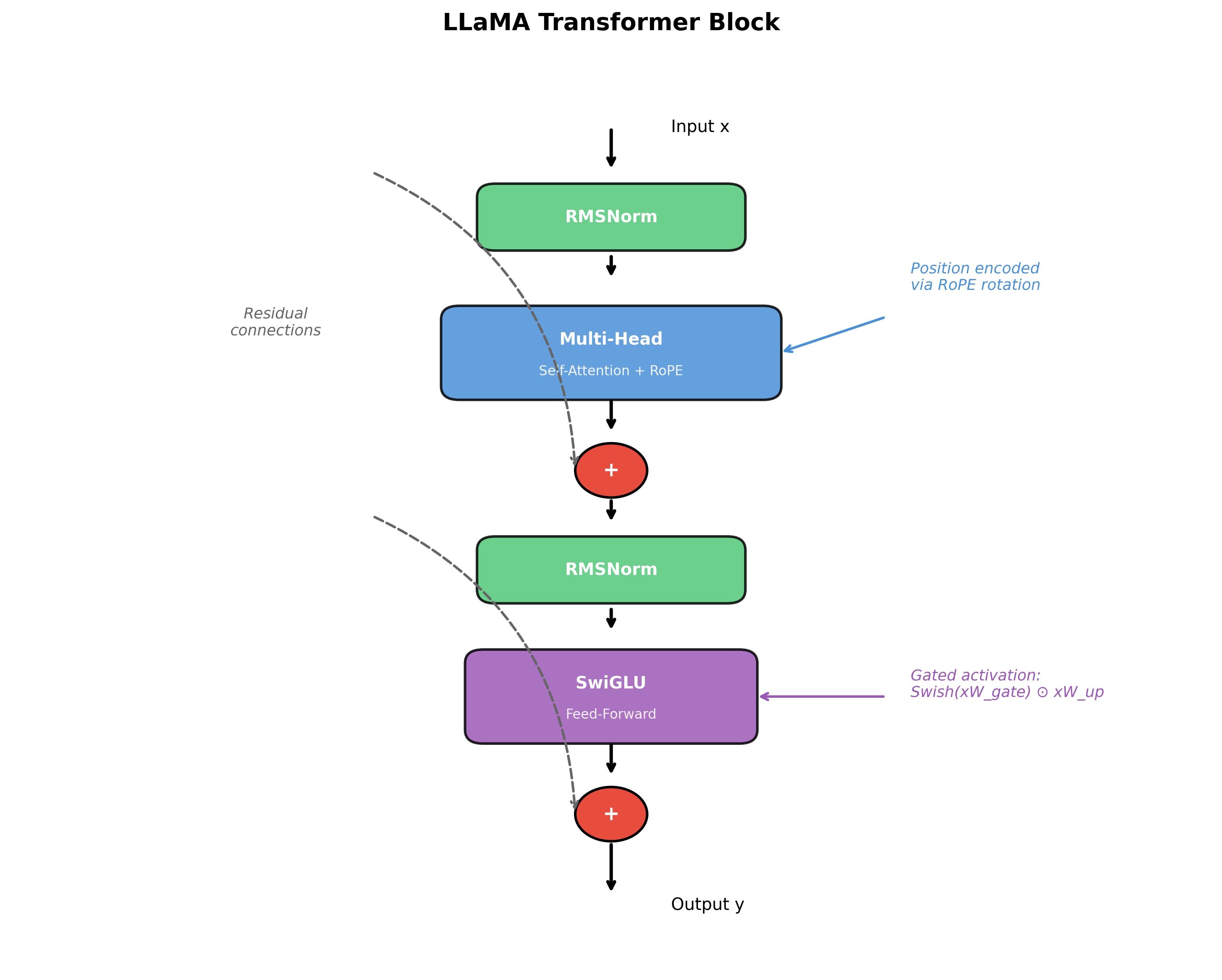
LLaMA didn't invent any new technique. Its strength lies in the judicious combination of existing best practices:
- Pre-norm with RMSNorm: normalize the input of each sub-layer (instead of the output). More stable for large-scale training.
- SwiGLU (activation function): replaces ReLU in feed-forward layers. Improves performance without significant overhead.
- Rotary Positional Embeddings (RoPE): a relative positional encoding that allows generalization to sequence lengths never seen during training.
- No bias in linear layers: a simplification that doesn't affect performance.
This exact recipe has become the industry standard. Mistral, LLaMA 2/3, Gemma, Qwen, Yi: they all copy this architecture, sometimes identically. LLaMA defined the archetype of the modern LLM.
Results: Data Beats Parameters
| Model | Parameters | Training tokens | Performance |
|---|---|---|---|
| LLaMA-7B | 7B | 1T | Outperforms GPT-3 (175B) on some benchmarks |
| LLaMA-13B | 13B | 1T | Outperforms GPT-3 overall |
| LLaMA-33B | 33B | 1.4T | Competitive with Chinchilla (70B) |
| LLaMA-65B | 65B | 1.4T | Rivals PaLM (540B) on several tasks |
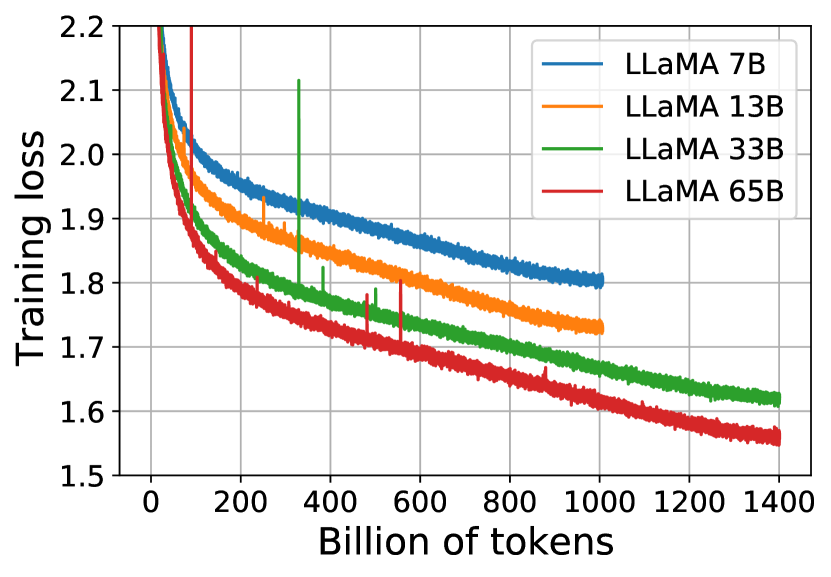
The evidence is overwhelming: brute size doesn't reign. What matters is the parameter/data ratio and training quality. A well-sized and properly trained model outperforms a giant model that's poorly calibrated.
The Leak and the Ecosystem Acceleration
LLaMA was initially reserved for academic researchers, with an access request form. But a few days after publication, the weights leaked onto the internet. Torrents, forums, GitHub: everyone had instant access.
Meta was "surprised." Or maybe not so upset. The leak massively accelerated adoption. And the resulting ecosystem gave Meta enormous influence over the direction of open-source AI.
The Explosion of Derivatives: One Week Is Enough
The ecosystem of LLaMA-derived models exploded in a matter of weeks:
Alpaca (Stanford, March 2023): LLaMA-7B fine-tuned with 52,000 instructions generated by GPT-4. Total fine-tuning cost: $600. Performance close to GPT-3.5 for certain tasks. Revelation: you can create a competent conversational assistant for the price of a restaurant dinner.
Vicuna: fine-tuned on ShareGPT conversations (users were sharing their ChatGPT dialogues). 90% of ChatGPT's quality, as estimated by GPT-4.
WizardLM: uses Evol-Instruct, a technique that progressively increases instruction complexity. The model learns to handle increasingly sophisticated requests.
Code Llama: specialized for programming. Fine-tuned on source code, supports infilling (completing code in the middle of a file).
Dozens of other variants followed. LLaMA became the "Linux" of AI: a foundation on which everyone builds.
The Evolution of the LLaMA Family
LLaMA 2 (July 2023): going commercial. Permissive license (unless you have more than 700 million users). Sizes 7B/13B/70B. Chat versions fine-tuned with RLHF. 4,096-token context.
LLaMA 3 (April 2024): the qualitative leap. 8B and 70B parameters. Trained on 15 trillion tokens (15x LLaMA 1). 8K token context. Performance close to GPT-4 for the 70B.
LLaMA 3.1 (July 2024): the major extension. Addition of the 405B model (the largest open-weight model ever published). 128K token context. 8 languages. The 405B rivals GPT-4 and Claude 3.5 Sonnet.
LLaMA 4 (2025): adoption of the Mixture of Experts (MoE) architecture. Scout (10M token context) and Maverick models. Routing efficiency joins open-source.
Each generation progresses significantly. LLaMA remains the undisputed king of open-source.
LLaMA demonstrated that open-source is viable for cutting-edge LLMs. Before, AI was a proprietary monopoly. After, it's a thriving open ecosystem. The industrial structure of AI has changed irreversibly. Proprietary models must now justify their price against open-source alternatives of comparable quality.
Let's be precise: LLaMA is open-weight (public weights), not open-source in the strict sense. The training data remains secret. The full training code isn't shared. Infrastructure and engineering details are absent. Reproducibility is therefore partial. Projects like OLMo (Allen AI) and Pythia (EleutherAI) go further by publishing data, code, and intermediate checkpoints.