The Bottleneck Nobody Saw
You have an ultra-powerful GPU. Trillions of operations per second. But the Transformer's attention only uses it at 25% of its capacity.
Why? Not because it lacks computing power. Because the GPU spends its time waiting for data to arrive from memory. It's like having a Ferrari on a one-lane road: the engine is powerful, but traffic limits the speed.
Flash Attention (Tri Dao et al., Stanford, 2022) solves this problem. 2 to 4x faster. The exact same computation, but organized in a radically smarter way to exploit the GPU's memory hierarchy.
It's one of the most practically important papers of modern AI. Not a new architecture, not a new theoretical algorithm. A better implementation of existing computation.
Standard attention is memory-bound: limited by the speed of data transfer in memory, not by available computing power. It's counterintuitive: we're used to thinking "more compute = faster." Flash Attention shows that the real bottleneck is data movement, not data processing.
The GPU Memory Hierarchy: The Key to Understanding
To understand Flash Attention, you need to understand how a GPU manages its memory. An A100 GPU (the reference chip when the paper came out) has two levels of memory:
- SRAM (on-chip): 20 MB, ultra-fast. Bandwidth: 19 TB/s. This is the memory directly on the chip, right next to the compute units.
- HBM (off-chip): 80 GB, much slower. Bandwidth: 2 TB/s. This is the GPU's "main memory," but it's physically separate from the chip.
SRAM is 10x faster than HBM, but 4,000x smaller.
The analogy: SRAM is your desk. Small, but everything is within arm's reach. HBM is the library down the hall. Large, but you have to get up every time you need a book. If you spend your time making round trips, it doesn't matter how fast you can read.
The Problem with Standard Attention: Too Many Round Trips
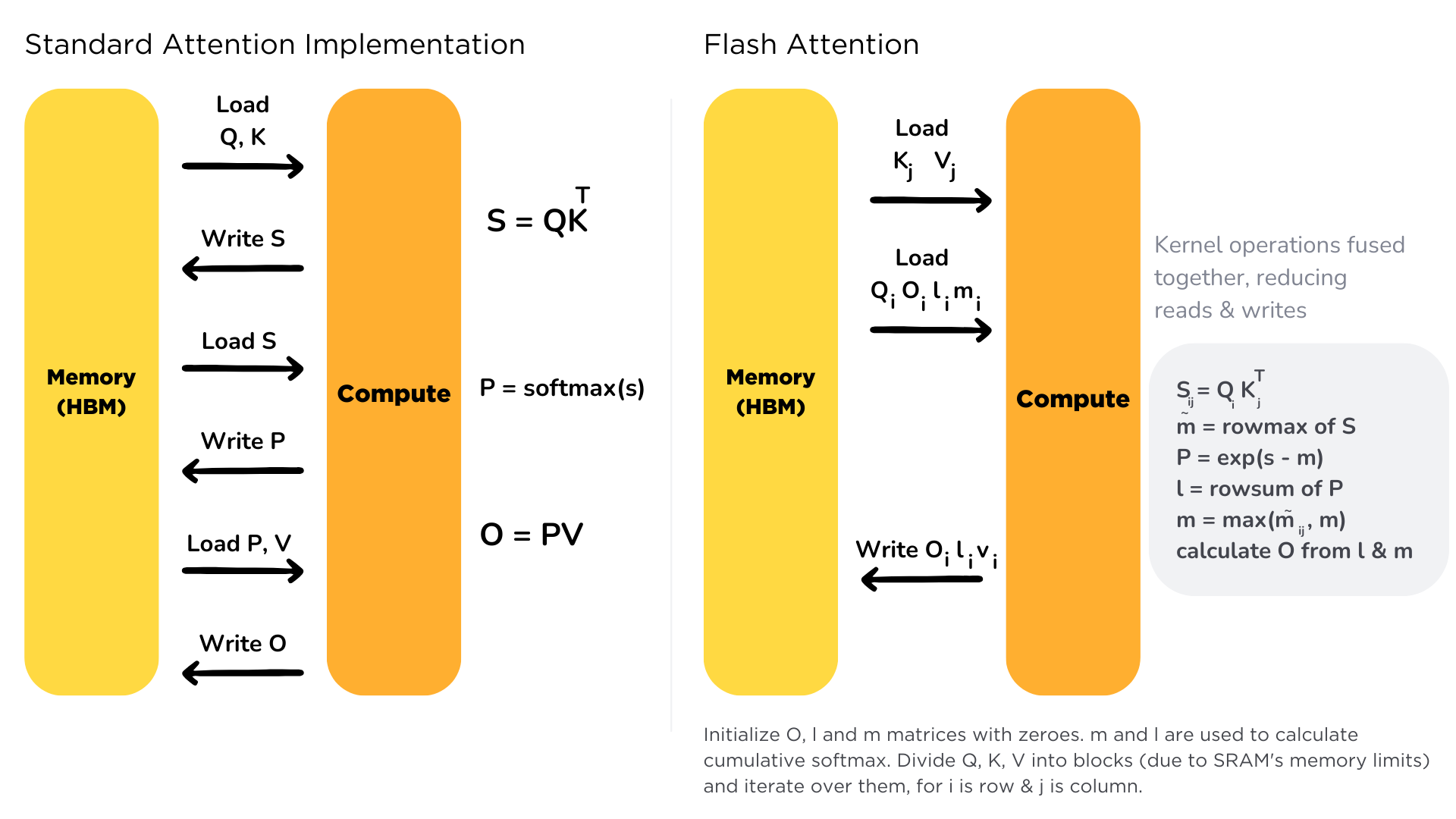
The classic implementation of attention makes constant round trips between HBM (slow) and SRAM (fast):
- Read Q, K, V from HBM -> load into SRAM
- Compute (the attention matrix)
- Write S to HBM (it's too large to stay in SRAM)
- Read S back from HBM, apply softmax
- Write the softmax result to HBM
- Read again to compute
- Write O to HBM
Each "read/write" arrow is a transfer between slow memory and fast memory. And the attention matrix has a size of (quadratic in sequence length). For an 8K token sequence, that's 64 million elements to read and write multiple times.
The computation is fast. The memory transfers are the bottleneck.
The Solution: Tiling and Online Softmax
Flash Attention uses two key ideas:
Tiling (block decomposition): instead of computing attention on the entire sequence at once, you split Q, K, V into small blocks that fit entirely in fast SRAM. Each block is processed locally: computation happens entirely in SRAM, and only the final result is written to HBM. One round trip instead of five or six.
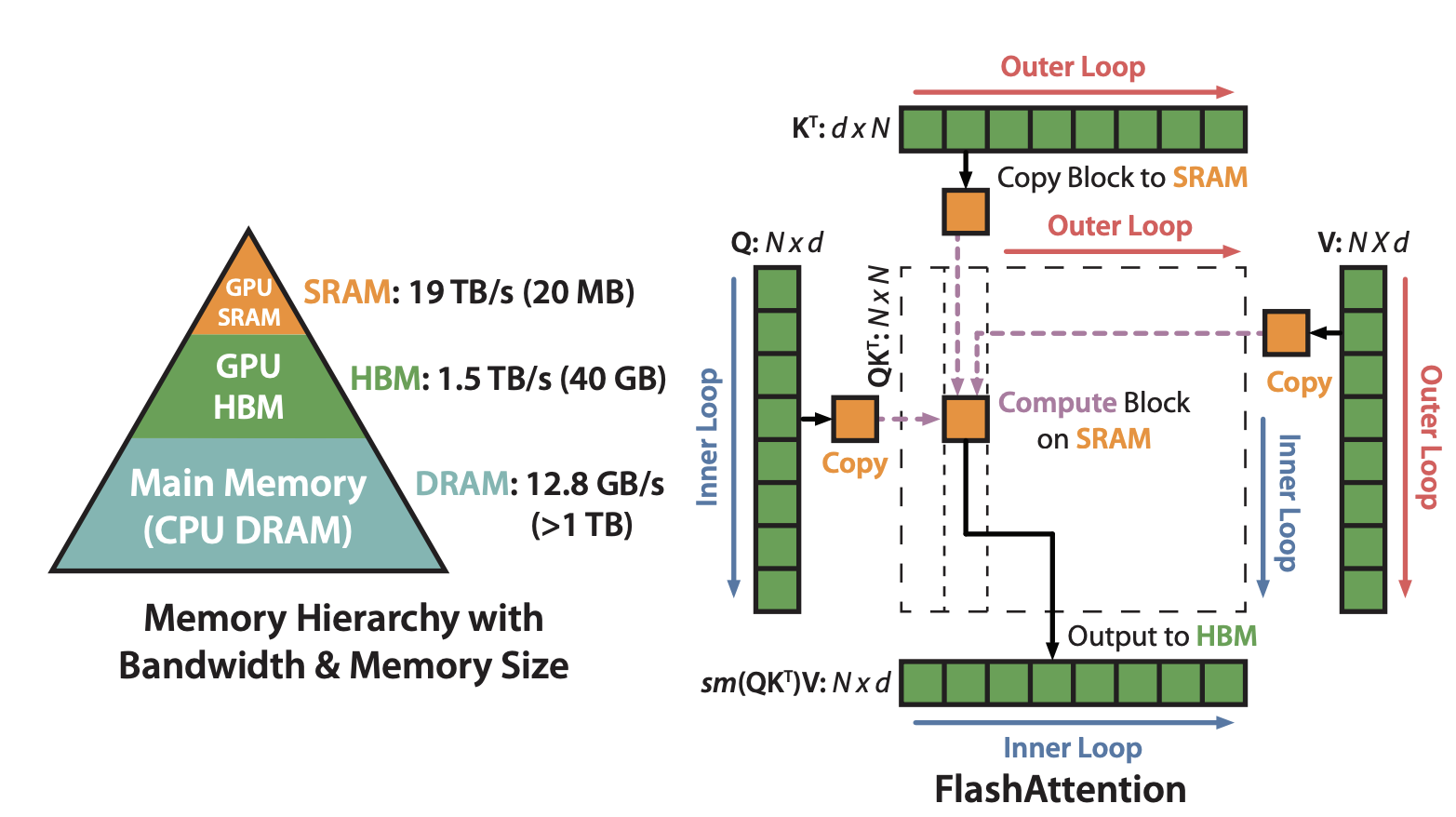
Online Softmax: classic softmax needs to see the entire row of the attention matrix before it can normalize (it needs the maximum and sum of the entire row). This is an obstacle to block-by-block processing. The trick from Milakov and King (2018), adopted by Flash Attention: compute softmax incrementally, block by block. You maintain a running maximum and running sum, updated with each block. The final result is mathematically identical to classic softmax.
Result: the exact same attention computation, but with far fewer memory transfers. The GPU spends its time computing instead of waiting for data.
Before Flash Attention, optimizing an algorithm meant reducing FLOPs (the number of floating-point operations). After Flash Attention, the paradigm changes: optimize IO (memory input-output). FLOPs are nearly free on modern GPUs. What costs is data movement. This realization changed the approach to GPU optimization across the entire field.
Results: Massive Gains
The improvements are spectacular:
- 2-4x faster than PyTorch's standard attention implementation
- 5-7x less GPU memory consumed
- 4-16x longer contexts for the same memory budget
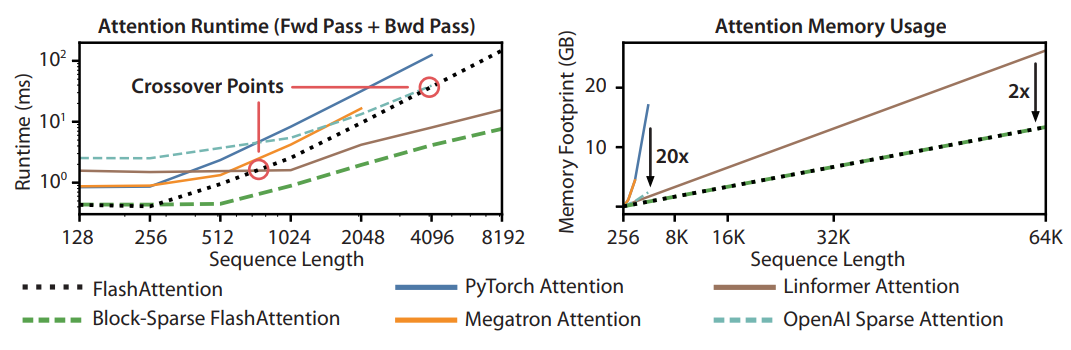
And the best part: the result is bit-exact. Flash Attention makes no approximation. It's the same computation, just better organized. Models trained with Flash Attention produce exactly the same results as with standard attention.
The Transformative Impact: Long Contexts Become Possible
Before Flash Attention, context windows were severely limited. GPT-3: 2K tokens. BERT: 512 tokens. GPU memory imposed a low ceiling.
After Flash Attention, the barriers fall:
- GPT-4: 128K tokens
- Claude: 200K tokens
- Gemini: 1 million tokens (then 2 million)
This context progress? Flash Attention made it possible. Without this optimization, long-context models would be impractical: the memory cost and computation time of standard attention would make training and inference unaffordable.
Flash Attention 2 and 3: Continued Evolution
Flash Attention 2 (2023): 2x faster than FA1. Better parallelization of work across GPU threads. Reduction of non-matmul operations (those that don't use the specialized Tensor Core compute units).
Flash Attention 3 (2024): specifically optimized for H100 GPUs (Hopper architecture). 1.5-2x faster than FA2. Exploits new hardware features (asynchronous execution, warp specialization).
Each new GPU generation brings new possible optimizations, and Flash Attention evolves to exploit them. It's continuous engineering work, not a one-shot.
Flash Attention is now everywhere. Natively integrated into PyTorch (torch.nn.functional.scaled_dot_product_attention). Supported by Hugging Face Transformers, vLLM, TensorRT-LLM, and all major inference frameworks. It's one of the most universally adopted technical contributions in AI. Tri Dao has become a major figure in GPU optimization.
What Flash Attention Doesn't Change
It's important to understand the limits. Flash Attention doesn't modify the asymptotic complexity of attention: it remains O(n^2). Flash Attention optimizes the constants (the multiplicative factors), not the fundamental curve.
For sequences of more than a million tokens, even with Flash Attention, quadratic attention eventually becomes prohibitive. That's why architectures with linear attention like Mamba (O(n)) or sparse attention methods remain necessary for very long contexts.
Flash Attention solves the implementation problem. The complexity problem awaits an architectural solution.
Flash Attention has pushed the limits of quadratic attention spectacularly. But O(n^2) remains O(n^2). For contexts of 10 million tokens or more, linear architectures (Mamba, RWKV, or hybrid approaches) will probably become necessary. Flash Attention bought time for the Transformer, but not eternity.