The Problem: Fine-Tuning a Large Model Costs a Fortune
You have a 70 billion parameter model. You want to adapt it to your domain: medical, legal, your writing style. Classic fine-tuning involves updating all 70 billion parameters.
In practice, that requires about 280 GB of GPU memory (the weights in float16, plus the gradients, plus the optimizer states). That's a GPU cluster. Tens of thousands of dollars.
And if you want to adapt the same model to 10 different tasks? You store 10 copies of 140 GB each. It's absurd.
LoRA (Low-Rank Adaptation, Hu et al., Microsoft, 2021) solves all of this at once.
LoRA makes fine-tuning large models possible on a single GPU. No cluster. No research budget. A student with an RTX 4090 can adapt a 7B parameter model. That's what made fine-tuning accessible to everyone.
The Brilliant Idea: Updates Are Low-Rank
The intuition behind LoRA is mathematically elegant. When you fine-tune a model, the changes to the weights (the "deltas") aren't arbitrary. They have a low intrinsic rank. In plain terms: the updates live in a subspace much smaller than the total parameter space.
Instead of updating the full weight matrix (of dimensions ), LoRA decomposes the update:
- has dimensions
- has dimensions
- (the rank, typically between 4 and 64)
To give a concrete example: if (typical for a modern LLM) and , you update parameters instead of . That's 256x fewer parameters.
The analogy? Imagine you want to modify a 10-megapixel photo. Instead of redesigning every pixel, you describe the modifications with a few simple filters (brightness, contrast, color balance). The result is visually identical, but your "modification recipe" fits in a few bytes instead of 10 MB.
The Mechanism in Practice
For each model layer you want to adapt:
- Freeze W: the original weight matrix receives no gradients, it stays intact
- Add two small matrices A and B: initialized so that initially (no initial perturbation)
- The output becomes: (the original plus the correction)
- Train only A and B: only these parameters receive gradients
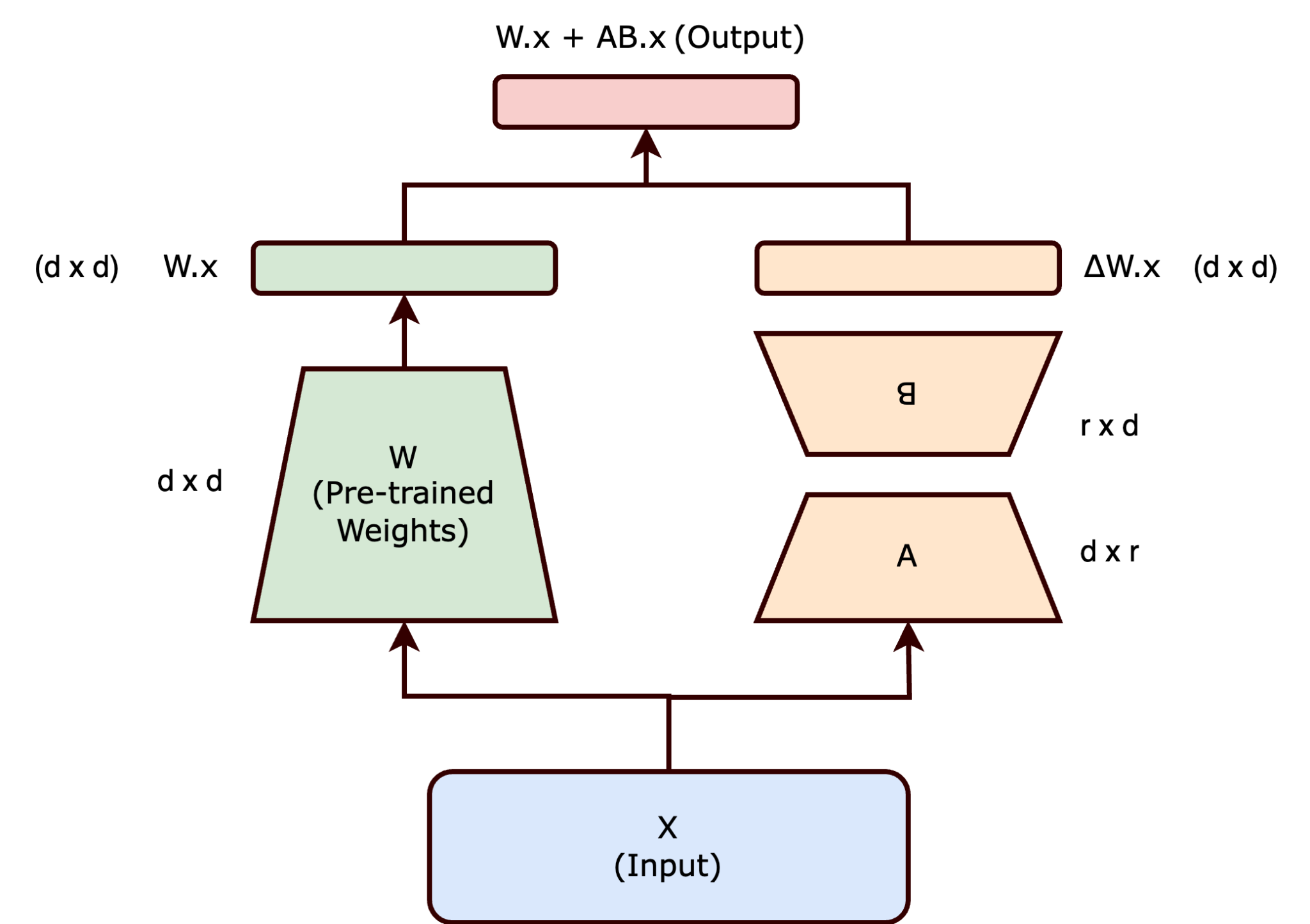
After training, the magic: you can merge the adaptations with the original weights. . The resulting model has exactly the same architecture and the same inference speed as the original. No overhead in production.
And if you want to adapt the same base model to 10 different tasks? You store 10 (A, B) pairs, each a few megabytes. You swap adapters in milliseconds. One base model, dozens of specializations.
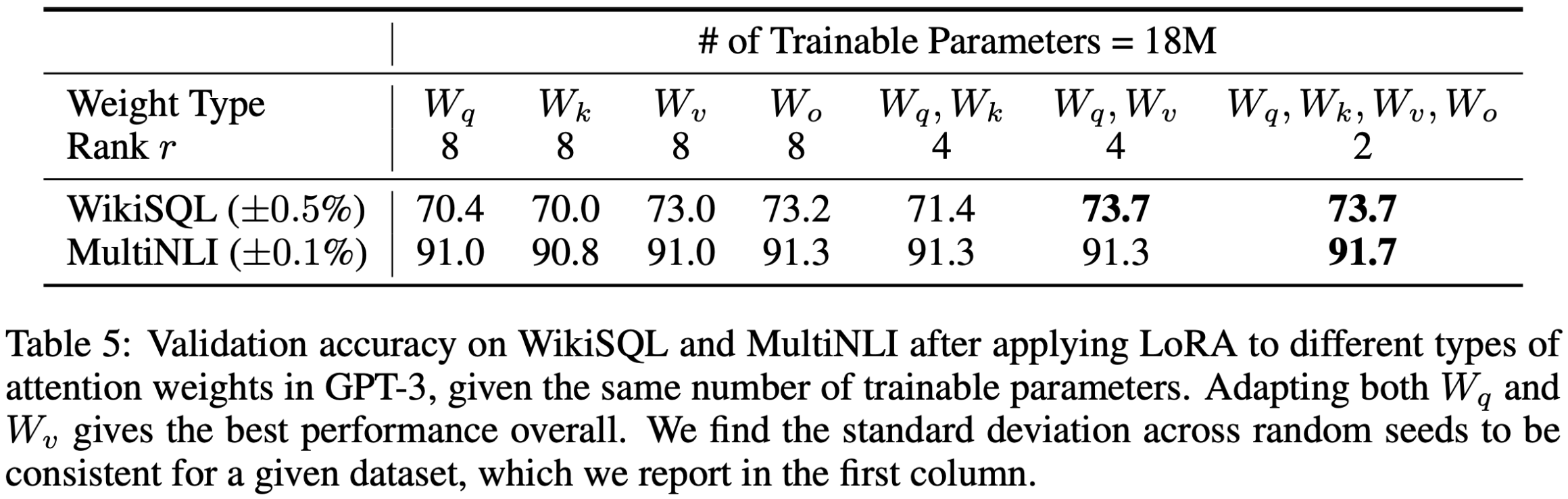
LoRA can be applied to any weight matrix. The original study shows that the (query) and (value) projections of attention give the best quality/cost ratio. In practice, adapting all layers (Q, K, V, O, FFN) with a small rank () often works better than a few layers with a high rank.
The Numbers Speak for Themselves
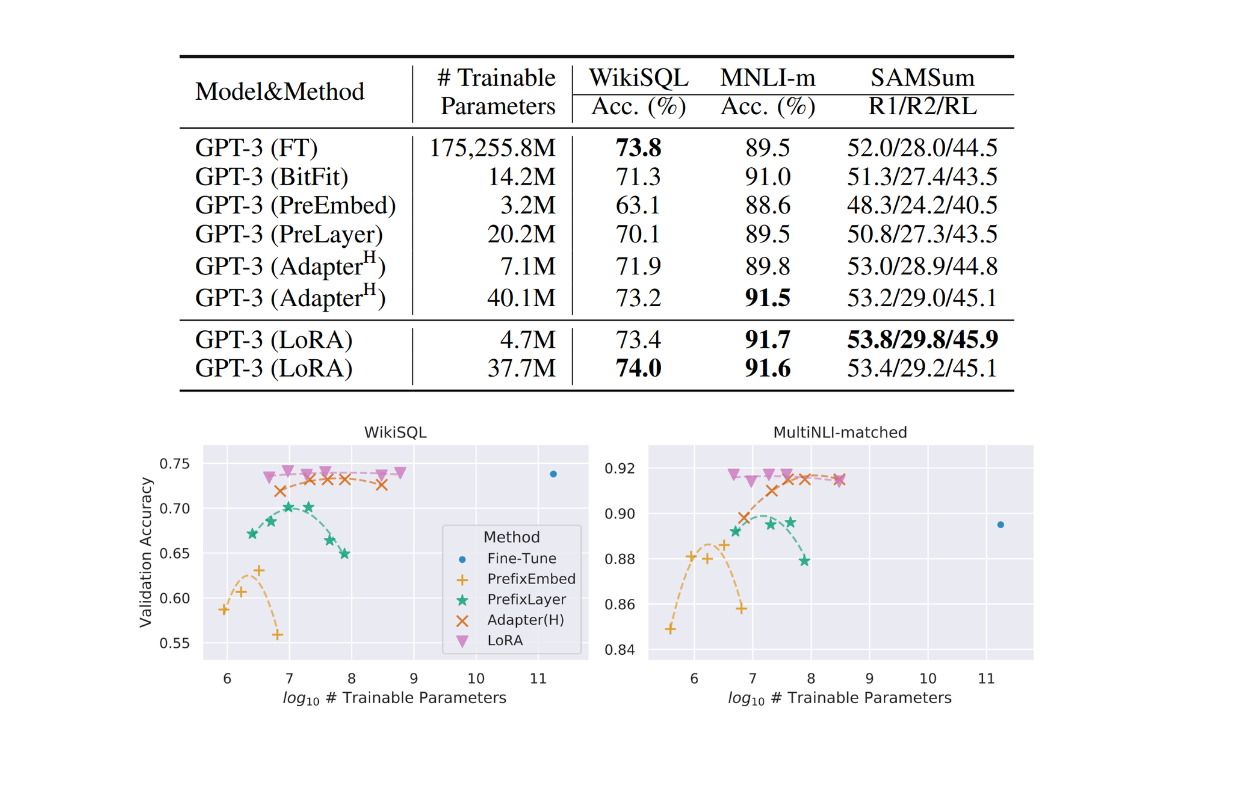
On GPT-3 175B with rank :
- Trainable parameters: 4.7 million (out of 175 billion)
- Reduction: 10,000x fewer parameters to train
- Performance: equal to or better than full fine-tuning on several tasks
- Memory: a single GPU is enough (instead of a cluster)
- Storage: a few MB per adaptation (instead of hundreds of GB)
How is it possible that 0.003% of parameters suffice? Because the pre-trained model has already learned the fundamental representations of language. Fine-tuning just "adjusts" them slightly. And these adjustments are low-rank: they only modify a small subspace of the weights.
The Variants: LoRA's Evolution
QLoRA (Dettmers et al., 2023): the real revolution. Combines LoRA with 4-bit quantization of the base model. Result: fine-tuning a 65B parameter model on a single 48 GB GPU (an A6000 or an A100). It's QLoRA that truly democratized fine-tuning for the community.
DoRA (Weight-Decomposed Low-Rank Adaptation): decomposes weights into a magnitude and direction component, then applies LoRA separately to each. More faithful to full fine-tuning behavior.
LoRA+: uses different learning rates for matrices A and B, which accelerates convergence.
rsLoRA: adjusts the scaling factor based on rank to improve stability.
The LoRA Ecosystem
LoRA has become the de facto standard for fine-tuning. The ecosystem is massive:
- PEFT (Hugging Face): the reference library for LoRA and other efficient fine-tuning methods
- Unsloth: optimized LoRA fine-tuning, 2x faster
- Civitai: thousands of community LoRAs for image generation (Stable Diffusion)
- Axolotl: simplified fine-tuning framework
Practical Applications
LoRA use cases are everywhere:
- Style personalization: adapting an assistant's writing tone (formal, casual, technical)
- Domain specialization: medical, legal, financial, scientific
- Instruction tuning: turning a base model into a conversational assistant
- Image generation: training custom visual styles on Stable Diffusion (an artist, a type of photo, a character)
- Multilingualism: adapting an English-centric model to another language
LoRA reduces cost, but not the need for good data. Poor-quality data will produce bad fine-tuning, regardless of the method. Too low a rank ( or ) limits performance on complex tasks that require deep behavioral modifications. And catastrophic forgetting remains possible: by adapting the model to a new task, it can "forget" existing capabilities.