"GPT-3: Language Models are Few-Shot Learners" (2020)
The Scale Jump That Changes Everything
GPT-2: 1.5 billion parameters. GPT-3: 175 billion.
That's 100x bigger. But what's fascinating is that GPT-3 isn't "just 100x better." It's qualitatively different. Capabilities that simply didn't exist in GPT-2 appear in GPT-3, as if the model had crossed an invisible threshold.
This is the paper (Brown et al., May 2020) that opened the age of scaling in AI. The idea that by making models large enough, capabilities emerge spontaneously.
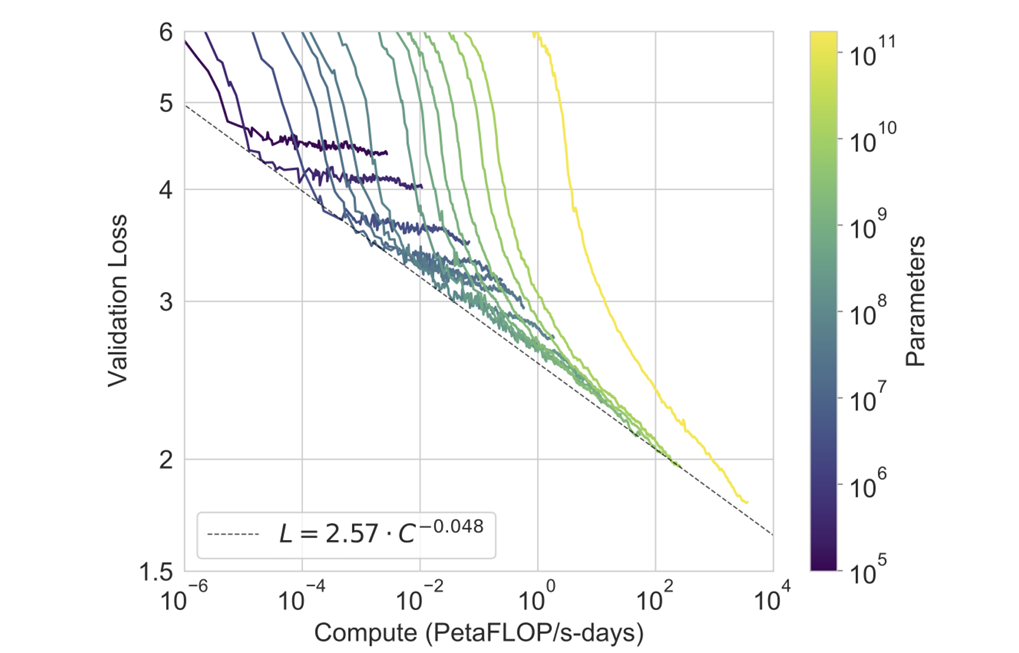
GPT-3 can do things nobody explicitly taught it: translation without parallel data, problem-solving by analogy, functional code generation, 3-digit arithmetic. These capabilities are absent in GPT-2. They emerge from scaling, as if size unlocked new aptitudes.
In-Context Learning: The Major Discovery
GPT-3's most important contribution isn't its size. It's the discovery of in-context learning: the ability to learn new tasks simply from examples in the prompt, without modifying the model's weights.
You don't fine-tune GPT-3 for translation. You give it a few examples in the prompt:
"English: Hello -> French: Bonjour. English: Goodbye -> French: Au revoir. English: Thank you -> French:"
And it responds "Merci." Without ever having been specifically trained on translation.
Three regimes were identified:
- Zero-shot: just the task description, no examples
- One-shot: a single example
- Few-shot: 10 to 100 examples in the prompt
The finding: performance increases significantly with the number of examples. And the larger the model, the more it benefits from examples. GPT-3 learns in the prompt, not through fine-tuning. It was revolutionary and nobody really understood how it worked.
To give an analogy: it's as if you showed someone 3 examples of haikus, and they could write a perfect one. Without poetry lessons. Just by seeing the pattern. GPT-3 does that, but for hundreds of different tasks.
Architecture and Training
- 175 billion parameters
- 96 layers, 12,288 embedding dimensions, 96 attention heads
- Context window: 2,048 tokens (modest by current standards)
- Decoder-only architecture (autoregressive, predicts the next token)
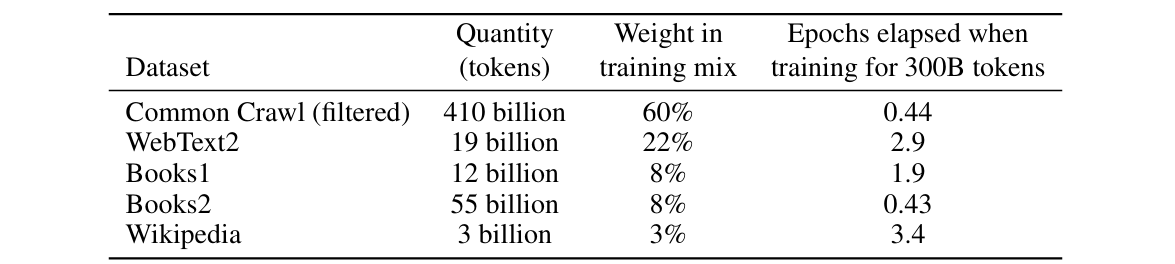
Training data (a carefully weighted mix):
- Filtered Common Crawl (60%): cleaned web pages
- WebText2 (22%): popular Reddit links
- Books1 and Books2 (16%): book corpora
- Wikipedia (3%): encyclopedia
- Total: approximately 300 billion tokens
Estimated training cost: $4.6 million in 2020. A figure that seems modest today (current models cost hundreds of millions), but was astronomical at the time for a single training run.
Results: Impressive and Surprising
SuperGLUE: few-shot performance approaches that of fine-tuned models. Without any fine-tuning, just examples in the prompt.
Translation: competitive in few-shot without ever having seen parallel bilingual data. The model learned translation as a byproduct of text prediction.
Arithmetic: addition and subtraction up to 5 digits. Not perfect, but the fact that a language model could "calculate" at all was surprising.
Text generation: GPT-3-generated articles were difficult to distinguish from human-written texts in blind studies. Human evaluators were wrong ~50% of the time.
Code generation: GPT-3 could write simple code in Python and JavaScript, laying the foundations for what would become Codex and then GitHub Copilot.
Impact: GPT-3 Creates an Industry
GPT-3 catalyzed several simultaneous transformations that shaped the industry as we know it:
The API as a product: GPT-3 is the first LLM offered as a service via an API. You send text, you receive text. No GPU needed, no training data needed. It democratized access to large models.
Prompt engineering as a discipline: how do you write effective prompts? How do you structure examples? How do you guide the model? A new skill set was born, which has become a full-fledged professional competency.
The startup explosion: hundreds of startups were built on the GPT-3 API. Jasper (marketing writing), Copy.ai (copywriting), and of course the projects that would become GitHub Copilot and Codex. AI became a product, not just a research topic.
The beginning of the AGI debate: for the first time, serious discussions about artificial general intelligence emerged in the mainstream. Does a model that can do "a bit of everything" approach general intelligence?
GPT-3 established a fundamental understanding: scaling is not linear. It's not about getting "slightly better" answers. At large scale, qualitatively new capabilities emerge. This is the foundation of the scaling paradigm that still dominates the industry and justifies billions of dollars in investments.
The Problems GPT-3 Reveals
GPT-3 isn't all good news. It also reveals fundamental problems:
Systematic biases: the model reproduces and amplifies gender, race, and religion biases present in its training data. Stereotyped associations appear in responses. This is a problem the industry is still fighting today.
Hallucinations: GPT-3 invents facts with confidence. It can cite studies that don't exist, attribute quotes to the wrong people, or fabricate statistics out of thin air. The fluency of the text masks the absence of truth.
Difficult tasks: reading long documents, multi-step reasoning, and causal understanding remain problematic.
These problems directly motivated subsequent research: InstructGPT (RLHF to align the model with human intentions), Constitutional AI (Anthropic, for safety), and ultimately ChatGPT (which made GPT accessible to the general public).
The Path from GPT-3 to ChatGPT
The lineage is direct:
GPT-3 (scaling) -> InstructGPT (RLHF, alignment) -> GPT-3.5 (optimizations) -> ChatGPT (dialogue fine-tuning) -> GPT-4 (multimodal, reasoning)
Each generation fixes the problems of the previous one. But it's GPT-3's massive scaling that laid the foundation on which everything else was built.
The Philosophical Debate: Stochastic Parrots?
Bender et al. (2021) published an influential paper arguing that GPT-3 is nothing but a "stochastic parrot": sophisticated pattern matching without any understanding. The model doesn't "know" anything, it recombines textual statistics.
Others, like Ilya Sutskever (then at OpenAI), argued the opposite: correctly predicting the next token in any context requires some form of world understanding. You can't predict what comes next in a physics text without "understanding" (in some sense) physics.
This debate remains open and active. It touches on deep questions: what is understanding? Can you understand without consciousness? Does the distinction between "simulating understanding" and "truly understanding" have practical meaning?
The original GPT-3 paper honestly acknowledges its limitations: prohibitive training cost, significant biases, poor performance on certain tasks. The authors presented these as challenges for future research. And indeed, these challenges were addressed: RLHF for alignment, Chinchilla for efficiency, Constitutional AI for safety. GPT-3 posed the problems as much as the solutions.