Why this directly concerns you
Are you training a model with data containing personal information? Do you have users residing in Europe? The GDPR (General Data Protection Regulation) applies to you. Are you deploying an AI system for recruiting, credit scoring, or healthcare? The EU AI Act applies too.
These aren't theoretical regulations. Non-compliance can result in fines of up to 20 million euros (GDPR) or 35 million euros (AI Act), not counting the reputational damage that can sink a startup. These penalties are not theoretical: numerous companies have already paid millions.
Enterprise clients increasingly require certifications before signing: "Do you have GDPR compliance? ISO 27001? SOC2?" It's become a non-negotiable prerequisite for landing large contracts. Data governance isn't just a legal obligation, it's a business differentiator. Companies that integrate it early win client trust faster.
GDPR: the fundamentals
The GDPR (General Data Protection Regulation) is the European framework on personal data, in effect since 2018. It applies to any organization processing data of European residents, even if the organization is based outside Europe.
The six guiding principles
- Lawfulness: you must have a legal basis for processing data. Explicit consent, legitimate interest, contractual obligation, etc. "We had the data so we used it" is not a legal basis.
- Purpose limitation: data collected for one purpose (e.g., customer service) cannot be reused for another (e.g., training a model) without an additional legal basis
- Minimization: only collect what is strictly necessary. If you don't need the date of birth, don't collect it.
- Accuracy: data must be correct and up to date
- Storage limitation: no indefinite storage. Define a retention period and delete afterward.
- Security: protect data against unauthorized access, leaks, and loss
Individual rights you must respect
- Right of access: any person can ask "what data do you have about me?" and you must respond within one month (extendable in some cases)
- Right to rectification: "this data is incorrect, fix it"
- Right to erasure (right to be forgotten): "delete all my data." And you must do it, with limited legal exceptions.
- Right to portability: "give me my data in a structured, machine-readable format"
The machine unlearning conundrum
The right to be forgotten poses a major technical challenge in ML: if someone requests deletion of their data, how do you make the model that already ingested that data "forget" it? A model does not file its data away in drawers you could empty: what it learned is spread across billions of parameters. The field of "machine unlearning" has made real research progress since 2023, but no method today can guarantee, verifiably, that a large model has truly forgotten a piece of information rather than merely learned not to say it. Retraining the model without the data in question is the only exact solution, and it is often impractical (cost and time). Methods and their limits are covered on machine unlearning.
The risk is not theoretical: a model can memorize passages of its training data and reproduce them word for word, especially passages that appeared several times (see memorization and extraction). That is why the European Data Protection Board (EDPB, which brings together national authorities such as France's CNIL) stated in a December 2024 opinion that a model trained on personal data is not automatically "anonymous": it only is if the likelihood of extracting that data, directly or by querying the model, is insignificant, which has to be assessed case by case.
The best strategy is prevention: anonymize or pseudonymize personal data before training, or better yet, don't include it in your training datasets at all.
This isn't a theoretical concept. Deletion requests do come in, and you must be able to respond. Prevent the problem upstream: scan your datasets to detect PII (Personally Identifiable Information) and remove it before any training.
EU AI Act: the first global legal framework for AI
The AI Act (EU Regulation 2024/1689, in force since 1 August 2024) is pioneering legislation at the global level. It is the first law to regulate artificial intelligence systems horizontally, across all sectors. But "in force" does not mean "applicable": its obligations switch on in stages, and part of the timetable was pushed back in 2026.
Classification by risk level
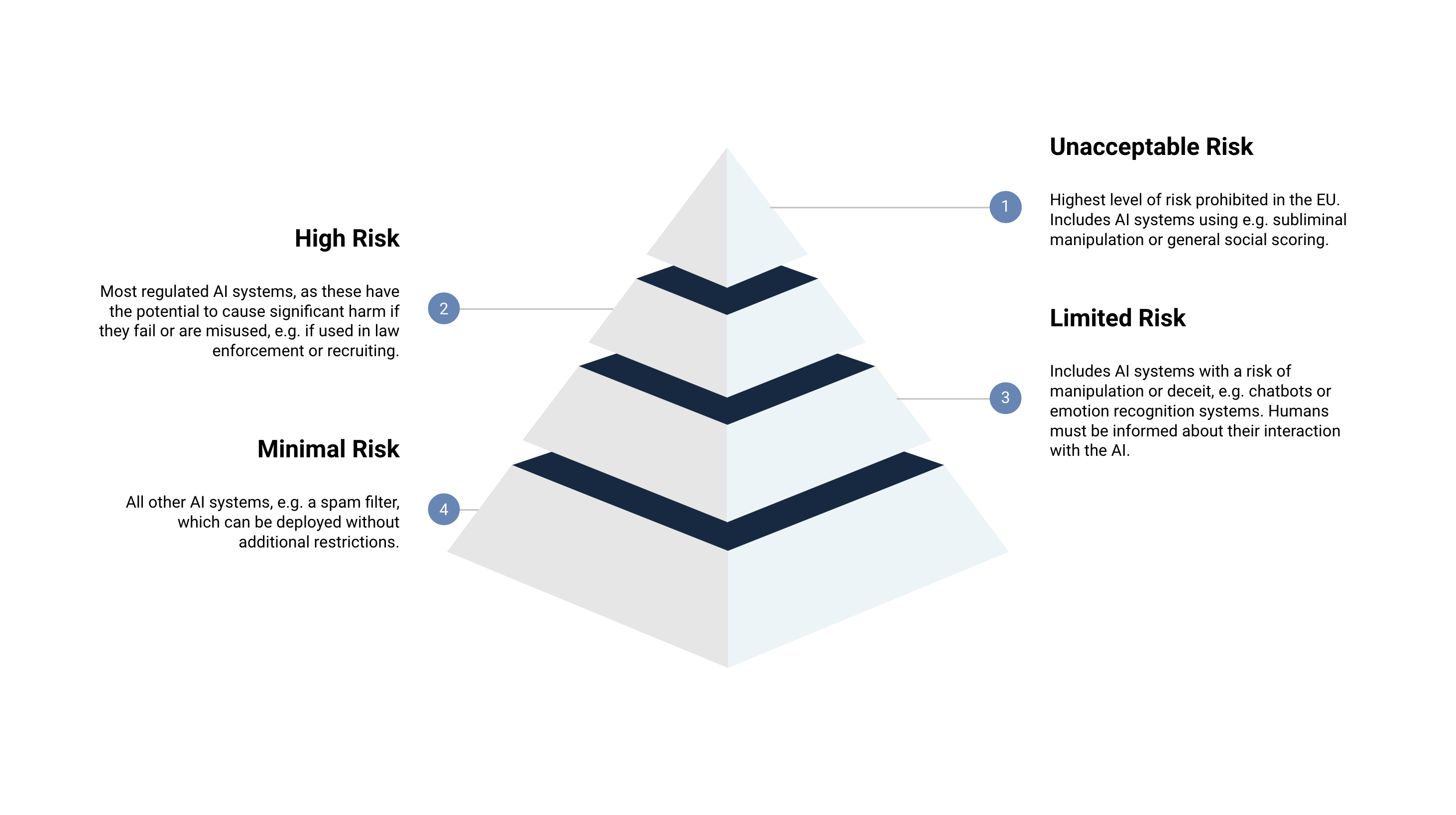
The AI Act classifies AI systems into four categories, each with its own obligations:
- Unacceptable risk (PROHIBITED): social scoring, subliminal behavior manipulation, exploiting vulnerabilities, real-time facial recognition in public spaces by law enforcement (with narrow exceptions), emotion recognition at work or school. These uses have been banned since 2 February 2025.
- High risk: AI systems used for recruiting, credit granting, criminal justice, education, or built into already-regulated products (medical devices, toys, vehicles). Strict obligations for documentation, risk management, data quality, testing, and human oversight.
- Limited risk: chatbots, deepfake systems, generated content. Transparency obligations: the user must know they are interacting with an AI, and generated content must be marked in a machine-readable way.
- Minimal risk: spam filters, video games, etc. No specific obligations.
The real timeline
| Date | What becomes applicable |
|---|---|
| 1 August 2024 | The regulation enters into force (no obligations yet) |
| 2 February 2025 | Prohibitions (unacceptable risk) and the AI literacy obligation |
| 2 August 2025 | Obligations for general-purpose AI (GPAI) models, governance, penalty regime |
| 2 August 2026 | Supervision and fining powers of the Commission's AI Office over GPAI; transparency obligations (chatbots, generated content) |
| 2 December 2026 | New prohibitions added in 2026 ("nudifier" apps, generated child sexual abuse material); end of the grace period for marking content from systems already on the market |
| 2 August 2027 | Compliance deadline for GPAI models placed on the market before 2 August 2025 |
| 2 December 2027 | Annex III high-risk systems (recruiting, credit, education...), originally due 2 August 2026 |
| 2 August 2028 | High-risk AI built into regulated products (Annex I), originally due 2 August 2027 |
The "digital omnibus": high-risk rules pushed back
On 19 November 2025 the European Commission proposed a simplification package called the digital omnibus. Its AI part started from a practical observation: the harmonised technical standards meant to spell out how to comply with the high-risk obligations were not ready, and not every national supervisory authority had been designated. Applying the law in August 2026 would have asked companies to comply with rules whose instruction manual did not yet exist.
Parliament and Council reached a provisional agreement on 7 May 2026; the text was formally adopted on 29 June 2026, published in the Official Journal on 24 July 2026 (Regulation 2026/1744), and has been in force since 27 July 2026. The essentials:
- high-risk obligations are postponed by sixteen months for Annex III (2 December 2027) and by a year for Annex I products (2 August 2028);
- general-purpose model obligations do not move: they have applied since 2 August 2025;
- two new prohibitions apply from 2 December 2026 (apps that "undress" people without consent, generation of child sexual abuse material);
- the AI literacy obligation is softened: it now falls mainly on the Commission and member states, tasked with promoting it;
- some relief reserved for SMEs is extended to small mid-cap companies.
The same package included a separate proposal touching the GDPR (notably on using personal data to develop AI), which follows its own legislative track.
Obligations for general-purpose AI models (GPAI)
A general-purpose AI model (GPAI) is a model able to perform a wide variety of tasks, such as large language models. The guidelines published by the Commission on 18 July 2025 give an indicative criterion: a model trained with more than floating-point operations (FLOP) and able to generate text, images or video is presumed to be one. They also clarify when a company that modifies someone else's model becomes a "provider" itself (roughly, when the modification uses more than a third of the original training compute).
Since 2 August 2025, every GPAI provider must:
- Technical documentation: describe the architecture, training, data, capabilities and limitations, for the AI Office and for the companies building on top
- Copyright policy: put in place a policy to comply with copyright, including opt-outs expressed by rights holders in a machine-readable way (see opt-out and access protocols)
- Public summary of training data: publish a "sufficiently detailed" summary following the template the Commission issued on 24 July 2025 (see below)
- Systemic risk (presumed above training FLOP): thorough evaluations, adversarial testing, reporting of serious incidents, cybersecurity
Models released under a free and open-source license are exempt from the technical documentation, but not from the copyright policy or the public summary, and not at all if they pose systemic risk.
The Commission's summary template has three parts: general information (modalities, order of magnitude of the data), the list of sources (large public datasets, licensed data, data scraped from the web with the main domain names involved, user data, synthetic data), then other aspects of processing (respecting rights holders' opt-outs, removing illegal content). It is not a list of documents: it is a map of sources. Even so, it forces you to know where your data comes from, which requires real traceability. On that subject, see dataset provenance and licenses.
The GPAI code of practice (July 2025)
To make these obligations concrete, the Commission published a General-Purpose AI Code of Practice on 10 July 2025, drafted by independent experts with close to a thousand participants. It has three chapters:
- Transparency: a standard model documentation form, to be kept up to date and handed over on request.
- Copyright: respect robots.txt when crawling, do not circumvent technical protections such as paywalls, exclude websites recognised as distributing infringing content at scale, limit the risk of outputs that reproduce works, and provide a point of contact for rights holders' complaints.
- Safety and security: reserved for systemic-risk models, with a risk assessment and management framework.
The code is voluntary: signing it gives a simpler way to demonstrate compliance. Most large providers signed it (including OpenAI, Anthropic, Google, Microsoft, Amazon, IBM and Mistral AI); xAI signed only the safety and security chapter, and Meta declined to sign, arguing it went beyond the regulation. Non-signatories must demonstrate compliance by other means.
The training FLOP threshold roughly corresponds to the compute level of GPT-4 (2023). In 2023 very few models exceeded it; today a growing number of frontier models sit above it, while most mid-sized open models remain below. The Commission can also designate a model as systemic on other criteria, and the threshold itself can be revised.
Data traceability (Data Lineage)
The concept
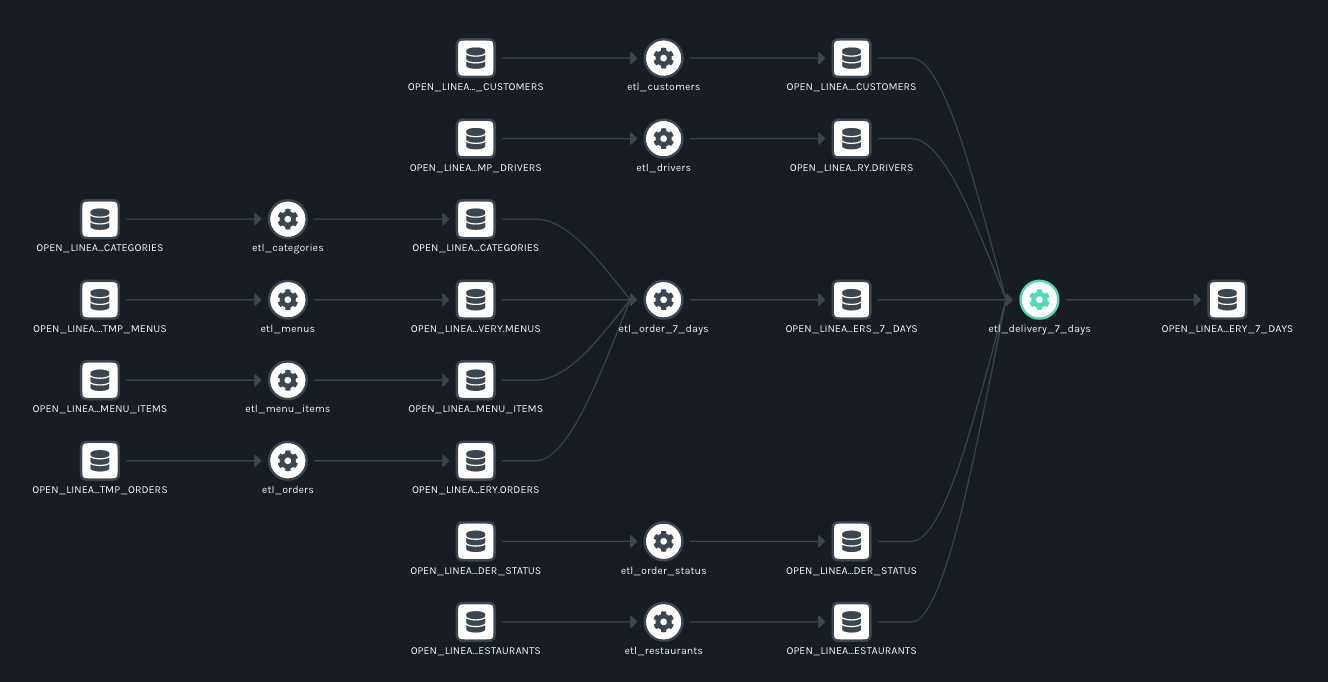
Data lineage means tracing the complete journey of each piece of data: where it came from, what transformations it underwent, and in which models it's used. It's the equivalent of food traceability, but for your data.
What you need to trace concretely
- Provenance: web scraping? Internal database? Data purchased from a third party? Public API?
- Transformations: cleaning, filtering, augmentation, tokenization. Each step documented.
- Consent: what legal basis justifies using this data?
- Access: who accessed the data, when, and for what purpose?
- Usage: in which models did this data serve for training?
Lineage tools
- Apache Atlas: governance and lineage for Hadoop/big data
- OpenLineage: open standard for data pipeline traceability
- Amundsen / DataHub: data catalogs with lineage features
- dbt: automatic lineage for SQL transformations
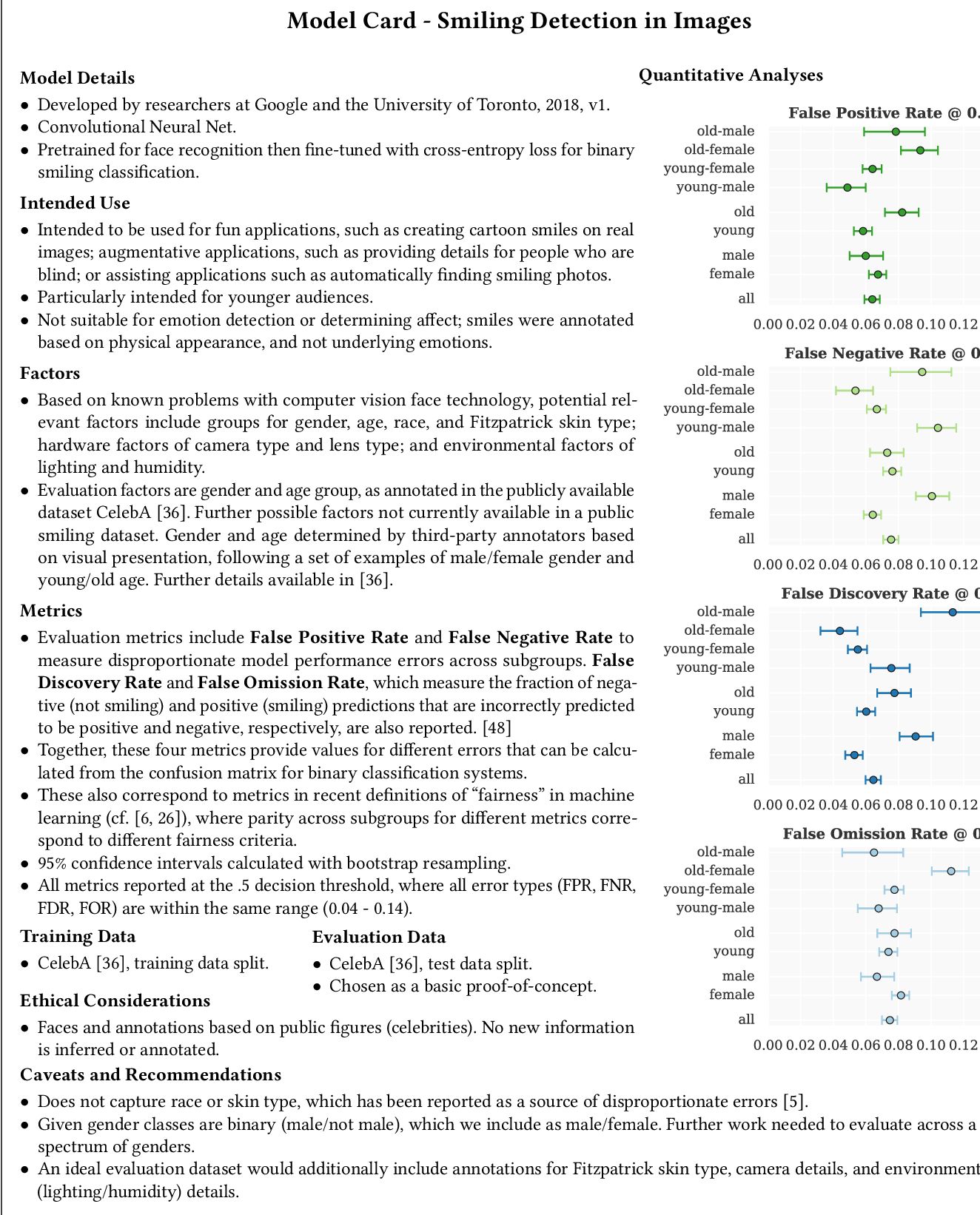
HuggingFace popularized Model Cards (a model's identity sheet) and Data Cards (a dataset's identity sheet). The AI Act picked up their spirit: the technical documentation required for general-purpose models, and the standard form in the code of practice, ask for exactly what a good model card contains (intended uses, data, limitations, evaluations). And even without a legal obligation, it's an excellent practice: it forces you to think about the model's limitations, potential biases, and appropriate uses.
Setting up good data governance
Inventory and classification
- Exhaustively catalog all your data sources
- Document the legal basis for each source
- Identify data containing personal information
- Classify by sensitivity level (public, internal, confidential, restricted)
Personal data protection
- PII detection: automatically scan your datasets to find emails, phone numbers, names, addresses, social security numbers
- PII removal: remove them before any training. This is non-negotiable.
- Pseudonymization: replace real identifiers with artificial ones
- Differential privacy: a mathematical technique that guarantees it's impossible to extract an individual's data from the trained model. More complex to implement but provides formal guarantees.
Data quality
- Automated tests on schema, statistical distributions, and completeness
- Continuous monitoring in production to detect drift
- Data Cards to document each dataset version
Organization
- Appoint a DPO (Data Protection Officer) if you haven't already
- Train ML teams on compliance issues: it's not just legal's problem
- Integrate compliance checks into your CI/CD: governance must be automated
- Plan regular audits, both internal and external
GDPR: up to 20 million euros or 4% of global annual revenue (whichever is higher). AI Act: up to 35 million euros or 7% of global annual revenue for prohibited practices; up to 15 million or 3% for most other breaches, including those of general-purpose model providers; up to 7.5 million or 1% for supplying incorrect information to authorities.
These are not empty threats. Numerous companies have already been heavily penalized for GDPR non-compliance. On the AI Act side, the prohibitions have applied since February 2025, and the AI Office has been able to fine general-purpose model providers since 2 August 2026. It's better to invest in compliance than to pay fines.
Elsewhere in the world: diverging paths
You used to read that "regulation is accelerating everywhere." The reality of 2025-2026 is more mixed: some countries passed laws, others reversed course, and several prefer targeted rules to a single comprehensive law.
- United States: the October 2023 executive order on "safe, secure, and trustworthy" AI was revoked on 20 January 2025. Federal policy then turned toward deregulation: a January 2025 order to remove "barriers" to American AI leadership, an AI Action Plan in July 2025, then an order of 11 December 2025 directing the Justice Department to challenge state laws deemed too burdensome, and a national policy framework released in March 2026. States keep legislating anyway: California passed SB 53 (the Transparency in Frontier AI Act) in September 2025, in force since 1 January 2026, which requires frontier model developers to publish their risk management framework and report serious incidents; New York, Colorado and Texas have their own texts too. The federal-versus-state conflict is not settled.
- China: rules by use case rather than one law. After the 2023 measures on generative AI, labeling rules for AI-generated content have applied since 1 September 2025: a visible label for users and a hidden one in the metadata.
- South Korea: its AI Basic Act, passed at the end of 2024, has been in force since 22 January 2026. It is the second comprehensive AI law after the AI Act, with obligations for "high-impact" systems and for labeling generated content.
- Japan: an AI Promotion Act passed in May 2025, with no penalties, relying on state coordination and voluntary cooperation from companies.
- Canada: AIDA (the Artificial Intelligence and Data Act) died when Parliament was prorogued on 6 January 2025, without ever being passed. The new government, which created a minister for AI, has not revived a comprehensive law; the bill tabled in 2026 covers privacy, not AI in general.
- United Kingdom: still no dedicated law. The legislation on the most powerful models promised in 2024 has not been introduced; the government favours sector regulators, regulatory sandboxes, and its public model-evaluation institute, renamed the AI Security Institute in February 2025.
For training data specifically, a large share of the rules come not from AI laws but from copyright, as courts apply it: see what the courts have said about training.
Teams that invest now in solid governance (source inventory, traceability, documentation) will be ready whatever the framework, because all these laws ultimately ask the same questions: where does your data come from, what did you do with it, and can you prove it?
1. Your company collected customer-service messages. The ML team now wants to use them to train a model. What does the page say?
2. A user exercises their right to erasure, but their data has already been used to train your model. What is the situation according to the page?
3. Under the AI Act classification presented in the page, where does a chatbot sit and what does that imply?
4. What is a data lineage graph concretely for, according to the page?
5. Which obligations does the page attribute to foundation models (GPAI) under the AI Act?
6. A company reads that in 2026 « the AI Act was postponed ». What actually happened, according to the page?