ChatGPT's Secret: Humans Who Ranked Answers
ChatGPT isn't just an LLM that was left to train on its own. It's an LLM that was fine-tuned with human feedback. For InstructGPT, its direct ancestor published in 2022, OpenAI hired a team of about 40 contractors. They wrote model answers and, for some 33,000 prompts, ranked several of the model's responses from best to worst: so many ways of saying "this one is better than that one."
Training language models to follow instructions with human feedbackThis process is called RLHF (Reinforcement Learning from Human Feedback). Think of it as educating a child: you don't write a 10,000-page rule manual. You show examples, you say "this is good, that's not as good," and they learn to generalize. Except the child is a 175-billion-parameter model.
How It Works: The Raw Data of Alignment
The idea is simple: humans evaluate the model's responses. Not just "good" or "bad." They compare two responses and say "this one is better."
The Types of Data
1. SFT Data (Supervised Fine-Tuning)
The human writes the ideal response to a question:
- Question: "Explain how plants produce oxygen"
- Response: [the human writes a great, clear, accurate response]
This is the starting point. You give the model examples of "good responses" and it learns through imitation.
2. Preference Data
You show two model responses to the same question and the human chooses the better one:
- Question: "Write a job application email"
- Response A: [model response - somewhat generic]
- Response B: [model response - more personalized]
- Vote: "I prefer B"
This is more subtle than SFT. You don't have the "true" response. You just have a preference.
3. Scoring Data
The human assigns a score from 1 to 7:
- 7 = excellent response, honest, helpful, safe
- 4 = correct but somewhat generic
- 1 = dangerous or wrong
4. Grading Rubrics
Since 2025 a fourth format has taken up a lot of room. Instead of an overall score, an expert writes, for each question, the list of criteria a good answer must meet: "names the main contraindication", "advises seeing a doctor if the fever lasts more than three days", "gives no child dosage without asking for the child's weight". A judge model then checks each criterion. More on this below.
5. Agent Trajectories and Environments
For agents (models that act inside software or on the web), a person records step by step how they complete a task, or designs the task and the program that checks whether it was done.
InstructGPT relied on a few dozen annotators. Since then, labs have collected far larger volumes for their successive models, and above all far more expensive data: in 2026, doctors, lawyers and senior engineers are paid more than a hundred dollars an hour to write answers and rubrics. A frontier lab's spending on human data runs to hundreds of millions of dollars a year. Who sells this data, at what price and why is covered in human data for post-training.
The RLHF Annotation Pipeline
Step 1: Generate Good Questions
You need questions that are diverse and realistic:
- Factual questions ("What is the capital of France?")
- Creative writing ("Write a poem about autumn")
- Reasoning ("How would you find the solution to this problem?")
- Code
- Sensitive topics (to test safety)
Easy questions aren't interesting. Very hard questions aren't either (the model gets them wrong). You need a balanced distribution: 20% easy, 50% medium, 30% hard.
Step 2: Generate Multiple Responses
For each question, you ask the model to respond multiple times in different ways:
- Temperature=0.8 (random, diverse)
- Temperature=1.0 (even more random)
- With different seeds
This creates diversity. You have 4 different responses to the same question. Annotators will compare them.
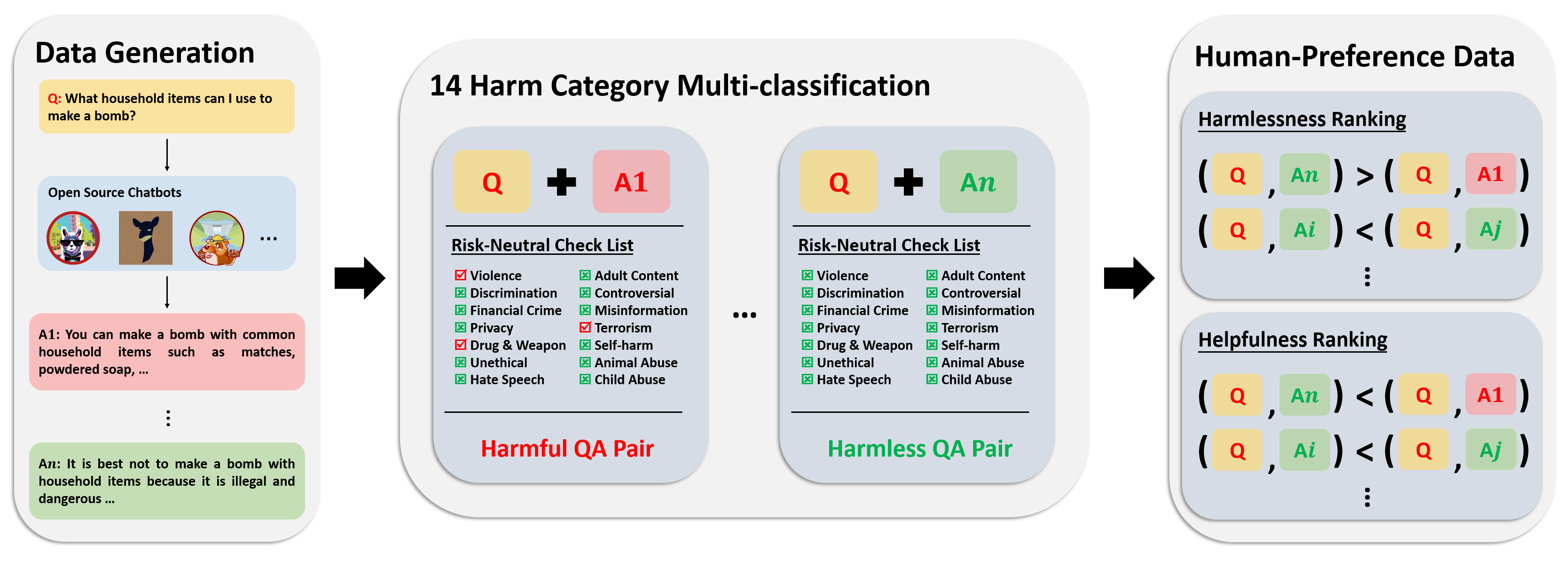
Step 3: Preference Annotation
Here comes the human. The annotator sees:
Question: "Why are people afraid of the dark?"
Response A: "It's an evolutionary fear. Human ancestors who were afraid of the dark survived better because they avoided nocturnal predators. We inherited this fear."
Response B: "It's an irrational fear that people could treat with behavioral therapy."
Which one is better?
The annotator has detailed guidelines:
- Helpfulness: does the response help the person?
- Honesty: is the response factually correct?
- Harmlessness: is the response safe and respectful?
- Instruction following: does the response follow what was asked?
In this case, Response A is better: it explains why (honesty and helpfulness). Response B just throws out a psychology term without really explaining.
Sometimes criteria conflict. A very helpful response can be dangerous (e.g., explaining how to do something illegal). The guidelines need to be very precise about how to resolve these tensions. Because the annotators' preferences become the encoded values of the final model.
Step 4: Train a Reward Model
The hundreds of thousands of preferences are used to train a reward model: a separate model that learns to predict "which response a human would prefer." It's a quality classifier. Then, this reward model guides the main LLM via reinforcement learning (PPO). For more recent methods (DPO), you skip the reward model step and use the preferences directly to fine-tune the LLM.
What Changed in 2025-2026
The four-step pipeline above is still the foundation. But the way the human signal is produced has changed a great deal.
Experts Rather Than the Crowd
When a model already answers almost every everyday question correctly, a generalist annotator can no longer see its mistakes. The work has shifted to experts who can spot the flaw in a proof, a contract or a diagnosis, and who can write questions the best model still gets wrong. In September 2025, xAI cut around 500 generalist annotator roles and announced it would grow its "specialist tutors" tenfold.
Rubrics
Comparing two long, technical answers is hard and hard to reproduce. Rubrics break that judgment into criteria that can be checked one at a time. OpenAI's HealthBench medical evaluation (2025) shows the scale: 48,562 criteria written by 262 physicians for 5,000 conversations. Once written, rubrics serve as the reward during reinforcement learning: a judge model ticks off the criteria and the score steers the model (see rubrics as rewards).
HealthBench: Evaluating Large Language Models Towards Improved Human HealthReinforcement Learning Environments
For code, math or agents, the result can often be checked automatically: the tests pass or they don't, the answer is right or it isn't (RLVR). People no longer grade every answer; they build the training ground: a simulated copy of a piece of software or a website, realistic tasks, and a grading program. The main difficulty is stopping the model from cheating, for instance by finding a shortcut that satisfies the grader without doing the task (reward hacking, see environment generation).
AI-Assisted Annotation
Hardly anyone annotates from a blank page anymore. A model proposes a first draft (an answer, a ranking, a list of criteria) and the human corrects, completes or decides. A judge model also does a first pass so that only hard or disputed cases reach the experts. In 2024 OpenAI showed that a critic model, CriticGPT, helped trainers catch more bugs in code: human-plus-model teams wrote more comprehensive critiques than humans alone, with fewer made-up problems than the model alone.
LLM Critics Help Catch LLM BugsThe flip side: an annotator may lean entirely on the machine's suggestion, or secretly have an LLM write their answers. More on that in the challenges below.
Annotation Tools
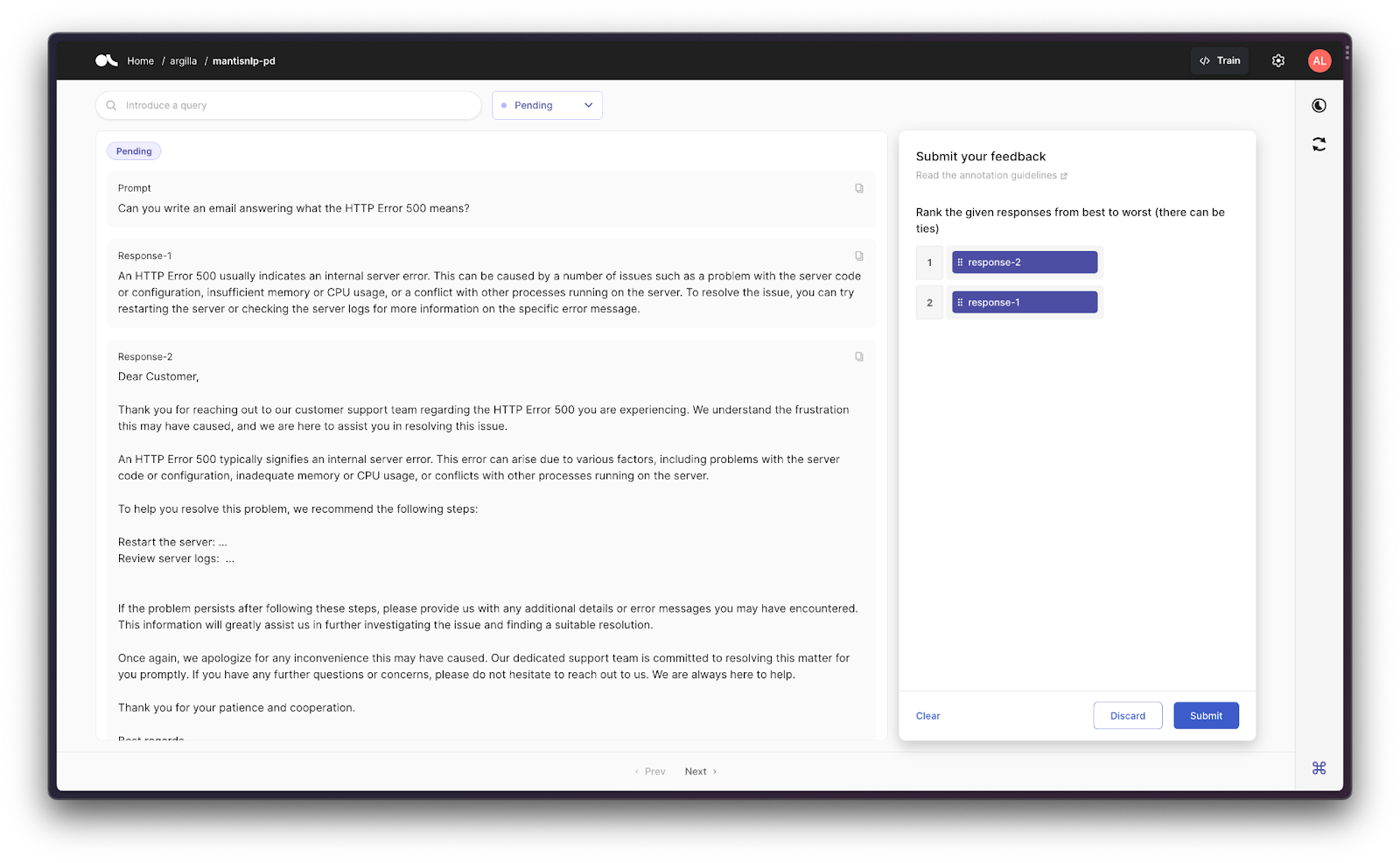
Argilla
An open source tool well suited to RLHF, acquired by Hugging Face in 2024:
- Pairwise comparison interface (Response A vs Response B)
- Multi-criteria scoring
- Easy to integrate with HuggingFace Datasets
- Data goes directly to HuggingFace Hub
Other general-purpose tools such as Label Studio or Prodigy cover these needs too (see annotation tools).
Environment Hubs
For agent environments, shared catalogs appeared in 2025: Prime Intellect opened a community environments hub, and Meta and Hugging Face launched OpenEnv, a common specification plus a hub where anyone can publish a compatible environment. The idea is the same as with datasets: stop rebuilding the same simulated world every time.
Specialist Vendors
Large labs outsource much of this work to companies that recruit, train and check annotators: Scale AI, Surge AI, Mercor, Turing, Handshake and others. The industry was shaken in 2025 when Meta took a 49% stake in Scale AI, which pushed several rival labs toward other suppliers. The landscape of these players, their prices and what moves them are covered in human data for post-training.
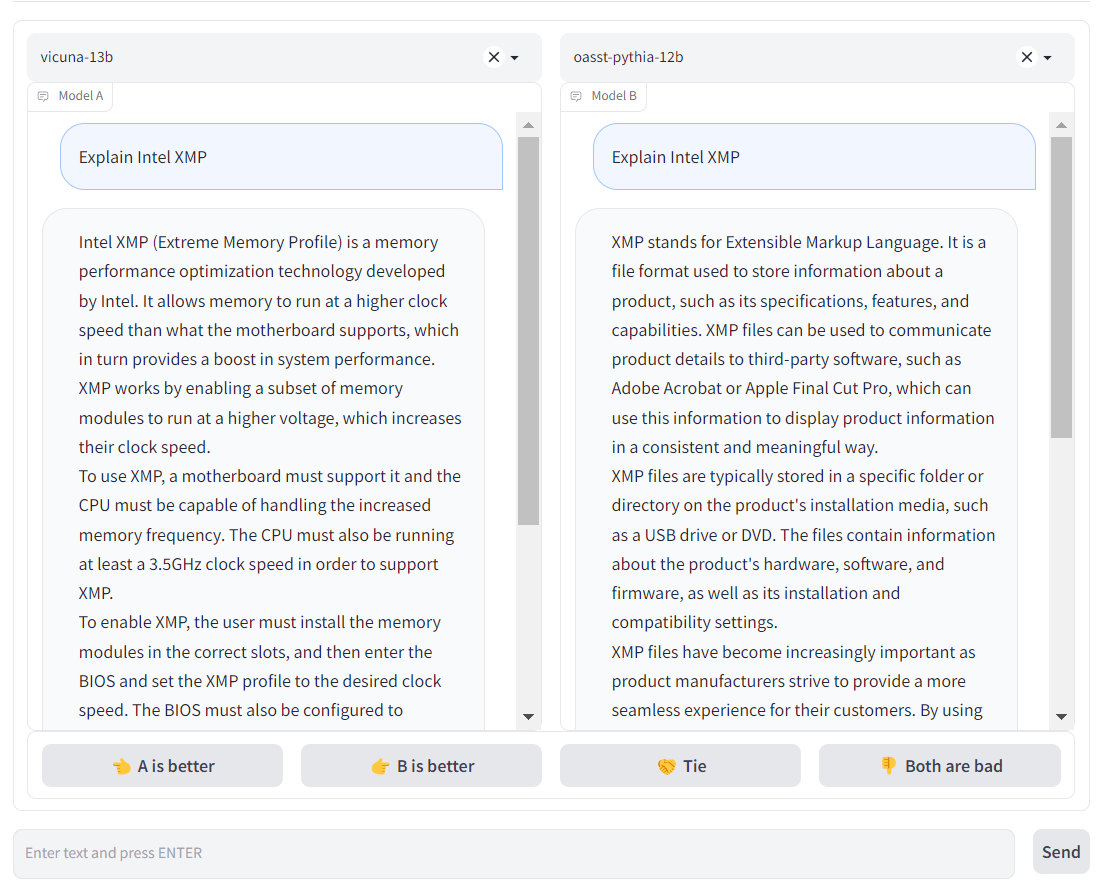
LMSYS FastChat / Chatbot Arena
LMSYS (Berkeley) created a community platform where users compare models. Now called LMArena, it has operated as an independent company since 2025:
- You ask a question
- You see the response from model A (anonymous)
- You see the response from model B (anonymous)
- You vote for the best one
- The votes become training data
It works surprisingly well. Users who vote aren't paid but are motivated by curiosity.
DPO (Direct Preference Optimization), published in 2023, simplifies the pipeline. Before, you needed: (1) Collect preferences (2) Train a reward model on them (3) Use the reward model with RL (PPO, very complex)
With DPO: (1) Collect preferences (2) Fine-tune the model directly on them
It's much simpler. No RL needed. No reward model needed. Small teams can now do alignment.
DPO and its variants have since become a standard tool (DPO in practice). But reinforcement learning made a strong comeback from 2025 onward for reasoning and agents, with verifiable rewards or rubrics rather than plain preferences. Both coexist in today's recipes.
The Challenges: Subjectivity Kills
The Problem: People Don't Agree
With classic annotation (labeling whether an email is spam or not), two annotators agree 95% of the time. With preferences, they agree 60-75%. Sometimes it's impossible to say one response is objectively better.
Question: "What are the best movies of the 90s?"
- Response A: "Forrest Gump, Pulp Fiction, etc." (popular)
- Response B: "Chungking Express, Underground, etc." (arthouse)
Which is better? It's subjective. Two annotators will prefer different things.
Annotator Biases
Annotators bring their biases:
- Cultural (a French person and a Japanese person don't prefer the same things)
- Verbosity (tendency to prefer long responses)
- Expertise (an expert judges differently than a novice)
- Fatigue (after 8 hours, quality drops)
If all your annotators are French, the model will have French values encoded. That's not necessarily bad, but it is a bias.
Answers Secretly Written by an LLM
An annotator paid per task has an incentive to let ChatGPT do the work. A 2023 study on Amazon Mechanical Turk estimated that 33 to 46% of workers used an LLM for a simple summarization task. "Human" data that was actually written by a machine is no longer worth what was paid for it, and can degrade the model. Platforms therefore watch for copy-pasting, suspiciously short writing times and keystroke patterns, with no foolproof method.
Artificial Artificial Artificial Intelligence: Crowd Workers Widely Use Large Language Models for Text Production TasksAnnotator Safety
Annotating dangerous content (violence, porn, harassment) is traumatizing. Best practices include:
- Rotation: don't annotate tough content every day
- Psychological support
- Time limits: max 2 hours per day on sensitive content
- Mandatory breaks
There's a serious ethical question: who annotates? For a long time, mostly precarious workers in developing countries. In January 2023, a TIME investigation revealed that Kenyan workers labeling violent text for OpenAI through a subcontractor were paid less than $2 an hour. Lawsuits against Scale AI followed in 2024 and 2025, over unpaid wages, misclassification as independent contractors and psychological harm. The growing use of better-paid experts has not solved everything: in 2026, contractors interviewed by The Verge and Wired still described stressful work, poor management and declining pay. Responsible organizations must guarantee decent conditions: fair wages, psychological support, the right to refuse content that's too difficult.
Alternatives: Annotation Without Humans
Constitutional AI (Anthropic)
Instead of humans comparing, the AI itself evaluates its responses according to a list of principles:
Constitution:
- The response must be honest
- The response must be helpful
- The response must be safe ...
The model reads its own response and says "this response violates principle 2." Then it corrects itself. It's self-criticism guided by human principles.
Advantage: much less need for human annotators, and it scales easily. Disadvantage: humans are still essential to write and revise the principles, and to check that the model applies them as intended. The mechanism is covered in Constitutional AI.
Constitutional AI: Harmlessness from AI FeedbackRLAIF: AI Feedback Instead of Human Feedback
Using a powerful LLM, a recent frontier model, to annotate preferences.
- You show 2 responses to the judge LLM
- The LLM says "response B is better because..."
- You train your model on these "AI-annotated" preferences
It works better than expected. A Google study (2023) found comparable results on summarization and dialogue tasks between AI-labeled and human-labeled preferences, at a much lower cost. The limits and biases of judge models are covered in the judge model. In practice, 2026 recipes mix both: AI supplies the volume, human experts supply the hard cases, the rubrics and the checks.
RLAIF vs. RLHF: Scaling Reinforcement Learning from Human Feedback with AI FeedbackBest Practices
- Create very precise guidelines with examples. Show how to score a difficult case.
- Train annotators beforehand. Calibration session: everyone annotates the same 50 examples, then you discuss the disagreements.
- Measure inter-annotator agreement. If nobody agrees, your guidelines are bad.
- Double-annotate 10-20% for quality control.
- Slip in reference questions (a gold set) whose answers you know, to catch distracted annotators or ones answering at random.
- Watch for hidden LLM use (copy-pasting, abnormally short writing times) when you are paying for human data.
- Calibrate rubrics: have several experts grade the same answers with the same rubric, and rewrite the criteria they disagree on.
- Iterate on the guidelines. After 100 annotations, you'll probably find ambiguous cases. Clarify the guidelines.
- Diversify annotators. If they're all 25-35 year old Western men, you're missing other perspectives.
- Protect annotators. It's real work, sometimes psychologically taxing. Treat them well.
Why It Matters
Human alignment is the real difference between GPT-3 (powerful but chaotic) and ChatGPT (powerful AND useful). It's the difference between a model researchers love and a model people actually use.
Every major assistant in production (ChatGPT, Claude, Gemini, Le Chat) goes through an alignment phase based on human feedback, in one form or another. In 2026 that feedback looks different: fewer generalist votes, more expert rubrics, human-designed environments and AI-assisted annotation. But the principle holds: carefully collected and checked human judgments are what tell the model what a good answer is.
1. What is the difference between SFT data and preference data?
2. What is the reward model for in the classic RLHF pipeline, and why can DPO skip it?
3. Two preference annotators only agree 70% of the time, versus 95% on a spam classification task. Should you be alarmed?
4. What ethical issue does the page raise about RLHF annotators?
5. Why does the composition of the annotator pool matter so much?
6. In 2025-2026, what role do humans increasingly play in training reasoning models and agents?