The backstory: where does the data that ChatGPT uses come from?
GPT-3 was trained on 300 billion tokens (small pieces of words). Each token comes from somewhere. And the vast majority comes from the web.
OpenAI crawled billions of web pages: Wikipedia, Reddit, GitHub, blogs, news sites. All of it was scraped, cleaned, filtered, then fed into training. The result? The data that powers modern LLMs.
But how do you do this at scale? You can't ask 1,000 humans to copy-paste web pages. You need an automated, scalable process, capable of handling petabytes of raw data.
Welcome to web scraping for ML.
Common Crawl: the largest public web dataset
What is it?
Common Crawl is a nonprofit organization that has been systematically crawling the web since 2011. Roughly once a month, it captures a snapshot of several billion web pages.
It's like taking a photograph of the entire web, a photograph that weighs about 300 terabytes compressed.
The data is public and free
Common Crawl makes all its data available online for free. You can download the snapshots, search through billions of pages, use what you find.
It's already used for:
- C4 (Common Crawl-Colossal Cleaned): the dataset that Google uses
- The Pile: 825 GB of high-quality text
- FineWeb: 15 trillion tokens, the most recent and widely used dataset
The formats
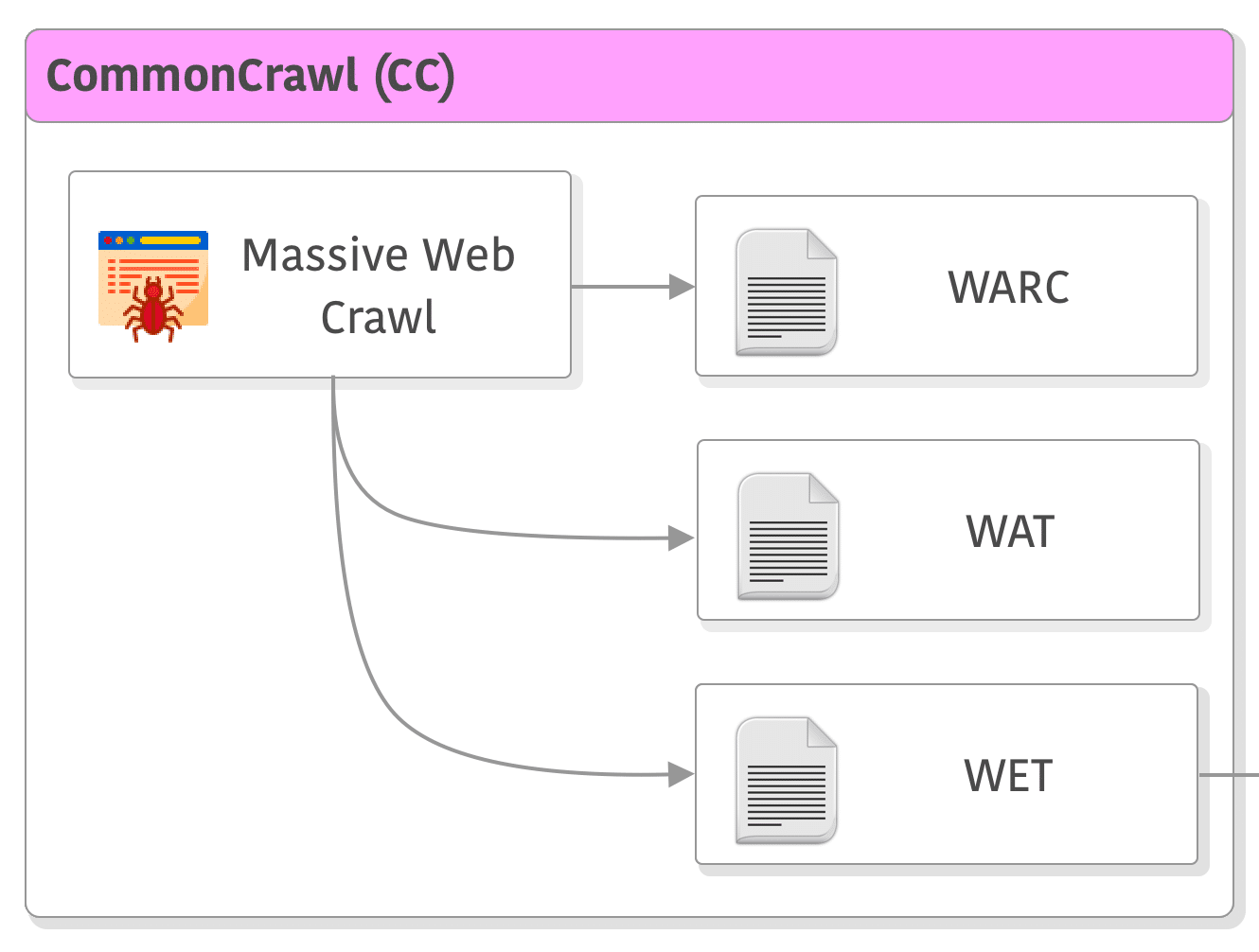
Common Crawl distributes its data in three formats:
WARC: the raw HTML of each page (complete, heavy) WAT: the metadata (HTTP headers, timestamps, URLs) WET: the extracted text (no HTML, just plain text)
For training an LLM, you mainly need the WET (just the text).
The pipeline: from raw web to clean dataset
Step 1: choose the snapshots
Common Crawl produces a new snapshot each month. You pick some. The most recent (for freshness), the oldest (for a baseline), all of them.
Step 2: extract the text
You need to parse the HTML and extract just the textual content. Not the menus, not the ads, not the footers. Just what a human would read.
Tools:
- BeautifulSoup: classic Python library for parsing HTML
- trafilatura: specialized in extracting the "main content" of a page
trafilatura is generally better for this use case. It uses advanced heuristics and ML to identify the editorial content of a page and ignore all the noise (menus, ads, footers, sidebars).
Step 3: filter by language
You want a French LLM? Keep the French text, discard the rest.
Tool: fastText (Meta's library) for language classification.
It sounds simple but at 300 TB of data, it takes time.
Step 4: filter by quality (THE BIG ONE)
This is the most critical step of the entire pipeline. Among billions of web pages, the majority is garbage: spam, auto-generated content, near-empty pages, repetitive content.
You need heuristics and classifiers to say "this page is good, this one is bad."
Simple heuristics:
- Length: not too short (< 100 words), not too long (> 100,000 words)
- Alphabetic character ratio: lots of symbols = probably code or spam
- Stop word ratio: too few "the," "a," "is" = probably spam
- Duplicate lines: lots of duplication = boilerplate (menus, footers)
- Unique word ratio: low diversity = repetitive content
More advanced classifiers:
- Perplexity filtering: a language model measures how "normal" the text is. Wikipedia has low perplexity. A spam page has high perplexity.
- Quality classifier: train a small model to distinguish "high-quality content" (Wikipedia, books) vs "low-quality content" (spam, auto-generated)
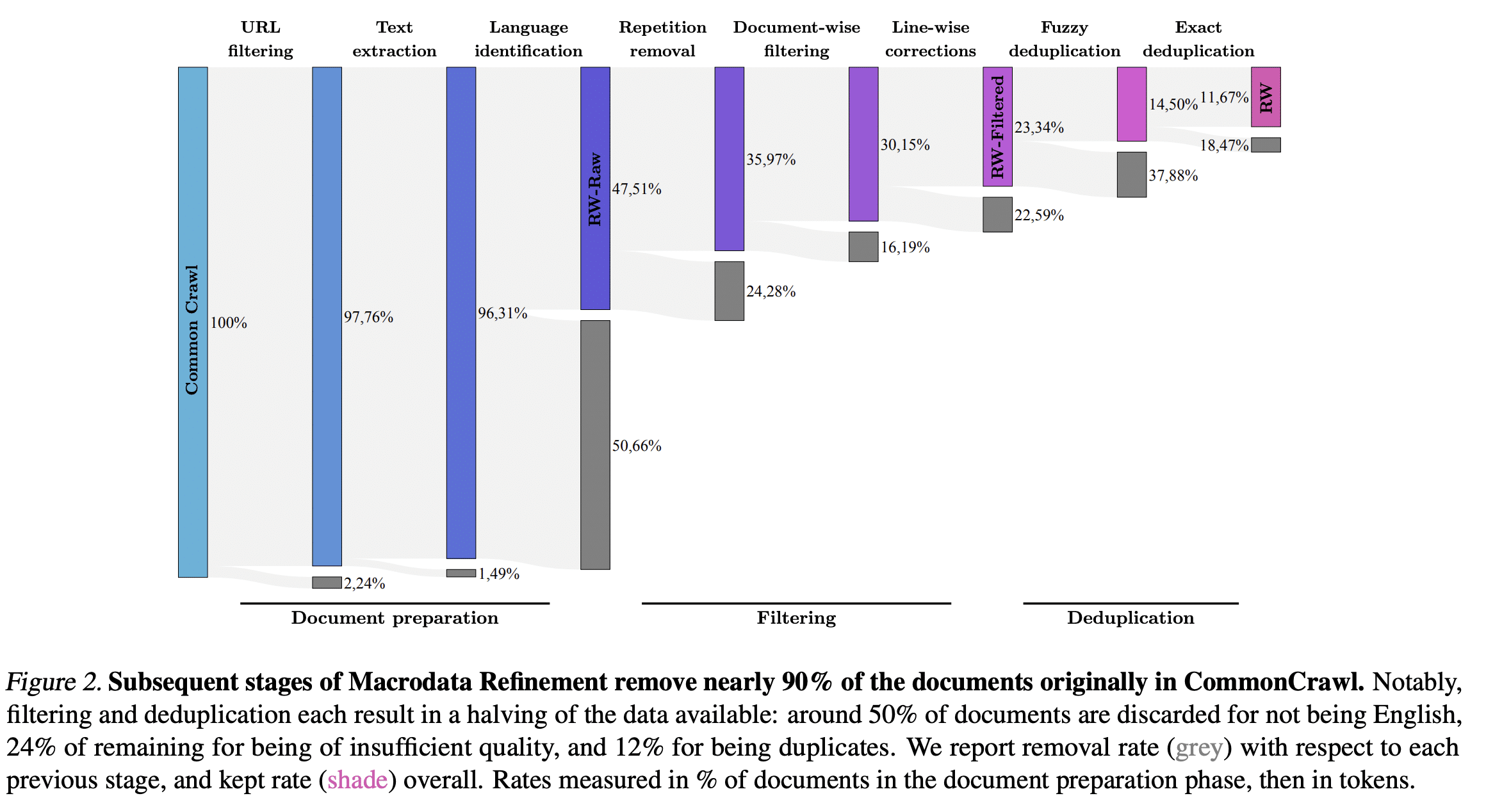
HuggingFace published FineWeb, a filtered Common Crawl dataset. They applied aggressive filtering: 90 billion original pages reduced to 15 billion after filtering (82% of content eliminated).
Result: models trained on FineWeb (15 billion filtered pages) perform significantly better than models trained on a larger raw dataset.
The lesson: 15 GB of clean data beats 100 GB of dirty data. Quality always trumps quantity.
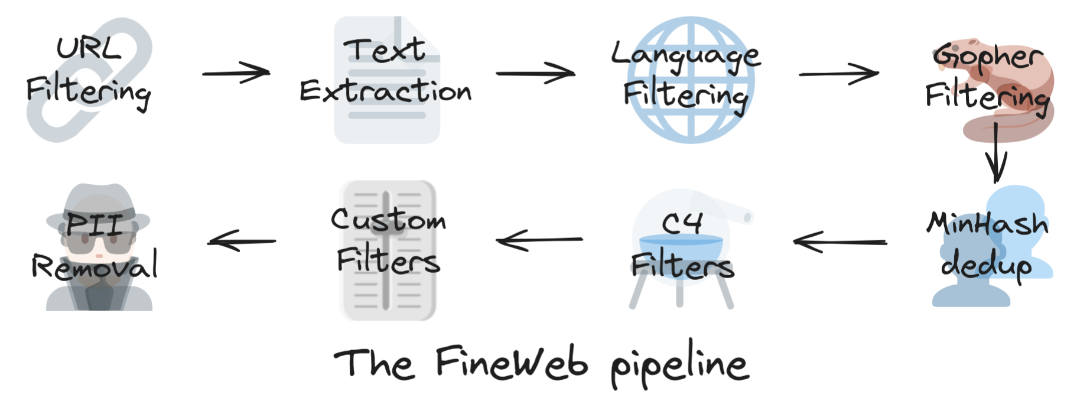
Step 5: deduplication
Common Crawl has A LOT of duplicate content. Mirror pages. Syndicated content (the same article on 100 different blogs). You need to clean up.
Exact deduplication: compute a SHA-256 hash of each page. Pages with the same hash are identical.
Near-exact deduplication: two pages are 99% identical (just one line different). That's more complex.
Tools: MinHash + LSH (Local Sensitive Hashing) to efficiently find near-identical documents at scale.
Alternatives to Common Crawl: when to crawl yourself
Public APIs
When they exist, prefer APIs:
- Wikipedia: complete free dump updated monthly
- ArXiv: all scientific articles in open access
- GitHub: API for source code (respect the licenses)
- Reddit: public archives
- Stack Overflow: public data dump
These APIs are cleaner than raw scraping. Less spam. Better structure.
Direct scraping
For sources not covered by Common Crawl or APIs:
requests + BeautifulSoup: simple, OK for small volumes
Scrapy: robust framework for large-scale crawls
Playwright/Selenium: if pages need JavaScript (single-page apps)
Trafilatura
trafilatura is the most accurate tool for extracting clean text from raw HTML. It combines:
- Heuristics to identify the main content block
- Automatic cleaning (removing boilerplate, ads, menus)
- Handling of tricky cases (tables, lists, multimedia content)
Ethical and legal considerations
Robots.txt
Websites publish a robots.txt file that tells bots which pages they can crawl and which are off-limits. An informal convention since 1994, it has been a written standard since 2022 (RFC 9309).
It is a declarative signal: it expresses a wish but blocks nothing technically. Yet its weight has grown a lot with AI:
- AI companies publish separate bots for training (GPTBot, ClaudeBot, Google-Extended...) and for real-time search, and sites block them more and more: in a single year (2023-2024), over a quarter of the most important sources in the C4 corpus closed their doors to AI crawlers.
- In Europe, robots.txt serves as a "machine-readable" reservation against text and data mining (Directive 2019/790, art. 4), and the AI Act Code of Practice (July 2025) explicitly asks model providers to honor it.
- Intermediaries such as Cloudflare now block AI crawlers by default on part of the sites they protect, and offer to make them pay ("pay per crawl").
Honoring robots.txt remains the baseline for responsible collection. The details of these mechanisms (dedicated agents, TDMRep, pay per crawl, RSL) are in Opt-outs and access protocols.
Copyright: the battleground
This is the real question of web scraping for AI.
The facts, as of November 2026:
- New York Times v. OpenAI and Microsoft (New York, filed December 2023): still pending. In autumn 2026, the case was at the summary judgment stage, with no ruling on the merits and no trial date.
- Getty Images v. Stability AI: in the UK, the High Court rejected most of Getty's case in November 2025 (it held that the Stable Diffusion model does not store the photos and is therefore not an "infringing copy"), upholding only limited trademark infringement linked to watermarks reproduced by older versions. Getty was granted permission to appeal; the appeal was pending in November 2026. The US action, moved to California, continues.
- In the US, two judges found in June 2025 that training on books was fair use (the American exception for certain uses of protected works) in the cases against Anthropic and Meta. But Anthropic agreed to pay authors $1.5 billion for downloading pirated books, a settlement approved in July 2026: how data is obtained matters as much as how it is used.
- In Germany, the Munich court ruled at first instance in November 2025 that OpenAI had infringed copyright because its models had memorized and reproduced song lyrics (see Memorization and extraction). OpenAI disputes the ruling.
- The EU AI Act has required providers of general-purpose AI models, since August 2025, to publish a summary of their training data and to have a policy for complying with copyright, including opt-outs expressed by rights holders.
- In Asia, it varies enormously (Japan and Singapore, for example, have broad exceptions for data analysis).
The takeaway: the legal landscape is evolving very fast and the rulings do not all point the same way. What was tolerated in 2020 may no longer be in 2026. A detailed overview of the rulings is in What the courts have said about training.
Scraping billions of pages to train a commercial model carries real legal risk, especially in Europe where rights holders' reservations must be honored. That is why the big labs increasingly sign licensing deals with publishers and platforms (see The training data market) and document the provenance of every source.
Personal data: GDPR
Scraping can collect personal data (names, emails, addresses). GDPR and other laws impose obligations:
- Minimization: only collect what is necessary
- PII scrubbing: remove emails, phone numbers, addresses
- Right to be forgotten: if someone asks, you must be able to delete their data from the dataset
Rate limiting and politeness
- Respect the server: delays between requests
- Descriptive User-Agent: identify your crawler ("MyCrawler/1.0")
- No accidental DDoS (Distributed Denial of Service): if you send 1,000 requests/second, the server goes down
Best practices
- Document provenance: for each piece of data, trace its URL, date, license
- Version the dataset: use DVC or LakeFS for data versioning
- Reproducibility: the pipeline must be runnable multiple times and produce the same result
- Quality over quantity: 10 GB of clean data is better than 1 TB of dubious content
- Respect licenses: check the terms of use for each source
Why this matters
80% of the data an LLM sees comes from the web. The quality of web scraping determines the quality of the model.
- Bad scraping -> model with lots of hallucinations
- Good scraping + good filtering -> capable and factual model
The labs that do good scraping (aggressive filtering, deduplication, cleaning) produce the best models.
It's an invisible but fundamental element of modern AI.
1. The FineWeb pipeline discarded 82% of Common Crawl's content through filtering. Isn't that an enormous waste of training data?
2. To train an LLM from Common Crawl, which format is usually the starting point?
3. What status does the page give to the robots.txt file in 2026?
4. Where did the copyright and training lawsuits cited by the page stand in November 2026?
5. According to the page, why do the big labs increasingly sign licensing deals with publishers?