The problem: care drowning in paperwork
A patient arrives with arm pain. The doctor examines, palpates, questions. Then sits down at a screen and writes. Then hunts for the patient's history in scattered notes written by other people. Typing, searching, copying.
Sinsky and co-authors (Annals of Internal Medicine, 2016) directly observed 57 US physicians across four specialties (family medicine, internal medicine, cardiology, orthopaedics) for 430 hours of office time. Result: 49.2% of the office day spent on the electronic record and desk work, against 27.0% in direct contact with the patient.
Three clarifications that decide what the figure licenses you to say: this is US ambulatory practice, not a hospital and not France; it is 2016, before the current generation of tools; and it is direct observation rather than self-report, which makes it rather more solid than average.
The raw material is free text: discharge summaries, consultation notes, referral letters, specialist correspondence. Everything needed to treat the patient is in there, but out of order, incomplete, stuffed with in-house abbreviations, written fast between patients.
Clinical NLP (natural language processing applied to medical text) exists to make that disorder machine-usable.
Spotting entities
The first task is NER, named entity recognition: highlighting the fragments of text that denote something medical, and saying what.
- Diseases and symptoms: "type 2 diabetes", "radiating chest pain", "exertional dyspnoea".
- Drugs: "metformin 500 mg", "atorvastatin 20 mg".
- Procedures: "brain MRI", "liver biopsy", "coronary angiography".
- Anatomy: "right upper lobe", "common femoral artery".
- Lab values: "HbA1c 7.2%", "creatinine 12 mg/L".
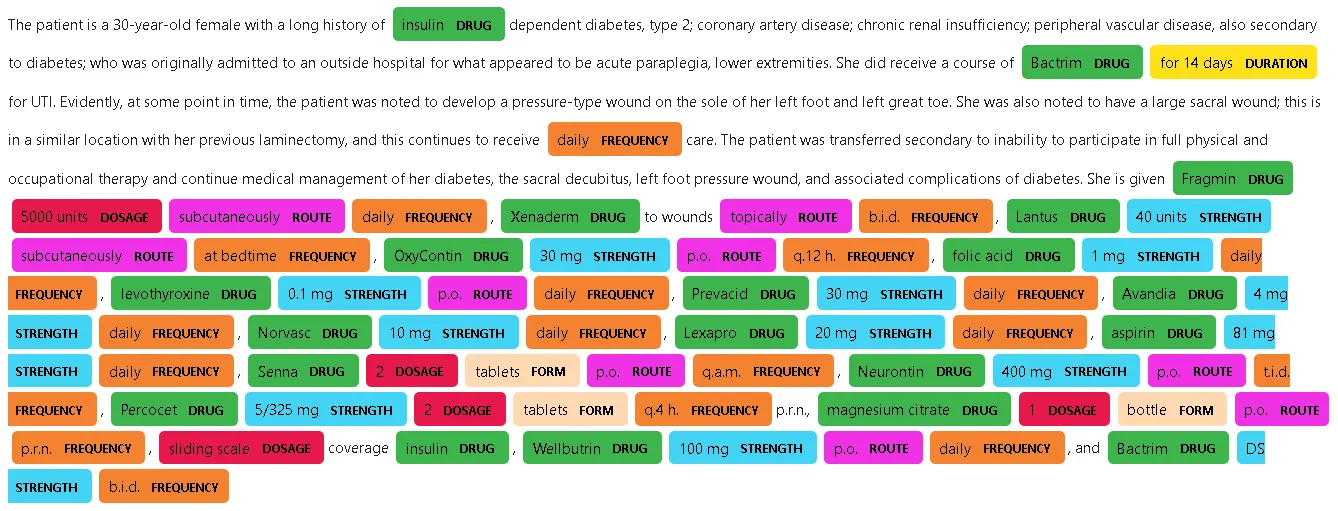
The reference models are BERTs (bidirectional encoder representations from transformers) retrained on clinical text. ClinicalBERT (Publicly Available Clinical BERT Embeddings) starts from a general BERT and continues its training on notes from MIMIC-III, drawn from intensive care at Beth Israel Deaconess Medical Center. The rationale is simple: the vocabulary and syntax of a hospital report resemble neither Wikipedia nor a scientific paper.
An earlier version claimed ClinicalBERT "identifies 14 types of pathology with accuracy above 90%." That claim corresponds to no result in the paper: the "14 observations" belong to the CheXpert chest radiograph dataset, an unrelated imaging task covered in medical imaging. The figure has been removed.
The case illustrates a common mechanism: an exact number travels from page to page, changing task on the way. Faced with any score, the question is not only "where does this number come from" but "from what task does it come".
Spotting is not enough, you have to normalize. One doctor writes "hypertension", another "HTN", a third "high BP". Same thing, and a system only knows it if all three are mapped to a single identifier in a reference terminology: ICD-10 (International Classification of Diseases, tenth revision) for diagnoses, SNOMED CT for very fine-grained clinical vocabulary, the UMLS (Unified Medical Language System) as a crosswalk between terminologies.
Without this step you cannot compare two cohorts, feed a registry, or bill. It is the least spectacular work in the field and the most decisive.
Spotting relations, and above all negations
Isolated entities are not enough. "Metformin 500 mg twice daily" only means something if the dosage and frequency attach to the right drug, and not to the paracetamol mentioned two lines down.
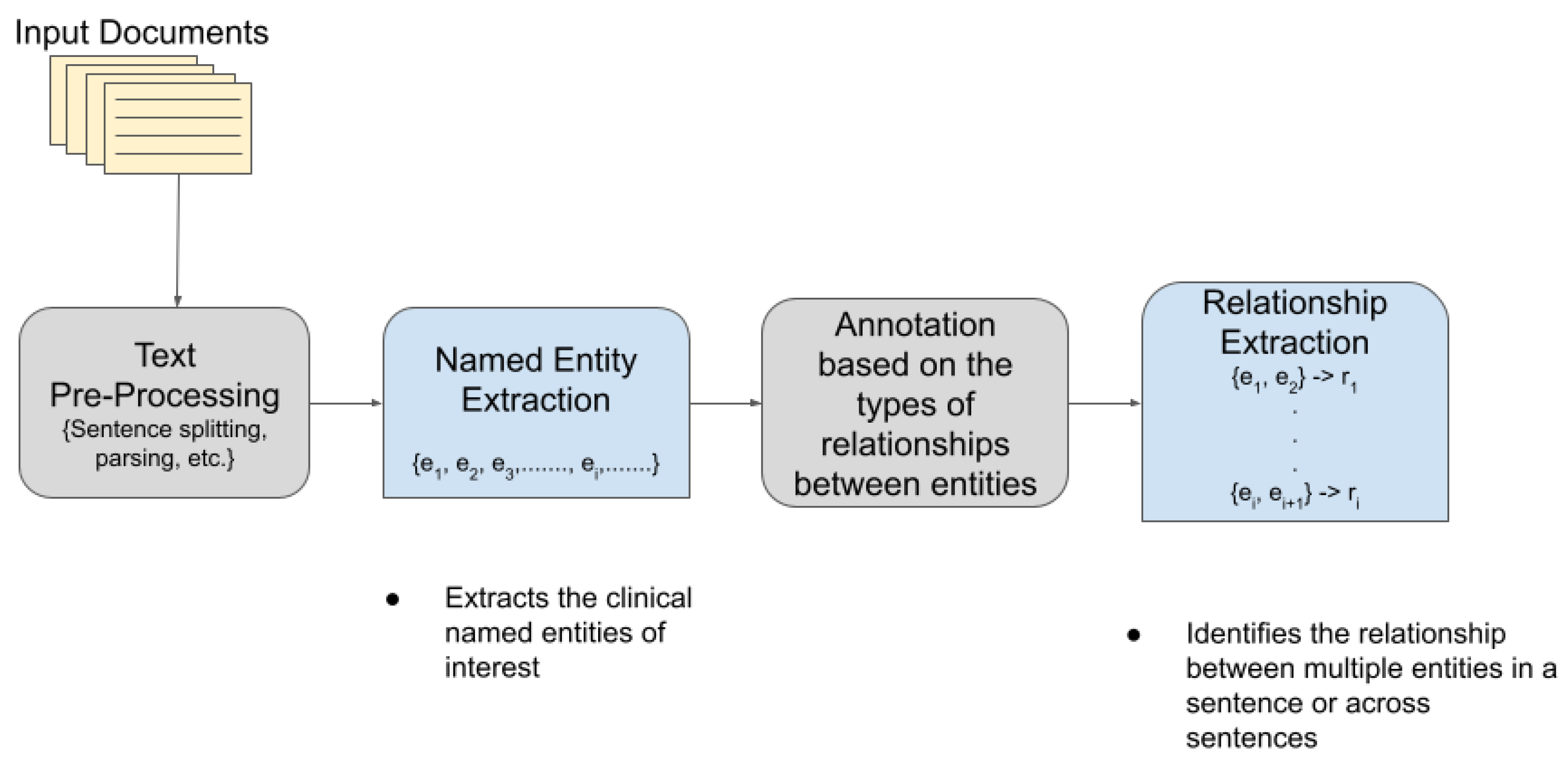
Medical text is overwhelmingly negative. A conscientious report lists what the patient does not have: "no sign of diabetes", "absence of chest pain", "the patient denies any smoking history".
A system that spots the entity "diabetes" without handling the "no sign of" in front of it produces exactly the opposite of the truth. That is not a marginal error: it is a false history entered into a record.
Hence dedicated tools, from the rule-based NegEx system through to trained models such as NegBERT. The real difficulty comes from complex constructions: negation scope spanning several clauses, uncertainty ("cannot be excluded"), attribution to someone else ("family history of diabetes, not in the patient"). These constructions are frequent and the error is silent.
Summarizing a record
Three families, with three different risk profiles.
Extractive summarization selects sentences from the record and copies them out. It cannot invent anything, by construction. On the other hand it loses the thread and can juxtapose contradictory items from different dates.
Abstractive summarization rewrites in free language. Far more readable, and exposed to the central risk: producing a sentence that is fluent and false.
Structured summarization fills mandated fields, history, allergies, current medication, recent results, care plan. It is the most useful format in practice and the easiest to check, because an empty field is visible.
Elsewhere, a model that invents produces an error. Here it produces a false health datum inserted into a record, which will then be read as established fact by clinicians who never saw the source text.
Two examples to fix the idea. An invented allergy can rule out the right treatment. An invented history can steer diagnosis in the wrong direction for years, because every subsequent reader takes it as given.
This yields a design constraint, not merely a caution in use: any automatically produced summary must be read and validated before entering the record, and the system must let you trace every statement back to the passage of the source record that supports it. A filing that claims clinical summarization without that chaining is claiming a shortcut, and that is the point to probe.
Automatic coding: a textbook case for reading a score
Medical coding means assigning a hospital stay the standardized codes that describe it: ICD-10 for diagnoses, and national procedure classifications for interventions. Billing, epidemiology and research all depend on it, and the work is currently done by specialist human coders.
It is also the field's best example of why an isolated score means nothing.
On the MIMIC-III database, automatic coding is evaluated two ways, and the two are constantly conflated.
On the full code set (several thousand possible labels, the vast majority of which appear very rarely) published results are around 54% micro-F1 for the 2018 CAML model (Explainable Prediction of Medical Codes from Clinical Text) and around 60% for the best models built on pre-trained language models.
On only the 50 most frequent codes, the same methods report markedly higher scores.
The model has not changed; the exercise has. Reducing the problem to the fifty common codes removes exactly what makes it hard: the long tail of rare codes, which is also where the atypical stays live. Faced with an automatic coding score, the first question is therefore across how many codes, before even looking at the percentage.
Micro-F1 itself pools all decisions across all codes before computing precision and recall: it is therefore dominated by the frequent codes. See evaluation metrics and how to read a benchmark score.
Even imperfect, such a model is useful, but for one precise purpose: pre-coding records, leaving the human coder to validate and correct. The gain is human time, not autonomy.
Ambient documentation: the best-evidenced case
The scenario: doctor and patient talk normally; a system listens, transcribes, and drafts a proposed note that the doctor reviews and corrects.
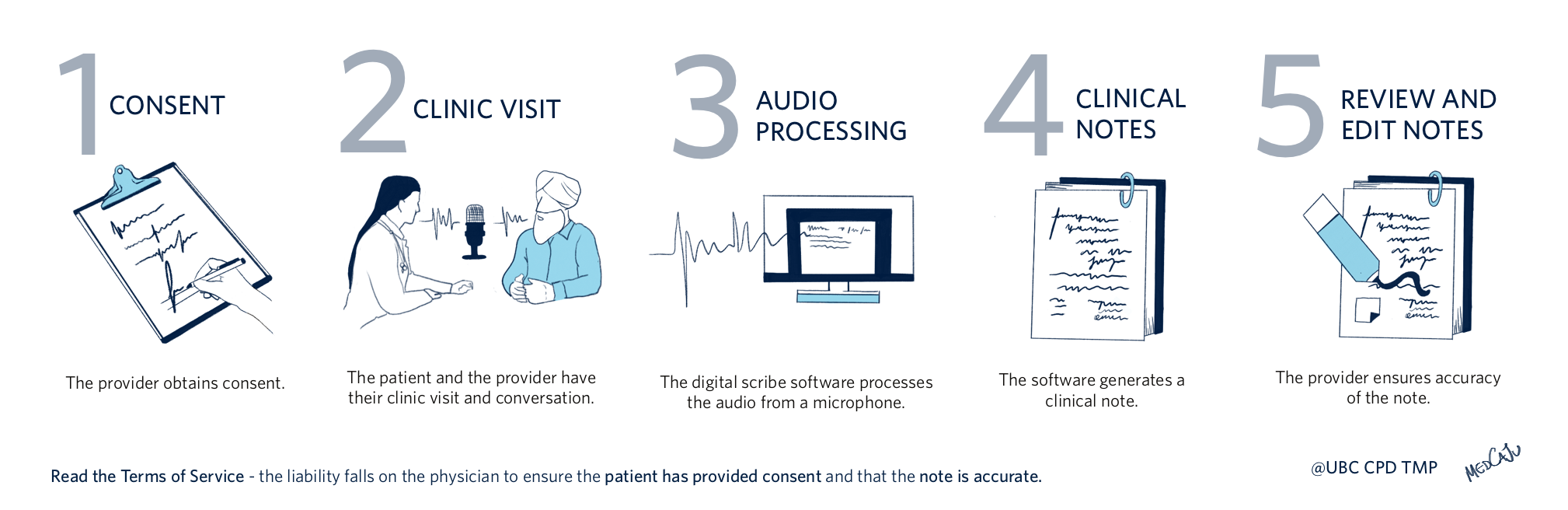
This is no accident. The quantity being measured (time spent writing) is objective, logged automatically by the information system, and diagnostically inconsequential. You can therefore randomize physicians without exposing any patient to risk, which is impossible for a diagnostic tool.
Randomized trials do exist, comparing ambient scribes against usual practice on time-in-note and on burnout scales. Quality improvement studies also report marked falls in burnout scores after a few weeks of use.
Two reading caveats, though. Before-and-after studies without a control group cannot attribute the change to the tool. And burnout is self-reported, hence sensitive to the effect of a new and eagerly awaited device, which an unblinded trial cannot neutralize.
Keep the general principle: in this field, the quality of the evidence tracks the ease of the measurement. That is why the best-supported claims concern administrative time, and the weakest concern diagnosis.
The difficulties specific to clinical text
Non-standardized abbreviations. The same three letters mean one thing in one department and something else next door. Every institution, sometimes every practitioner, maintains their own.
Writing noise. Typos, unfinished sentences, copy-paste from an earlier report that was never updated. That last point is underestimated: a good share of an electronic record consists of copied text, which distorts both human reading and model training.
Siloed jargons. Cardiology, neurology and dermatology do not write the same language. A single model has to cover them all, or else be specialized, and then validated specialty by specialty.
Confidentiality. A record consists of health data, the most protected category under the European GDPR (General Data Protection Regulation), with additional national requirements on certified health data hosting in several countries. Hence the frequent preference for on-premise deployment, with the model running inside the institution.
To use clinical notes in research, they are de-identified: names, dates, addresses and numbers are stripped out. That stripping is very generally performed by an entity recognition model, that is, by the same kind of system described above, with the same non-zero error rate.
Two consequences for a reader of filings. A dataset presented as de-identified was de-identified at some recall, never at 100%. And de-identification is not equivalent to anonymization in the legal sense: a rich clinical text can allow a person to be re-identified by cross-referencing, even without a name. The question to ask is always about the level of guarantee, not the label.
1. A discharge summary contains the sentence 'no sign of diabetes'. What is an extraction system likely to produce if it spots entities without handling negation?
2. A vendor announces an automatic ICD-10 coding score well above the 54-60% published on MIMIC-III. What is the first question to ask?
3. Why does the page treat a hallucination in a medical record summary as being of a different kind from an ordinary hallucination?
4. The page removed the claim that ClinicalBERT 'identifies 14 types of pathology with over 90% accuracy'. What mechanism does that correction illustrate?
5. Why is ambient documentation (the scribe that drafts the note during the consultation) the best-evidenced case in the field?