The problem: a long, expensive tunnel that keeps narrowing
Drug development always follows the same sequence. You identify a target, usually a protein whose malfunction causes the disease. You look for a molecule that binds to it: that is a hit. You improve it into a lead, a molecule that does not merely bind but also has the properties of a medicine. Then come cell tests, animal tests, and finally the three phases of human clinical trials.
"Ten years, two billion dollars, 90% failure." These circulate as self-evident. They in fact rest on studies that do not agree, and a reader of claims should know which.
The cost. DiMasi and co-authors (2016) put the capitalized cost of a new molecule at around $2.6 billion. Wouters, McKee and Luyten (JAMA, 2020), working from financial reports filed with the US securities regulator, find a median of $985 million, with a 95% confidence interval running from about $684 million to $1.23 billion. The two-to-threefold gap comes from what is counted: number and size of firms studied, opportunity cost of capital, treatment of failures. There is no "true" figure.
The failure rate. The commonly cited order of magnitude is that roughly one molecule in ten entering phase I reaches approval. So "nine in ten fail" is reasonable, but it is a sector statistic, not a constant.
The duration. A decade is the usual order of magnitude, highly variable by therapeutic area.
Keep the principle rather than the numbers: when a filing announces a gain "against the usual ten years and two billion," the baseline itself is a contested estimate.
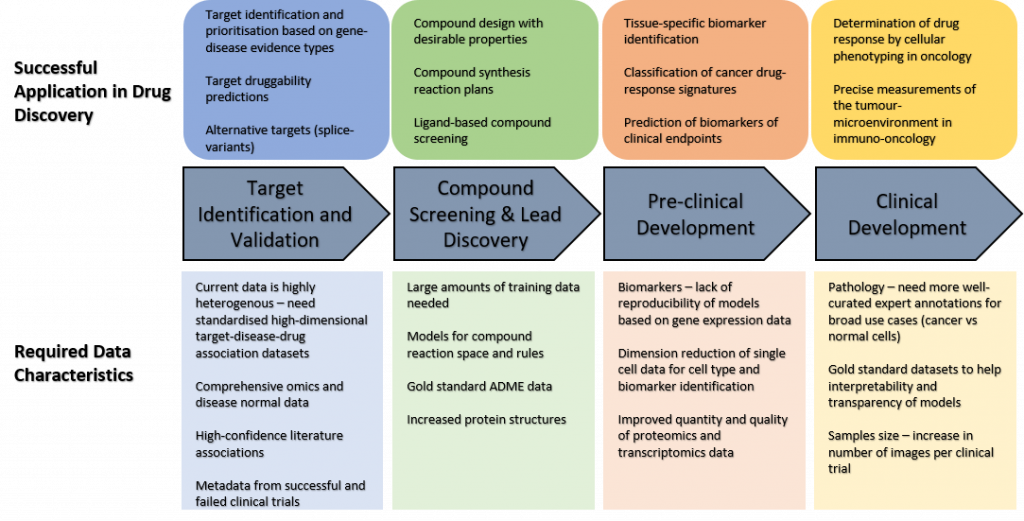
The distinction that governs how to read this whole page
Almost everything AI does well in this field bears on a single question: does this molecule bind to this protein? That is a question of physics and chemistry, with abundant data and verifiable answers.
It is not the question that kills drugs. The vast majority of abandonments happen in phase II and III, for two reasons: the molecule does not deliver the expected clinical benefit, or it produces unacceptable toxicity in humans. Both outcomes depend on the whole biology of a diseased organism, not on the geometry of a binding pocket.
Direct consequence: improving binding prediction improves the front of the tunnel, where it is already cheapest. By construction it says nothing about the part where the money is lost. A filing presenting a binding gain as a gain in clinical success rate is making a leap no data currently supports.
AlphaFold 3, in one section
AlphaFold 2 predicted the shape of an isolated protein. AlphaFold 3 (Abramson et al., Nature 630, 2024) predicts complexes: a protein with a small molecule, with a strand of DNA, with an ion. For drug discovery that is the right question, since a drug is precisely a small molecule attached to a protein.
The AlphaFold 3 article appeared in Nature and has no arXiv preprint: the reference is the journal article. How AlphaFold works internally, from version 1 to version 3, is covered in detail in AlphaFold 1/2/3, this page does not repeat it.
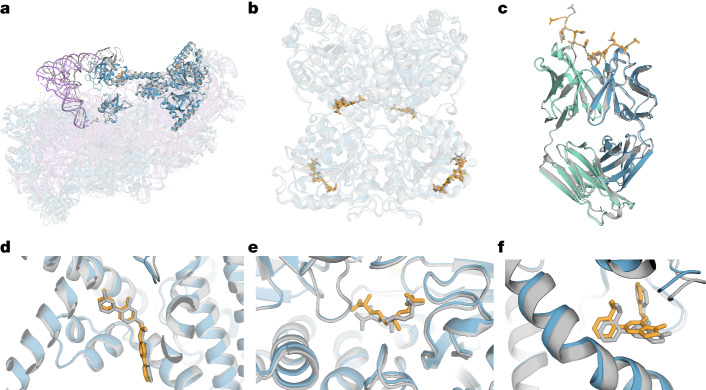
What this changes concretely for a chemist: they see where the molecule inserts and which atoms hold it, hydrogen bonds, hydrophobic contacts, van der Waals forces. They can then reason by modification: "adding a hydroxyl group here creates one more hydrogen bond." That is a gain in direction, not proof of efficacy.
A predicted structure is a hypothesis. The paper compares its predictions against experimentally solved structures, and the resemblance is striking on the cases shown. But a prediction remains a prediction, and the model supplies confidence estimates that must be read alongside it.
Predicting the pose is not predicting the affinity. Knowing how a molecule sits in the pocket is easier than predicting how strongly it stays there, which is the quantity you need to rank candidates. These are two distinct problems, and the second is markedly less well solved.
Virtual screening: sorting billions of molecules
Virtual screening means computationally evaluating a very large number of molecules before synthesizing a single one.
Docking physically simulates each molecule slotting into the target's pocket and gives it a score. Accurate but computationally expensive. DiffDock is a diffusion model that predicts the pose directly instead of searching for it by simulation, hence far faster. Uni-Mol offers a transformer-based molecular representation usable across several downstream tasks.
The ZINC-22 database, published in 2023, indexes more than 37 billion molecules. Enamine's commercial REAL library reported more than 83 billion in autumn 2025, and the count keeps growing.
The crucial point is that these molecules do not exist. They are make-on-demand compounds: combinations of available chemical building blocks and reactions the supplier guarantees generally work. The catalogue describes what could be made, not what is on a shelf.
That has two consequences. The first is welcome: a candidate found in this catalogue can in principle be synthesized within weeks, which is not true of a freely invented molecule. The second calls for caution: catalogue size is a commercial argument as much as a fact, and a figure of "billions of molecules screened" measures compute spent, not the quality of what comes out.
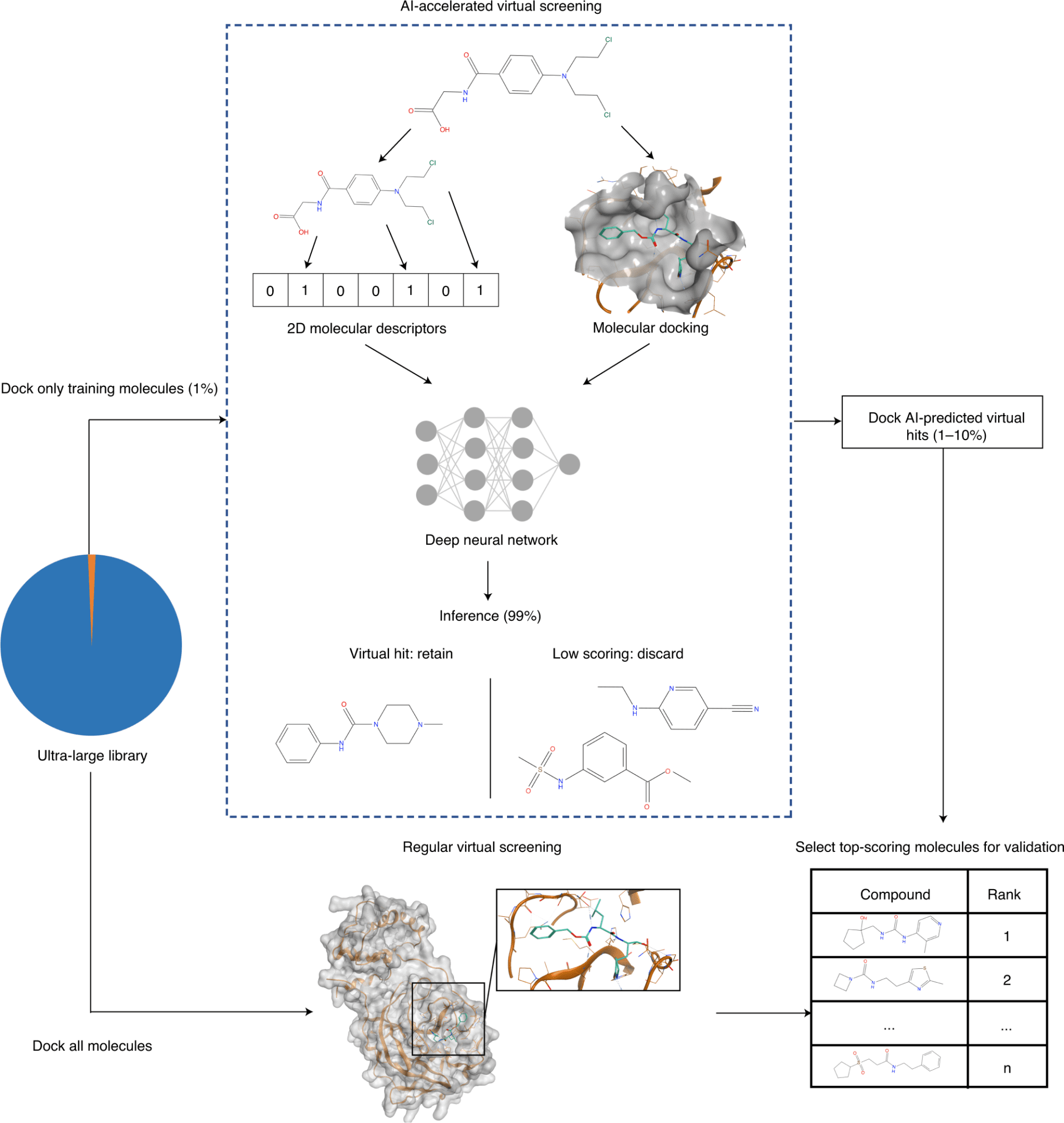
The idea in the diagram is worth stating outright, because it recurs constantly in the field: the network is not used to replace the expensive simulation, but to predict its result so the simulation only runs on the candidates it keeps. The network therefore learns to imitate a computation, not a biological measurement. Its ceiling is the quality of the simulation it imitates, and that simulation is itself approximate.
Generating rather than searching
Instead of combing an existing catalogue, you can ask a model to invent a molecule suited to a target.
- Generative models (variational autoencoders (VAEs), adversarial networks (GANs), diffusion models) applied to molecular graphs: the model learns the grammar of chemistry, then writes new sentences in it. Diffusion models for molecular design details that mechanism.
- Reinforcement learning: optimizing several conflicting objectives at once, bind strongly, dissolve in water, avoid toxicity, stay manufacturable.
- Representations: either SMILES (simplified molecular-input line-entry system), a way of writing a molecule as a character string, or a graph whose vertices are atoms and edges are bonds.
The most advanced case: rentosertib
This is currently the best-documented example of a molecule from AI-assisted design carried through to published clinical results. It deserves precise reading, because it is also the most over-interpreted.
Rentosertib (development code ISM001-055), from Insilico Medicine, is an inhibitor of the TNIK protein developed against idiopathic pulmonary fibrosis. Both the target and the molecule were proposed by the company's generative platform. Phase IIa trial results were published in Nature Medicine in June 2025.
| Protocol element | What the trial says |
|---|---|
| Design | Randomized, double-blind, placebo-controlled |
| Size | 71 patients, 22 sites, in China |
| Duration | 12 weeks |
| Arms | Placebo, 30 mg once daily, 30 mg twice daily, 60 mg once daily |
| Primary endpoint | Safety and tolerability |
| Reported lung function result | At 60 mg daily, mean change in forced vital capacity of +98.4 mL, against −20.3 mL on placebo |
The primary endpoint was safety, not efficacy. This is the most important line. An early phase IIa is designed to check the product is tolerable and to explore doses. The lung function figure is an exploratory result, not the demonstration the trial was sized for.
71 patients, 12 weeks. A trial of that size and duration cannot conclude on clinical benefit in a chronic progressive disease. This is not a criticism of the trial, it is what a phase IIa is meant to be.
One country. Twenty-two sites, all in China. Transfer to other populations remains to be established.
What the case does demonstrate. A target and a molecule proposed by a generative system cleared preclinical work and phase I, and produced in phase IIa an acceptable safety signal and an encouraging efficacy signal. That is real and it is new. It is not yet a medicine: only a phase III can say so, and the company has announced one.
Other players. Recursion couples high-throughput automated cell imaging with learning. Generate Biomedicines designs therapeutic proteins by generation.
The Isomorphic Labs case, and a reasoning error to avoid
Isomorphic Labs, the Alphabet subsidiary spun out of DeepMind, announced two research agreements in January 2024. The amounts were very widely reported, often incorrectly.
| Eli Lilly | Novartis | |
|---|---|---|
| Upfront payment | $45 million | $37.5 million |
| Potential milestone payments | up to $1.7 billion | up to $1.2 billion |
The $2.9 billion total seen everywhere is the sum of contingent milestone payments: sums owed if a candidate reaches specified milestones, most of them clinical stages that nothing guarantees. The money actually paid at signature was a little over $82 million, roughly three percent of the headline figure. This structure (small upfront, large contingent milestones) is the absolute norm in pharmaceutical deals; it is neither a scandal nor a signal.
And above all, the implicit argument does not hold. "Industry would not invest that much in an unproven technology, therefore the technology works" is circular: a deal built on contingent milestones is precisely the instrument you use when the technology is unproven, since it transfers the risk. The size of a deal measures an expectation, never a result.
Predicting what happens to the molecule in the body: ADMET
A molecule that is excellent in a test tube can be useless in a human. The acronym ADMET captures the five questions that decide its fate:
- Absorption: does it cross from the gut into the blood if swallowed?
- Distribution: does it reach the target organ? The brain in particular is shielded by a barrier few molecules cross.
- Metabolism: how fast does the liver break it down? Too fast, no effect; too slow, accumulation.
- Excretion: by what route does the body clear it?
- Toxicity: to the liver, the heart, DNA?
Models such as ADMET-AI estimate these properties from the chemical formula alone in negligible time, where measurement takes weeks. Their proper use is as an upstream filter: discard obviously problematic molecules very early, before spending on synthesis. Their limitation is their training data, which is scarce, noisy, and concentrated on already-explored chemical families.
The four remaining difficulties
The gap between screen and bench. A computationally promising molecule has to be made and tested. The confirmation rate remains modest, and it is the only measure that matters when judging a screening system.
Synthesizability. A generative model can propose a molecule that is beautiful on paper and unreachable in practice. Building synthetic feasibility into generation as a constraint is an active research direction, and a frequent claim.
Data quality. Biological activity measurements are sparse, scattered across labs with differing protocols, and biased by publication: what works gets published. A model trained on that literature learns a world where almost everything works.
The regulatory frame. The authorities (the US FDA and the European EMA (European Medicines Agency)) have no separate procedure for an AI-designed drug, and there is no reason they should: what is assessed is the molecule and its trials, not the method that suggested it. The new questions lie elsewhere, around traceability and reproducibility of the design. See regulation.
AI massively accelerates the computational part: proposing targets, ranking molecules, predicting properties. It shortens neither synthesis, nor cell tests, nor animal models, nor the three phases of clinical trials, and that is where most of the time, most of the cost, and all of the failures that matter are located.
The honest formulation is therefore this: AI does not make the tunnel shorter, it feeds better candidates into it. Whether that translates into a higher clinical success rate will be known by following cohorts of molecules from these methods over a decade. That demonstration does not yet exist.
1. Better prediction of how a molecule binds its target protein: what does that actually improve?
2. Catalogues advertising tens of billions of screenable molecules: what is actually behind that number?
3. In AI-accelerated screening, a network is trained to imitate the docking score. What follows from that?
4. What does the phase IIa trial of rentosertib establish?
5. A research deal announced at over a billion dollars: what does it tell you about the partner's technology?