This page describes a moving regulatory framework. Procedures, classification thresholds and above all application dates change, and some of those set out below have been amended since the original texts were adopted.
Nothing that follows replaces reading the text applicable on the date you read it. Every statement below is tied to its source so you can check it; where the situation is unstable, that is flagged explicitly.
The principle: medical software is a medical device
The concept that governs everything else has a name: SaMD, software as a medical device. The definition used by the IMDRF (International Medical Device Regulators Forum) covers software intended for one or more medical purposes that performs those purposes without being part of a hardware medical device.
That last clause is the hinge. Software embedded in a scanner is not a SaMD: it is a component of the scanner and follows the scanner's regime. An algorithm running on a server, reading images and proposing a diagnosis, is a SaMD and is regulated in its own right, as a physical device would be.
Qualification depends not on the technique used but on the intended purpose claimed by the manufacturer. The same computer vision model can be out of scope if presented as a research tool, and a medical device if presented as diagnostic support.
This is the most operational point on the page. In a filing, the sentence describing the intended use is not marketing: it determines the applicable regime, the risk class, and therefore the cost and timeline of getting to market.
United States: the FDA's routes
The FDA (Food and Drug Administration) has three main routes, chosen according to risk and to whether a comparable product exists.
| Route | For what | What must be shown |
|---|---|---|
| 510(k) | A device comparable to one already legally marketed | Substantial equivalence to that predicate device |
| De Novo | A novel device of low to moderate risk with no existing predicate | Safety and effectiveness, with performance data; creates a new classification |
| PMA (premarket approval) | High-risk, class III devices | Reasonable assurance of safety and effectiveness, generally through clinical trials |
This is the most important thing to grasp about the US regime, and the most often misstated.
The 510(k) does not require showing that a device works. It requires showing that it is substantially equivalent to a device already on the market, same intended use, and technological characteristics that raise no new questions of safety or effectiveness. Clinical data may be required, but it is not the rule.
Direct consequence: the phrase "FDA authorized" does not mean, for the vast majority of AI devices, that a clinical trial demonstrated patient benefit. It means a submission established equivalence. Everyday vocabulary erases that distinction (people say "approval" for everything) and claim analysis cannot afford to erase it.
The numbers. The FDA maintains a public list of authorized AI-enabled medical devices. At the end of 2025 it recorded 1,451 since tracking began, of which 1,104 in radiology, or 76% of the total. It is a living list: the figure to quote is the one for the day you write, with its date.
The PCCP: regulating a model that moves
A classic device is fixed: it is authorized as it stands, and any substantial modification requires a new submission. A learned model, by contrast, is meant to be retrained. Hence a mechanism designed for that case: the PCCP, predetermined change control plan.
The idea: the manufacturer describes in advance, in its initial submission, what modifications it intends to make and by what protocol it will validate them. If the FDA authorizes that plan, modifications staying within its scope need no new submission, they are documented in the quality system.
- December 2022: the Food and Drug Omnibus Reform Act (FDORA), at section 3308, inserts section 515C into the Federal Food, Drug, and Cosmetic Act, titled Predetermined Change Control Plans for Devices. This is the statutory basis.
- April 2023: FDA draft guidance, limited to machine-learning-enabled device software functions.
- 4 December 2024: final guidance, broadened to all AI-enabled device software functions.
Those three dates are distinct and often collapsed into the shorthand "PCCP, that's 2023."
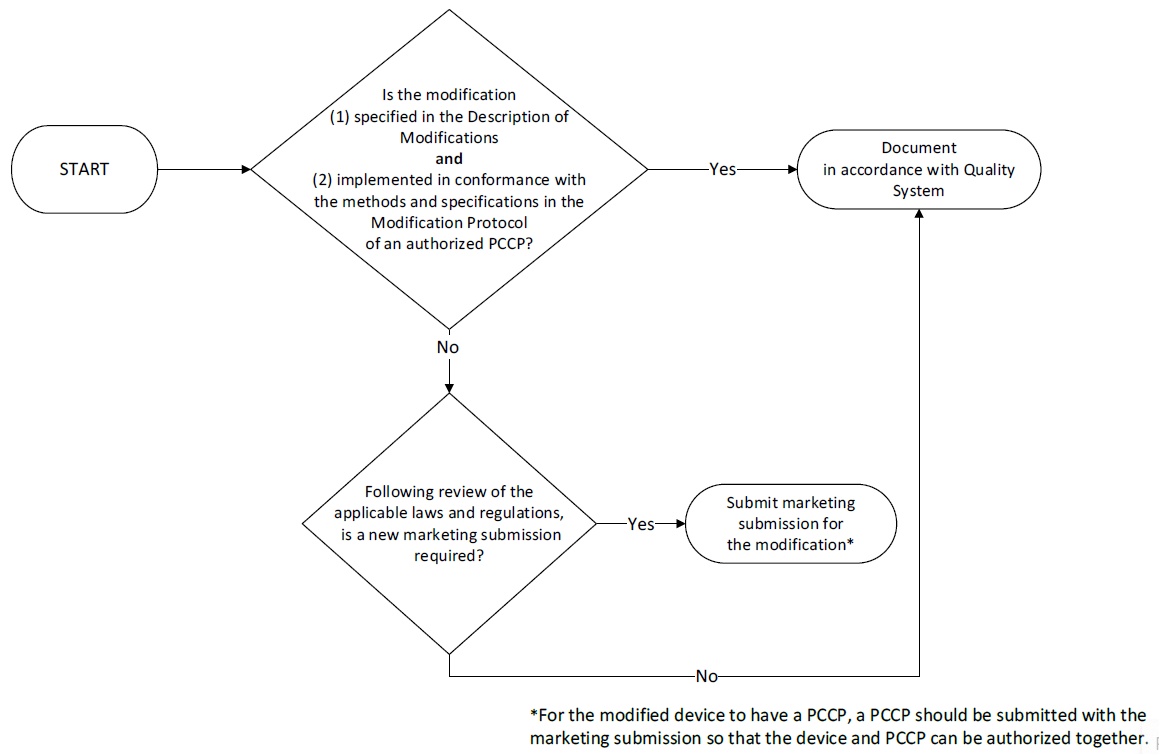
That shift is worth stating plainly, because it is conceptually new: you no longer authorize an object, you authorize a space of variation. What the FDA validates is not only today's model, but the description of the intended modifications and the protocol that will verify them.
Europe: the Medical Device Regulation
The applicable text is Regulation (EU) 2017/745, known as the MDR. The CE marking attests that the manufacturer has followed the conformity assessment procedure matching its device's class.
Rule 11, word by word
Software classification falls under Rule 11 of Annex VIII of the MDR. It is better read in its actual structure than in the summaries in circulation, because the thresholds are not where people think.
Software intended to provide information used to take decisions for diagnostic or therapeutic purposes falls in class IIa, unless such decisions have an impact that may cause:
- death or an irreversible deterioration of a person's state of health, then class III;
- a serious deterioration of a person's state of health, or a surgical intervention, then class IIb.
Software intended to monitor physiological processes falls in class IIa, unless it monitors vital physiological parameters whose variations could result in immediate danger, then class IIb.
All other software falls in class I.
The starting point is not class I but class IIa: as soon as software supplies information used for a diagnostic or therapeutic decision, it lands there by default, and only moves upward from there. Class I is the residue.
Moving up a class depends neither on the technology, nor on the severity of the disease as such, but on the severity of the consequence of a wrong decision taken on the basis of the information supplied. Two technically identical pieces of software can therefore be classified differently depending on how their intended use is described.
And moving from class I to class IIa is no administrative detail: from class IIa upward, involvement of a notified body (a designated and supervised third party) becomes necessary. Class I is, as a general rule, self-declared by the manufacturer, with exceptions notably for sterile devices and those with a measuring function.
After going to market
The MDR imposes post-market surveillance: the manufacturer must run a system for collecting and analysing experience gained from its devices in real use, with a documented plan, and must report serious incidents.
For AI this obligation takes on particular weight. A model whose performance was established on a given population can degrade silently as that population, the equipment or the practices change, that is drift. Post-market surveillance is the only mechanism capable of detecting it, and it is where claims of "performance maintained over time" have to meet real measurements.
The post-market surveillance regime varies by class and by device type: reporting periodicity, the form of the documents to be produced, clinical follow-up obligations. The detail lies in the MDR articles devoted to these obligations and in the corresponding implementing acts.
Do not rely on any summary, including this one, to determine what applies to a given device.
The AI Act: the second layer, and its staggered timeline
Regulation (EU) 2024/1689, the AI Act, adds a regime applicable to artificial intelligence systems, independently of the MDR. Medical software with an AI component therefore falls under both texts at once.
How a SaMD becomes a high-risk system
The mechanism rests on Article 6(1), which combines two cumulative conditions. An AI system is high-risk where:
- it is intended to be used as a safety component of a product, or is itself a product, covered by the Union harmonisation legislation listed in Annex I, the MDR is listed there; and
- that product is required to undergo third-party conformity assessment under that same legislation.
The second condition points to notified body involvement. Under the MDR, that involvement is required from class IIa upward.
The reading that follows is therefore that a SaMD of class IIa, IIb or III falls within the AI Act's high-risk regime, and not only classes IIb and III as is frequently stated, including in an earlier version of this page. That reading follows from the text; it nonetheless deserves confirmation case by case, since the exact qualification can depend on the conformity assessment procedure actually followed.
The obligations attached to high risk cover, among others, a risk management system, training data governance and quality, technical documentation, logging, transparency toward the user, human oversight, and accuracy, robustness and cybersecurity.
The timeline: the trickiest part of this page
The AI Act did not come into application in one block. The original regulation provided for staggered application:
| Original deadline | What applies |
|---|---|
| 2 February 2025 | Prohibitions on unacceptable AI practices, and AI literacy obligations |
| 2 August 2025 | Obligations for general-purpose AI models, governance, penalties |
| 2 August 2026 | General application of the regulation, except Article 6(1) |
| 2 August 2027 | Article 6(1), that is, high-risk systems embedded in regulated products, including medical devices |
Two frequent errors live in that table. The first is taking August 2026 for medical devices: in the original regulation, those fall precisely within the exception, and therefore under the later deadline. The second is describing 2 August 2025 as the date of "transparency obligations for all AI systems": that deadline concerns general-purpose models, governance and penalties.
A simplification package, presented by the European Commission on 19 November 2025 as the digital omnibus, provides for postponing the deadlines applicable to high-risk systems. The dates from the political agreement separate two cases:
- stand-alone high-risk systems, falling under Annex III;
- high-risk systems embedded in regulated products, falling under Annex I, the category that includes medical devices, and which would receive the longer postponement.
What this page cannot do for you. A postponement produces legal effect only from publication of the amending text in the Official Journal of the European Union. The status of that publication, and the dates finally retained, must be checked directly at source when you need them. Do not quote any date from this section without that check: this is exactly the kind of point where a second-hand summary goes stale between the moment it is written and the moment it is read.
A European manufacturer of AI-enabled medical software falls under the MDR and the AI Act. The two texts partly overlap (risk management, technical documentation, surveillance) without merging, and the AI Act provides mechanisms for articulating with existing conformity assessments.
The cost of that overlay is not evenly spread. A large group has a regulatory affairs department; a young company does not. It is a well-documented threshold effect, which bears on market structure as much as on the products themselves.
What everyone must demonstrate, whatever the regime
On training data: documented provenance, representativeness of the target population, bias analysis and mitigation, annotation quality. A model built on a single population cannot claim universal performance.
On clinical performance: it is demonstrated with sensitivity and specificity, never with a single accuracy figure, the reason is developed in medical imaging. On data independent of the training set. With comparison against the reference practice. And with subgroup analysis, failing which a satisfactory average performance can mask failure across an entire subgroup.
On continuous learning: a model that keeps learning in service changes behaviour after authorization. That is the problem the US PCCP tackles head-on. It does not fully solve it, and it is one of the field's open questions today.
The other jurisdictions
A US authorization does not carry over to Europe, nor to Japan (where the competent authority is the PMDA, Pharmaceuticals and Medical Devices Agency) nor to China, where it is the NMPA, National Medical Products Administration. Each jurisdiction has its own requirements, timelines and bodies.
The IMDRF works to bring these frameworks closer together, notably through shared vocabulary and a shared risk framework for SaMD. Its work is not binding: it influences national regulators without substituting for them.
- What exactly is the claimed intended use? That, not the technique, determines the regime.
- Which route was taken? A 510(k) resting on equivalence does not say the same thing as a De Novo resting on performance data.
- Is the device authorized as an aid or as an autonomous system? The overwhelming majority of existing authorizations cover decision-support tools, with a professional in the loop.
- Which date are we talking about? Authorization counts, agency guidance and application deadlines all change, and not at the same pace.
1. Two companies market the same computer vision model. What decides whether one falls under medical device regulation and the other does not?
2. A filing highlights that an AI tool is 'FDA cleared' through the 510(k) route. What does that establish, according to the page?
3. How does the PCCP (predetermined change control plan) change what the US regulator authorizes?
4. Under MDR Rule 11, a software provides information used for a diagnostic decision. What is its classification starting point, and why does that matter?
5. On the page's reading of AI Act Article 6(1), which SaMD fall under the 'high risk' regime?