The problem: more literature than one brain can hold
A doctor can read only a tiny fraction of what gets published each year in their own specialty. PubMed, the US National Library of Medicine's bibliographic database, reports more than 40 million records. Nobody keeps up.
You often read that "medical knowledge doubles every 73 days." That number comes from a projection published in 2011 by Peter Densen, extrapolating a doubling rate for the year 2020. It is not a measurement, and it is not a doubling of knowledge either: at best a doubling of published volume. Treat it as an image, never as a fact.
An LLM, large language model: a model trained to predict what comes next in a text, covered in detail in what is an LLM is precisely a machine for digesting large volumes of text. Hence the idea: train it on the medical literature, clinical practice guidelines, and de-identified patient records. Then ask it a question, "which anticoagulant for a 65-year-old in atrial fibrillation?", and get a synthesis instead of a reference list.
Medicine is a largely textual field: textbooks, papers, guidelines, discharge summaries, referral letters. Where imaging needs computer vision, written medicine sits directly in a language model's register. That is what makes the promise strong, and what makes evaluation hard, because fluent text and correct text look very much alike.
Before any number on this page: the question to ask
This whole page rests on scores. A score, in medicine more than anywhere else, means nothing without its protocol. How to read a benchmark score gives the full checklist; keep four questions in mind here.
- On what? An exam-style multiple-choice question set, or actual patients?
- Under what protocol? A single attempt, or the best of several? Was the model allowed to search the web?
- Against whom? A student, a general practitioner, a specialist?
- Measured how? And above all: is accuracy the right measure at all?
That last question is the field's central trap, and it is worth seeing once so you never forget it.
Take a disease affecting one person in a thousand. Build the dumbest possible system: it always answers "negative." Across a thousand patients it is right 999 times. Its accuracy (the share of correct answers) is 99.9%. It detects nothing.
That is why, whenever the task is detecting a disease, you do not use accuracy but two separate measures:
- sensitivity: among the people who have the disease, what fraction does the system flag? (The dumb system: 0%.)
- specificity: among the people who don't, what fraction does it correctly clear? (The dumb system: 100%.)
Both, together, or neither. A single headline number for "diagnostic accuracy" is almost always a sign that someone would rather not tell you which of the two was sacrificed. Evaluation metrics builds these notions from scratch: sensitivity is recall on the diseased class, and specificity is recall on the healthy class.
The exam scores below partly escape this trap, because a multiple-choice set has balanced answers by construction. But they fall into another one, covered at the end of this page: passing an exam is not treating a patient.
Med-PaLM and Med-PaLM 2 (Google)
Google produced three generations: Med-PaLM (2022), Med-PaLM 2 (2023), then Med-Gemini (2024, able to handle images as well).
The main measuring ground is MedQA, a multiple-choice question set in the style of the USMLE, the United States Medical Licensing Examination, the American medical licensing exam.
The numbers, with their protocol. The Med-PaLM 2 paper reports a score of up to 86.5% on MedQA. "Up to" is the load-bearing phrase: this is the best result across several prompting strategies, including the ensemble refinement described below. The same paper puts Med-PaLM at 67.2% and presents it as the first model to exceed the passing mark on questions of this style, a mark sitting around 60%.
An earlier version of this page claimed "untuned GPT-4, around 60%" on MedQA. That is wrong, and the figure below, taken from the publication, contradicts it directly: 60.2% is GPT-3.5's score, and GPT-4 appears at 90.2%. Med-PaLM 2 therefore does not beat GPT-4 on MedQA. The case is instructive: a numeric comparison between vendors is the spot in any dossier where an error (or a convenient arrangement) passes unnoticed most easily.
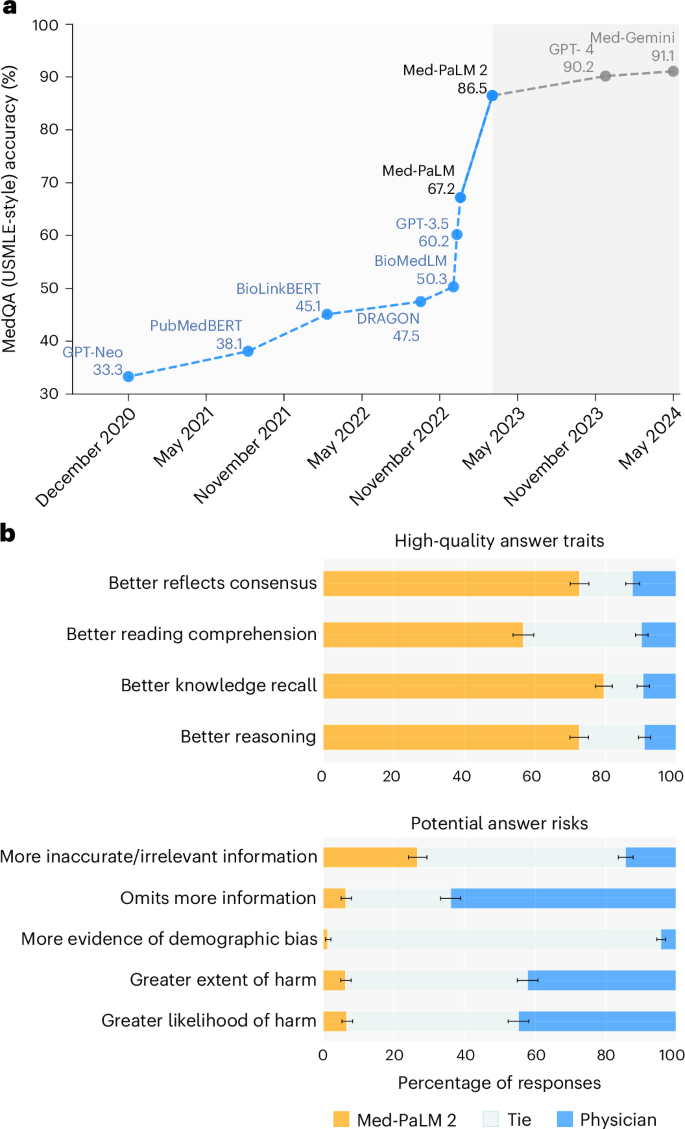
The second protocol, more interesting than the exam score. The Med-PaLM 2 paper also reports a physician-run comparison: 1,066 consumer health questions, each answered both by the model and by a physician, with the two answers shown side by side to other physicians who rank them. Reported result: the raters prefer the model's answer on eight of the nine clinical-utility axes used.
Read that sentence precisely, because it is easy to over-read. "Preferred by a physician reader" is not "better for the patient." The authors themselves write that further studies are needed to validate these models in real-world settings. And the one axis where the model does not win is the risk axis (omitted information, potential for harm) which is exactly the one that matters at the bedside.
The three techniques put forward. Supervised fine-tuning on question-answer pairs written and checked by physicians. Ensemble refinement: the model produces several candidate answers, then is given those candidates back and asked to write a better one. And chain-of-thought: asking it to lay out its steps before concluding, the way a clinician works through a differential diagnosis.
These models happily write "the patient presents with X and Y, therefore Z." That is useful: a stated line of reasoning is easier to contradict than a bare answer. But do not conflate the two things. The text produced is a plausible justification, generated by the same mechanism as the answer itself; nothing guarantees it describes the computation that actually led there. A filing claiming "traceable reasoning" from an LLM is claiming the production of an explanation, not its faithfulness, and that distinction is exactly the one to isolate.
BioGPT (Microsoft)
BioGPT takes the other route: instead of tuning a very large generalist model, it pre-trains from scratch a modest model on biomedical literature only, 15 million PubMed abstracts, not full articles. The backbone is GPT-2 medium, a few hundred million parameters: two to three orders of magnitude below Med-PaLM 2.
The paper reports scores on six tasks. Two examples, with their measure:
| Task | Measure | Reported score |
|---|---|---|
| BC5CDR end-to-end relation extraction | F1 | 44.98% |
| PubMedQA question answering | accuracy | 78.2% |
An F1 of 44.98% looks like a failure. It was nonetheless the reported state of the art on that task. The reason: "end-to-end relation extraction" means recovering, from free text, both entities and the relation linking them, with nobody telling you where to look. The space of possible combinations is enormous, so hitting one shot in two is already a lot. F1 itself is the harmonic mean of precision and recall, see evaluation metrics.
Keep the rule: a number is never read against the intuition that "100% is perfect and 50% is mediocre," but against what the best previous system did on the same task.
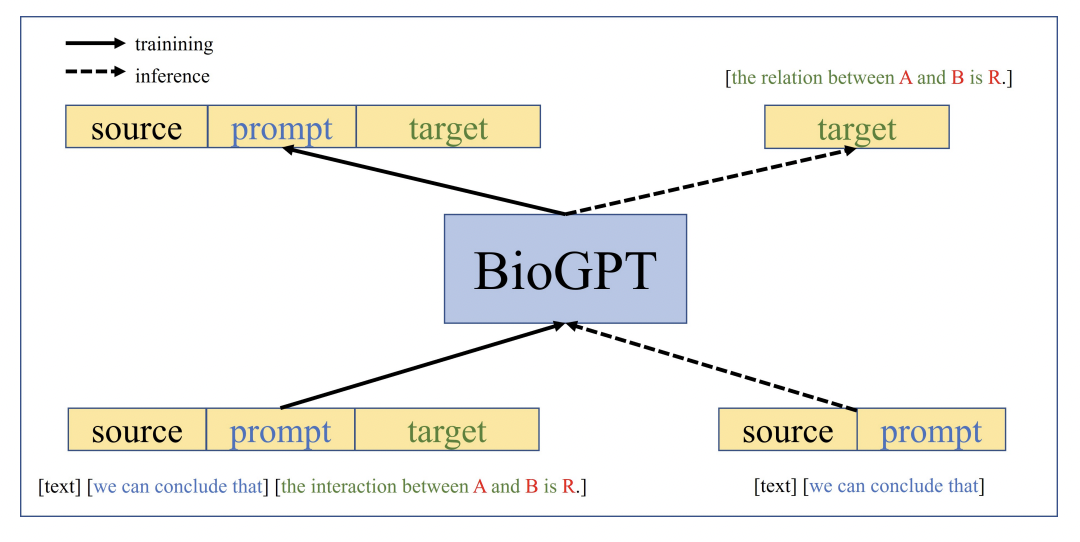
BioGPT's strengths: extracting entities and relations from the literature (which gene is associated with which disease, which drug interacts with which). Its structural weakness: it has only ever read biology. It knows biochemistry and not geography, and it does not do complex clinical reasoning.
A few other models
- Meditron (EPFL, MEDITRON-70B: Scaling Medical Pretraining for Large Language Models): an open medical model released in 7- and 70-billion-parameter versions.
- GatorTron (University of Florida, GatorTron: A Large Clinical Language Model to Unlock Patient Information from Unstructured Electronic Health Records): up to 8.9 billion parameters, pre-trained on more than 90 billion words, of which more than 82 billion are de-identified clinical text. It is an encoder-style model, built to pull information out of a record rather than to converse. Its interest: it has seen the actual language of hospital wards, abbreviations and jargon included.
- PMC-LLaMA: LLaMA tuned on the open-access literature of PubMed Central.
- BioMistral: Mistral tuned for the biomedical domain.
MultiMedQA, and what an exam does not measure
MultiMedQA is the evaluation assembly introduced by the Med-PaLM paper: six existing question sets (including MedQA (USMLE-style questions), MedMCQA (Indian medical exam) and PubMedQA (questions grounded in papers)) plus HealthSearchQA, a set of health questions actually typed into a search engine.
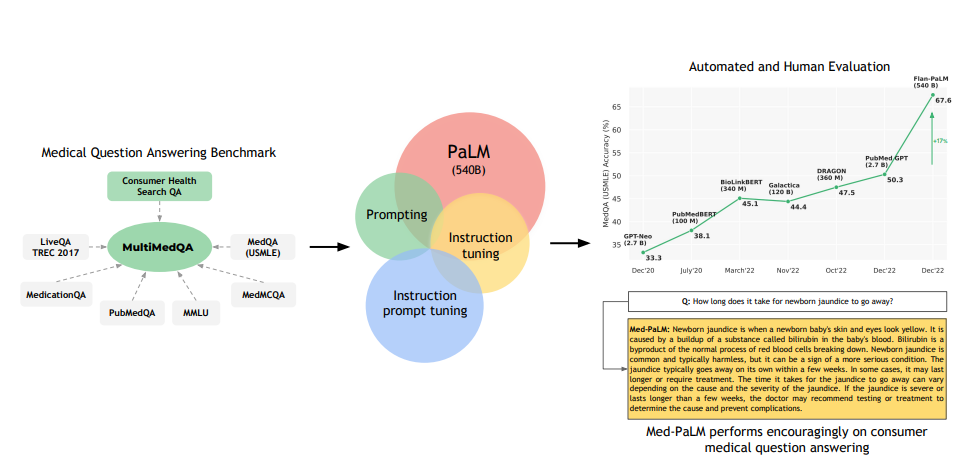
The distinction this figure carries is the most important thing on the page. On the left, multiple-choice questions: automatically gradable, therefore measurable at scale, but nothing like a consultation. On the right, open questions from real people: impossible to grade automatically, requiring physician readers, so the sample is small and the judgment subjective.
Neither measures what actually matters.
This is the line to hold in every claim made in this field.
What a dataset score demonstrates: on questions written in advance, with known answers, in a constrained format, with no patient in the room, the model produces the right output in some percentage of cases.
What it does not demonstrate: that a clinician using it treats patients better. Three things are missing.
- Prospective validation. A score is measured on data already collected and already labelled. The clinical question is: if I switch the tool on today and watch what happens next, do patient outcomes change?
- The real population. A test set is curated: clean cases, complete data, artificial prevalence. An emergency department is not.
- Integration into the care pathway. A correct tool whose alert arrives too late, or too often, changes nothing, or does harm, because people stop reading it.
Passing the exam is necessary and very far from sufficient. In a filing, dataset performance presented as evidence of clinical usefulness is not a lie: it is a slide, and it is the most common slide in the field.
The four remaining difficulties
Hallucinations. The model can produce a dose that does not exist, a wrong diagnosis, or a perfectly formatted and perfectly imaginary citation. The problem is not just the error, it is that the error comes out with the same confidence as a correct answer. Hence the importance of calibration, a model stating 90% confidence actually being right nine times in ten: see advanced metrics.
Bias. A model inherits the composition of its data. The medical literature has historically over-represented some populations and under-represented others, notably women and non-Western populations. Without explicit correction, a model reproduces that asymmetry and applies it to patients who were never in it.
Confidentiality. Training or querying a model on patient records falls, in Europe, under the GDPR (General Data Protection Regulation) and, in the United States, under HIPAA (Health Insurance Portability and Accountability Act). Hence two common reflexes: on-premise deployment (the model runs inside the hospital, no data leaves) and federated learning, covered in federated learning.
Liability. If bad advice harms a patient: the clinician who followed it, the institution that deployed the tool, or the vendor? The applicable framework is covered in regulation.
These systems are decision-support tools. Physical examination, listening, contextual judgment and responsibility remain human. The model synthesizes and suggests; the clinician decides and answers for it. This is not a rhetorical hedge: it is also, in practice, what the regulatory framework governing these tools assumes.
Where this is going
The clear trend is multimodal: a single model taking text, images and physiological signals, with Med-Gemini as the example. Read its numbers carefully: its 91.1% on MedQA was obtained with an uncertainty-guided search strategy, and the model is described as able to use web search. A model allowed to look things up during the exam is not sitting the same exam as one answering from memory. The number is real; the protocol is not comparable.
The real challenge of the coming years is not adding points on MedQA. It is producing the right-hand column of evidence: prospective validation, real populations, integration into care.
1. A filing states: 'Med-PaLM 2 scores 86.5% on MedQA, ahead of GPT-4.' What is wrong with that sentence, according to the page?
2. Physicians blindly compare 1,066 answers from Med-PaLM 2 and from practitioners, and prefer the model on eight of the nine axes. What is the correct reading?
3. A medical model writes 'the patient presents X and Y, therefore Z'. What exactly is a filing claiming when it calls this 'traceable reasoning'?
4. BioGPT reports 44.98% F1 on end-to-end BC5CDR relation extraction, and that was state of the art. How should the figure be read?
5. A filing presents an excellent MultiMedQA score as proof that a tool improves patient care. What slippage does the page identify?