The problem: the data is where you cannot take it from
A hospital wants to train a breast cancer detector. It has ten thousand annotated mammograms. That is not much. Ten hospitals together would have enough, but none of them can send its records to a shared server. The GDPR (General Data Protection Regulation) in Europe and HIPAA (Health Insurance Portability and Accountability Act) in the United States strictly govern such transfers, and patients did not consent to that sharing.
Nor is the obstacle purely legal. Two competing institutions do not much want to hand each other their cohorts, and moving terabytes of images is a heavy operation.
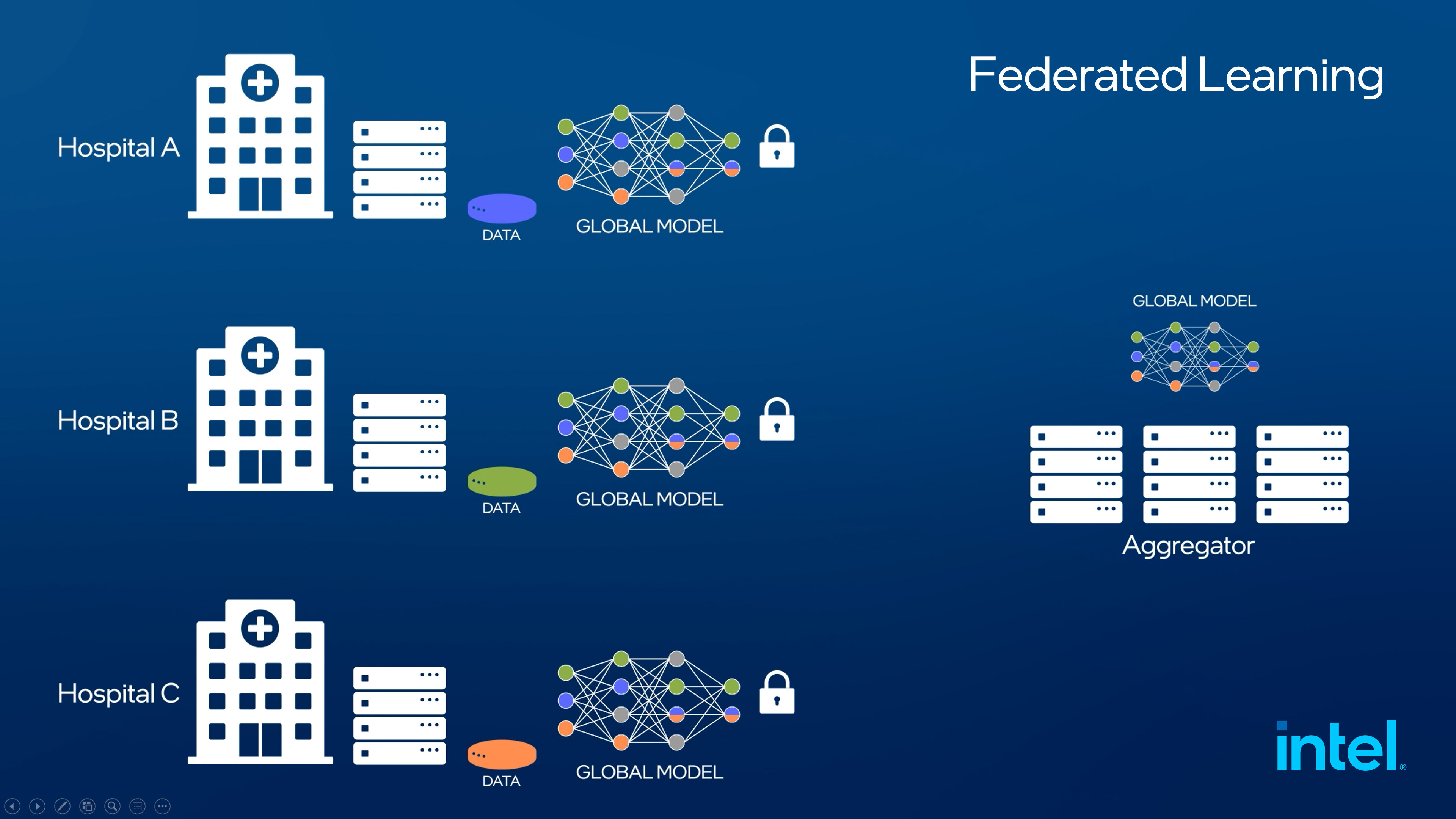
Federated learning answers this with an inversion: rather than bringing the data to the model, bring the model to the data.
The data does not move. Only the model's parameters travel.
Each hospital receives a copy of the model, trains it on its own records behind its firewall, and returns only what changed in the network's weights. A server combines these contributions and sends back an improved model. No patient record ever leaves its institution of origin.
What exactly travels, and what does not
This is the most important distinction on the page, and it cuts across a general confusion in the field.
| Nature | Travels? | |
|---|---|---|
| The data (images, records) | What you want to protect | Never |
| The model weights | Learned parameters, frozen between rounds | Yes, both ways |
| The local update | The difference between the weights after local training and the weights received | Yes, from site to server |
A network weight is a number learned during training, not a patient datum. That distinction underpins both the legal and the technical argument for the method, and it is also the one that will need qualifying at the end of this page, because a number learned from data necessarily carries a trace of that data.
FedAvg: the base algorithm
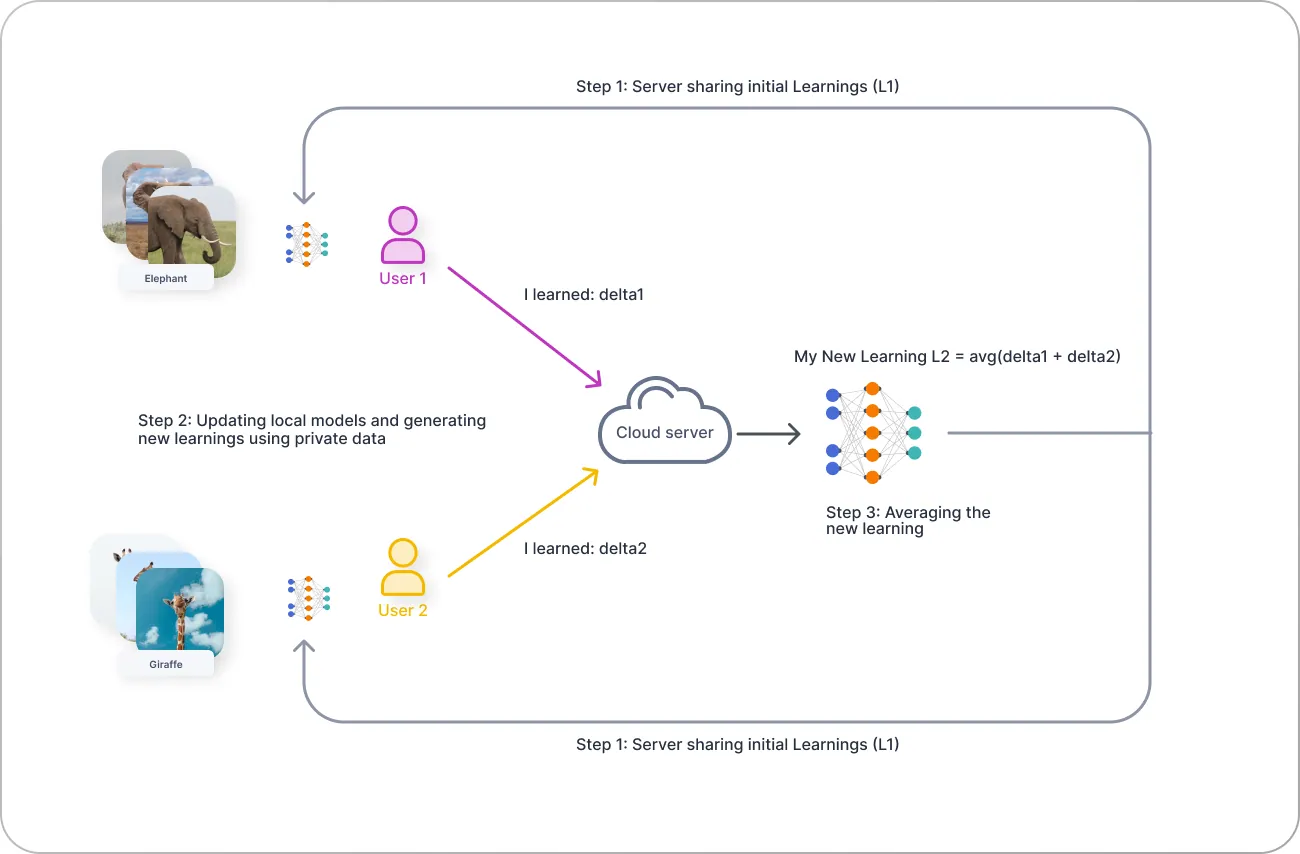
The founding algorithm is FedAvg, short for federated averaging (Communication-Efficient Learning of Deep Networks from Decentralized Data). A round proceeds in five steps.
- The server sends the current model to every participant.
- Each participant trains it on its own data for a few passes, one full pass over a local dataset is called an epoch.
- Each returns its updated weights.
- The server computes a weighted average of them.
- Repeat.
Step 4 is written:
The symbols, one by one. is the vector of all the global model's weights after round . is the number of participants. is the weight vector obtained by participant number after its local training. is how many examples that participant holds, and the total across all participants.
In one sentence: the new model is the average of the local models, each counting in proportion to the amount of data it was trained on. The fraction exists for exactly that reason, without it, a small practice with three hundred records would weigh as much as a teaching hospital with three hundred thousand.
The variants each answer a specific difficulty. FedProx adds a term that stops a local model drifting too far from the global one, useful when participants hold very dissimilar data. SCAFFOLD explicitly corrects the drift of local updates. FedBN keeps normalization parameters local, those that encode the typical scale and offset of a site's data, precisely what you do not want to average between a 2012 scanner and a 2024 one.
A model with a hundred million parameters, at four bytes each, weighs four hundred megabytes. Every round, each participant sends and receives that object, and it takes tens to hundreds of rounds. The volume transmitted quickly exceeds that of the data you refused to move.
Hence the reduction techniques: update compression, sparsification (transmit only the weights that moved appreciably), or exchanging only some layers. That is the real cost of the method, and it is often underestimated in filings.
What has been demonstrated in medicine
Two studies deserve quoting with their numbers, because they are precise and because they do not quite say what they are made to say.
Pati and co-authors, Nature Communications, 2022, presented by its authors as the largest federated learning study to that date.
The setup: 71 sites across 6 continents, 6,314 cases of glioblastoma, a rare brain tumour.
The result: a 33% improvement in delineating the surgically targetable part of the tumour, and 23% for the complete tumour extent.
Against what, exactly. The comparison is against a model trained on public data. That is not the same claim as "as good as a model centralized on all this data", a comparison that could not be run here, since centralization was precisely what was impossible. An earlier version of this page stated the second formulation; it has been corrected.
Dayan and co-authors, Nature Medicine, 2021.
The setup: 20 institutions worldwide, a model combining vital signs, laboratory results and chest radiographs, to predict the future oxygen requirements of COVID-19 patients presenting to the emergency department.
The results: an average area under the curve (AUC) above 0.92 at the 24- and 72-hour horizons; a 16% improvement in average AUC measured across all participating sites, and an average 38% increase in generalizability, compared with models each trained only on its own site's data.
The second figure is the more interesting one, and the one people forget to quote. Federated learning's main gain is not being better on your own site: it is not collapsing elsewhere. See the domain shift problem in medical imaging.
In pharmaceutical research, the European MELLODDY consortium brought together ten companies (Amgen, Astellas, AstraZeneca, Bayer, Boehringer Ingelheim, GSK, Servier, Janssen, Merck KGaA and Novartis) to train activity prediction models in federated fashion, each keeping its proprietary compounds. The consortium reports an average improvement in its models and no leakage of intellectual property; those figures come from consortium communications, not from an independent evaluation, and that is how they should be cited.
The limitation, stated honestly
This is the point that matters most for assessing a claim in this field, and it fits in one sentence: not transmitting the data reduces exposure, but does not eliminate it.
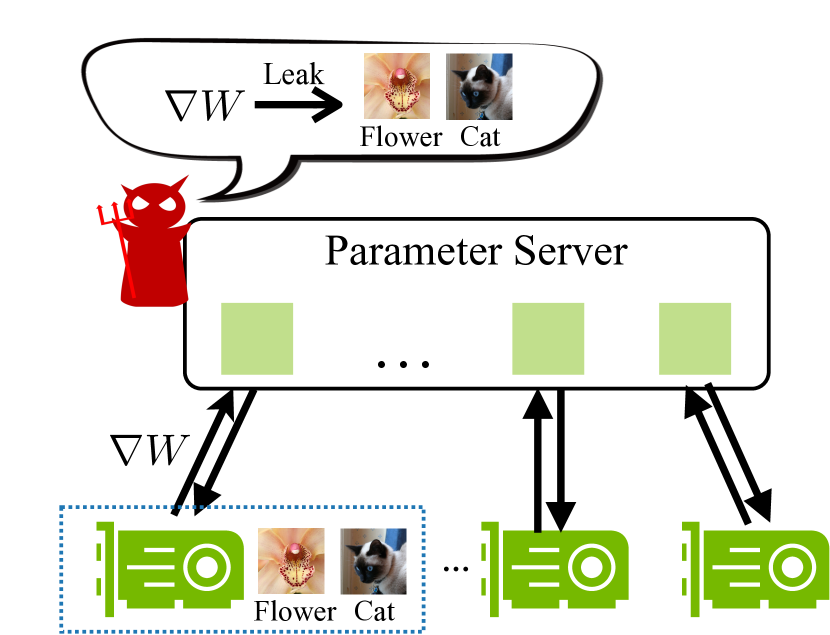
A weight update is not an arbitrary number: it is the result of a computation that takes the local data as input. It depends on that data, therefore it carries information about it. The work Deep Leakage from Gradients (Deep Leakage from Gradients) showed this as vividly as possible: from the transmitted gradients alone, the training images are reconstructed.
The attack's principle is easy to grasp. The attacker starts from a noise image, computes the gradient it would produce, and adjusts that image until the resulting gradient resembles the one intercepted. If the two gradients match, there is a good chance the two images match too.
This attack works better when the update comes from few examples and few local steps. It is harder against heavily aggregated updates. It does not disappear for all that, and a second family of attacks (membership inference) aims less at reconstructing a datum than at answering the question "was this person's record used to train this model?" In healthcare, that question alone is already a disclosure.
That is why a serious system stacks layers. Two matter.
Differential privacy (often abbreviated DP) deliberately adds calibrated noise to updates before they are sent. Its guarantee is mathematical and is written : bounds how much the probability of any observable outcome can change depending on whether a given individual is in the data, and is the very small probability that the bound fails to hold. A small means strong protection. The trade-off is direct and unavoidable: more noise, less leakage, but also a weaker model.
Secure aggregation ensures the server can only see the sum of contributions, never any single participant's. This is achieved by secret sharing among participants, by homomorphic encryption (encryption that lets values be added without ever being decrypted) or by running inside a trusted hardware enclave.
This is the part directly useful for analysing a claim.
What federated learning alone demonstrates. Raw data does not transit. That is verifiable from the architecture, and it is a real and substantial reduction in exposure, no central copy, no bulk transfer, a smaller attack surface.
What it does not demonstrate. That nothing sensitive can be inferred from what does transit. A claim of "privacy by design" or "privacy preserving" resting on the federated nature of the architecture alone asserts more than the architecture guarantees.
What to look for in the filing. Is there differential privacy, and at what ? Is there secure aggregation, and against what adversary model, an honest-but-curious server, or a malicious one? Can one participant attack the others? Without answers to those questions, the announced guarantee is an architectural property presented as a security property, and the two are not the same thing.
The remaining technical difficulties
Data heterogeneity. The data is said to be non-IID, for independent and identically distributed: each site draws its patients from a different distribution. A Paris teaching hospital and a rural clinic share neither pathologies, nor equipment, nor prevalence. Naively averaging models trained on different worlds degrades the result, and that is what FedProx and SCAFFOLD set out to fix.
Hardware heterogeneity. Some sites have recent graphics processors and a fast link, others do not. The protocol has to tolerate slow or intermittent participants without excluding them, failing which the final model will represent only the best-equipped institutions, exactly the representation bias it claimed to correct.
The tooling. NVIDIA FLARE for industrial use, Flower for research, PySyft oriented toward data protection, and Substra, developed by the French company Owkin and used in real hospital deployments.
1. In FedAvg, the server weights each local model by the fraction n_k / n. What exactly is that weighting for?
2. What, according to the page, is the real cost of federated learning, often underestimated in filings?
3. The FeTS study reports a 33% improvement in delineating the surgically targeted tumour region. Improvement against what, exactly?
4. The EXAM study reports a 16% improvement in mean AUC and a 38% gain in generalization. Why does the page consider the second figure the more interesting one?
5. A filing claims 'privacy by design' on the grounds that training is federated. What should you make of that?