Two different problems, routinely conflated
This field constantly mixes two questions that differ in difficulty and in the evidence they require. Separate them before anything else.
Question 1, placement. You have a target protein and an existing molecule. Where and how does that molecule sit in the protein's pocket? This is molecular docking. The molecule is given; you are looking for its position and orientation.
Question 2, invention. You have a pocket, and nothing else. What molecule should be made so that it fits well? Here nothing is given: you have to produce the atoms, their types and their positions.
Diffusion models attack both, but not with the same tools and not with the same hit rates. DiffDock answers question 1: it creates no molecule, it places one you hand it. TargetDiff and Pocket2Mol answer question 2.
Take clean data and add noise, little by little, until nothing but noise remains. Then train a network to walk the path backwards: starting from pure noise, remove a little noise at each step until a plausible datum appears. The full mechanism is described in diffusion models.
The transposition here: instead of adding noise to an image's pixel values, you add noise to atom coordinates in space. Denoising therefore produces a molecular geometry, which is exactly the object biology needs.
Why geometry rather than a text encoding? A molecule can be written as SMILES (simplified molecular-input line-entry system), a character string encoding atoms and bonds. That is compact and convenient, but it does not say how the molecule folds in space. And what decides whether a drug enters its target is its three-dimensional shape, not its formula.
Equivariance: the constraint that shapes the whole architecture
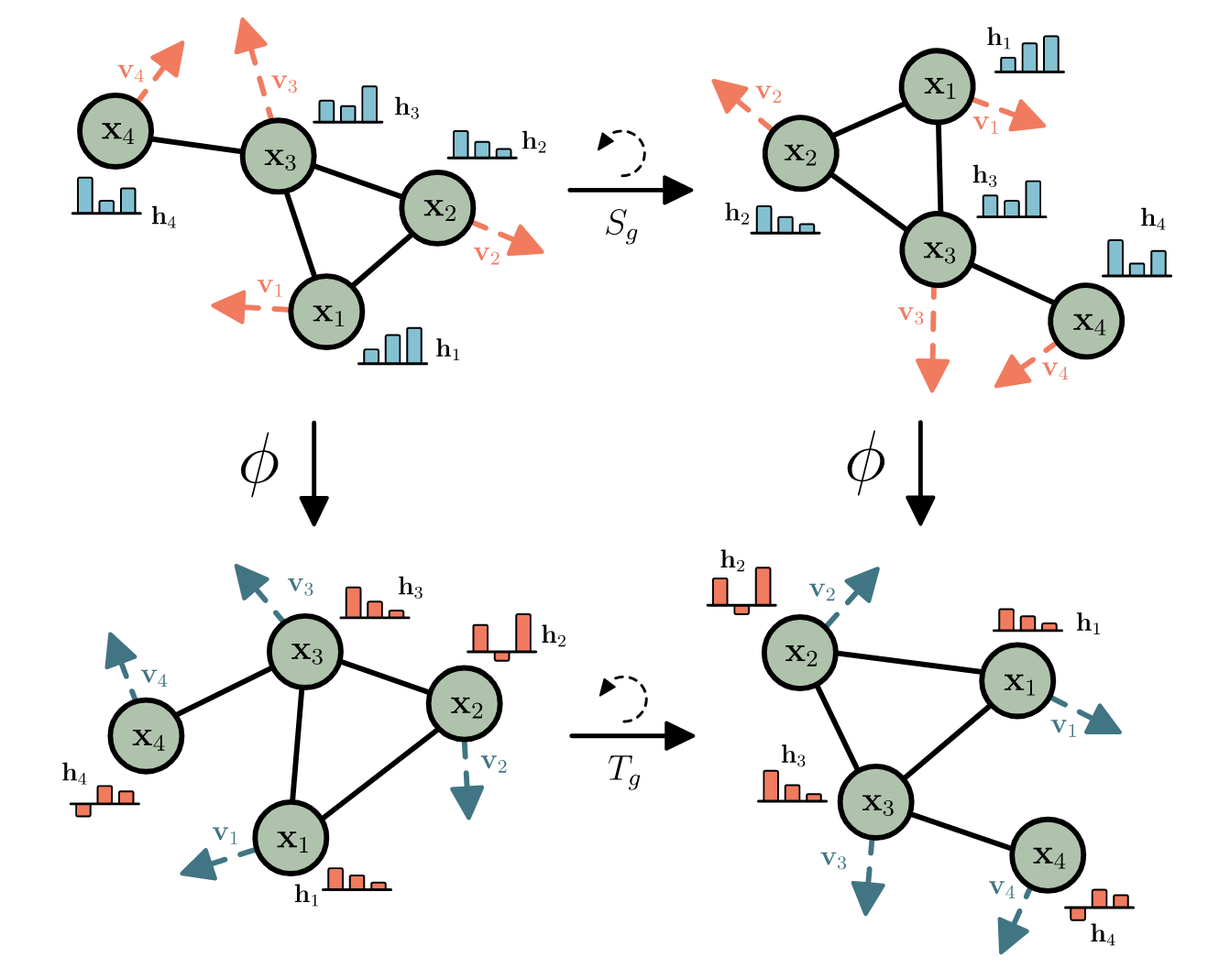
Take a molecule. Rotate it 90 degrees: same molecule, same properties. Move it three metres: still the same.
An ordinary neural network does not know this. It receives numbers (coordinates) and a rotation changes all of them. It would see two different inputs and would have to learn, through sheer volume of examples, that they describe the same object.
E(3) is the Euclidean group in three dimensions: the set of all transformations that preserve distances, translations, rotations, and reflections (mirror symmetries). SE(3) is its "special" subset: translations and rotations only, no mirrors.
The distinction matters in chemistry, because a molecule and its mirror image can be two different compounds with different biological effects. That is chirality, and it is why work is most often done on SE(3) rather than E(3) when that difference must be preserved.
A network said to be equivariant to these transformations guarantees by construction that if you rotate the input, the output rotates in exactly the same way. The usual architectures carry names like EGNN (equivariant graph neural network) or SE(3)-Transformer.
The gain is one of data efficiency. Without equivariance you would have to show the network the same molecule in thousands of orientations before it grasped that they are equivalent. With equivariance, a single example implicitly carries every orientation. The symmetry is no longer something to be learned: it is sewn into the architecture.
DiffDock: docking reformulated
Placing a molecule in a pocket amounts to fixing three things: where it is (translation), how it is oriented (rotation), and how its bonds twist on themselves (internal torsions). DiffDock (DiffDock: Diffusion Steps, Twists, and Turns for Molecular Docking) runs diffusion directly over these three families of degrees of freedom, instead of searching the space by physical simulation as classical tools do.
The reported numbers, with their measure. The paper reports, on the PDBBind set:
| Method | Top-1 success rate (RMSD < 2 Å) |
|---|---|
| DiffDock | 38% |
| Best classical docking tool | 23% |
| Best prior deep learning method | 20% |
On protein structures predicted computationally rather than solved experimentally, the gap widens: 21.7% for DiffDock, against 10.4% at best for earlier methods.
RMSD stands for root mean square deviation. You compare the predicted pose to the real pose observed by crystallography, atom by atom, and take the square root of the mean squared deviations. One number, in ångströms, an ångström (Å) being a ten-billionth of a metre, roughly the diameter of an atom.
The 2 Å threshold is a field convention: below it, the pose is counted correct. That is not a physical truth, it is a community agreement, and changing the threshold changes every percentage in the table. "Top-1 success rate" means only the pose the model ranks first is considered, although it produces several.
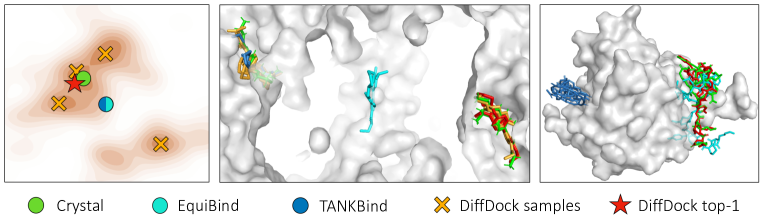
That difference in kind is real and useful: a model returning a distribution of poses with confidence scores says something about its own uncertainty, which a deterministic method does not. And in reality a molecule does adopt several conformations within one pocket.
Work from Oxford, the PoseBusters tool (PoseBusters: AI-based docking methods fail to generate physically valid poses or generalise to novel sequences, published in Chemical Science in 2024), took five learning-based docking methods including DiffDock, plus two classical tools, and applied elementary physical plausibility checks: acceptable bond lengths, no overlapping atoms, molecule not embedded inside the protein.
The authors' conclusion: root mean square deviation from the native pose is not enough to evaluate these methods, and no learning-based method then outperforms classical docking tools, either on physical plausibility or on the ability to generalize to protein sequences far from those seen in training.
This case is a model of its kind for a reader of claims. The 38% is not false: it measures exactly what it says it measures. But the chosen measure ignored properties the field implicitly assumed were guaranteed, and part of the apparent gain came from the closeness of the training and test sets. When a filing announces an improvement on a single metric, the useful question is always: what does that metric not look at?
Designing in the pocket
Now to question 2. The geometry of a protein's active site is known, and the goal is to produce a molecule that fits inside it.
TargetDiff (3D Equivariant Diffusion for Target-Aware Molecule Generation and Affinity Prediction) jointly generates the atoms' coordinates, which are continuous quantities, and their chemical types, which are discrete categories, both at once, through an SE(3)-equivariant network. The paper also shows the model can be used to estimate binding affinity without retraining.
Pocket2Mol proceeds differently: it places atoms one at a time, accounting at each step for what is already there, like a sculptor filling a mould.
When a model invents a molecule that does not exist, how do you know it is any good? You cannot compare it to a reference: there is none.
Field practice is therefore to evaluate generated molecules with other programs: a docking score for presumed affinity, a drug-likeness score, an estimated ease-of-synthesis score. All of these are computed approximations, not measurements.
The result is a circularity worth seeing clearly: a generative model optimized to score well on a docking score learns to please that score, which is not the same as learning to produce active molecules. The only way out of the loop is actual synthesis and biological testing, rare in publications of this family, and precisely what to look for in a filing.
RFdiffusion: designing whole proteins
A change of scale. Instead of a small molecule of a few dozen atoms, RFdiffusion (Watson et al., Nature, 2023, Baker lab at the University of Washington) generates the backbone of a complete protein (the main chain, without side chains) folded so as to serve a function.
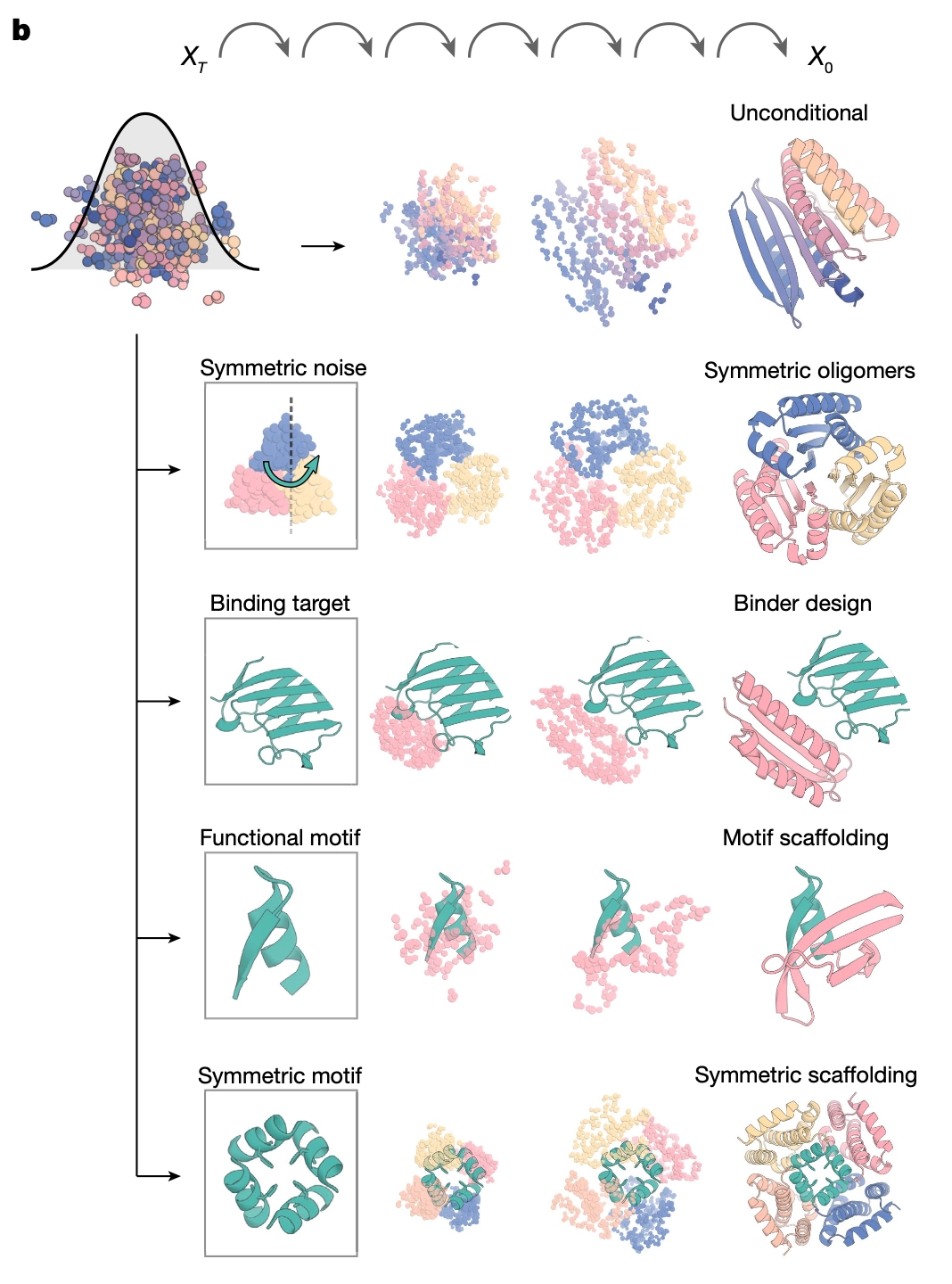
The most cited application is designing binders: small proteins made to order so they latch onto a chosen target. The published work reports binders obtained against several real targets, experimentally confirmed by crystallography and cryo-electron microscopy, notably the interleukin-7 receptor, PD-L1, TrkA and influenza haemagglutinin.
"Experimentally validated" is true, and it is a considerable result: proteins that do not exist in nature, drawn by a model, fold and bind as intended.
But the reported success rate varies widely by target (from zero to around a third of the candidates tested) and it often takes producing and screening anywhere from a few dozen to several thousand candidates for a single target. In other words: the model does not design the protein that will work, it designs an enriched batch in which the working ones are then found experimentally.
That is a difference in kind, not degree, and it changes what a filing may claim. "Designing functional proteins" describes the process correctly; "designing a functional protein" suggests a determinism that does not exist.
Chroma and EvoDiff: two other angles
Chroma (Generate Biomedicines) aims at protein design under explicit constraints: impose a symmetry, a cavity of a given size, a target to bind. The appeal is the expressiveness of the instruction, closer to a specification than to a setting.
EvoDiff attacks from the other end: instead of generating a geometry, it generates the amino acid sequence directly, leaning on the regularities accumulated in natural proteins. The argument is that evolution has already explored an immense space of functional proteins, and learning its regularities amounts to inheriting that exploration. This route suits proteins with no stable folded structure particularly well, where a geometric approach has nothing to model.
Flow matching: the straight-line alternative
Diffusion follows a noisy path between noise and data: at each step a little noise is removed, but some is also injected back, which makes the trajectory winding and requires many steps.
Flow matching replaces that path with a deterministic and nearly straight trajectory between the two points. The network is trained to predict, at each point along the way, the direction in which to move. Fewer steps, therefore faster generation. Score-based models and flow matching details the construction.
FrameFlow applies this idea to protein design on SE(3). AlphaFold 3 uses a diffusion module to produce its final coordinates, see AlphaFold 1/2/3 for its architecture in detail.
What to take away
Diffusion brings two real things to this field. It works natively on continuous three-dimensional coordinates, which is the right representation. And it produces a distribution of proposals rather than a single answer, which better matches a reality where several conformations coexist.
Generation takes seconds. Chemical synthesis takes days to weeks. Cell assays take months. Clinical trials take years, see drug discovery.
Nothing on this page shortens the last three lines. What changes is what you decide to synthesize. When a claim concerns time saved, the question to ask is: which step, and was that step the bottleneck?
1. DiffDock reports better rates than classical docking tools. What does it actually do?
2. What is equivariance actually for in these architectures?
3. PoseBusters re-examined the learning-based docking methods. What did that work show?
4. Molecules invented inside a pocket are judged by a computed docking score. Where is the problem?
5. RFdiffusion produces experimentally validated binders. How should that result be stated without overreaching?