When you scale up a model, weird things happen
Imagine a scale. You add weights, the scale tips gradually. Nothing surprising: more weight, more tipping. But what if, beyond a certain amount, the scale suddenly started to fly? That would be a qualitatively new property, something that didn't exist at all before and appears all at once past a certain threshold.
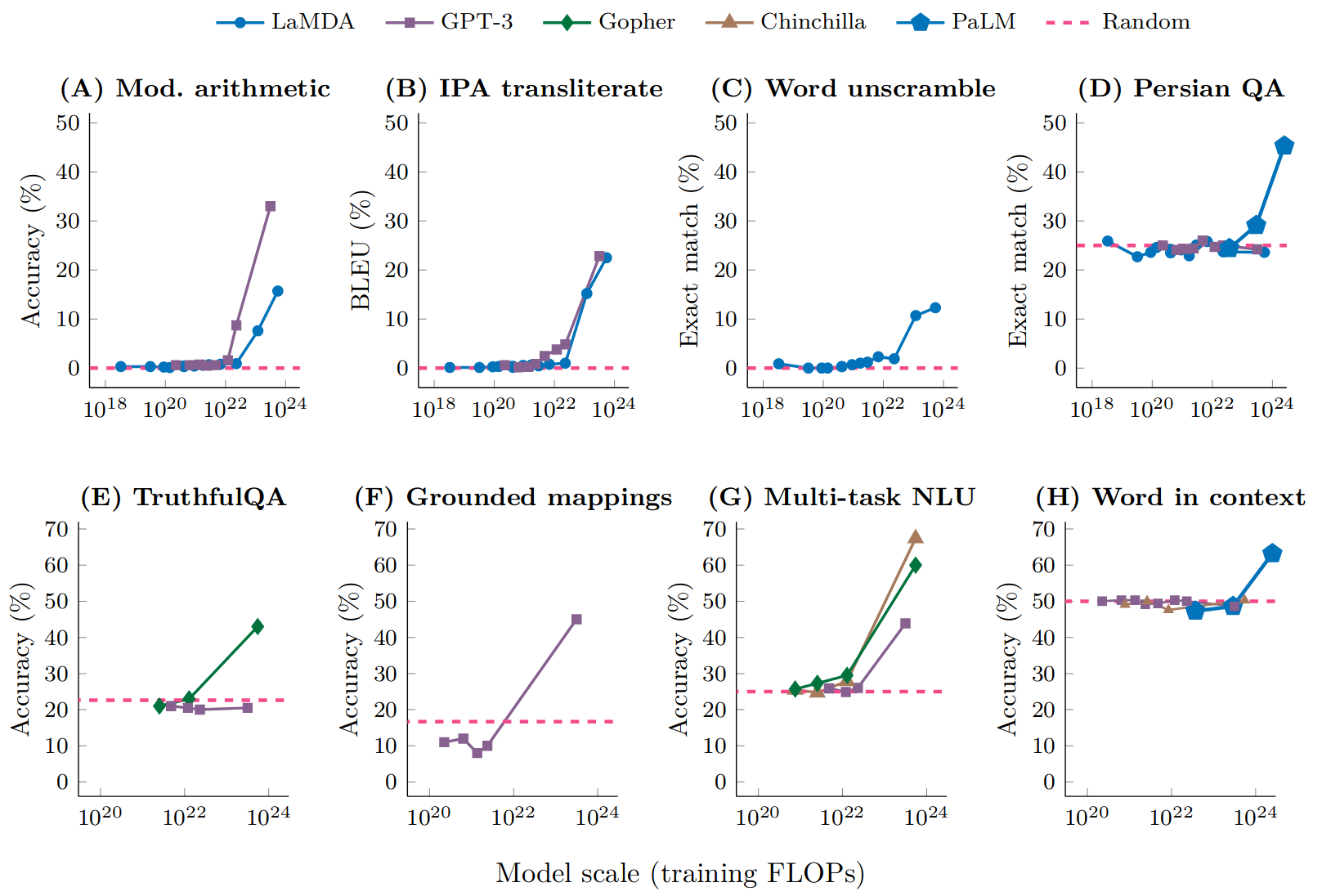
This is what seems to happen with certain LLM capabilities. Below a certain size, the model is completely incapable of performing a task: its results are indistinguishable from random guessing. Above a threshold, the capability appears and results take off sharply. The phenomenon is called emergent abilities, and it was systematically documented by Wei et al. in 2022.
Emergent Abilities of Large Language Models (Wei et al., 2022)It's one of the most fascinating and most debated phenomena in AI research. And understanding this debate is essential to grasping the current stakes of LLMs.
What makes a capability "emergent"?
Three criteria define an emergent capability in the strict sense:
- Absent in small models: below a size threshold, performance is close to random. The model doesn't "know" how to do it at all, not even partially.
- Present in large models: beyond the threshold, performance increases significantly and the task is solved reliably.
- Not predictable by extrapolation: if you plot the performance curve of small models and extend it, you don't predict the appearance of the capability. It seems to arise "out of nowhere."
It's this third criterion that makes the phenomenon so intriguing. You'd expect improvements to be gradual: a model 2x larger is a bit better, a model 10x larger is even better. But for emergent capabilities, it's as if the curve stays flat for a long time, then makes a sudden vertical jump.
In physics, a "phase transition" describes a sudden qualitative change: water freezing at 0 degrees, a magnet losing its magnetism beyond a certain temperature (the Curie temperature). Just before the threshold: nothing visibly changes. Just after: everything is different. For LLMs, the analogy is appealing, but the underlying theory remains much less well understood than in physics. We observe the phenomenon, but we don't fully explain it yet.
Concrete examples of emergent capabilities
Multi-digit arithmetic
Ask a small model to compute 347 + 892. It gets it wrong, and not "a bit" wrong: almost always wrong.
Here is what Wei et al. actually measure, and it is better to quote their numbers than to invent any. On 3-digit addition, models stay at close-to-zero performance for several orders of magnitude of training compute, then rise clearly above chance:
| Family | Take-off threshold | Corresponding size |
|---|---|---|
| GPT-3 | training operations | about 13 billion parameters |
| LaMDA | training operations | about 68 billion parameters |
Note that "close to zero" is the right reference level here: 3-digit addition has a thousand possible answers, so guessing at random gets you nothing. This is not a multiple-choice task where chance would give 25%.
What is striking is the shape of the transition: the curve stays flat, flat, flat, then jumps.
Chain-of-thought reasoning
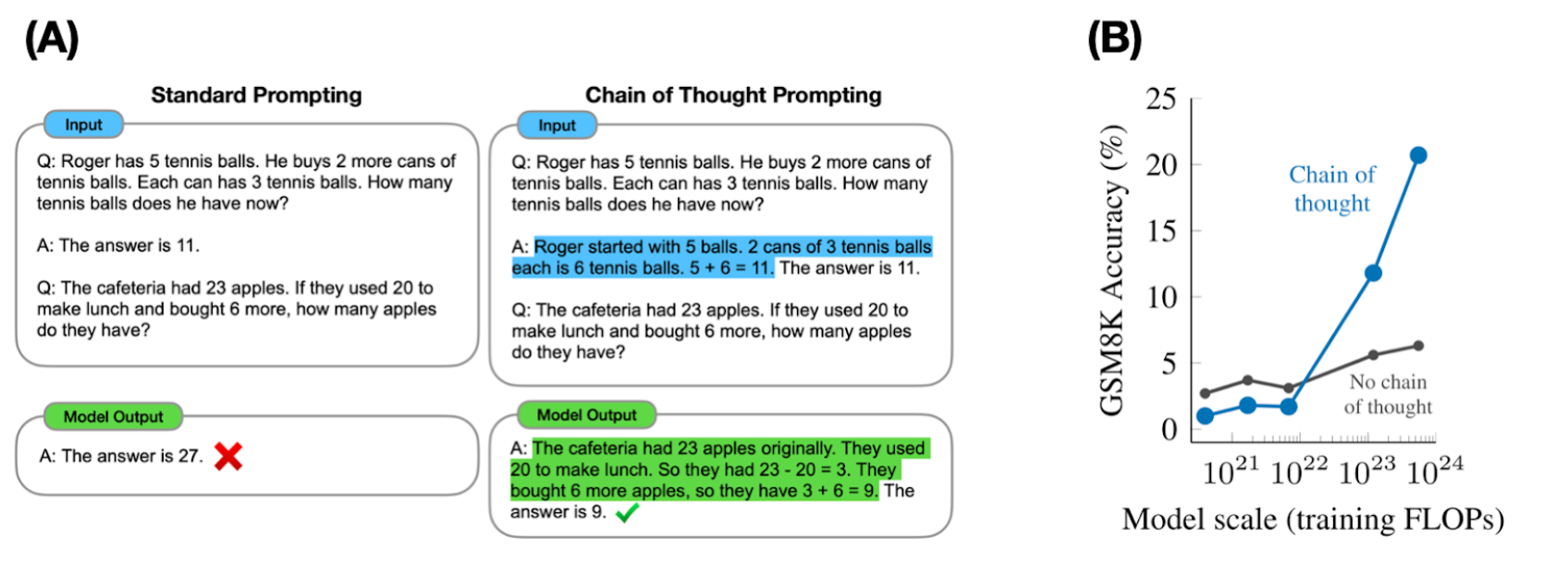
Ask a small model to "reason step by step before answering." It will produce incoherent steps, or ignore the instruction. Above a threshold, the same instruction produces structured and often correct reasoning.
Wei et al. give the figure: chain-of-thought (CoT) only beats ordinary prompting from training operations upward, about 100 billion parameters. Below that it is not merely useless but slightly harmful, the model does worse with the steps than without them.
That is what makes this case remarkable: the same prompt, word for word, goes from counterproductive to decisive purely as a function of model size. So the technique itself is emergent, not just the task. It is covered on its own page.
Capabilities in under-represented languages
Among the tasks Wei et al. measure are phonetic transliteration and Persian question answering, tasks for which the training corpus holds relatively little material. There too, the curve sits at chance level and then takes off.
The usual interpretation is that linguistic structure learned from well-represented languages transfers to poorly-represented ones. That is a plausible and widely shared hypothesis, but it should be read as one: what the paper establishes is the shape of the curve, not the mechanism producing it.
The authors reviewed all 210 tasks of the BIG-Bench suite, across five model families: GPT-3, LaMDA, Gopher, Chinchilla and PaLM. Wherever emergence shows up, the finding is the same: near-chance performance below a threshold, sharp take-off above.
This work had a considerable effect on industry strategy. If some capabilities only appear at large scale, then you have to build very large models to reach them, an argument used to justify investment in models above 100 billion parameters. It is precisely because that argument was so expensive that the criticism in the next section deserves to be taken seriously.
The great debate: does emergence really exist?
This is where things get controversial. The observed phenomenon is real, but its interpretation is the subject of intense debate in the community.
The argument for: circuits that form
Proponents of "strong" emergence argue that these transitions reflect real structural changes inside the model. At a certain scale, new computational circuits form: connections between neurons that didn't exist in smaller models and that enable a new type of reasoning.
Research in mechanistic interpretability (understanding a model's internal mechanisms rather than only observing its outputs) has indeed found specialized structures, such as induction heads: attention circuits that learn to replay a regularity, "if B followed A once in this text, then when A returns, predict B". These circuits only appear beyond a certain size and play a central role in in-context learning.
The argument against: the metric creates the illusion
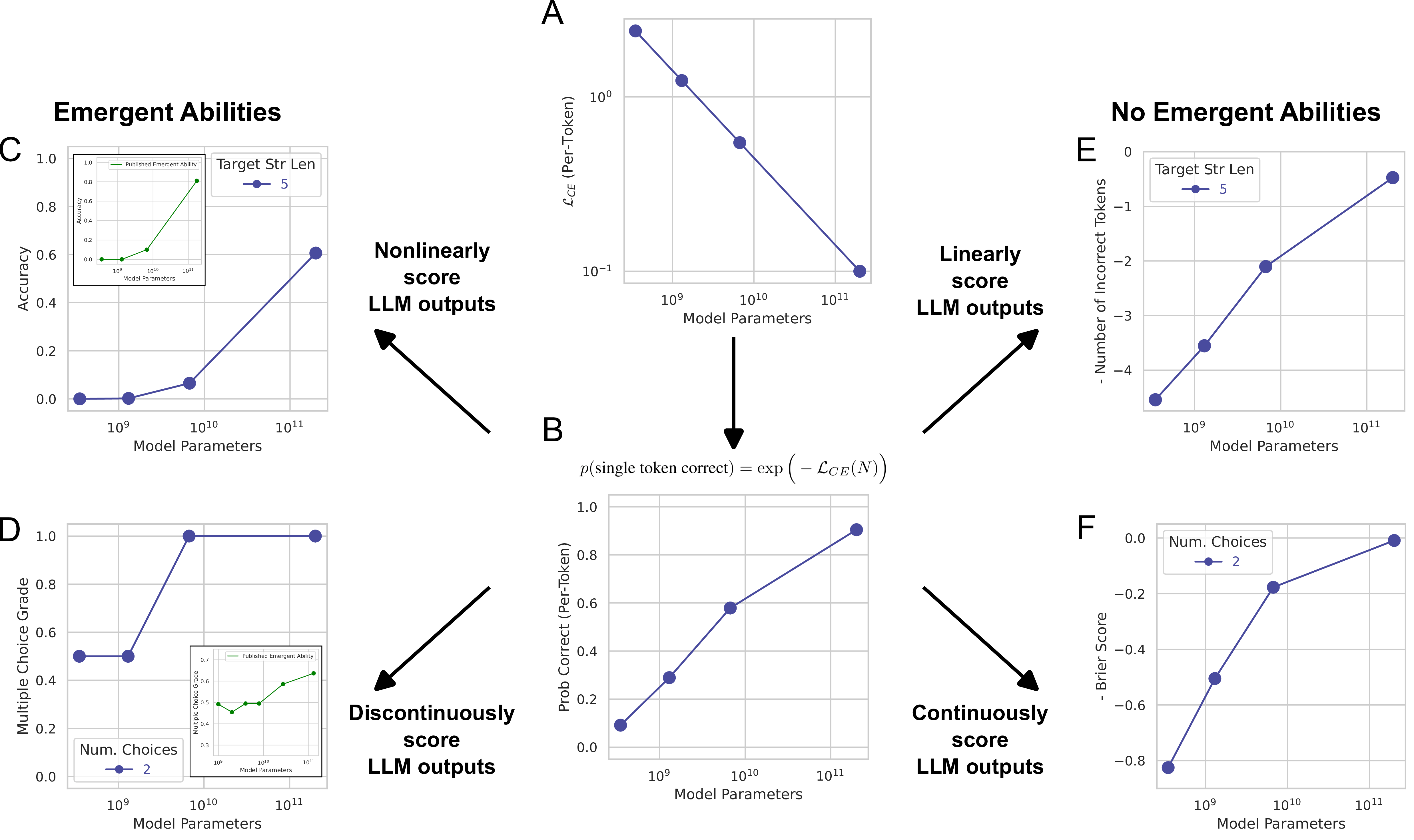
In 2023, Schaeffer, Miranda and Koyejo published a paper that calls all of this into question. Their thesis: emergence is largely a measurement artifact. The model improves smoothly; it is our way of grading it that manufactures the appearance of a jump.
Are Emergent Abilities of Large Language Models a Mirage? (Schaeffer et al., 2023)The problem is subtle but important. Most studies measure capabilities with a binary metric: is the answer exactly correct (score = 1) or not (score = 0)? This metric hides the gradual improvement.
Example: a model must calculate 347 + 892 = 1239. If the model answers 1238, it gets a score of 0 (wrong). Yet it has the first 3 digits correct, it has significant partial understanding. If the model goes from "1100" to "1230" to "1238" to "1239," each step represents real progress. But with a binary metric, you see 0, 0, 0, 1, a sudden "jump" that is actually just a gradual threshold crossing.
The authors show that if you replace binary measures with continuous ones (the Brier score, which grades the probability assigned to the right answer rather than only the final choice, or the edit distance between the produced answer and the correct one) the improvements become smooth and gradual at all scales. The phase transition disappears. It was in the thermometer.
The truth, somewhere in the middle
The reality is probably nuanced, and both sides are partly right:
The underlying improvements are gradual, continuous metrics show this clearly. The model improves little by little, not by quantum leaps. But some capabilities need a functional threshold to be truly useful. A calculator that's wrong 30% of the time isn't a functional calculator, it's unusable in practice, even if it's "a little less wrong" than random.
Emergence in the functional sense (the moment when a capability becomes reliable enough to be usable in practice) is therefore very real, even if the underlying mechanisms evolve continuously. It's the difference between "the model understands addition a little better" (gradual) and "the model can now be used as a calculator" (functional threshold).
Practical implications
For AI safety
If potentially dangerous capabilities can appear unexpectedly at a certain scale, how do you anticipate them before deployment? This is one of the main arguments for systematic safety evals (evaluations).
Before deploying a new model, labs test it on hundreds of potentially problematic tasks: biosecurity (can it help create pathogens?), cybersecurity (can it write exploits?), manipulation (can it persuade someone to do something dangerous?). The goal is to detect dangerous emergent capabilities before they end up in the hands of the general public. This has become standard practice at Anthropic, OpenAI, Google DeepMind, and others, motivated in part by the discoveries about emergence.
For the "small but performant model"
The emergence debate has also stimulated research on efficient small models. If underlying improvements are gradual, then a small model well-trained (with high-quality data and optimized training techniques) can capture a significant fraction of a large model's capabilities.
Phi-2 (Microsoft, 2.7 billion parameters) and Mistral 7B validated the intuition. The Mistral 7B case is the best documented, here is what its authors claim, and nothing more: the model outperforms Llama 2 13B on every benchmark evaluated (a model close to twice its size), and Llama 1 34B in reasoning, mathematics and code generation (close to five times its size).
Those are factors of 2 and 5, not 10. The exact factor barely matters for the conclusion, which holds: raw size is not the only lever, and data quality and training care weigh heavily.
Emergence beyond model size
Emergence isn't solely tied to the number of parameters. Other factors can trigger capability "jumps":
- Data quality: careful filtering of the corpus can unlock capabilities without making the model bigger. The reference result here is FineWeb-Edu, described on the page about pre-training datasets: better filtering is worth roughly a factor of ten on volume.
- Fine-tuning: instruction tuning brings out the ability to follow instructions in a base model that did not do so. The knowledge was there; the behaviour was not.
- The prompt: chain-of-thought brings out multi-step reasoning. A model capable of reasoning that way does not do it spontaneously, you have to ask.
- Compute at inference (test-time compute): giving the model more computation when answering (multiple attempts, a beam search over continuations, or simply longer reflection) improves reasoning. This is improvement through computation rather than size.
Whether emergence is real in the strong sense or a measurement artifact in the weak one, it remains one of the most influential phenomena in LLM research, above all because it served as an argument for very large investment decisions. Knowing when and why new capabilities appear, and being able to tell a genuine appearance from an effect of measurement, is therefore as much a matter of judgement as of technique.
1. Which criterion makes an emergent ability so intriguing?
2. What happens when you ask a model well below 100 billion parameters to reason step by step (chain-of-thought)?
3. What is the argument of Schaeffer et al.'s Mirage paper against emergence?
4. How can the two camps of the emergence debate be reconciled?