The simple formula that works: predict the next word
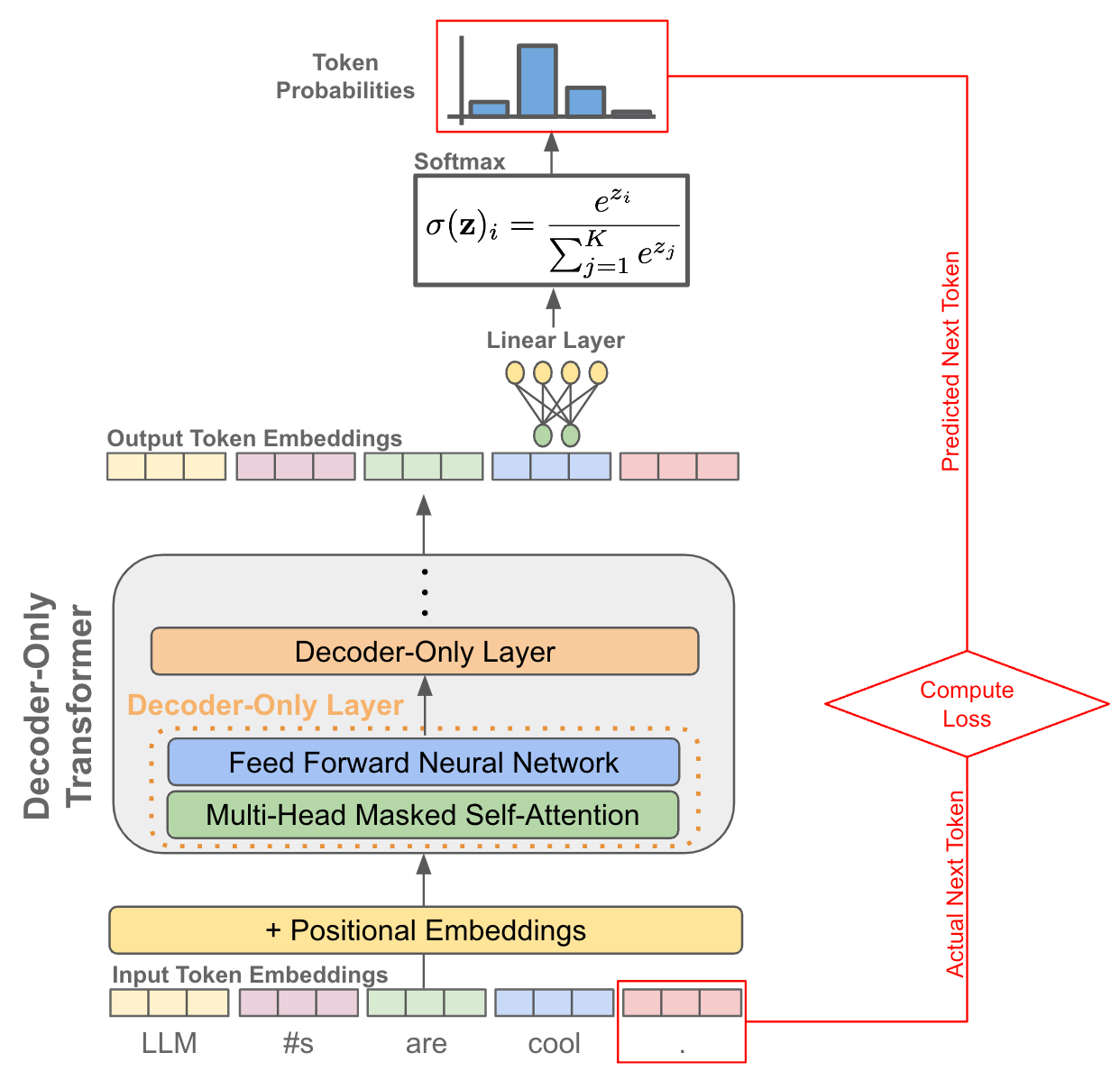
An LLM (Large Language Model) is a neural network (almost always a Transformer) trained on a single simple task:
Predict the next token given all the previous ones.
Given: "The black cat" Objective: Predict what comes next Answer: "sleeps", "jumps", "meows" (with probabilities)
What makes it "Large":
- Billions of parameters: GPT-1 has 117 million, GPT-3 has 175 billion, PaLM 540 billion, Llama 3.1 405 billion
- Trillions of training tokens: a gigantic corpus of web text, books, code, scientific articles
- A massive compute budget: thousands of GPUs (Graphics Processing Units) for months
The miracle: a mundane task is enough
The task is trivial. Predict the next word. Just that.
And yet, at sufficient scale, out come:
- world knowledge (knowing that Paris is the capital of France)
- mathematical logic (solving equations)
- multi-step reasoning (breaking problems down)
- code (producing working Python)
- translation, without ever being given a single translated sentence pair
None of these capabilities is programmed explicitly. They emerge from the prediction task alone, and the word "emerge" is more contested than it looks, as the page on emergent abilities explains.
LLMs don't process "whole words." They break text into tokens (word pieces or subwords):
| Input | Tokens |
|---|---|
| "extraordinary" | ["extra", "ordinary"] or ["ext", "raord", "inary"] |
| "the" | ["the"] |
| "!" | ["!"] |
The exact split depends on the model: these are not grammatical rules but pieces learned statistically from the corpus.
A useful rule of thumb: about 1.3 tokens per word in English. That is the conversion providers use to turn a text into a billed token count.
Common algorithms: BPE (Byte-Pair Encoding), WordPiece, SentencePiece.
The three levers of progress
The history of LLMs since 2018 is: increase three variables and watch the model get more capable. It isn't subtle, but it works every time. The figures below come from the publications of the labs concerned.
Lever 1: parameters (network size)
| Model | Year | Parameters |
|---|---|---|
| GPT-1 | 2018 | 117 million |
| GPT-2 | 2019 | 1.5 billion |
| GPT-3 | 2020 | 175 billion |
| PaLM | 2022 | 540 billion |
| Llama 3.1 | 2024 | 405 billion |
Observation: bigger means more capable, provided, as we'll see, the model is fed in proportion.
Lever 2: data (volume of training text)
| Model | Training tokens |
|---|---|
| GPT-1 | about 1 billion (the BooksCorpus dataset) |
| GPT-3 | 300 billion |
| Llama 3.1 405B | 15.6 trillion |
You will often read that GPT-3 was trained on 570 billion tokens. That is a mix-up of units.
The GPT-3 paper says two distinct things: the filtered version of Common Crawl weighs 570 gigabytes on disk, and the model was trained on 300 billion tokens in total, drawn from a mixture of sources. A gigabyte and a token are not the same unit, and only one of those two figures is a token count.
Observation: more text, and more varied text, means better regularities learned.
Lever 3: the compute budget
| Model | Compute budget, in operations |
|---|---|
| GPT-3 175B | (that is, 3,640 petaflop/s-days) |
| PaLM 540B | , about 8 times more |
| Llama 3.1 405B | , about 120 times more than GPT-3 |
These figures are directly checkable: a training run's compute budget is about , six times the parameter count times the token count. For Llama 3.1: , exactly the figure Meta reported. The page on Kaplan's laws explains where the factor 6 comes from.
We give no dollar costs: labs do not publish them, and the estimates in circulation vary by orders of magnitude depending on the rental price assumed.
The key point: it's predictable
Kaplan et al. (OpenAI, 2020) found that the loss follows a regular curve, not one law, but three separate ones:
is the loss, the parameter count, the token count, the compute budget. Each law is read "all else being equal". Plotted with both axes in logarithm, they are straight lines.
Consequence: you can plan. "With this budget I will reach this loss" becomes a calculation.
One important caveat, developed on the dedicated page: what the formula predicts is a loss, a statistical error in predicting the next token. Not a success rate on a given task. Nobody knows how to convert one into the other.
Scaling laws describe the pre-training loss. But a score on a given task can plateau while the loss keeps falling, either because the task is saturated, or because the measurement itself is. The debate remains open.
"Emergent" capabilities: the scaling puzzle
At certain size thresholds, apparently new capabilities show up. No specialized training: the model is bigger, and it can suddenly do something it could not do before.
Four examples, before we say why the word "emergent" is contested.
In-context learning
GPT-2 does this poorly; GPT-3 (175 billion) does it well. Give it three examples in the prompt and it continues the pattern. The mechanism is laid out on the page about in-context learning.
Few-shot: Sentiment: "I love it!" -> positive Sentiment: "Meh..." -> neutral Sentiment: "Excellent!" -> ?
GPT-3 responds correctly ("positive") without fine-tuning.
Spelled-out reasoning
A small model gives a bare answer. A large model told to "think step by step" walks through its reasoning, this is chain-of-thought, covered on its own page.
Question: If I have 3 apples and my friend gives me 5, then I share half with my mom...
GPT-3: "Step 1: . Step 2: . Answer: 4 apples"
Explicit reasoning! And it helps performance.
Code generation
Not specifically trained on code, just a generic LLM. GPT-3.5?
Prompt: "Write a Python function that checks if a number is prime" Output: Correct, efficient, commented code.
Translation without examples
The model never received translated sentence pairs, no parallel Chinese-French corpus of the kind classical translation systems relied on. It did see Chinese and French separately in its corpus. And it translates anyway.
"Translate from Chinese to French: 你好 ->" Answer: "Bonjour"
What was missing, then, was not the language. It was the supervision.
The underlying debate
The question: do these capabilities emerge (genuinely new behaviour appears) or do they become visible (they were improving all along, but our thermometer could not see it)?
Both camps have serious arguments, and the dedicated page lays them out with the relevant papers. In short: what is observed is a sharp take-off in scores; what is disputed is whether it comes from the model or from the way we grade it.
"Can do" does not mean "always gets right." A model may translate nine sentences out of ten correctly and fail on the tenth, with no way to predict which. Newly acquired capabilities are often fragile to rephrasing.
Key models
GPT (OpenAI)
GPT-3 (2020) -> ChatGPT (2022, with RLHF) -> GPT-4 (2023, multimodal).
Open models
LLaMA (Meta, 2023), Mistral (2023), Mixtral (2024), Qwen (Alibaba), DeepSeek.
Claude (Anthropic)
Emphasis on safety and alignment, notably through Constitutional AI.
Gemini (Google DeepMind)
Natively multimodal: text, images, audio, video.
The training pipeline: 4 steps to go from nothing to an assistant
An LLM isn't born intelligent. It goes through 4 successive steps that progressively transform it from a neural network with random weights into an assistant capable of reasoning and following instructions. Each step builds on the previous one:
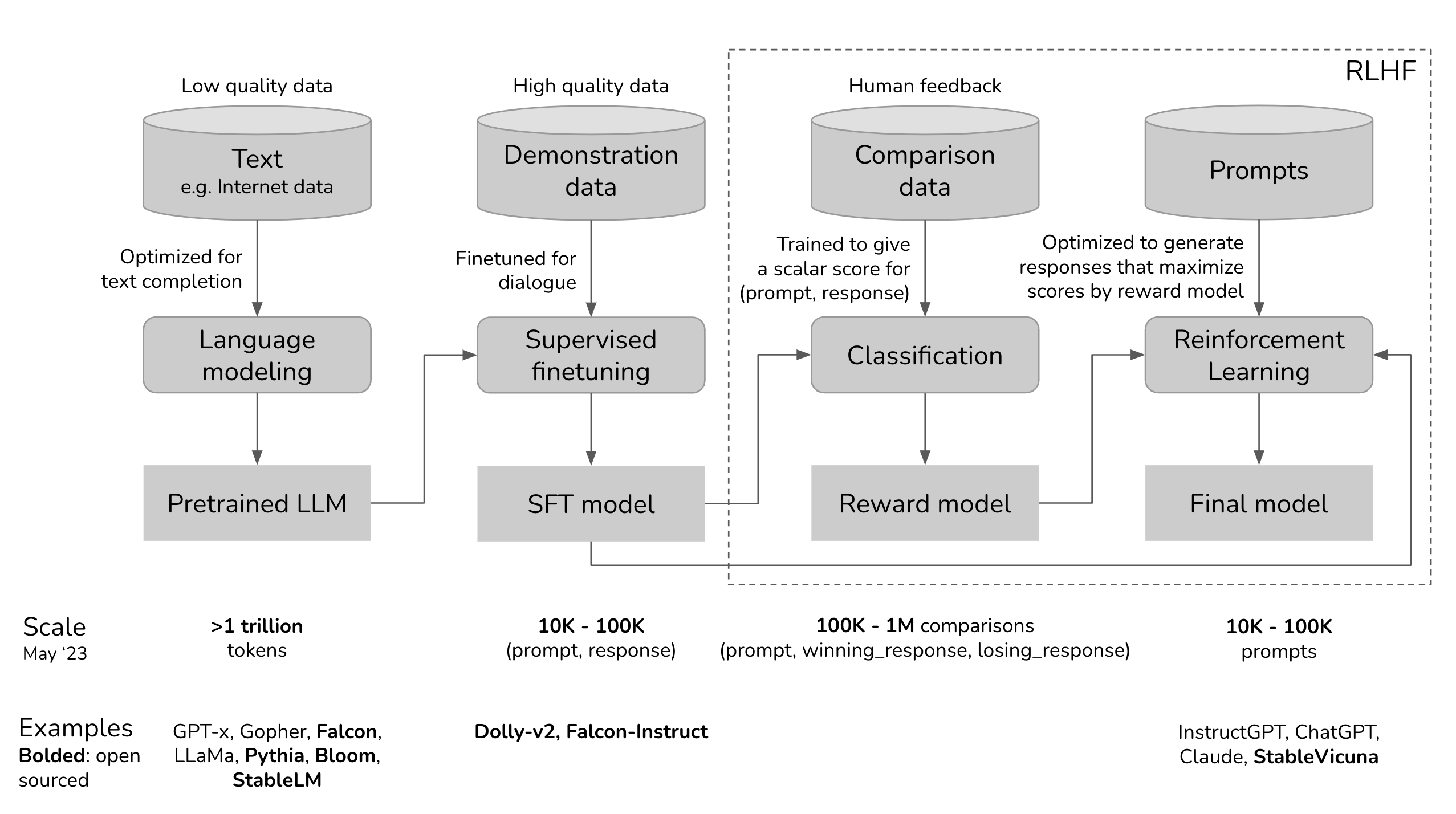
Step 1, Pre-training (Base Training)
Objective: learn language and world knowledge.
The model ingests trillions of tokens of text (web, books, code, articles) and learns to predict the next token. This is the most expensive phase: thousands of GPUs for months.
Result: a "base" model that can complete text coherently. It knows facts, speaks several languages, can write code. But it doesn't yet know how to answer a question, ask it "What is the capital of France?" and it might continue with "What is the capital of Germany?" rather than answering "Paris."
-> Detailed on the GPT, pre-training and scaling laws pages.
Step 2, SFT, supervised fine-tuning
Objective: learn to follow instructions.
The base model is trained on thousands of examples of conversations (a question, then a good answer), written by humans or produced by other LLMs. The model learns the format: when asked a question, answer it.
Result: a model that follows instructions. Already usable, but it can still produce dangerous, misleading, or uneven answers.
-> Detailed on the instruction tuning page.
Step 3, Alignment
Objective: learn human preferences, be helpful, honest, and safe.
The model is refined so that it prefers good answers to bad ones. Several algorithms do this:
- RLHF (Reinforcement Learning from Human Feedback) with PPO (Proximal Policy Optimization): a reward model scores answers, PPO corrects the model;
- DPO (Direct Preference Optimization): direct training on preference pairs, with no reinforcement learning;
- GRPO (Group Relative Policy Optimization): several answers to the same question are compared against each other, which removes the need for a critic model.
Result: an aligned assistant, it refuses dangerous requests, gives nuanced answers, and becomes usable by the public.
Step 4 (optional), Specialization
Depending on the final use, you can add:
- RLVR (Reinforcement Learning with Verifiable Rewards) for mathematics and code, this is what produces reasoning models;
- domain fine-tuning to adapt the model to a sector (medical, legal, finance);
- distillation, which transfers a large model's behaviour into a smaller one.
The total cost of such a chain, for a frontier model, runs into tens of millions of dollars, but labs do not publish it, and the figures in circulation are reconstructions. Adapting an existing model with LoRA or QLoRA, by contrast, costs a tiny fraction of that, and that order of magnitude is checkable.
How an LLM generates text (the concrete mechanics)
Step by step, when you ask a question to an LLM:
1. Tokenization
Input: "Explain gravity" Tokens: ["Expl", "ain", "grav", "ity"]
The tokenizer breaks text into manageable pieces (not whole words, sub-units).
2. Embedding
Token "Expl" -> vector of numbers Token "ain" -> vector of numbers
Each token becomes a vector, that is, a list of numbers. Its length is the "model dimension": 4,096 for Llama 3 8B, 12,288 for GPT-3 175B. These vectors are learned during pre-training and frozen afterwards.
3. Passing through the Transformer
- Layer 1: self-attention, then MLP
- Layer 2: self-attention, then MLP
- ...
- Layer : self-attention, then MLP, with for Llama 3 8B, for GPT-3 175B
The MLP (Multi-Layer Perceptron) is simply a small conventional neural network, applied to each token independently. Self-attention is the mechanism by which each token consults the others.
Output: an updated vector for each token. At each layer, every token queries the others through attention, and the network refines its representation.
4. Predicting the next token
The last token's vector goes through a linear layer that produces one score per token in the vocabulary, on the order of 50,000 scores for GPT-2, 128,000 for Llama 3. These raw scores are called logits.
The softmax function exponentiates each score and divides by the sum of all of them: it turns arbitrary scores into a probability distribution, a categorical distribution, laid out in distributions.
Result: , , , and so on.
5. Sampling
You draw a token at random from that distribution. The temperature controls how you draw: every logit is divided by it before the softmax. The draw itself and temperature's exact effect are covered in sampling.
| Temperature | Effect on the logits | Behaviour |
|---|---|---|
| 0 | limiting case, no draw at all | always take the most probable token; output is reproducible |
| 1 | logits unchanged | draw according to the model's own probabilities |
| 2 | logits halved, so pulled together | gaps flatten out, rare tokens become reachable |
The mechanism is arithmetic: dividing by a number above 1 brings the scores closer together, which evens out the probabilities, which increases variety. Dividing by a number below 1 does the opposite.
6. Auto-regression (the loop)
Initial prompt: "Explain gravity"
| Iteration | Input | Output | New prompt |
|---|---|---|---|
| 1 | "Explain gravity" | "It's" | "Explain gravity It's" |
| 2 | "Explain gravity It's" | "a" | "Explain gravity It's a" |
| 3 | "Explain gravity It's a" | "force" | "Explain gravity It's a force" |
Continues until </s> or max_tokens.
Each generated token becomes the input for the next prediction. It's auto-regressive: the model feeds on its own output to keep generating.
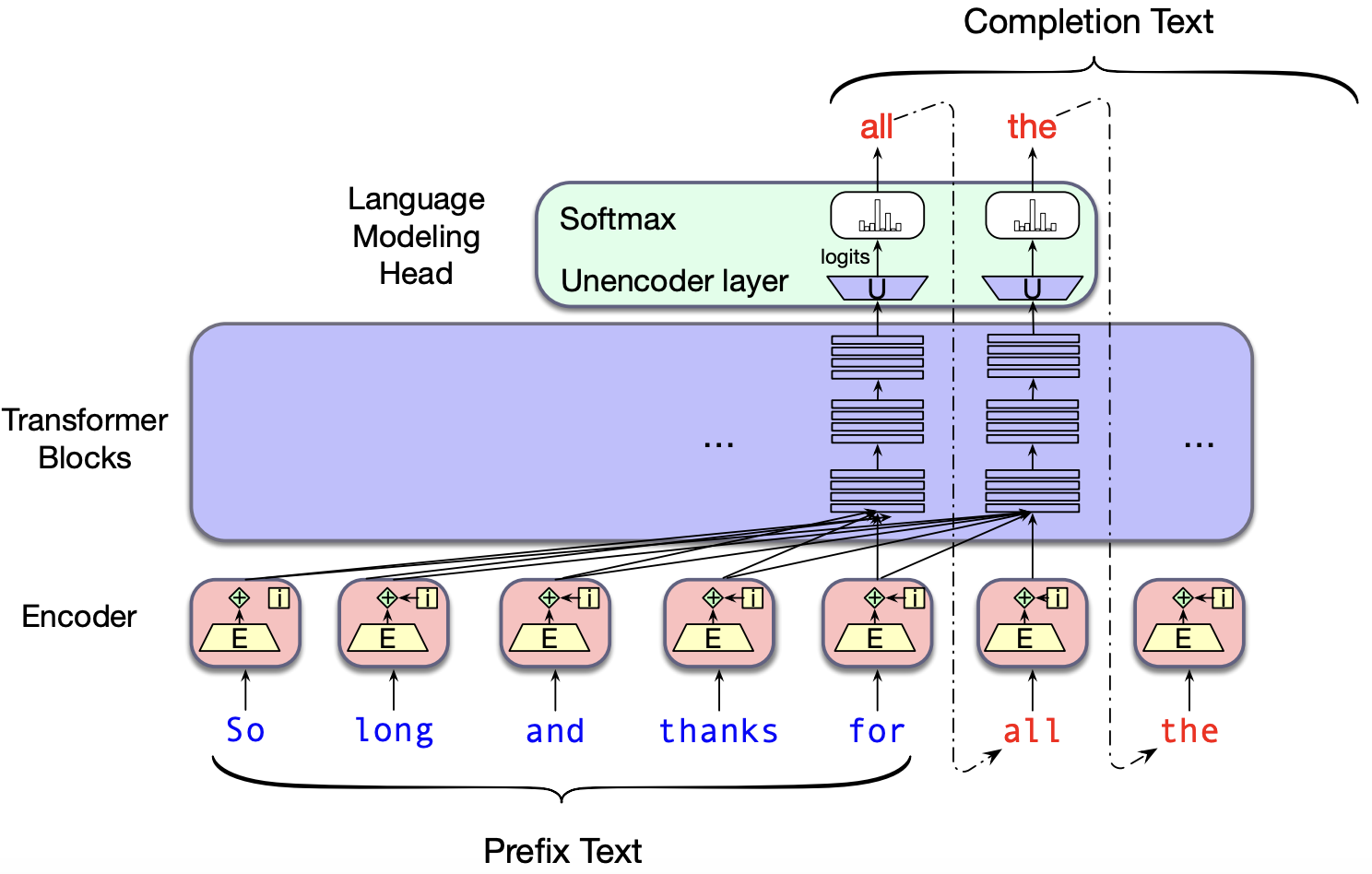
Mechanically, an LLM does exactly three things:
- transforms vectors by multiplying them with learned weight matrices;
- produces a probability distribution over the vocabulary;
- draws a token from that distribution.
Is that understanding? The question is open, and it is better left open than settled too quickly either way. What is certain is that the result is useful.
Hard limitations
- Hallucinations: the model generates false facts with apparent confidence, because it optimizes for statistical plausibility, not factual truth
- Context window: limit on tokens it can process at once (improving, but remains a constraint)
- No persistent memory: each conversation starts from scratch (unless an external memory system is added)
- Fragile reasoning: can fail on minor variations of the same problem
- Computational cost: enormous training, and inference also consumes significant resources
Why LLMs took over
- Architecture: the Transformer scales well, which no earlier architecture did
- Data: text is abundant and already written
- Compute: the required GPUs can be bought
- Flexibility: one model covers hundreds of tasks, switched by changing the prompt
Why this matters
An LLM is a network trained on a trivial task (predict the next token) at an unusual scale (billions of parameters, trillions of tokens).
That combination produces a remarkably flexible tool: answering questions, producing code, translating, summarizing, arguing, roughly anything that can be framed as "generate text."
The three levers (parameters, data, compute) govern progress, and do so predictably. No magic breakthrough.
What the newly appearing capabilities reveal is that the regularities of written language contain far more than expected (logic, reasoning, world knowledge) implicitly encoded in the statistics of text.
The following pages cover the exact scaling laws (Kaplan then Chinchilla), pre-training, and the alignment techniques that turn a text completer into an assistant.
The following sections explore the exact scaling laws, how to optimize training, and how to build real systems with these models.
1. You read that GPT-3 was trained on 570 billion tokens. What should you make of that?
2. You ask a freshly pretrained model, with no SFT and no alignment, what the capital of France is. What might it answer?
3. Mechanically, what does a temperature of 2 do?
4. What exactly do Kaplan's scaling laws predict?