The Base Model Is an Unusable Genius
After pre-training, you have a model that has read the entire Internet and knows an enormous amount... but it doesn't know how to answer your questions. Ask it "What is the capital of Germany?" and instead of saying "Berlin," it's likely to continue with "What is the capital of Italy? What is the capital of Spain?", because in its training data, lists of questions were common, and that is the most likely continuation.
The base model is a text completer, not an assistant. It doesn't understand that it's being spoken to. It doesn't know it should be helpful. It doesn't know it shouldn't generate toxic content. Fine-tuning is the process that transforms it into a tool usable by real humans.
There are two major families of approaches, and the choice between them has major consequences on cost, required resources, and performance: full fine-tuning (you modify all the model's parameters) and PEFT methods (Parameter-Efficient Fine-Tuning) like LoRA (you modify only a tiny fraction, often less than 1%).
Full Fine-tuning: Heavy Surgery
The Principle
You take the pre-trained model and continue training on a specialized dataset (conversations, instructions, domain-specific data). Every parameter of the model can be modified, the billions of weights learned during pre-training are all "unfrozen" and subject to adjustment. It's the equivalent of deeply re-educating someone: you're not just changing their specialty, you're potentially modifying their entire internal functioning.
The Real Cost, and This Is Where It Hurts
Let's do the full arithmetic for a 7-billion-parameter model with the AdamW optimizer, line by line. Everything reduces to one multiplication: bytes per parameter × 7 billion.
| Component | Bytes per parameter | Graphics memory |
|---|---|---|
| Model weights, in 16 bits | 2 | GB |
| Gradients, in 16 bits | 2 | 14 GB |
| Optimizer states: AdamW keeps two running averages per parameter, each in 32 bits | 56 GB | |
| Intermediate activations (depends on sequence length and on whether they are recomputed) | varies | 10 to 30 GB |
| Total | roughly 95 to 115 GB |
Two comments, because it is the optimizer-state line that always surprises people. Where do those 8 bytes come from? AdamW does not just use the current gradient: for every parameter it stores an average of past gradients and an average of their squares, two numbers, kept in full precision so they don't drift, hence 4 bytes each. The heaviest item in training is therefore not the model: it is the optimizer's bookkeeping, four times larger than the weights themselves.
This memory is the graphics card's own, its VRAM (Video Random Access Memory). It tops out at 80 GB on the most common data-centre cards, so even a 7-billion-parameter model does not fit on a single card under full fine-tuning.
A 70-billion-parameter model? Multiply everything by 10, close to a terabyte: you need a cluster of cards.
Another danger of full fine-tuning: specializing the model on one task can cost it capabilities acquired during pre-training. This is catastrophic forgetting. A model fine-tuned only on medical text may become unable to draft a professional email, the weights that carried that skill have been overwritten.
Two remedies: mix a fraction of general data into the specialization set, and use a very low learning rate (the size of each weight correction).
LoRA: The Genius of Minimalist Adaptation
A Surprising Observation
In 2021, researchers at Microsoft (Hu et al.) made a discovery that would change fine-tuning practice: when you adapt a pre-trained model to a new task, the resulting weight changes have a particular mathematical structure, they are low-rank. In simple terms, even though the model has billions of parameters, the modifications needed to adapt it live in a very small-dimensional subspace.
It's as if, to redirect a general medicine expert toward cardiology, you only needed to adjust a few key connections rather than rewiring their entire brain. So why modify the billions of original parameters if the actual adaptation only touches a tiny corner of the parameter space?
The LoRA Solution
LoRA: Low-Rank Adaptation of Large Language Models (Hu et al., 2021)LoRA (Low-Rank Adaptation) does not touch the original weights . Instead it adds a low-rank correction to them:
| Matrix | Dimensions | Status |
|---|---|---|
| a parameter learned during pre-training, then frozen, never modified by LoRA | ||
| a parameter learned by LoRA | ||
| a parameter learned by LoRA | ||
| (the rank) | usually 8, 16, or 64 | much smaller than |
"Rank" here means the intermediate dimension that you force the computation through: the product has the same shape as but can only represent a subspace of dimension . That is exactly the paper's hypothesis, adaptation lives in such a subspace.
You train only the small matrices and . The original weights stay frozen. The arithmetic, with concrete numbers: if (the dimension of a 7-billion-parameter model) and , then instead of modifying
you train only
which is times fewer. LoRA is applied to the attention weight matrices , , , of each layer, note that it is those weight matrices that are targeted, not the activations , , they produce.
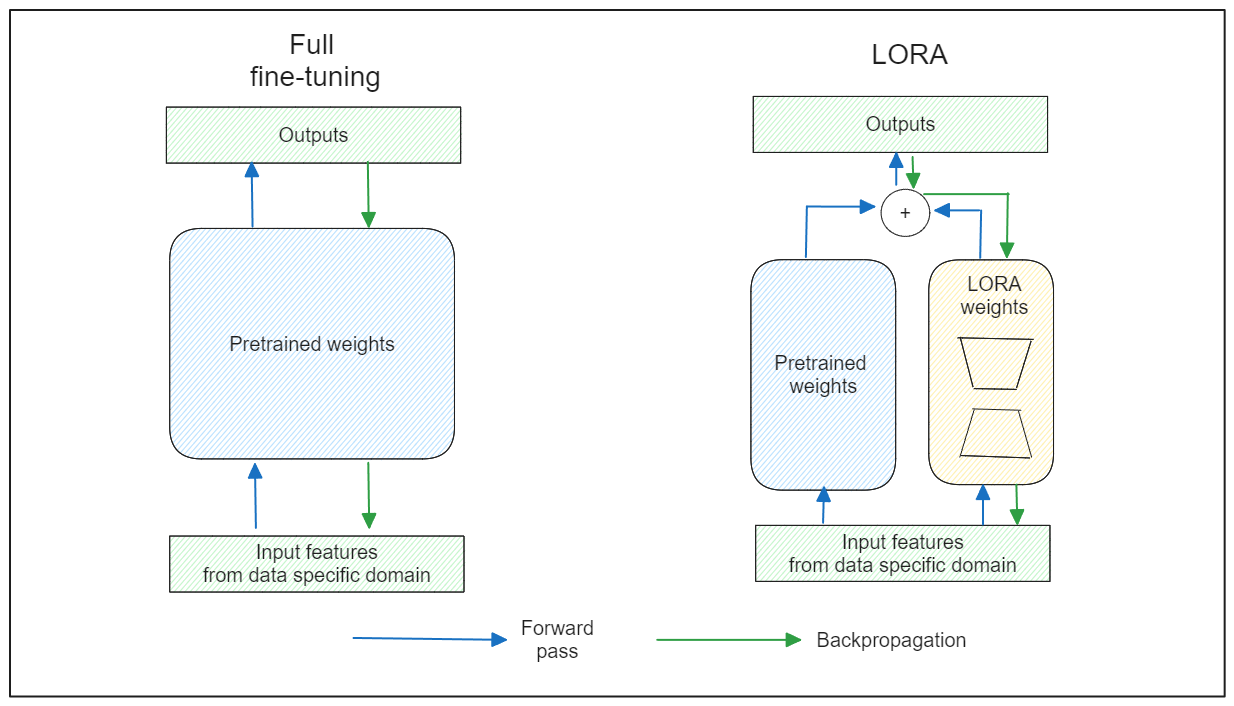
Here are the figures as the authors state them; better to stick to these than to the approximate percentages that circulate. On GPT-3 at 175 billion parameters, LoRA:
- reduces the number of trainable parameters by a factor of 10,000;
- reduces the graphics memory required by a factor of 3;
- achieves quality "on par or better" than full fine-tuning on the models tested (RoBERTa, DeBERTa, GPT-2, GPT-3);
- adds no inference latency, unlike adapters.
The reasoning behind it: adapting a pre-trained model is not a rebuild, it is a slight refocusing, and that refocusing fits in a low-dimensional subspace.
The Practical Advantages
- Memory: optimizer states are kept only for the trained weights, that is, for 0.1 to 1% of the model. Look back at the table above: the 56 GB line drops to a few hundred megabytes
- Portability: the LoRA adapter (the and matrices) weighs a few dozen megabytes, not dozens of gigabytes
- Modularity: one base model can carry ten different adapters, one per client, per language, per task
- No inference overhead: since has exactly the shape of , you can add the two together before deployment and serve a single model, indistinguishable from an ordinary one
QLoRA: Fine-tuning a 70B on a Single GPU
QLoRA: Efficient Finetuning of Quantized LLMs (Dettmers et al., 2023)QLoRA (Quantized LoRA) pushes LoRA further by combining two ideas:
- The base model is quantized to 4 bits instead of 16, that is, half a byte per parameter: four times less space. The weights are encoded in a format called NF4 (NormalFloat 4-bit), designed for the particular statistical distribution of neural network weights, they are roughly Gaussian, so the quantization levels are spaced accordingly rather than uniformly.
- The LoRA adapters stay in 16 bits, which preserves the precision of learning. The frozen model is compressed; what you learn is not.
The headline result the authors report: fine-tuning a 65-billion-parameter model on a single 48 GB card, while matching the quality of 16-bit fine-tuning.
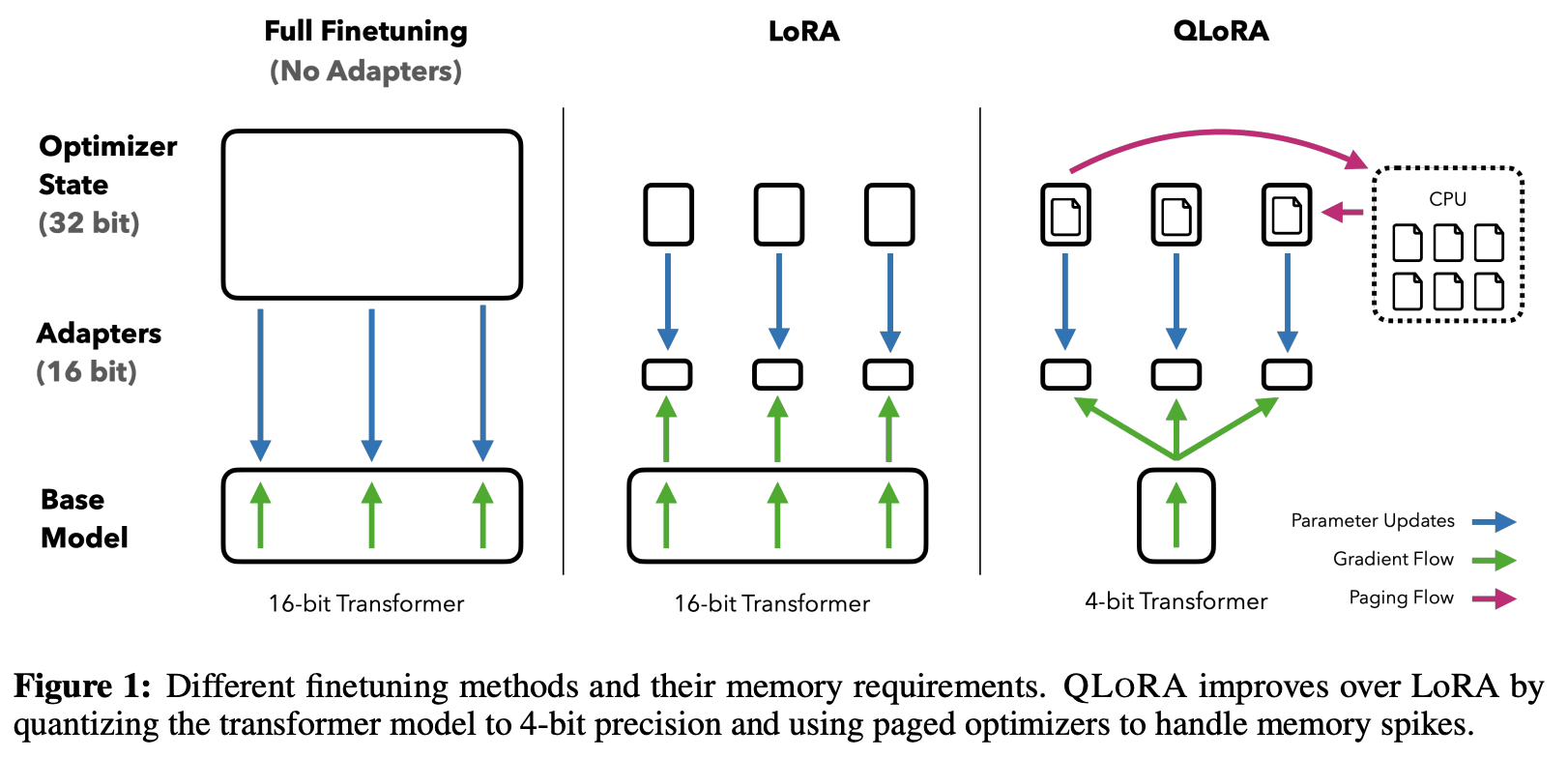
The orders of magnitude, set against the detailed table at the top of this page:
| Model | Full fine-tuning | LoRA | QLoRA |
|---|---|---|---|
| 7 billion parameters | about 100 GB | about 16 GB | about 6 GB |
| 70 billion parameters | about 1 TB | about 160 GB | about 48 GB |
The QLoRA column can be recovered in your head: the quantized weights of a 70-billion-parameter model take GB, plus activations and adapters. The 48 GB figure for a 65-billion model is the one the QLoRA authors actually report.
A consumer card with 24 GB is enough to fine-tune a 7-to-13-billion-parameter model with QLoRA; an 80 GB data-centre card gets you to 70 billion. What required a cluster of machines a few years ago now fits on a desktop.
We give no prices: they move too fast for any figure written into a course to stay correct.
Other PEFT Methods in Brief
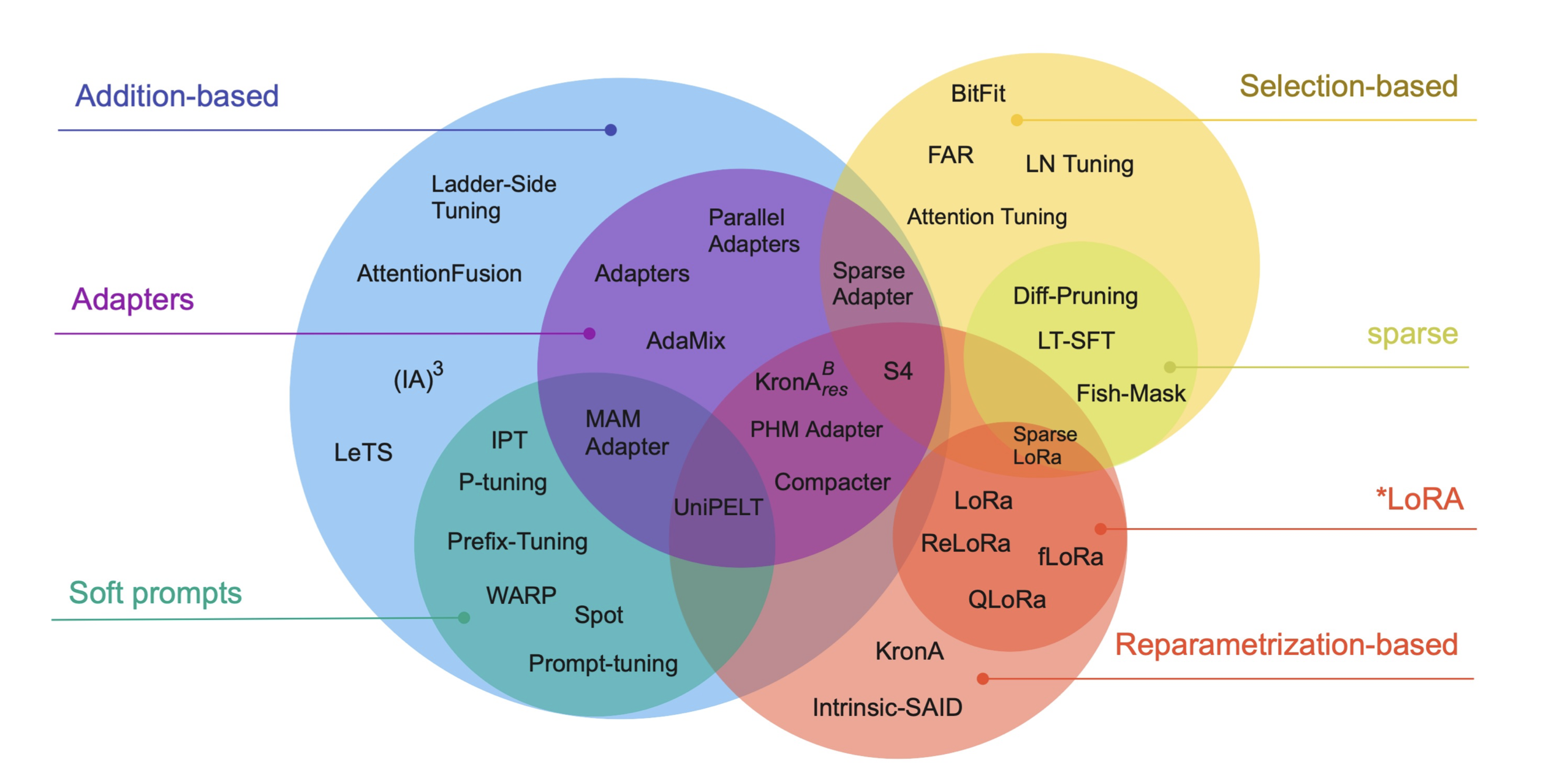
LoRA and QLoRA aren't the only PEFT approaches. Here are others, in chronological order:
Adapters (Houlsby et al., 2019): small modules are inserted between the existing Transformer layers. Each one squeezes the vector down and expands it again, hence the name bottleneck. This is the original PEFT method, predating LoRA. Its drawback: those modules remain layers to traverse at inference time, which adds latency. LoRA avoids this, because its correction is added to the original weights rather than stacked behind them.
Prefix tuning (Li and Liang, 2021): you learn "virtual tokens" placed at the start of the context, which correspond to no real word but steer the model's behaviour. Very lightweight, generally less effective than LoRA.
Prompt tuning (Lester et al., 2021): more minimal still, you learn only the embeddings of a few tokens prepended to the input, a few thousand parameters in all. The paper's title says the essential thing: The Power of Scale. The method becomes comparable to full fine-tuning only from several billion parameters upward (the authors go as far as T5-XXL, 11 billion). Below that, LoRA is clearly better.
How to Choose?
| Criterion | Full fine-tuning | LoRA | QLoRA |
|---|---|---|---|
| Parameters modified | 100% | 0.1 to 1% | 0.1 to 1% |
| VRAM for a 7-billion model | about 100 GB | about 16 GB | about 6 GB |
| Quality obtained | the reference | on par, per the LoRA authors | slightly below LoRA |
| What you have to move around | the whole model (14 GB) | an adapter (a few dozen MB) | an adapter (a few dozen MB) |
We do not put percentages on the quality row: the gaps depend entirely on the task, and the figures in circulation ("95 to 99%") do not come from any particular published measurement.
Choose full fine-tuning if: you're a lab with GPU clusters, you're building a foundation model for a highly specialized domain (medical, legal, proprietary code), and you have hundreds of thousands of training examples.
Choose LoRA/QLoRA if: you're adapting an existing model to a specific use case, your resources are limited, you need to iterate quickly, or you have multiple adapters for multiple different tasks.
The vast majority of fine-tuning in industry uses LoRA or QLoRA. Full fine-tuning is reserved for major players (OpenAI, Google, Meta, Anthropic, Mistral) for their main models. For any specific use case, PEFT methods have become the absolute standard.
What's Next?
Choosing between full fine-tuning and LoRA is only the first technical decision. The real strategic question is: what to fine-tune on, and with what objective? There are two major steps after pre-training:
- SFT (Supervised Fine-Tuning): teaching the model to follow instructions, hold a conversation, and answer in the right format. You show it examples of good question-answer pairs. Covered on the instruction tuning page.
- Alignment: teaching the model to be helpful, honest and harmless, via RLHF (Reinforcement Learning from Human Feedback) or DPO (Direct Preference Optimization).
Both are covered on the following pages. But take away the key point of this one: LoRA and QLoRA made fine-tuning accessible. What was reserved for the largest players now fits on a good graphics card.
1. In full fine-tuning of a 7-billion-parameter model with AdamW, what is the heaviest memory item?
2. What exactly does LoRA modify in the model?
3. Why does LoRA add no inference latency, unlike adapters?
4. What is the key idea of QLoRA?