The Race to Simplify Continues
DPO removed the reward model and the reinforcement learning loop. But researchers keep asking: can we simplify further? And what do you do when your data doesn't come in the format DPO requires?
Three methods deserve attention: ORPO, which merges SFT and alignment into a single step; KTO, which works without response pairs; and SimPO, which removes even the reference model.
A vocabulary reminder, set out in full on the RLHF page: the policy is the model itself seen as a generation rule, written ; the reward model is a second network that scores answers; the reference model is a frozen copy used as a yardstick, written .
ORPO: Why Do Two Steps When One Is Enough?
The Standard Pipeline and Its Hidden Cost
Until now, alignment happens in two distinct phases:
- SFT: learn to follow instructions (training #1)
- DPO or RLHF: learn to prefer good responses (training #2)
Two training runs means twice the compute time, two sets of hyperparameters to tune, and an intermediate checkpoint of the SFT model to store and manage. What if we did both at once?
The ORPO Solution
ORPO (Odds Ratio Preference Optimization) proposes exactly that: a unified loss combining format learning (SFT) and preference learning in a single pass.
ORPO: Monolithic Preference Optimization without Reference Model (Hong et al., 2024)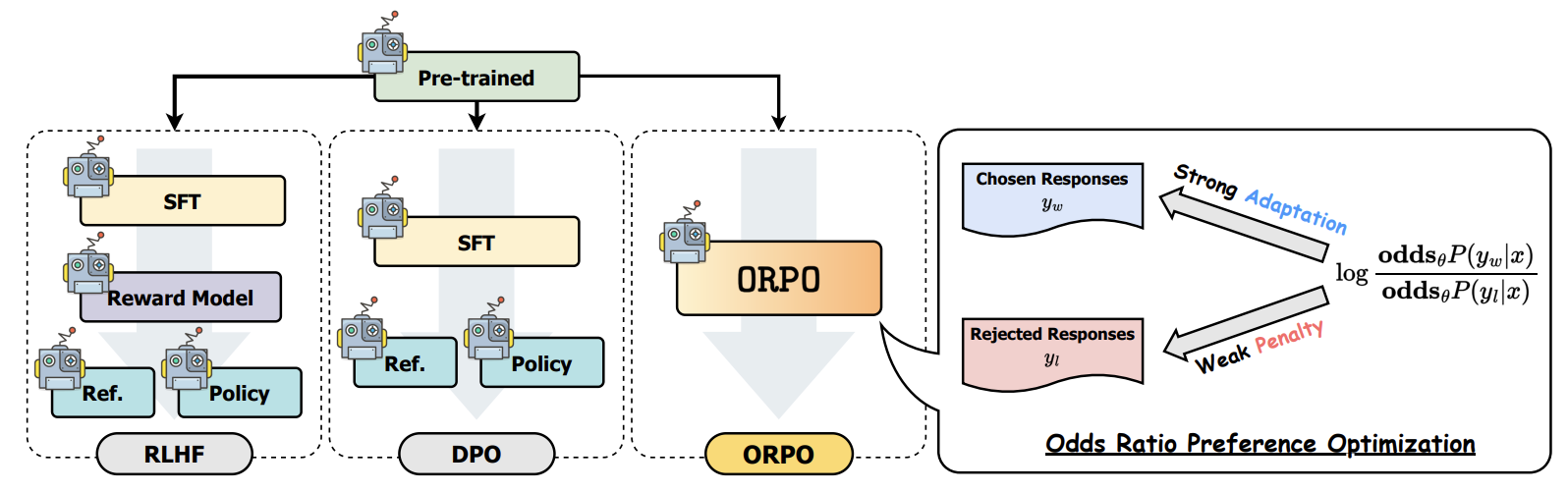
The total loss is a sum of two terms:
Term by term: is the ordinary language modelling loss applied to the preferred response , the model learns to produce that kind of answer. penalizes the model when it assigns a higher probability to the rejected response than to the preferred one. And (lambda) is a hand-set coefficient balancing the second term against the first.
That this is a sum is the whole point: two kinds of learning that used to be two successive training runs become two terms of one gradient descent.
This second term uses the odds ratio, a classic measure in statistics, widely used in medicine and sports betting. The idea is simple: instead of directly comparing the probabilities of the two responses, you compare their odds. Odds are the ratio of "chances for / chances against", like when a bookmaker says "3 to 1." If the model gives 75% probability to a response, its odds are (3 chances for, 1 against).
The odds ratio compares the odds of the two responses:
The good response's odds on top, the bad one's underneath. If OR is above 1, the model "bets" more on the good response; if below 1, it bets on the bad one and gets penalized.
Why odds rather than probabilities? Because a probability is capped at 1 and saturates: between 0.98 and 0.99 the gap is 0.01, a very faint signal. The corresponding odds are 49 and 99, a factor of 2. Odds keep discriminating where probabilities flatten out.
ORPO uses no reference model, unlike DPO. It is tempting to say "the original weights play that role implicitly," but that is not accurate: there is no frozen copy anywhere.
What actually acts as the guard rail is the first term of the loss. The SFT component constantly pulls the model towards producing good answers, which stops it drifting into a degenerate strategy without needing to measure any distance to a yardstick. The guard rail hasn't gone away; it has changed form.
Result: one model held in memory, one training run.
In Practice
The authors release two demonstration models, Mistral-ORPO-α and Mistral-ORPO-β, at 7 billion parameters, trained straight from the base model with no separate SFT phase. Hugging Face's TRL library implements ORPO.
The economic argument is easy to state: you replace two training runs with one, so you roughly halve the total alignment time. "Roughly" is deliberate, the exact saving depends on the relative length of the two phases being merged.
KTO: What If Your Data Isn't in Pairs?
The Real-World Problem
DPO has a constraining prerequisite: for each prompt you need a chosen response AND a rejected response, and both must answer the same prompt.
But in real life, feedback rarely looks like that. What you actually have:
- a user clicking "thumbs up" or "thumbs down" on a single response;
- an annotator marking a response good or bad without comparing it to another;
- chat logs with satisfaction signals, never paired.
KTO (Kahneman-Tversky Optimization) is designed for this case: it works with individual labels on isolated responses.
KTO: Model Alignment as Prospect Theoretic Optimization (Ethayarajh et al., 2024)The Behavioral Economics Inspiration
The name "Kahneman-Tversky" comes from the two psychologists (Daniel Kahneman, 2002 Nobel Prize in Economics, and Amos Tversky) who developed prospect theory. Their main discovery: humans are asymmetric when it comes to gains and losses.
Losing $100 hurts about twice as much as gaining $100 feels good, the loss-aversion coefficient the authors estimate is close to 2. We are structurally more sensitive to losses than to gains.
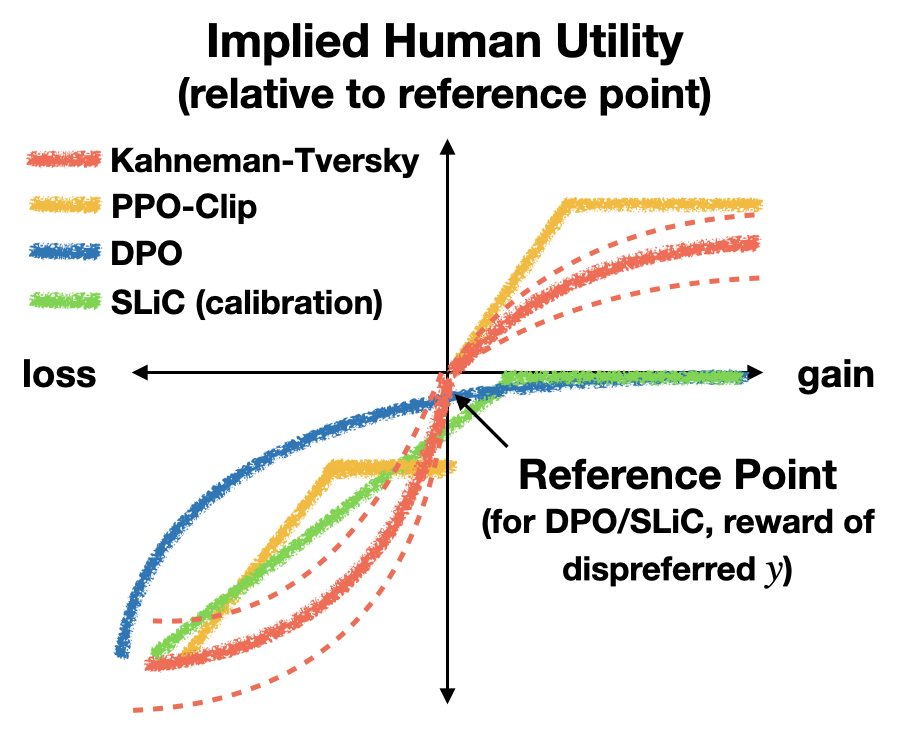
KTO integrates this asymmetry directly into its training objective. The model is penalized more strongly for producing bad responses than rewarded for producing good ones. This asymmetry better matches true human preferences than symmetric methods.
The Mechanics
The intuition before the formulas: for each response, KTO measures how much more the current model prefers it than the reference model does, the ratio , exactly as in DPO. It then compares that gap to a reference point: the model's average gap over the whole batch. This is grading a student not in absolute terms but against the class average.
That reference point is what stands in for the missing second response: DPO compared two answers with each other, KTO compares each answer with the average.
For a desirable response y_w (label "good"), the loss is low if the model prefers it more than the average:
For an undesirable response y_l (label "bad"), the loss is low if the model prefers it less than the average:
The term is that reference point: the average Kullback-Leibler divergence, estimated over the current batch. is the sigmoid, the coefficient setting sensitivity, the model being trained and its frozen reference.
Note that the two formulas are identical up to an inversion: for a good response we want a ratio above the average, for a bad one below. The subtraction is simply flipped.
The paragraph above announced that KTO penalizes bad responses more strongly than it rewards good ones. But the two formulas as written are perfectly symmetric. So where is the asymmetry?
It is not in those expressions: it is in the weights the full loss applies to them. KTO multiplies the undesirable-response term by a larger coefficient than the desirable one. That imbalance of weights, and nothing else, is what reproduces Kahneman and Tversky's loss aversion. Without it, the method would be as symmetric as the others.
Both formulas operate on individual examples, never on pairs. So you can freely mix good- and bad-labelled responses in a single batch, without them matching up.
For a company that has deployed a conversational assistant and collected thumbs up and down, KTO is often the right choice: that unpaired data is usable as it stands.
The alternative is bad. To use DPO you would have to manufacture artificial pairs, matching a well-rated answer with a badly-rated one from the same prompt, except you usually have only one judgement per prompt. So you end up pairing answers to different prompts, and teaching the model to prefer an answer for the wrong reasons.
SimPO: Without a Reference Model at All
SimPO (Simple Preference Optimization) pushes simplification further still: it does without a reference model.
SimPO: Simple Preference Optimization with a Reference-Free Reward (Meng et al., 2024)DPO and KTO need a frozen copy in memory to compute their probability ratios. SimPO removes it and uses the sequence's average log-probability per token directly as an implicit reward:
is the number of tokens in the response, and the sum of those tokens' log-probabilities. Dividing by is essential, and here is why: a sequence's probability is the product of its tokens' probabilities, each below 1. A response twice as long therefore has a mechanically far lower probability. Without normalization the model would simply learn to be brief. Dividing by the length reduces everything to an average probability per token, comparable across responses of different sizes.
SimPO also adds a margin term (gamma), imposing a minimum gap between the scores of the good and the bad response:
is that margin: the loss only becomes small once the gap exceeds , which stops the model from settling for a tiny separation.
SimPO Advantages
- Half the memory: a single model loaded instead of two
- Length bias handled at the root: length normalization is part of the formula, not a correction bolted on afterwards
- Competitive results: the authors report performance equal to or better than DPO on the benchmarks they test
Comparison Table: Choosing Your Method
| Method | Required data | Models loaded | Steps | Complexity |
|---|---|---|---|---|
| RLHF (PPO) | pairs ranked by annotators | 4: policy, reference, reward model, critic | SFT, then reward model, then RL | very high |
| DPO | preference pairs | 2: policy and reference | SFT, then DPO | moderate |
| ORPO | preference pairs | 1: the policy alone | one run, SFT and preferences merged | low |
| KTO | individual, unpaired labels | 2: policy and reference | SFT, then KTO | moderate |
| SimPO | preference pairs | 1: the policy alone | SFT, then SimPO | low |
The column to read first is the second one: the format of your data decides, ahead of any performance consideration. If all you have is thumbs up and down, only KTO applies.
None of these methods systematically dominates the others, and published comparisons depend heavily on the evaluation sets chosen. Rule of thumb: start with DPO, the best documented; move to KTO if your data is unpaired; look at ORPO or SimPO if you need to cut compute cost.
Emerging Trends
Iterative alignment: rather than one pass over frozen data, recent approaches (online DPO, self-play) regenerate fresh data at every round. The model improves against an always-current version of itself, like an athlete facing progressively stronger opponents. This is the direct answer to classic DPO's distribution shift.
Multi-objective alignment: today we optimize a single score. Recent work looks at balancing several sometimes conflicting objectives at once, helpfulness, honesty, safety, concision, originality. One number no longer represents them all.
SFT + alignment convergence: ORPO showed that the two phases can be merged. This trend should continue, training pipelines will become simpler and more unified as we better understand the interactions between these phases.
1. ORPO has no reference model. What keeps the model from drifting, then?
2. Why does ORPO compare odds rather than probabilities?
3. What data problem does KTO solve?
4. Where does KTO's Kahneman-Tversky asymmetry actually live?