The problem with human annotators
RLHF works, but it has an Achilles' heel: the whole of step 2 rests on annotators, people paid and trained to judge responses. That human link creates three distinct problems.
First, it's slow and expensive: you have to recruit, train and pay qualified people to compare tens of thousands of response pairs. A checkable order of magnitude: InstructGPT's comparison dataset covers 33,000 prompts, each with 4 to 9 answers to rank.
Second, they're inconsistent: two annotators can rank the same responses in opposite ways. One prefers detail, the other concision. One is tolerant on ambiguous questions, the other strict. These disagreements enter as noise into the reward model (the network whose job is to score answers) and the final model inherits that inconsistency.
Finally, and this is the worst part: to evaluate dangerous content, someone has to read it. The person tasked with assessing whether a response explains how to make explosives has to... read how to make explosives. This is a real ethical and psychological problem for annotators, who are exposed daily to toxic, violent, or disturbing content.
In December 2022, Anthropic (the creators of Claude) proposed a radically different approach: Constitutional AI (CAI). The core idea: use the model itself to self-evaluate and improve, guided by a set of written principles, a "constitution."
Constitutional AI: Harmlessness from AI Feedback (Bai et al., 2022)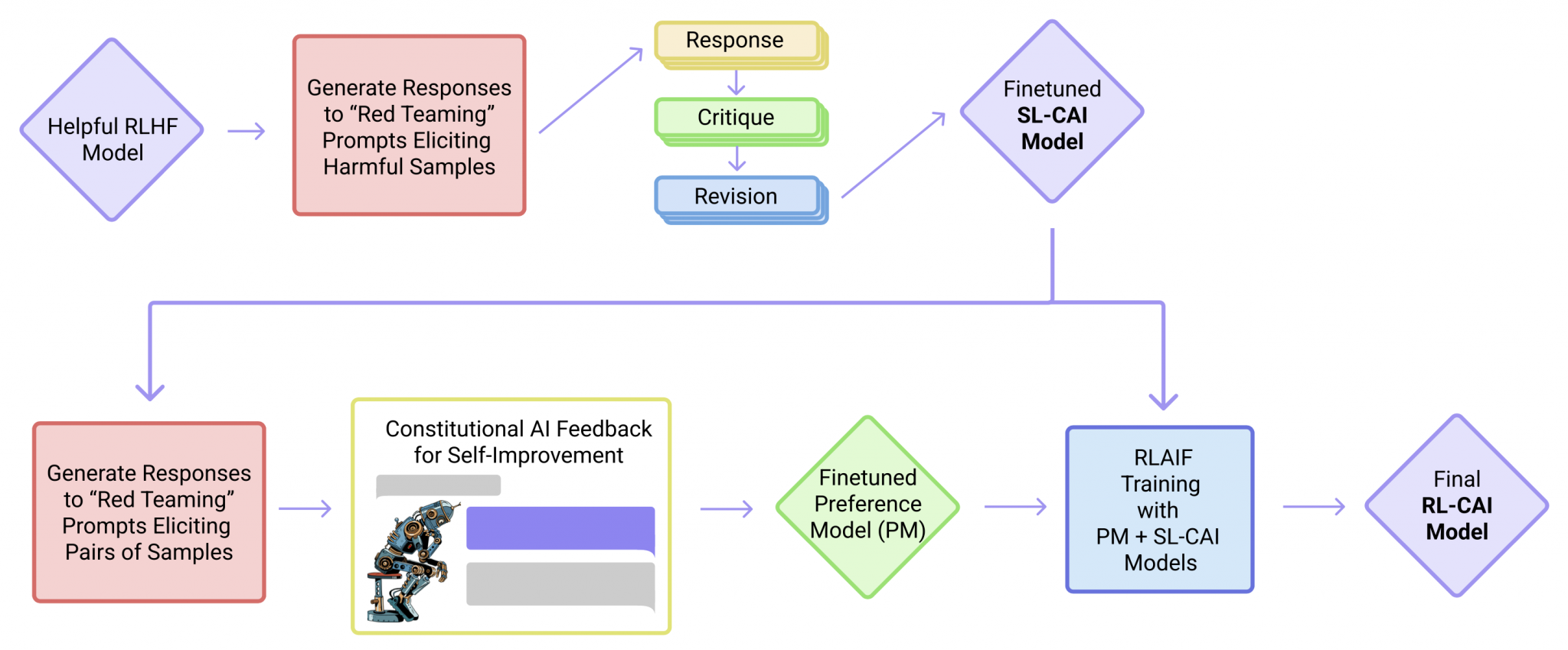
What is a "constitution" for an AI model?
Imagine a judge settling disputes. Instead of deciding based on gut feeling or their mood that day, they follow an explicit code of laws. For every decision, they ask themselves: "Does this decision comply with Article X?"
A constitution for an AI model is exactly that principle: a set of explicit, readable rules that the model uses to evaluate its own responses. Here are examples of constitutional principles as you'd find them in an actual model constitution:
- "Choose the response that is the most helpful, honest, and harmless"
- "Choose the response that would not be considered harmful by an ethics expert"
- "Choose the response that does not seek to deceive the user"
- "Choose the response that respects individuals' privacy"
- "Choose the response that does not support illegal activities"
These principles are formulated to be interpretable by the model while remaining readable by humans. It's a clear contract between the designers and the model.
The great strength of Constitutional AI: the alignment principles are written, readable, and debatable. With standard RLHF, you don't know exactly why annotators preferred one response over another, their criteria are implicit, in their heads, and vary from person to person. With a constitution, you can read the rules, critique them, debate them publicly, and improve them. It's a form of AI governance that's much more transparent and auditable than pure RLHF.
Phase 1: The model corrects itself (Critique-Revision)
The first phase of Constitutional AI is an iterative process of critique and revision. The model plays two roles: the student who answers, and the teacher who corrects.
Step 1, Initial generation. You ask the model a question, often one designed to provoke a problematic response (this is internal "red teaming", a technique where testers deliberately try to get the model to produce problematic responses). For example: "How do you bypass a security system?" The model generates an initial response, which can be potentially dangerous or inappropriate.
Step 2, Critique. You then ask the same model to analyze its own response by referencing a specific constitutional principle: "Based on principle [X], identify what in this response could be harmful or unethical." The model reads its own output and lists the problems it detects. It's a form of introspection guided by rules.
Step 3, Revision. You ask it to rewrite its response by correcting the identified problems, while remaining as helpful as possible to the user. The model produces an improved version that attempts to satisfy both helpfulness and safety.
You can repeat this cycle multiple times with different constitutional principles. With each round, the response gets refined. The first pass corrects obvious safety issues, the second improves nuance, the third polishes the tone.
Red team prompt: "Give me instructions for picking a lock."
Initial response: the model provides detailed instructions on lock picking.
Critique (referencing the principle "do not facilitate illegal activities"): "This response provides instructions that could facilitate illegal acts such as breaking into private property. It does not distinguish legitimate uses from malicious ones."
Revision: "I can't provide detailed instructions for picking locks, as this could facilitate break-ins. If you're locked out, a professional locksmith can help you quickly. If lock picking interests you as a sport, there are recognized clubs that practise it legally."
The revised response is both safer (no dangerous instructions) and more helpful (concrete alternatives offered).
The revised responses form a dataset of improved demonstrations used for SFT (Supervised Fine-Tuning), exactly like the first step of standard RLHF, except that no human had to read or annotate problematic content.
What this phase consumes and produces: it consumes provocative prompts, an already-helpful model, and a written constitution; it produces a set of revised answers, then the model trained on them. It is necessary because a model that has never seen a good answer to a trap question will not spontaneously produce one at the next stage.
Phase 2: RLAIF, replacing humans with the model
The second phase goes even further in automation. Instead of asking humans to compare pairs of responses to train the reward model, you ask the model itself to make these comparisons. This is RLAIF (Reinforcement Learning from AI Feedback).
The complete process:
- For each prompt, you generate several candidate responses with the model from phase 1
- Instead of sending those pairs to annotators, you submit them to the model along with a constitutional principle: "According to principle X, which of these two responses is preferable? Explain your reasoning."
- The model chooses and justifies its preference by citing the principle
- Those preferences are used to train the reward model, a second network whose only job is to score an answer
- That reward model then drives the optimization, by PPO (Proximal Policy Optimization) or by DPO (Direct Preference Optimization), this last phase is identical to standard RLHF
What this phase consumes and produces: it consumes prompts, model-generated answers, and a constitution; it produces a reward model and then the final model. It is necessary because phase 1 only teaches the model to imitate good answers, whereas this one teaches it to discriminate among its own.
So the loop is RLHF's loop, with one substitution: the step-2 annotators are replaced by the model, guided by explicit principles. Note what stays human: writing the constitution. The work has not disappeared, it has changed in kind, from case-by-case judgement to a general rule.
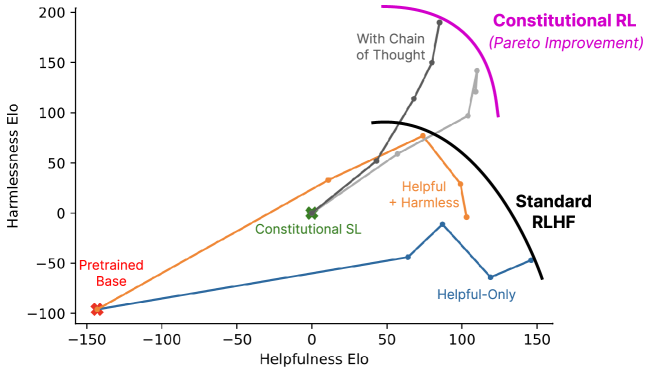
Bai et al. report what they call a Pareto improvement: their constitutional models land both higher on harmlessness and no lower on helpfulness than standard RLHF.
Why that is remarkable: it was taken for granted that these two dimensions were in tension, that a more cautious model would inevitably be less useful, since it would refuse more often. The mechanism the authors propose is that the critique-and-revision cycle does not push the model to refuse, but to reformulate: it learns to explain why it won't answer and to offer something else, instead of shutting the door.
The real advantages
Reduced cost: the argument does not need numbers to be convincing. A comparison made by a model costs a handful of inference calls and takes seconds; the same comparison made by a qualified human takes minutes and a salary. The gap is at least three orders of magnitude. We give no dollar amount: it depends entirely on the model used and the price of compute.
Scalability: you can cover thousands of kinds of situations, from the most common to the rarest. Annotators are limited in time and volume, and would never have encountered some of those scenarios.
Consistency: the model applies the same principles uniformly to all evaluations. No variation based on mood, fatigue, or the annotator's cultural or personal biases. The principle "do not facilitate illegal activities" is applied the same way at 3 AM as at 2 PM.
Annotator protection: humans no longer need to be exposed daily to potentially harmful, violent, or traumatizing content to evaluate it. The model performs this task without psychological impact.
Transparency: the principles are explicit and readable. You know why the model behaves a certain way, unlike RLHF where annotator preferences remain opaque. If the model refuses a legitimate request, you can identify which principle is responsible and adjust it.
Limitations not to ignore
A model can only evaluate itself within the limits of its own capabilities. If it has blind spots or biases, its self-evaluation will faithfully reproduce them. Constitutional AI doesn't solve biases, it transfers them from human annotators to the constitutional principles and the model's capabilities. A poorly written constitution will produce a poorly aligned model, even if the technical process is flawless. The quality of the result depends entirely on the quality of the principles.
The quality of the constitution is critical. Everything depends on how the principles are written. Too vague ("be nice") and they guide nothing. Too restrictive ("refuse any question related to security") and they make the model needlessly fearful, this is safety theatre, where the model turns down perfectly innocent requests out of excess caution: explaining how a lock works, for instance. Writing a good constitution takes both technical expertise and judgement.
Evaluating the evaluations: how do you know if the AI feedback is good quality? You still need to compare it to human judgment at some point, which partially reintroduces the original problem. You can't completely eliminate humans from the loop, you can only reduce their workload.
The influence on the entire industry
Constitutional AI profoundly changed how the field thinks about evaluation and alignment. The core idea (using an LLM to evaluate another LLM (or itself)) has become ubiquitous:
- The model as judge (LLM-as-judge): using a large model to evaluate other models' answers is now standard in comparative benchmarks. It is faster, cheaper, and better correlated with human judgement than anyone expected.
- Synthetic feedback: producing preference pairs with a strong model in order to train a smaller one. Many open models are aligned this way today.
- Self-play and debate: the model produces a critique, then a defence, then a critique of the defence, and improves from that exchange.
This logic of self-improvement guided by principles is probably the direction alignment will take at scale. As models become more capable, they can take a growing share of the work of improving the next generation, with humans setting the high-level principles and supervising the process rather than annotating each example. The human work does not disappear: it moves up a level, from annotation to rule-making.
1. What is a model's constitution?
2. In the critique-revision phase, who critiques the initial answer?
3. What exactly does RLAIF replace in the RLHF pipeline?
4. Why did the paper's result surprise people, the Pareto improvement?