Three things get confused here, and they need separating.
Codestral (version v25.08, released 30 July 2025) is an API model, still in the catalogue. It specialises in one precise task: low-latency, high-frequency code completion, the kind that appears while you type. It is not open-weight: it belongs to the Premier tier, accessible through the API.
Codestral Embed (version v25.05, released 28 May 2025) is a different product: a code embedding model. It does not generate code, it turns code into vectors so you can find it. We give it its own section below.
Vibe Code is neither: it is Vibe's agentic coding mode (CLI, VS Code extension, remote sessions), which reads your files, runs commands and opens pull requests. Since April 2026 the heavy agentic work belongs to Mistral Medium 3.5, which absorbed Devstral 2, the latter being retired on 31 July 2026. The Vibe Code documentation names no model at all; the product page still lists Codestral and Codestral Embed among the stack's bricks.
The useful image: Codestral is the reflex, Medium 3.5 is the deliberation. One completes the line you are typing, the other refactors your repository.
Codestral: When AI Speaks the Language of Code
Imagine an AI copilot that knows Python, JavaScript, Java, Go, Rust, and 75 other programming languages. Codestral was born from a simple question: what if, instead of using a generalist model that "also" does code, we created a model entirely specialized in understanding and generating code?
The difference is comparable to that between a dictionary and a native speaker. Generalist models do code, but it's like asking an encyclopedia to fix your syntax. A specialized model like Codestral is like having a developer sitting next to you who knows the idioms of every language.
In 2026 that question has partly changed its answer: Mistral's large generalist models have become excellent at code, and it is now their main job (Mistral Medium 3.5 is described as optimised for agentic work and coding). So what still justifies a dedicated model is no longer quality so much as latency. Codestral is small and fast; it answers while you type. A frontier model cannot keep that pace, and does not need to.
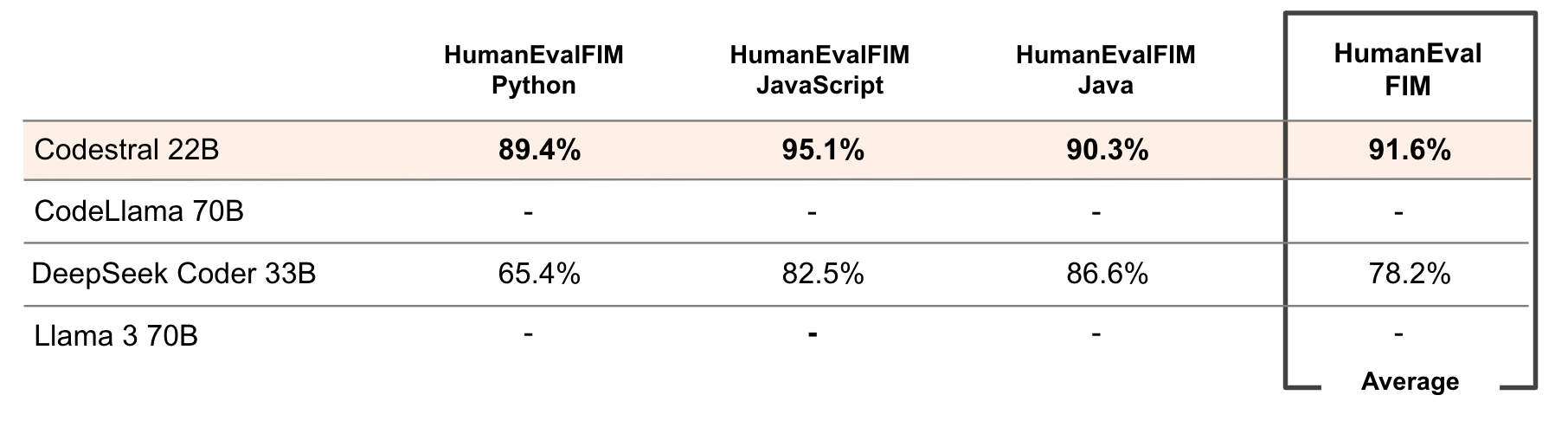
Codestral masters FIM (Fill-in-the-Middle). Your cursor is in the middle of a file. The model sees the code before AND after the cursor, and completes what's missing between the two. That's exactly what happens in your IDE when you use autocompletion: the model needs to understand context in both directions.
Why a Code-Specialized Model?
Generalist models are trained on billions of web pages: articles, forums, books, social media. Code is only a fraction of that data. Codestral was trained on a corpus massively oriented toward code: millions of GitHub repositories, Stack Overflow discussions, technical documentation, and programming Q&A pairs.
The analogy: learning a language by reading grammar textbooks is one thing. Living in the country for years and absorbing the language through immersion is another. Codestral was "immersed" in code.
The result: Codestral understands not only syntax, but also programming patterns, each language community's conventions, the semantics of popular APIs, and idiomatic best practices.
The Five Core Capabilities
Generation: describe what you want in plain English ("a function that sorts an array of objects by date in descending order"), and Codestral generates the code in the language of your choice. Fast, idiomatic, and with proper error handling.
Smart completion: type the beginning of a function, and Codestral doesn't just complete the next variable name. It completes entire logic blocks: loops, conditions, error handling. It anticipates your intent.
Debugging: you show broken code along with the error message. Codestral identifies the root cause, explains why it breaks, and suggests a fix. It's like rubber duck debugging, except the duck answers back.
Refactoring: "this code works but it's unreadable" -> Codestral restructures it to make it more readable, more efficient, and more idiomatic in the target language.
Explanation: incomprehensible legacy code from a colleague who left 5 years ago? Codestral reads it and explains it to you in plain English, function by function, with the context of what each part does and why.
Supported Languages (80+)
- Tier 1 (excellent): Python, JavaScript/TypeScript, Java, C/C++, Go, Rust, C#, PHP, Ruby
- Tier 2 (good): Scala, Dart, Haskell, Elixir, Lua, R, SQL
- Tier 3 (basic): COBOL, Fortran, assembly, specialized DSLs
But Codestral isn't limited to programming languages. It also understands configuration files (YAML, JSON, TOML), infrastructure-as-code (Terraform, Docker, Kubernetes, Ansible), database queries, and GraphQL schemas.
Codestral isn't limited to .py and .js files. It understands Makefile, CMakeLists, Dockerfile, docker-compose, Kubernetes manifests, Terraform files, Gradle/Maven build files, and even CI/CD (Continuous Integration / Continuous Deployment) configurations. It's a companion for the entire developer ecosystem, not just application code.
What version 25.08 brings
The current version, released on 30 July 2025, is a tuning pass rather than a redesign. Mistral gives four measurements for it, and they reveal what actually matters in a completion model:
- +30% accepted completions, the developer hits Tab more often;
- +10% of code retained after acceptance, they do not delete it a minute later;
- 50% fewer runaway generations, the model stops when it should, instead of carrying on writing code nobody asked for;
- +5% on instruction following and +5% on coding ability in conversational mode.
Note that three of those four measurements are not about the code being correct but about its perceived usefulness. That is the right criterion for a tool that interrupts you fifty times an hour: a technically correct but irrelevant suggestion is a cost, not a gain.
On the spec sheet, version 25.08 offers 128K of context and two API endpoints: /v1/fim/completions, dedicated to fill-in-the-middle, and the usual conversational endpoint.
Where it is used today
Code completion is now surfaced through Vibe Code (see the Vibe page), available in three forms: the CLI, terminal-native and scriptable; the editor extensions for VS Code, JetBrains and Zed; and remote sessions, a cloud sandbox launched from any surface against a GitHub repository.
The "Tab to complete" feature (the multi-line suggestions that appear as you type) is explicitly listed among Vibe Code's announced capabilities, and Codestral appears in that stack's model list. The documentation does not spell out which model serves which function, so it is better to remember the role (low-latency completion) than the exact plumbing, which moves.
The direct API obviously remains open for your own integrations.
Benchmark Performance
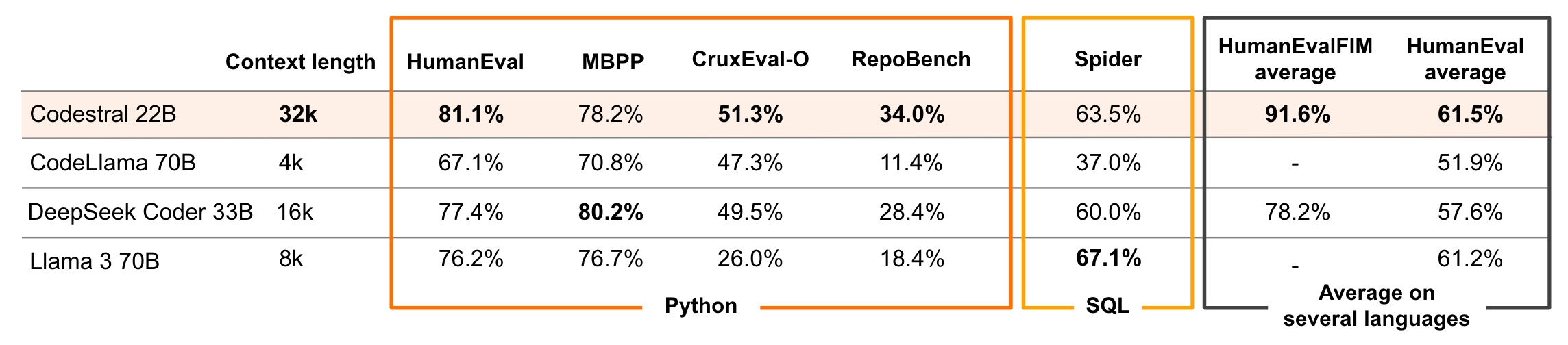
Codestral was evaluated on the reference benchmarks for code models. One useful caveat before reading the two tables below: they date from the announcement of the first Codestral, a 22-billion-parameter model with 32K of context, released in May 2024. We keep them because they illustrate well what FIM is and why it cannot be measured like ordinary generation. The current version offers 128K of context, and its competitors have moved on since too.
- HumanEval: Python function generation tasks. Code-specialized models systematically outperform generalists here.
- MBPP (Mostly Basic Python Problems): basic Python problems. Codestral achieves scores significantly higher than generic models of comparable size.
- MultiPL-E: multi-language evaluation confirming that Codestral maintains its performance across many languages, not just Python.
Codestral isn't infallible. Generated code can contain subtle bugs, inefficiencies, or even security vulnerabilities. Always review the code before pushing it to production. Codestral is an assistant that accelerates your work, not a replacement for human judgment.
Code Security
Codestral promotes good security practices: user input validation, proper error handling, use of proven cryptographic functions. It can also identify common vulnerabilities in existing code (SQL injection, XSS, insecure deserialization) and suggest fixes.
It's not a full security audit, but it's a useful first safety net.
Pricing
Codestral is billed at $0.30 per million input tokens and $0.90 per million output tokens. The model supports batch processing (/v1/batch), the usual route for bringing the bill down on large volumes that are not in a hurry.
Codestral Embed: the other model, the one that generates nothing
It carries almost the same name and does the exact opposite. Codestral Embed (version v25.05, released 28 May 2025) does not produce code: it turns code into vectors, so it can be found again. It is the retrieval brick underneath coding agents, before modifying a million-line repository, you first have to find the twenty lines that matter.
It is a separate product, with its own version, its own price and its own API name. The course devotes a full page to it: Codestral Embed, covering why code warrants an embedding model of its own, and how its vectors can be truncated without being recomputed.
Codestral is your development companion that speaks 80+ languages, never gets tired, and doesn't judge your legacy code. But it'll gladly refactor it. And Codestral Embed is the one that knows where, in your repository, that code actually lives.