Robostral Navigate was announced on 8 July 2026. It is Mistral's first model aimed at robotics, and specifically at embodied navigation. The announcement states neither a licence nor availability terms for the model: as of that date, Mistral invites interested parties to talk to its team. A technical report accompanies the announcement.
The problem: answering a question is not the same as crossing a corridor
Everything this course has described so far happens outside the world. You send text, the model returns text. If it is wrong, nothing falls over.
Change one thing: put the model inside a robot. Give it the instruction from the announcement:
"Leave the lobby, walk through the corridor, enter the supply room, and stop to face the second shelf."
Everything gets harder at once. The model no longer produces a sentence: it produces a sequence of movements, in a real building, where people move around, where doors are sometimes shut, and where "the second shelf" does not exist anywhere until it has been seen. And there is no undo: a robot that has committed to the wrong corridor has already burned time and battery.
This is embodied AI: intelligence with a body, sensors, and physical consequences. Navigation is its foundational brick, before a robot can pick something up, it has to be able to reach it.
- Time exists. A text answer is produced in one go. A route unfolds step by step, and every step changes what the robot sees next.
- Errors compound. A clumsy sentence stays local. A missed turn puts the robot somewhere it has never seen, where its next mistakes will be worse.
- Information is partial. The model does not see a floor plan. It sees what the camera sees, right now, plus what it remembers seeing before.
What is remarkable: an ordinary camera, and nothing else
To move around, robots normally rely on an arsenal of sensors: LiDAR (a laser rangefinder that sweeps the space and measures distances), depth cameras, or several cameras working together to reconstruct relief the way our two eyes do.
Robostral Navigate has none of that. It receives images from a single RGB camera (a plain photographic camera that measures no distances at all) plus an instruction in plain language. No LiDAR, no depth sensor, no pre-built map of the building.
The analogy is direct: it is the difference between a surveyor with a laser rangefinder and a visitor who finds their way by eye. The visitor has no exact measurement, but knows the door is "at the far end on the left", and that is enough to get there.
The stakes are not academic. A depth sensor is expensive, drifts, needs calibration, and imposes particular mechanics on each robot. RGB cameras are already everywhere. A model that makes do with one is a model you can deploy on cheap, heterogeneous hardware.
The central trick: pointing instead of measuring
This is the most elegant part, and it is worth dwelling on, because it explains why one camera is enough.
The classic way to command a robot is to give it a metric displacement: move forward 2 metres, turn 25 degrees. The trouble is that those numbers only mean something if the robot can convert what it sees into real distances, so it has to measure depth, and know its camera's optical characteristics very precisely.
Robostral Navigate does something else. At each step it looks at the image and designates a point within that image: here is where to go, and here is the orientation to adopt on arrival. Its output is not a distance, it is a coordinate inside the picture.
A point in an image does not depend on the scale of the world, nor on the lens settings. The same model therefore works with a wide-angle or a telephoto lens, on a 30-centimetre wheeled robot or on a drone. Mistral states that the model is robust to differences in camera intrinsics and runs on wheeled, legged and flying robots, generalising across robot sizes. Nothing gets recalibrated: you point, and pointing always works.
It is exactly the gesture you make when giving directions to a stranger in the street. You do not say "14 metres north-northeast"; you stretch out your arm.
One case pointing cannot cover: when the destination is outside the camera's field of view, there is nothing to point at. The model then falls back on relative displacements, of the form "move 2 metres forward, 1.5 metres to the left, and turn 25 degrees left".
This design did not come from nowhere. The model is initialised from an in-house vision-language model specialised in grounding: pointing, counting, locating an object in an image. Navigation is the natural extension, once you know where things are, what remains is learning how to get to them.
Trick two: learn everything inside a simulator
The second remarkable point: Mistral states that the model was trained entirely in simulation. No data-collection campaign in real offices.
The figures give the measure of it: roughly 2.4 million trajectories across 350,000 generated scenes, produced by an in-house data generation pipeline.
Why the detour? Because collecting real trajectories is the bottleneck of all robotics: you need a robot, an operator, a building and time, and you end up with a few hundred trajectories a day. In a simulator you get millions, you rearrange the rooms at will, and you can replay an experiment identically.
The bet, obviously, is that what was learned in the simulator holds in the real world, what the literature calls the sim-to-real transfer. Mistral says the model copes in a live space, full of people and obstacles it was never shown.
Trick three: the attention tree, training a thousand steps in one pass
A route is a sequence of steps: at each one the model sees a new image and remembers the previous ones. The naive way to train is to build one example per step, one for the first two steps, one for the first three, one for the first four, and so on. Each replays the whole history from the start, so the beginning of the route gets recomputed dozens of times.
The shared prefix
Look at what those examples have in common. The "steps 1 to 5" example and the "steps 1 to 6" example share exactly their first five steps. That is a shared prefix: one beginning, common to several continuations. Recomputing it every time is pure wasted work.
The remedy is called prefix-caching: compute the beginning once, and reuse it for every continuation that shares it.
Why a tree
One obstacle remains. If you put the whole episode into a single sequence so as to compute it only once, each step risks seeing the future, and a model that already knows where the route ends learns nothing useful. So you must compute once while guaranteeing that step 5 sees only steps 1 to 5.
That is what the tree-based attention mask does. An attention mask is simply a rule stating, for each position, which others it is allowed to look at. Here it takes the shape of a tree: the trunk is the shared prefix, each branch is a possible continuation, and a branch may see the trunk and itself, never a neighbouring branch.
The right image is a case file: you do not photocopy the entire file every time a document is added. You keep the file open, add the document, and each reader sees only what had been filed by the time they stepped in.
The claimed gain: 22 times fewer training tokens, with the learning signal preserved. In practice, says the announcement, this turns training runs that would take months into runs that finish in days.
Trick four: reinforcement learning, to learn how to recover
After supervised training (imitating successful routes) Mistral applies online reinforcement learning with the CISPO algorithm.
The problem this fixes is a classic one, worth spelling out. A model trained purely by imitation has only ever seen correct routes. The day it makes a mistake, it finds itself in a situation that appeared in no example: it never learned how to get out of it. That is the flaw of behaviour cloning, a learner driver shown only flawless journeys would have no idea what to do after a bad turn.
Reinforcement learning fixes this by letting the model try, fail and try again, with a reward for successful routes. It learns to explore and to recover. Mistral puts the contribution of this single stage at +3.2 points of success rate, and reports seeing no plateau, in other words, the headroom is not exhausted.
CISPO was not invented for the occasion: it is one of the GRPO variants used for post-training large language models. The course covers it in GRPO variants. The interesting fact here is that Mistral reuses its LLM post-training toolbox, unchanged, to make a robot better.
The results
The benchmark is R2R-CE (Room-to-Room in Continuous Environments): following natural-language instructions in continuous environments. Its validation unseen split matters most, because the buildings tested were never seen during training, the equivalent of an exam on unrevised material.
| Measure | Announced result |
|---|---|
| R2R-CE, validation seen | 79.4% success |
| R2R-CE, validation unseen | 76.6% success |
| Margin over the best single-camera approach | +9.7 points |
| Margin over the best depth or multi-camera system | +4.5 points |
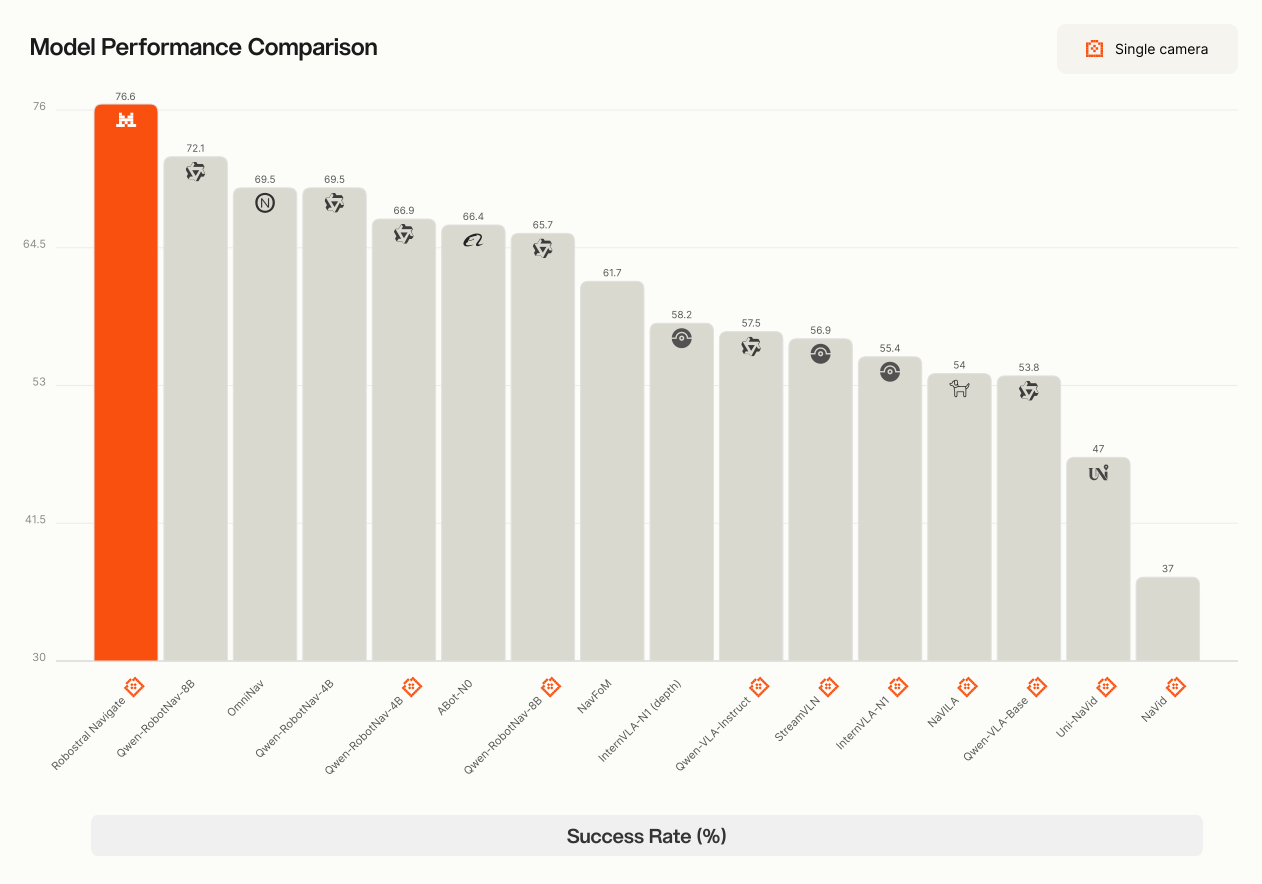
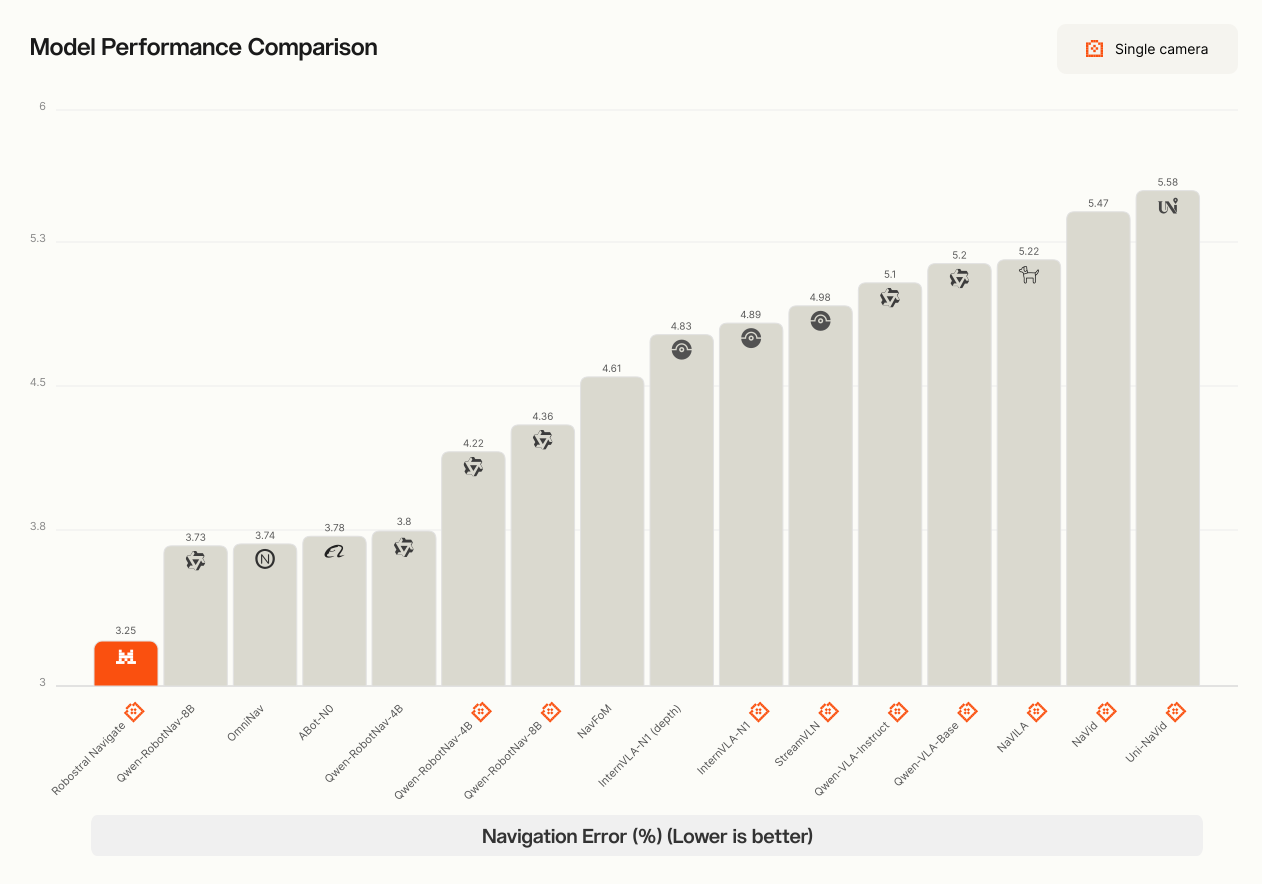
The second margin is the telling one. Robostral Navigate does not merely beat models fighting with the same weapons: it beats those that have sensors it does not have. An 8-billion-parameter, one-camera model outperforms LiDAR-equipped systems.
The report gives the full architecture, the training setup and detailed benchmark results, on R2R-CE and on a second benchmark of the same family, RxR-CE.
Robostral NavigateWhat the announcement does not say
Three silences are worth flagging, because they are exactly where one is tempted to fill in the blanks.
No licence, no availability terms. Unlike most Mistral models, the announcement states neither a licence nor how to obtain the model. Nothing so far supports saying it is open-weights, or that it can be called through the API.
No real-world performance figures. The published results are benchmark results, so, by construction, simulated environments. Mistral shows the model moving through a working office and says it adapts to obstacles it was never shown, but gives no measured success rate in the field.
Nothing about safety. No indication of behaviour when the camera fails, of safe distances from people, or of what happens when an instruction is ambiguous or impossible to satisfy. Those are the first questions any industrial deployment raises.
Where it is useful
Mistral names four sectors as the ones its customers ask about most: manufacturing, delivery, logistics, hospitality. The common denominator is easy to see, these are jobs where moving through a building takes up a considerable share of the working day, and where the routes are repetitive without being fixed.
That is precisely the niche existing robots cover badly. A robot following a floor line or a pre-recorded map can do one route, always the same, and stalls as soon as anything changes. A robot that understands an instruction can do a route it was never shown, expressed in the words of whoever is asking.
Why it matters
For robotics. The message is that navigation is no longer a sensor problem but a model problem. The cost moves from hardware to software, and software copies itself.
For Mistral's strategy. This is the company's first public move into robotics, on applications it says customers are asking for today: manufacturing, delivery, logistics, hospitality. Mistral presents Robostral Navigate as the first step toward a unified embodied agent, and is recruiting for its robotics team.
Beyond the tech. Three points deserve noting now. First, a model that acts physically does not sit under the same liability regime as one that produces text: there is a machine, a movement, and a possible injury. Second, a system trained exclusively in simulation raises a novel evidential question, what is a safety-behaviour validation worth when the training data never existed in the world? Third, a camera moving through offices films people: embodied navigation is also, mechanically, a processing of personal data.
In one sentence: Robostral Navigate shows that a compact model, an ordinary camera and a great deal of simulation are enough to move a robot through an unfamiliar building, and that the post-training recipes of language models carry over to machines that move.