Magistral: The Dedicated Reasoning Model (2025-2026)
Magistral is no longer a product. The last two versions, Magistral Medium 1.2 and Magistral Small 1.2 (September 2025), were deprecated in spring 2026 and are retired from the API on 31 July 2026. Every earlier version (1.0 and 1.1) has been retired since November 2025.
The official documentation points to Mistral Medium 3.5 as the replacement for Magistral Medium, and to Mistral Small 4 as the replacement for Magistral Small. In Medium 3.5, reasoning is no longer a separate model: it is a per-request setting, configurable reasoning effort on a single set of weights.
This page keeps the original story. It explains what a dedicated reasoning model was, and why Mistral turned it into a standalone product, a stage the whole industry went through between 2024 and 2026.
Magistral: When AI Actually Thinks
Imagine the difference between a student who answers "4" to a math question and a student who writes out their complete reasoning before giving their answer. The first one might get it right by luck. The second, by making each step explicit, is wrong far less often, and when they are wrong, you can identify exactly where and why.
That was the founding principle of Magistral, announced by Mistral on 10 June 2025. Standard LLMs generate an answer directly. Magistral first produced an explicit chain of thought (its step-by-step reasoning) and only then the answer. The result: clearly better performance on hard tasks.
Magistral: Multilingual ReasoningThe Conceptual Leap: Answering vs Reasoning
Standard model: "Solve 2x + 5 = 13" --> Directly answers "x = 4" (This works for simple cases. For complex ones, the model often hallucinates.)
Reasoning model (Magistral):
- "I see a linear equation with one unknown"
- "I need to isolate x"
- "I subtract 5 from both sides: 2x = 8"
- "I divide by 2: x = 4"
This "thinking out loud" dramatically improves accuracy. Why? Because each intermediate step creates a checkpoint. If the model makes an error at step 2, the following steps have a chance to correct it. Without a chain of thought, an early error in the internal reasoning propagates silently.
Important enterprise bonus: you see exactly how the model arrived at its conclusion. This matters for debugging, trust, and audit. A model that says "the answer is 42" with no explanation is a black box. A model that shows its reasoning is a transparent colleague. This property did not disappear with Magistral, it moved into the unified models.
AIME 2024: The Numbers from the Announcement
The AIME (American Invitational Mathematics Examination) is one of the hardest math exams in the world, reserved for the strongest American high school students. In its June 2025 announcement, Mistral published these scores:
| Model | AIME 2024 | AIME 2024, majority vote over 64 attempts |
|---|---|---|
| Magistral Medium | 73.6% | 90% |
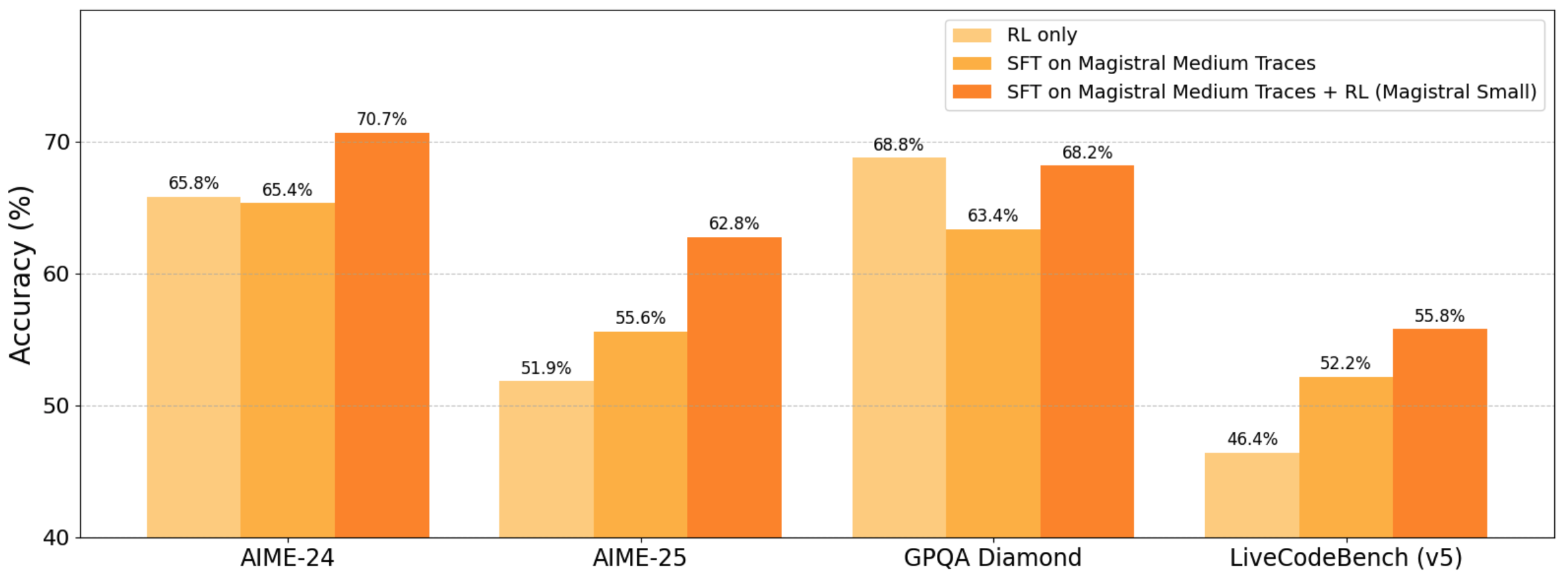
| Magistral Small | 70.7% | 83.3% |
The second column deserves a word of explanation. "Majority vote over 64 attempts" means: ask the model the same question 64 times, then keep the answer that comes back most often. The score climbs because reasoning mistakes tend to be random and scatter, while correct reasoning converges. It is an honest technique but an expensive one (64 times the bill) and you should always check which column a vendor is quoting.
Those numbers mattered because AIME problems are not routine exercises. They demand creativity, multi-step reasoning, and often non-obvious approaches.
Flash Answers: Reasoning Without the Wait
The problem with reasoning: generating a long, detailed chain of thought is expensive in tokens, and above all it is visible. The user stares at an empty screen while the model "thinks".
Mistral's answer: Flash Answers, a feature of the Le Chat interface. Mistral claimed that inside Le Chat, Magistral Medium reached up to 10x the token throughput of most competing models. The idea was not to reason less, but to unroll the reasoning fast enough that the wait stayed tolerable.
A useful piece of vocabulary when reading model announcements. Throughput (tokens per second) measures writing speed, not reasoning quality. A fast model that reasons badly is still a model that reasons badly, it just hands you the wrong answer sooner. Flash Answers was a promise about comfort of use, not about capability.
Magistral Small: Reasoning in Open Source
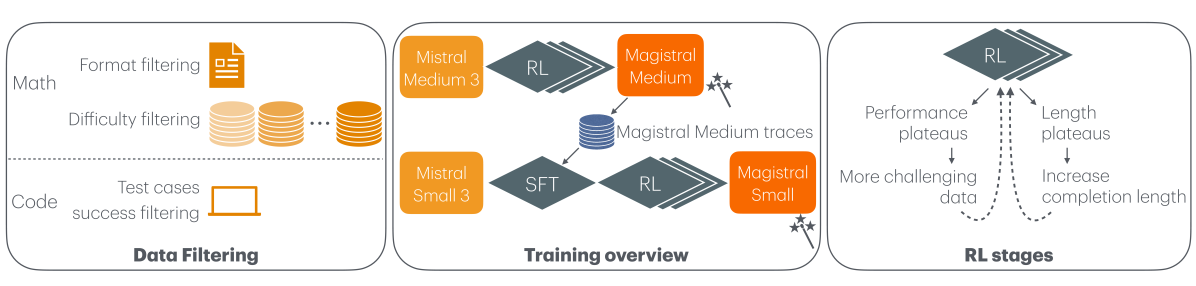
Mistral released a compact version of Magistral as open weights, under the Apache 2.0 licence, with 24 billion parameters. That was a deliberate strategic choice, and a sharp contrast with Magistral Medium, which was never released as open weights: it stayed a proprietary model, reachable only through the API.
- Democratized access: researchers, students, and small organizations got reasoning without a cloud budget
- Open research: the community could study, reproduce, and improve the reasoning mechanisms
- Fine-tuning: companies could adapt Magistral Small to their own domains
Multilingual and Structured
This was Mistral's differentiator, and it held up to the end: Magistral reasoned in the user's own language, English, French, Spanish, German, Italian, Arabic, Russian, Simplified Chinese. Many competing reasoning models of that era only really thought in English, translating the final answer afterwards.
For a legal reader, that detail is not cosmetic. A legal argument built in English and then translated into French loses the categories of French law along the way. An argument built directly in French keeps them.
The chains of thought were structured and readable, which made human verification practical.
Where Magistral Was Used
Mathematics and science: physics, chemistry, differential equations. Any problem requiring multi-step reasoning with intermediate calculations.
Legal analysis: interpreting complex contracts, building arguments, analysing case law. Structured reasoning is exactly what a lawyer needs in order to check the model's work.
Planning: breaking a complex problem into sub-problems, defining a plan, anticipating obstacles.
Complex programming: algorithm design, debugging distributed systems, designing software architectures.
None of these four families went away. Today they are handled by raising the reasoning effort on Mistral Medium 3.5, instead of switching models.
Chain of thought = more tokens generated = a bigger bill. That was true with Magistral and it is still true with a unified model: cranking reasoning effort to maximum on every request means paying reasoning-model prices to ask trivial questions. The discipline simply changed shape, yesterday you picked the right model, today you pick the right level of effort.
The Family Tree
| Version | Released | Licence | API retirement | Official replacement |
|---|---|---|---|---|
| Magistral Medium 1.0 / Small 1.0 | June 2025 | Premier / Apache 2.0 | 30 Nov 2025 | – |
| Magistral Medium 1.1 / Small 1.1 | July 2025 | Premier / Apache 2.0 | 30 Nov 2025 | – |
| Magistral Medium 1.2 | September 2025 | Premier | 31 July 2026 | Mistral Medium 3.5 |
| Magistral Small 1.2 | September 2025 | Apache 2.0 | 31 July 2026 | Mistral Small 4 |
Note that the two branches do not land in the same place. The large reasoning model was absorbed into Mistral Medium 3.5; the small one, into Mistral Small 4, which Mistral describes as a hybrid model unifying instruct, reasoning and coding. Two sizes, one logic: reasoning becomes a feature again, not a product.
Why Model Line-Ups Shrank in 2026
This is the structural story of the year, and it goes well beyond Mistral.
How we got there. When explicit reasoning first worked, nobody knew how to make it coexist cleanly with everything else. So you trained one model to reason, another to code, another for vision. Each capability became its own commercial reference, a SKU, in catalogue language.
Why it stopped working. Three reasons, in increasing order of annoyance.
First, the customer had to do the routing: it was on you to guess whether your question belonged to the coding model or the reasoning model, and you regularly guessed wrong. Second, capabilities refused to stay in their box, fixing a bug requires reasoning, reading a table inside a PDF requires vision and reasoning. Third, every extra model is expensive to maintain: its own documentation, its own safety evaluations, its own deprecation curve, its own weights to host.
What changed. Vendors learned to put the capabilities into a single set of weights and to expose behaviour as a parameter set at call time, rather than as a choice of model. Mistral Medium 3.5 is the example: reasoning effort configurable per request. You no longer swap models, you turn a dial. OpenAI and Anthropic made the same move earlier in 2026.
What it costs you, what it buys you. You gain simpler integration, a more readable bill, and fewer forced migrations. You lose the guarantee a specialist gave you on its home turf, and you inherit a new setting to master. A unified model is a deliberate trade-off: very good everywhere rather than unbeatable somewhere.
The habit to keep. In a contract or a technical specification, avoid hard-coding a model name if you can. Capabilities outlive commercial references, and at the pace observed in 2025-2026, a reference lives somewhere between twelve and twenty-four months before deprecation.
Magistral was the AI that thought out loud: step by step, transparently, in your own language. The product is gone; the idea has become a standard setting.