Voxtral is not one model. It is a family of four models currently in the catalogue:
| Model | Version | Licence | What it does |
|---|---|---|---|
| Voxtral Small | v25.07 | Apache 2.0 | Understand audio (the model that listens and reasons) |
| Voxtral Mini Transcribe 2 | v26.02 | Premier (API) | Transcribe a finished recording, with diarization |
| Voxtral Mini Transcribe Realtime | v26.02 | Apache 2.0 | Transcribe on the fly, live |
| Voxtral TTS | v26.03 | CC BY-NC 4.0 | Synthesize a voice from text |
Two dates matter: 4 February 2026 for the two transcription models, 23 March 2026 for speech synthesis. The first Voxtral Mini Transcribe (v25.07) was retired on 31 May 2026 and replaced by Voxtral Mini Transcribe 2.
A legal caution: the licences differ from one model to the next. Voxtral Small and the real-time model are Apache 2.0, so commercially usable. The weights of Voxtral TTS are published under CC BY-NC 4.0, a non-commercial licence: commercial use runs through the API or a separate agreement, not through the downloaded weights.
Voxtral: when Mistral learns to listen and to speak
The Mistral line-up grew in stages. First text (Mistral 7B, Mistral Large). Then vision, with Pixtral, which gave the model "eyes." Voxtral is the logical next brick: ears and a mouth. It is Mistral's audio and speech family, the one that listens to spoken language, understands it, and can also answer out loud.
The analogy is simple. Pixtral learned to look at an invoice and read the numbers. Voxtral learns to listen to someone talking and understand what they mean, not just transcribe the words, but answer a question asked aloud, and even trigger an action. And in its synthesis form, it does the reverse: it turns text into a genuine human-sounding voice.
Text → Vision (Pixtral) → Audio/Speech (Voxtral). The philosophy is the same each time: take a new modality (words, images, sound) and plug it into Mistral's shared language brain. Voxtral is not a single model but a family that grew in three waves: speech understanding (July 2025), transcription (both batch and live) in February 2026, and speech synthesis in March 2026.
The problem: understanding speech, not just transcribing it
For a long time, working with voice meant stacking two separate tools. First an ASR system (Automatic Speech Recognition) like Whisper to turn audio into text. Then a language model that reads that text and reasons over it.
That split has a cost. At each step you lose information: intonation, hesitations, the acoustic context. And worse, you add up two sources of error. If the transcription gets one word wrong, the language model reasons over a false text without ever knowing it.
Voxtral's idea (on the understanding side) is to fuse the two into a single system that takes audio as input and reasons directly on it.
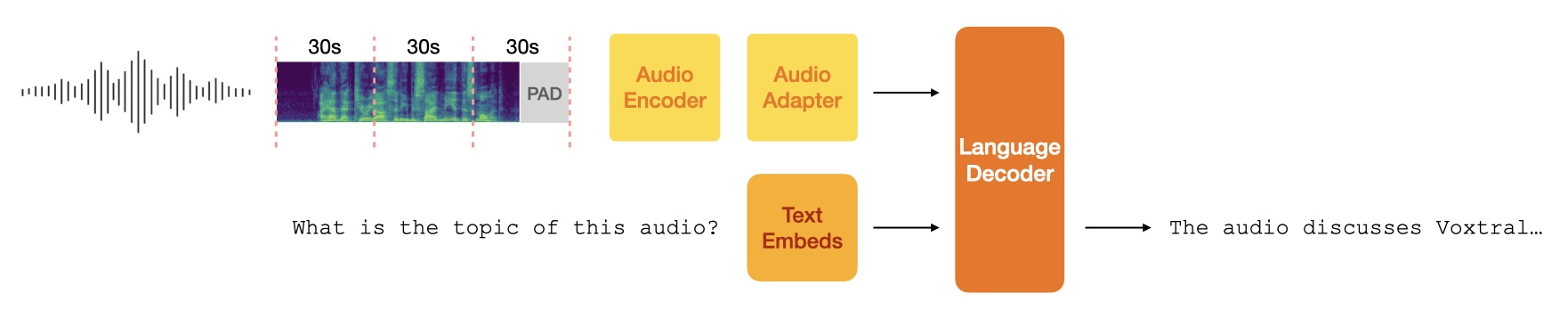
Voxtral understanding: an audio encoder grafted onto a Mistral brain
The architecture reuses exactly the modular recipe of Pixtral, but with sound in place of images.
The audio encoder (the "ears")
A Whisper-style audio encoder turns the sound signal into a sequence of numerical representations, "audio tokens," the equivalent of text tokens. Concretely, the sound is first converted into a spectrogram (a "photo" of the sound, frequency vertically, time horizontally), and the encoder extracts what matters: phonemes, rhythm, who is speaking.
The language decoder (the "brain")
These audio tokens are then fed into a Mistral language decoder, the same kind of model that handles text. It processes the audio as if it were part of the conversation. The result is a single model that can do several things from sound.
- Transcription: write down what is said (the classic ASR task).
- Question answering over audio: give it a recording and ask a question about it ("What is this meeting about?"), and it answers directly, with no visible intermediate transcription step.
- Function-calling from voice: this is the most striking one. From a spoken command, the model can decide to call a tool or function ("book a room for tomorrow at 2pm"), exactly the way a text model does function-calling, but starting directly from speech.
A two-stage ASR + LLM pipeline never truly "understands" the sound: it translates it into text, then forgets the sound. Voxtral keeps the audio all the way through the reasoning. So the model can lean on cues that text throws away, who is speaking, tone, what was inaudible. It is the same conceptual shift Pixtral made for images: you no longer do "OCR then reason," you reason directly on the raw modality.
February 2026: two transcription models, not one
On 4 February 2026 Mistral released Voxtral Transcribe 2, which is not a model but a pair. The division of labour is simple: one works on a recording you already have, the other on a stream arriving live. These are different problems, and they deserve different models.
Voxtral Mini Transcribe 2: the model for finished files
This is the one you call when you have a complete recording in hand: a meeting, an interview, a customer call. It bills at $0.003 per minute of audio and does four things that matter in practice.
- Diarization: putting a speaker label on each passage, with start and end times. In plain terms, "who said what, and when." Mistral flags one limit: when two people talk over each other, the model typically transcribes only one of them.
- Context biasing: you can supply up to 100 words or phrases ahead of transcription (proper nouns, domain terms, product references) to steer the spelling. Very useful for a legal file full of party names. Mistral notes the feature is optimized for English and experimental in other languages.
- Word-level timestamps, for subtitling or searching inside audio.
- Long recordings: up to 3 hours in a single request.
The model covers 13 languages (English, Chinese, Hindi, Spanish, Arabic, French, Portuguese, Russian, German, Japanese, Korean, Italian, Dutch).
Voxtral Mini Transcribe Realtime: the model for streams
Many uses (live captioning, voice assistants, meeting note-taking) need real-time transcription that appears while you speak, with minimal delay. Whisper, for instance, does no native streaming: it swallows 30-second segments in one go.
The lazy approach would be to chop the stream into chunks and feed them one by one to a model designed for files. Mistral says explicitly that it did the opposite: a streaming architecture trained to transcribe audio as it arrives. The model has a 4 billion parameter footprint, covers the same 13 languages, ships under Apache 2.0 on Hugging Face (so it can run on-device, which matters when the audio must not leave the building), and costs $0.006 per minute through the API.
Voxtral-realtime solves the live problem with two technical ingredients.
A causal audio encoder
"Causal" means the model only looks at the past (the sound already heard) never the future. A standard encoder often waits to have the whole recording before deciding, because the end of a sentence helps make sense of its beginning. A causal encoder forbids itself that luxury: it must decide as it goes, which is the condition for producing text live without waiting for the end.
A "delay-aware" decoder
The decoder is trained to explicitly manage a small gap between what is heard and what is written. That delay is configurable: you tune it for the trade-off you want. A shorter delay gives maximum responsiveness but slightly less accuracy; a longer delay lets the model "listen a bit more" before committing, which improves quality.
Mistral publishes three reference points on that dial, and together they tell the story of the trade-off.
- Set to 2.4 seconds of delay, the real-time model matches the quality of the batch model. That is the subtitling setting: nobody notices two seconds of lag on a caption.
- Set to 480 milliseconds, it stays within 1 to 2% word error rate of the batch model. That is the voice-agent setting: near-offline accuracy, inside a conversation.
- The delay is configurable down to sub-200 milliseconds for cases where every instant counts.
Remember the principle: this is not a fast model or an accurate model, it is a dial you set yourself.
Voxtral TTS: making the machine speak (23 March 2026)
The last component, announced on 23 March 2026, does the opposite of understanding: from text, it produces a voice (TTS, Text-to-Speech, speech synthesis). This is where the architecture is at its most modern and most interesting to explain.
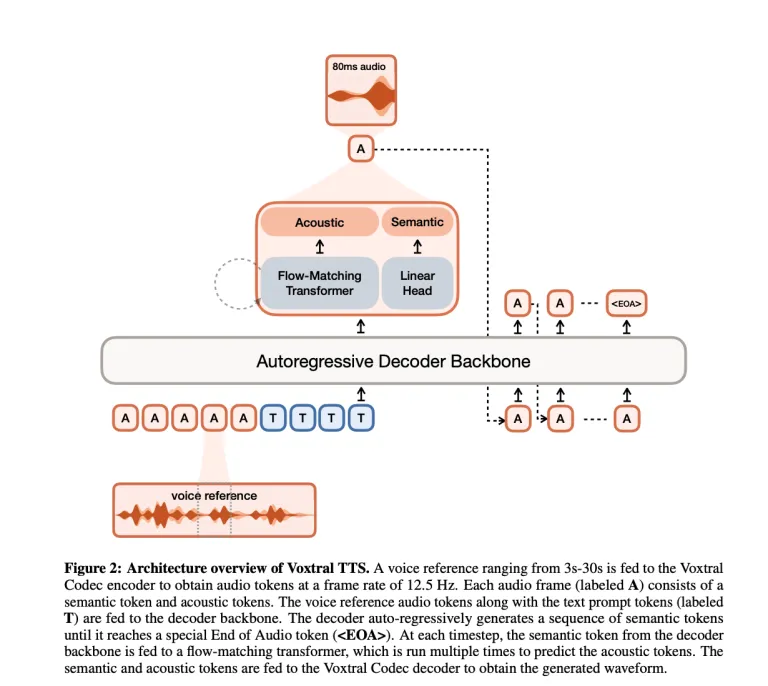
The model is deliberately small: 4 billion parameters in total, and it is built on Ministral 3B, the small model of the line-up, described on the Ministral page. Those 4 billion split into three bricks, which is already a useful map of the architecture:
- 3.4 billion for the transformer decoder backbone, the part that "holds the thread" of the utterance;
- 390 million for the flow-matching acoustic transformer, the part that sculpts the sound;
- 300 million for the neural audio codec, which translates between sound and internal representation.
Hybrid: autoregressive + flow matching
Voxtral TTS combines two families of techniques.
- Autoregressive: the model generates speech step by step, in order, building on what it has just produced, like an LLM writing word after word. This is what gives a coherent rhythm and intonation over time.
- Flow matching: the same family as modern image models (and as F5-TTS). Instead of building the sound in successive layers, flow matching learns a continuous "path" that turns pure noise into a clean audio signal along a smooth trajectory. See the score-based and flow matching page for the full intuition.
The hybrid takes the best of both: the autoregressive part handles structure over time (where to put pauses, how to chain phrases), and flow matching handles the fine rendering of timbre (the precise texture of the voice).
Zero-shot voice cloning
Voxtral TTS can do zero-shot voice cloning: from a few seconds of someone's audio, it can produce new speech in that voice without having been trained specifically on it. "Zero-shot" is precisely that: no retraining, you show it the sample and it imitates. Mistral states that the model was trained to adapt to a voice from a reference as short as 3 seconds, and that in practice you give it a clip of 5 to 25 seconds. What it picks up goes beyond timbre: accent, inflection, intonation, and even the disfluencies present in the reference.
The model covers 9 languages: English, French, German, Spanish, Dutch, Portuguese, Italian, Hindi and Arabic.
One capability emerged without being explicitly trained for: cross-lingual voice adaptation. Give the model a French voice clip and an English text, and it produces English spoken in that voice, with its French accent. That is what makes it possible to build speech translation chains where the speaker's voice carries across languages.
A model that reproduces an identifiable voice from three seconds of audio shifts the question from image rights to voice rights. The course covers the topic elsewhere; what matters here is that the technical barrier ("you need hours of recordings and a retraining run") is gone. And that the licence on the weights (CC BY-NC 4.0, non-commercial) says nothing about the consent of the person whose voice is being cloned. Those are two separate permissions.
The distinctive part: dropping RVQ
Here is the genuinely modern technical point of the architecture.
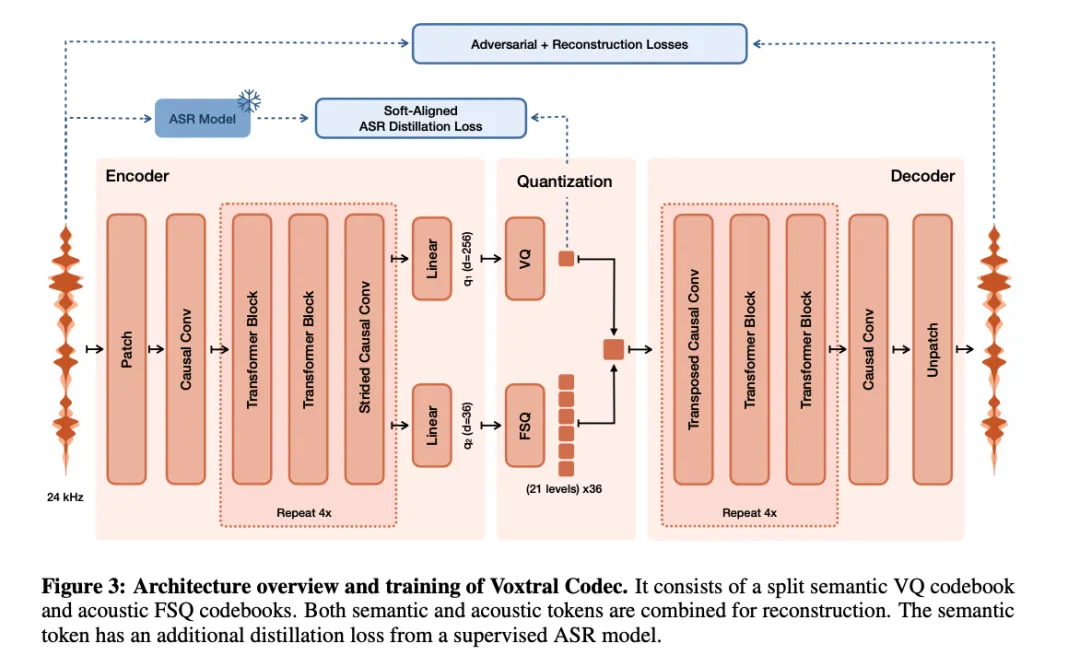
Most recent neural audio systems rely on a neural audio codec that compresses sound into discrete tokens. To compress well, almost all of these codecs use RVQ (Residual Vector Quantization). The idea of RVQ: approximate the sound with a first "codebook" of typical chunks, then approximate the remaining error with a second codebook, then the error of that error with a third, and so on, stacking quantization layers to refine progressively. (See the neural audio codecs and audio tokens page for the detail.)
It is effective, but heavy: several layers of tokens to generate, hence more compute and more latency.
Mistral built its own codec, and the official description fits in one line: it processes audio causally with a semantic vector quantizer (an 8192-entry codebook) and an acoustic finite scalar quantizer (FSQ, 36 dimensions at 21 levels), at a 12.5 Hz frame rate.
Translation: where an RVQ codec stacks several residual quantization levels one behind the other, this one has a single stage split into two parallel branches, one for the meaning of the words, one for the sound. Fewer layers to produce at generation time mechanically means less compute and lower latency. This is exactly the kind of architectural choice, replacing a standard brick with a simpler representation without losing quality, that makes a practical difference and is worth protecting.
Very low latency
Thanks to this combination (compact codec + flow matching), synthesis starts very fast. Mistral reports a model latency of 70 ms on a typical input (a 10-second voice clip and 500 characters of text), with a real-time factor of about 9.7x, meaning the model produces roughly ten seconds of audio per second of compute. At that latency, live dialogue becomes workable, where every tenth of a second of delay is felt.
The model natively generates up to two minutes of audio at a time; the API handles longer text by stitching segments together.
On price, synthesis bills at $0.016 per 1,000 characters.
The four Voxtrals at a glance
| Model | Input → Output | Key brick | What it's for |
|---|---|---|---|
| Voxtral Small (v25.07, Apache 2.0) | Audio → text / answer / action | Audio encoder (Whisper-style) + Mistral decoder | Answer over audio, voice function-calling |
| Mini Transcribe 2 (v26.02, API) | Recording → annotated text | Diarization, context biasing, word timestamps | Meetings, interviews, calls, up to 3 hours |
| Mini Transcribe Realtime (v26.02, Apache 2.0) | Audio stream → live text | Causal encoder + delay-aware decoder | Live captioning, voice assistant, on-device |
| Voxtral TTS (v26.03, CC BY-NC 4.0) | Text (+ reference voice) → audio | Autoregressive + flow matching, single-stage codec | Speech synthesis, zero-shot cloning, 9 languages |
Going further in the course
Voxtral is a good junction point between several lessons:
- Whisper (ASR), Voxtral's audio encoder is of this family.
- TTS: Bark, ElevenLabs, F5-TTS, to place Voxtral TTS among the other approaches, including zero-shot cloning and flow matching.
- Neural audio codecs and audio tokens, to understand the RVQ that Voxtral TTS chooses to avoid.
- Diarization, "who speaks when," a natural capability when you keep the audio all the way to reasoning.
- Score-based and flow matching, the theoretical foundation for the voice-generation part.
Why it matters
With Voxtral, Mistral completes its set of modalities: text, vision (Pixtral), and now sound both ways, listening and speaking. For a genuinely useful assistant, voice is no longer a gadget but a natural interface: you speak, it understands, it acts, it answers out loud. All with latency low enough to keep the exchange fluid.
Technically, two choices show where the state of the art is heading: keeping the audio all the way through reasoning (instead of the old ASR + LLM pipeline), and generating the voice via flow matching with a compact tokenizer that avoids RVQ. Fewer stacked bricks, lower latency, same quality.
Key takeaways
- Voxtral is a family of four models, not one: understanding (Voxtral Small), batch transcription, live transcription, and speech synthesis.
- Understanding: a Whisper-style audio encoder grafted onto a Mistral language decoder, to answer over audio and do function-calling directly from voice.
- Transcription (4 February 2026): two separate models. The batch one brings diarization, context biasing (up to 100 terms) and word-level timestamps; the live one uses a streaming architecture with delay configurable below 200 ms, weighs 4 billion parameters, and ships under Apache 2.0.
- TTS (23 March 2026): 4 billion parameters built on Ministral 3B, hybrid autoregressive + flow matching, zero-shot voice cloning from 3 seconds, 9 languages, ~70 ms model latency.
- A single quantization stage: the Voxtral TTS codec replaces the cascade of residual quantizers with a semantic VQ and an acoustic FSQ in parallel, fewer layers to generate, hence less compute and latency.
- The licences are not uniform: Apache 2.0 for Voxtral Small and the real-time model, proprietary API for Mini Transcribe 2, CC BY-NC 4.0 (non-commercial) for the Voxtral TTS weights. Check before any deployment.
- The common thread: keep the raw modality (sound) all the way to reasoning, rather than chaining separate tools that add up their errors.