Codestral Embed: the model that generates nothing
The name invites confusion. Codestral writes code; Codestral Embed, released on 28 May 2025 (version v25.05), does the exact opposite: it does not produce code, it turns code into vectors. Two distinct products, two prices, two API names.
The principle behind embeddings is explained on the Mistral Embed page: turn a text into a list of numbers that captures its meaning, so that two pieces close in meaning end up close in space.
Why code deserves its own model
You might assume a good general-purpose embedding model would do. It does not, and the reason is instructive.
Take two functions that sort a list, one in Python, one in Rust. They do the same thing. But they share almost no words: different keywords, different syntax, different variable names. A model trained on prose will see two texts that have nothing to do with each other.
Conversely, two functions that look very much alike can behave radically differently, one flipped comparison is enough. Code is a domain where surface similarity and semantic similarity diverge violently. Hence the value of a model that learned on code.
What it is for
Finding code. It is the retrieval brick underneath coding agents: before modifying a repository of a million lines, you first have to find the twenty lines that matter. An agent that read the whole repository on every question would be slow and ruinous; an agent that guessed would be cheap and wrong.
Mistral also cites semantic search across a codebase, duplicate detection, and repository analysis.
This is the same mechanism as RAG, applied to code: index first, retrieve second, and hand the model only the relevant pieces. If the topic interests you beyond Mistral, the Search Toolkit treats retrieval quality as a subject in its own right.
Its distinctive feature: vectors of adjustable geometry
This is the interesting technical point, and it is a rare one. Two parameters let you choose the trade-off between quality and storage cost.
output_dimensionsets the vector size: 1536 by default, 3072 at most. The subtlety is that the dimensions are ordered by relevance. To get a vector of size n, you simply keep the first n values, nothing needs recomputing. It is a continuous dial, not a binary choice.output_dtypesets the precision of each number:float(32 bits, the most precise),int8,uint8, or evenbinary/ubinary, where each value fits in a single bit, the resulting vector then takes an eighth of its nominal size.
This idea of ordering dimensions so a vector can be truncated without recomputation has a name, and the course devotes a lesson to it: Matryoshka embeddings, after the Russian dolls that nest inside one another. Codestral Embed is a direct application of it.
A vector database costs memory, and memory is expensive. Going from 3072 dimensions at 32 bits to 256 dimensions at 8 bits shrinks the footprint by a considerable factor.
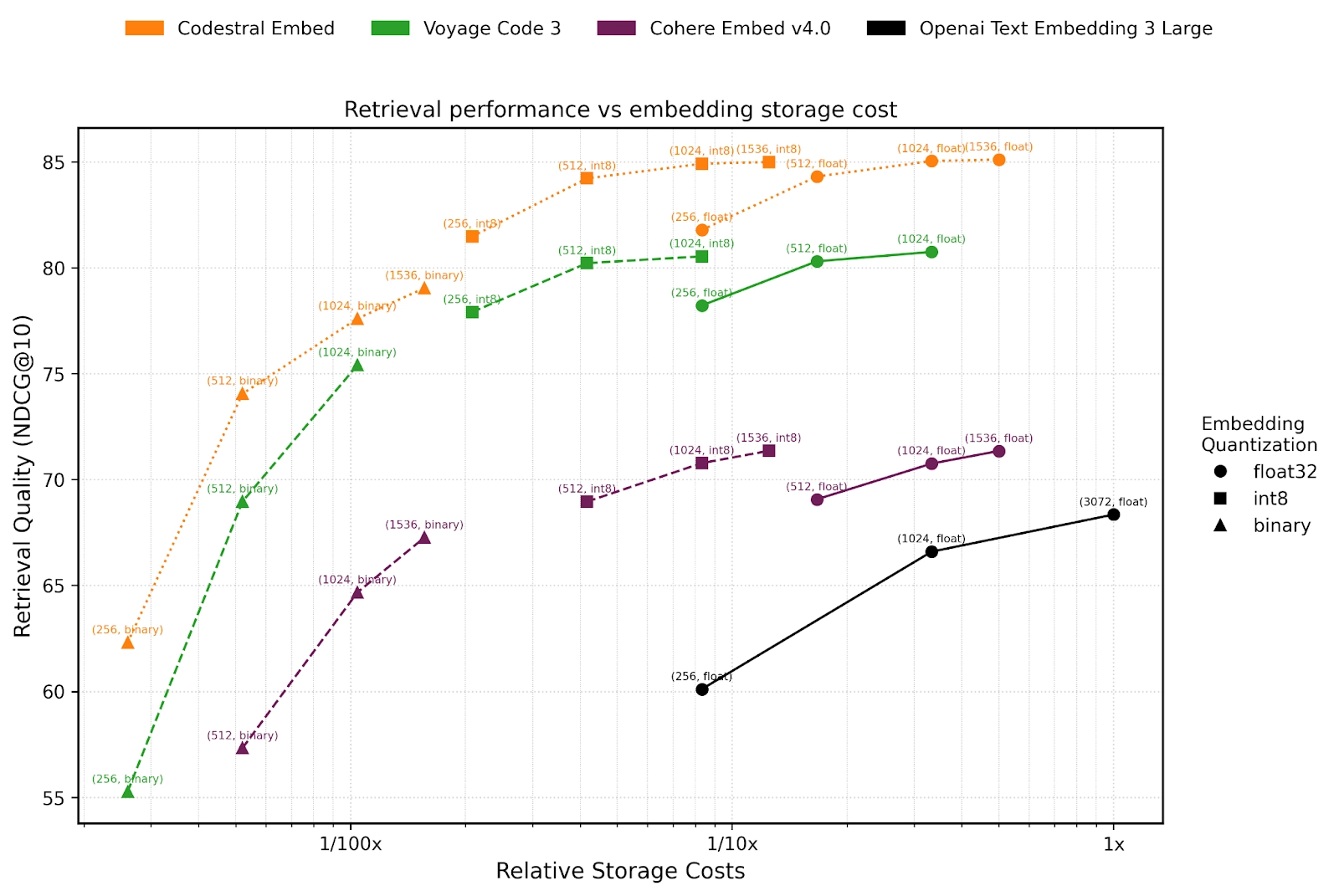
Mistral claims that at dimension 256 and int8 precision, Codestral Embed still beats competing models. In other words the dial is not a trade-off between "good" and "cheap": on this particular case, you can have both. That is the kind of claim to verify on your own data, but the architectural idea (ordering dimensions by relevance so the vector can be truncated) is solid and quite real.
What Mistral claims against the competition
The announcement positions Codestral Embed ahead of Voyage Code 3, Cohere Embed v4.0 and OpenAI's large embedding model on real-world code retrieval.
Two families of tests are highlighted: SWE-Bench, built on genuine GitHub issues and their fixes, which measures the ability to find the right file from a bug description; and Text2Code, which measures retrieval of the context needed to complete or edit code.
These are vendor-published comparisons, on test sets the vendor chose. That does not make them worthless (SWE-Bench is a public, recognised benchmark) but the only measurement that concerns you is the one run on your codebase. An embedding model can be tested in a day: index a sample, ask twenty questions whose answers you already know, and count.
Quick reference
| Characteristic | Value |
|---|---|
| Version | v25.05, released 28 May 2025 |
| Maximum context | 8,192 tokens |
| Dimension | 1536 by default, 3072 at most, truncatable |
| Precisions | float, int8, uint8, binary, ubinary |
| Price | $0.15 per million tokens (50% discount in batch mode) |
| API name | codestral-embed |
| Licence | Premier, proprietary model, available through the API |
Mistral recommends chunking code into segments of roughly 3,000 characters with 1,000 characters of overlap for good retrieval results.
Unlike the code models absorbed into Mistral Medium 3.5 during the April 2026 consolidation, Codestral Embed still appears in the official list of available models, with no announced retirement date. It does a job no large generative model does: produce a vector, fast and for almost nothing.
If Codestral is the reflex that completes your line, Codestral Embed is the memory that knows where, in your repository, that code lives.