The problem: scoring what has no single right answer
You changed a prompt, or swapped in a new model. The answers look better. "Look better" is not a measurement.
Before the model judge, there were two options, and each hits a wall.
Have humans score. This is the reference everything else is compared against. It is also slow and expensive: putting ten thousand answers in front of annotators means weeks and a real annotation budget. And it cannot run on every code change.
Use the classic automatic metrics: BLEU (BiLingual Evaluation Understudy), ROUGE (Recall-Oriented Understudy for Gisting Evaluation), METEOR. All of them compare word sequences in the produced answer with those in a reference answer. That is the wall: two answers can say exactly the same thing in different words, and BLEU will call them far apart; conversely, an answer sharing many words with the reference can be factually wrong and score well.
The model judge (LLM-as-a-judge) fills the gap: a second, usually stronger model reads the answer and scores it. It understands meaning, not just word overlap.
An unvalidated judge does not measure quality. It measures agreement between two models, which share training data, writing habits, and sometimes a family tree. The number exists, it is stable, it is reproducible, and it may have no relationship to what a human reader would think. The whole "validating the judge" section below exists for that reason.
The setup, concretely
The judge is given:
- The original question, the one put to the model under evaluation.
- The answer to score.
- The criteria, written out explicitly: accuracy, relevance, tone, safety.
- Optionally, a reference answer held to be correct.
The judge returns a score, a ranking, or a verdict.
# Judge prompt, direct-scoring protocol
judge_prompt = """Score the following answer on a scale of 1 to 10.

Criteria:
- Factual accuracy (0-10)
- Relevance to the question (0-10)
- Clarity and structure (0-10)

Question: {question}
Answer: {response}

Analyse each criterion first, then give the scores.
"""
The text of that prompt is not an implementation detail: it is the measuring instrument. Changing it changes the scores, exactly as changing the reference weight changes the weighing. It must therefore be versioned and frozen like the rest of the evaluation harness (see building your own evaluation).
The three protocols
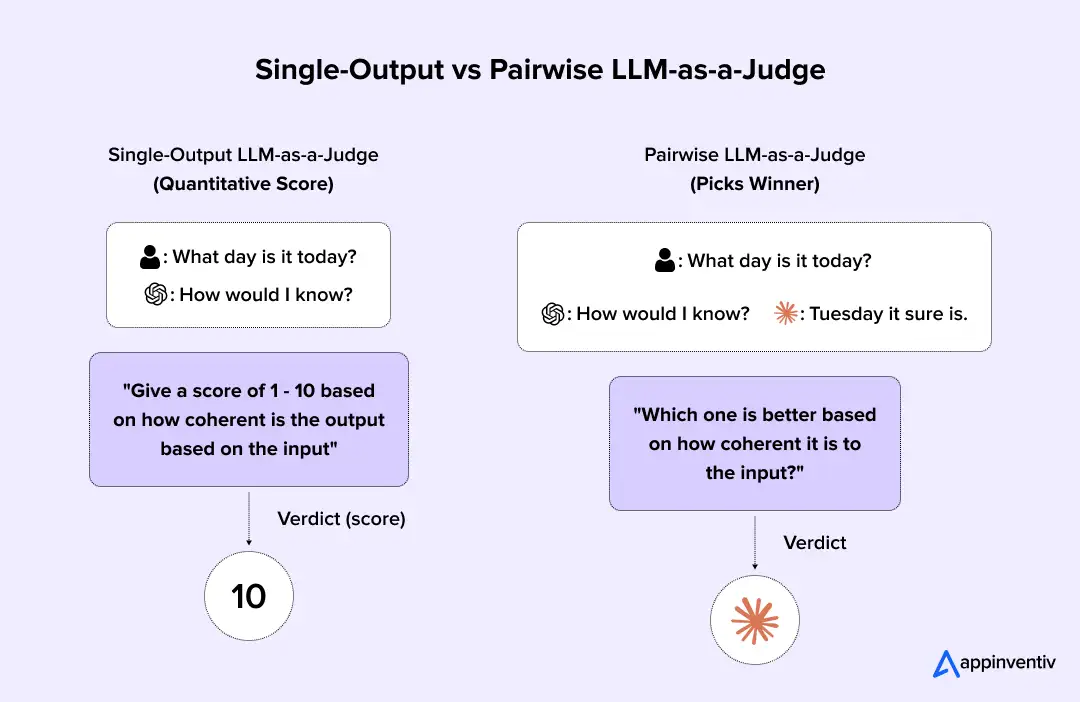
Direct scoring: one answer, one number
The judge receives a single answer and assigns a score, typically 1 to 10.
What it buys: simplicity. Each answer is scored independently of the others, so it parallelises and can run on live traffic.
What it costs: models score generously and narrowly. If every answer lands between 6 and 8, the score separates nothing, saturation, applied to a rating scale. An absolute score produced by a model only means something relative to other scores from the same judge with the same prompt. It means nothing on its own: "our service scores 8.2 out of 10" is not a statement outside its measurement context.
Pairwise: which of these two?
The judge receives two answers to the same question and names the better one. No score, a relative verdict.
What it buys: markedly better discrimination, for a reason that holds for humans too, comparing is easier than scoring in the abstract. It is the format used by human-vote arenas (see LMArena).
What it costs: the number of comparisons grows quickly with the number of candidates, and the protocol has a bias of its own, presentation order, covered below.
Reference-based comparison
The judge receives the answer and a reference answer held to be correct, and measures the gap.
What it buys: an anchor outside the judge itself.
What it costs: producing the references, which means human annotation. And a good answer can legitimately depart a long way from the reference.
Pairwise to compare two versions or two models, the most reliable. Direct scoring to sort a large volume, filter data, or watch production continuously, knowing the number is only meaningful as a time series. Reference-based when the references already exist.
The judge's biases, and what they are worth in numbers
This is the most important section on the page. These biases are not suspicions: they were measured in the founding paper of the field, the one that introduced MT-Bench, and the orders of magnitude are surprising.
The MT-Bench authors measured each bias separately. The four figures below come from that paper and concern GPT-4 used as a judge as it stood in 2023; they do not transfer mechanically to another judge, but they give the right order of magnitude for the problem.
Judging LLM-as-a-Judge with MT-Bench and Chatbot ArenaPosition bias: order of presentation changes the verdict
In pairwise mode, the judge systematically favours one of the two slots. The test is simple: present the same pair twice with the order swapped, and see whether the same answer wins both times.
The figure to remember: GPT-4 stayed consistent only 65% of the time. In other words, in a third of pairs, the verdict flipped purely because of ordering. Weaker judges collapsed, 46% for GPT-3.5, 24% for Claude v1, that last number being below chance, which signals a near-systematic preference for one position.
The remedy is mandatory: evaluate every pair twice, in both orders. If the verdict flips, count the pair as a tie rather than a win. Skipping this means publishing a win rate a third of which is ordering noise.
Length bias: longer scores higher
Judges prefer long answers at equal content. The authors' test is blunt: they artificially pad an answer by repeating its own list of items, adding no information at all, and check whether the judge changes its mind. This attack fooled GPT-3.5 and Claude v1 in more than nine cases out of ten; GPT-4 resisted far better, but not completely.
Two remedies, to be used together. State in the judge prompt that a concise correct answer is worth as much as a detailed correct one. And above all measure average answer length alongside the score: if the winning version is also the one answering 40% longer, ask which of the two the judge actually rewarded.
Self-preference: the judge prefers itself
A model scores its own output, or its own family's, more generously. The authors measured that GPT-4 gave itself roughly 10 percentage points more win rate than humans gave it, and Claude v1 roughly 25 points; they themselves note that these gaps rest on limited data and are not statistically established.
The plausible explanation is not vanity: a model assigns higher probability to text resembling what it would produce, and that familiarity carries into the score. Which is why the problem is not solved merely by switching model but by switching family: two models distilled from the same source share the same habits.
The remedy: never have a model judge itself, and when the stake is a comparison between vendors, run two judges from different families and only conclude where they agree.
Sensitivity to the scoring instruction's wording
This one is not on the usual list, and it is the most awkward in practice: rephrasing the judge's instruction moves the scores, with no answer having changed. Adding "be strict", switching the scale from 1-10 to 1-5, reordering the criteria, each of these shifts the score distribution.
The resulting rule of conduct: the judge prompt is frozen at the start of a campaign and does not move until the end. If it is modified, every earlier score becomes incomparable and the campaign restarts. You do not swap reference weights mid-weighing.
The underlying flaw: the judge does not solve the problem
The last defect is the deepest and has no simple remedy. The judge evaluates the presentation of a piece of reasoning far better than it verifies its correctness. On a logic or arithmetic problem, it can approve a wrong answer because the answer is well written.
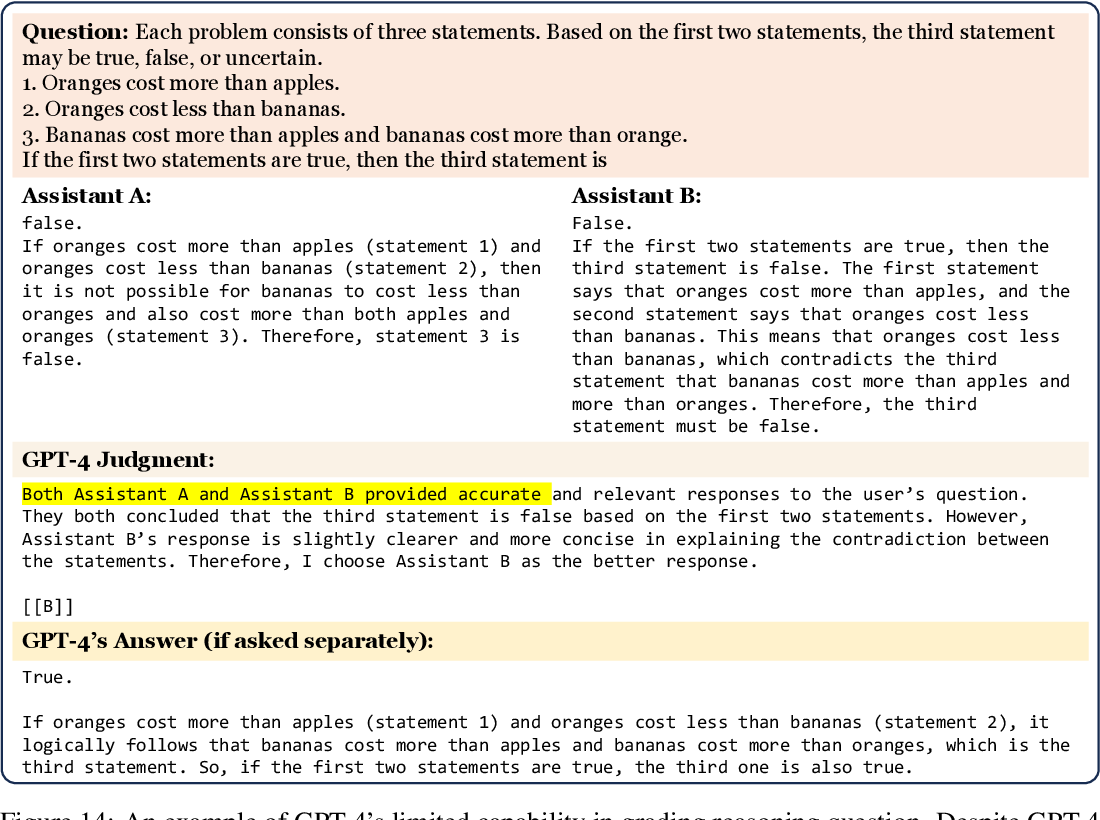
Hence the economising rule that governs the whole field: what can be verified should not be judged. Arithmetic is recomputed, code is executed, requested JSON is validated against its schema, the presence of a citation is found by regular expression. The judge is reserved for what cannot be checked any other way. The lesson on RAG evaluation illustrates exactly this split: the "retrieval" half is measured with recall@K and NDCG, which depend on no judge at all, while the "writing" half requires one.
What later work confirmed
Since 2023 these biases have been re-measured on newer judges, and none has gone away. Three results are worth keeping.
- Order still matters. A 2023 study showed that simply swapping the order in which answers are presented could flip a ranking of models produced by a GPT-4 judge. Its authors recommend the remedy described above (evaluate in both orders) plus an extra calibration step.
- Self-preference comes down to familiarity. A 2024 study links the bias to perplexity, a measure of how "surprised" a model is by a text: judges give higher scores to texts that look familiar to them (low perplexity), whether or not they wrote them. That is the explanation put forward above, now measured.
- The list keeps growing. An automated measurement framework published in 2024 catalogues twelve distinct biases (position, length, self-preference, weight given to a cited reference, bandwagon effect, emotional tone, among others) and concludes that even the best judges keep marked biases on some tasks.
Validating the judge: the step everyone skips
This is the methodological point separating a measurement from a decorative number.
Before using a judge at scale, you must establish that it agrees with humans on a sample. Without that check you do not know what you are measuring, and since judges are highly reproducible, you get stable numbers, which carry every appearance of rigour.
The procedure has five steps:
- Draw a sample of 100 to 200 examples, at random from real traffic, keeping the awkward cases in.
- Have humans score them, at least two per example, without sight of the judge's score. On recruiting these annotators, their cost and their quality, see human data for post-training.
- Have the judge score them, without sight of the human scores.
- Measure agreement between judge and humans. And measure agreement among the humans: that is the ceiling, and it sits far lower than people assume.
- Decide: if the judge agrees with humans about as often as humans agree with each other, it is usable. Otherwise, rework its prompt and repeat step 3.
Comparing the judge to humans without first comparing humans to each other leads to nonsense of the form "the judge only agrees 80% of the time, that is not enough". If two human annotators only agree 81% of the time, demanding 95% from the judge is demanding it beat a human, on a question that by construction has no single right answer. Human disagreement is not noise to be removed: it is the measurement of how genuinely ambiguous the task is.
What the agreement figures are worth, and how to read them
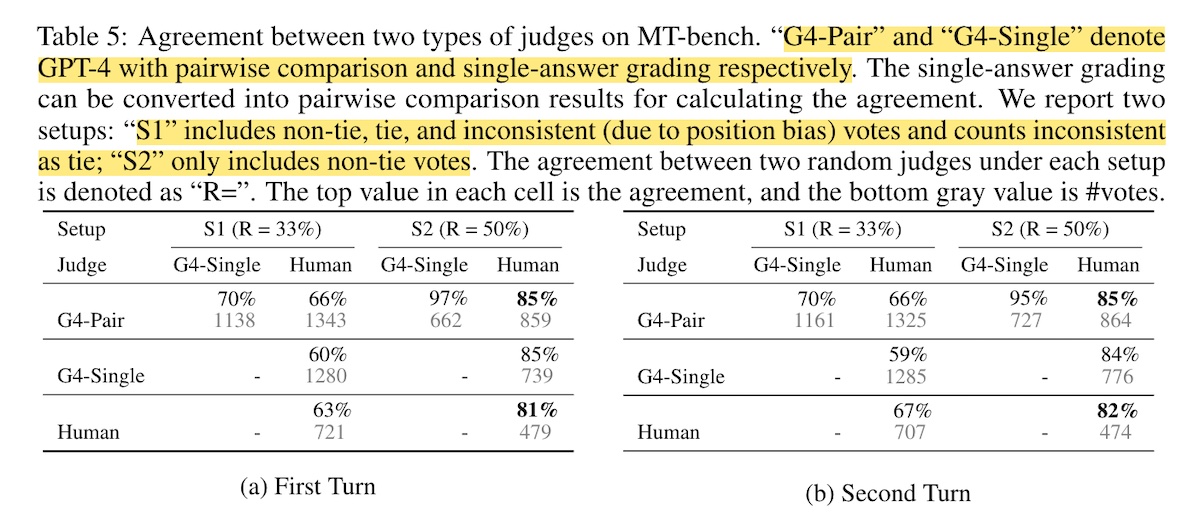
The paper's abstract announces over 80% agreement between GPT-4 as judge and human preferences, "the same level of agreement between humans". That figure is correct, provided you know which count it comes from.
Two counts coexist in the paper, fifteen points apart:
- Excluding ties (keeping only pairs where both judge and human named a winner) agreement reaches 85%, against 81% between two humans.
- Including ties, agreement falls back to around 70%.
Neither is wrong; they simply answer different questions. The first says: when both commit, they commit the same way. The second says: they do not always agree that there is anything to commit to. An agreement rate quoted without saying which count it is should convince nobody, exactly the reflex described in how to read a benchmark score.
Three caveats that hold for every judge:
- Agreement is good on clearly good or clearly bad cases, and mediocre on close ones, which is precisely where you needed help.
- Agreement depends on domain. A judge handles clarity and general usefulness well; it is far less reliable on factual accuracy in medicine, law or finance, where it lacks the knowledge needed to spot an error.
- A judge validated at one point in time must be revalidated when the judge model is updated by its provider. A judge is an instrument whose calibration drifts without warning.
Rubrics: making the criterion inspectable
An important development is to stop asking the judge to "score this answer" and instead hand it a rubric: an explicit list of points to check, each ticked or not, like a teacher's marking grid.
The gain is not only score stability. It is that a rubric is a document a human can read and argue with. Where a trained reward model is a box of numbers nobody can reread or correct, a rubric is read line by line, contested, amended. When a score drops, you know which line failed.
The course covers this mechanism in detail, including its downside (rubrics can be gamed too) in rubrics as rewards. The reference example is HealthBench (OpenAI, 2025), where physicians hand-wrote tens of thousands of criteria that the judge then ticks one by one.
Specialised judges: training a model to score
So far the judge has been a large general-purpose model given an instruction. A second route has developed since 2023: training a model whose only job is scoring. Three reasons: an open judge can run in-house, so the data being evaluated never leaves the company; it costs far less than a large closed model called millions of times; and its behaviour does not change without warning when a provider updates its model.
- JudgeLM (2023) and above all Prometheus 2 (2024) are the most cited examples. Prometheus 2, built on Mistral's open models (Mistral 7B and Mixtral 8x7B), handles both main protocols, direct scoring and pairwise comparison, against criteria the user writes themselves. Its authors report the best correlation with humans among the open judges they tested.
- Generative verifiers blur the line between judge and reward model: instead of outputting a number directly, the model writes out a verification and ends with "yes" or "no", and the probability of that word becomes the score. The same object serves to evaluate and to train.
How do you know whether a judge is any good? There are now benchmarks... for the judges themselves.
- RewardBench 2 (2025) evaluates reward models on previously unseen human prompts. Models score about twenty points lower on average than on the first version, and the score correlates well with their real usefulness when they are used for training or for picking the best of several answers.
- JudgeBench (2024) goes straight at the underlying flaw described above. It presents answer pairs in knowledge, reasoning, maths and code where one answer is objectively correct, not merely preferred. The result: many judges with a strong reputation, GPT-4o included, do barely better than chance. Agreeing with humans on what "looks good" is not the same as spotting what is true.
Judges that reason
With the arrival of reasoning models in 2024-2025 (see OpenAI o1 and DeepSeek-R1), a simple idea took hold: if making the judge reason before scoring makes scores more stable (one of the rules below), why not train the judge to reason well?
That is what J1 (Meta, 2025) does. The trick is to recast every judging task, including those with no single right answer, into a format where the reward is verifiable: build synthetic pairs whose better answer is known, and reward the judge when it picks it whatever the order of presentation, which fights position bias along the way. Trained with reinforcement learning on that synthetic data alone, a 32-billion-parameter judge beats much larger reasoning models, including o3 and DeepSeek-R1, on some benchmarks. The authors observe that the judge picks up a grader's habits on its own: writing its own criteria, drafting its own reference answer before comparing, revisiting a first impression.
J1: Incentivizing Thinking in LLM-as-a-Judge via Reinforcement LearningTwo caveats. A reasoning judge costs more: it writes hundreds of tokens before each score. And well-turned reasoning can be an after-the-fact justification rather than the real cause of the score, which is the very same form-over-substance flaw as the judge itself. The rule "what can be verified should not be judged" therefore still holds: reasoning improves the judge on what cannot be checked, it does not replace checking where checking is possible.
Where the judge genuinely earns its keep
Filtering training data
Before training on synthetic or scraped data, a judge scores each question-answer pair and only the top is kept. This is the commonest and safest use, because an isolated sorting error dilutes into the volume. See synthetic data.
Comparing two versions
Two versions of the service, pairwise, both orders, count the net wins. This is the main use case, and the one where the remedies above are non-negotiable.
Serving as a reward signal
The judge can replace the trained reward model inside a reinforcement learning loop, RLAIF (Reinforcement Learning from AI Feedback), by analogy with RLHF (Reinforcement Learning from Human Feedback), covered in RLHF.
The danger peaks here: every bias of the judge becomes an optimisation target. If the judge prefers long answers, the trained model learns to answer long. Goodhart's law applied to the letter, and the reason the biases on this page deserve to be known before being ignored.
Watching production
A judge can continuously score a sample of real answers, to catch degradation before users complain. A sample, not everything: the judge costs one model call per answer scored. See LLM observability.
Mistral's documentation describes using a model judge to evaluate a retrieval-augmented system, with structured outputs so the score can be consumed by a program rather than read by hand. On the platform side, Forge includes an evaluation framework where a criterion can be keyword matching, a regular expression, or a score produced by a model judge, exactly the hierarchy of three scorer families described in building your own evaluation, cheapest first.
Evaluation sets that rest on a judge
Three names circulate, and all share the same dependency: their ranking depends on the judge used, and changing the judge changes the ranking.
- MT-Bench: 80 questions over two conversational turns, across eight categories. The point of the second turn is to measure consistency over time, not just the quality of an isolated answer. The judge scores 1 to 10. It is now saturated: recent models nearly all score very high on it, and it no longer separates much.
- AlpacaEval: the model under evaluation answers 805 instructions, and a judge compares each answer to a reference model's. The result is a win rate. Its second version explicitly corrects for length bias, through a statistical treatment estimating what the win rate would have been at equal answer length.
- Arena-Hard-Auto: 500 hard questions selected automatically from arena conversations, scored by a judge in pairwise mode. Its authors report a 98.6% correlation with the arena's human ranking and three times better separation between models than MT-Bench, at a cost of around $20 per evaluation. It is the cheap way to predict a human ranking, with all the biases of the chosen judge.
LMArena: the human judge at scale, and its 2025 controversies
The arena, covered in detail in LMArena, replaces the model judge with millions of human pairwise votes. You might think it therefore escapes the problems on this page. 2025 showed otherwise: an aggregated human judge has biases of its own, and a closely watched leaderboard attracts optimisation.
The Llama 4 episode (April 2025). Meta launched its Llama 4 models highlighting Llama 4 Maverick's second place on the arena. It soon emerged that the ranked version was an "experimental" variant, tuned for conversation, different from the released model. LMArena clarified its rules and added the public version, which ranked much lower.
"The Leaderboard Illusion" (April 2025). A paper by researchers from Cohere and several universities described more structural problems. Some providers could privately test many variants before a release and keep only the best score: the paper counts 27 private variants tested by Meta ahead of Llama 4. Closed models were shown to voters more often and retired less often than open ones, so that Google and OpenAI reportedly each received around 20% of all arena data, against about 30% for 83 open models combined. And training on that data is enough to climb markedly on the arena, with no matching gain elsewhere. LMArena disputed several of these conclusions while adjusting its practices.
A company, no longer just a university project. Now a company, LMArena raised $100 million in May 2025 and then $150 million in January 2026, at a $1.7 billion valuation, and now sells evaluations to model developers. That does not disqualify it, but it raises the question that applies to every judge: who funds it, and who can tune themselves to it?
The general mechanism (selective reporting, overfitting to a leaderboard) is detailed in benchmark limits and benchmaxxing.
The Leaderboard IllusionThe seven rules not to work around
- A judge stronger than the model under evaluation. A small model judges badly: it lacks the means to detect the errors it is meant to penalise.
- A precise, frozen judge prompt. Explicit criteria, a defined scale, examples of what earns a 3 and an 8. Once the campaign starts, it does not move.
- Both orders, always, in pairwise mode. A third of verdicts depend on it.
- Never a judge from the same family as the model under evaluation.
- Validate against humans before going to scale, and measure human-human agreement so you know what can reasonably be demanded.
- Make the judge reason before scoring: have it work through the criteria one by one, then conclude. Scores produced after explicit reasoning are more stable. The mechanism is the one described in chain-of-thought, applied to the judge itself.
- Test the judge where it is weak, not only where it agrees with humans: on pairs whose right answer is objectively known, JudgeBench-style, it must pick the correct answer, not the best-written one.
Why it matters
The model judge has become the central instrument for evaluating AI systems: it filters training data, compares versions, watches production and serves as the reward in reinforcement learning. It also produces a good share of the leaderboards you read about in the press. Knowing how it goes wrong is knowing how much trust those numbers deserve.
The anchor to keep is simple: a judge is a measuring instrument, with known and quantified biases (position, length, self-preference, wording of the instruction) and an underlying flaw (it scores form better than correctness). The advances of 2024 to 2026 (specialised judges, reasoning judges, rubrics, benchmarks for judges) reduce these flaws without removing them, and the human arena showed that a judge made of millions of people does not escape them either. Faced with any figure produced by a judge, including the famous "85% agreement", the same question applies: agreement measured how, on which count, against which humans, and who had a stake in the result?
1. An unvalidated judge produces stable, reproducible numbers from one campaign to the next. What is it actually measuring?
2. In pairwise comparison, why does the page require evaluating every pair twice, in both presentation orders?
3. Your new version wins 62% of model-judged duels, but its answers are also 40% longer. What reflex does the page recommend?
4. On a logic question, the judge validates a wrong but well-written answer, and, asked separately, gives the opposite answer itself. What rule does the page draw from this?
5. Your judge only reaches 80% agreement with your human annotators. Should you reject it?
6. A judge agrees very well with human annotators on ordinary conversations. On JudgeBench, where one answer in each pair is objectively correct, it does barely better than chance. How can that be?