The Shock That Changed Everything
January 2025. DeepSeek, a Chinese company, publishes an open-source reasoning model (MIT license) that rivals OpenAI's o1 on the most demanding benchmarks.
Not just "close." Equivalent, even better on certain benchmarks.
And the real bombshell is everything they publish with it: the complete code, the detailed paper with all the recipes, and freely downloadable model weights. Overnight, advanced reasoning is no longer a black box guarded by an American lab.
DeepSeek-R1: Incentivizing Reasoning Capability in LLMs via Reinforcement Learning (DeepSeek-AI, 2025)- Advanced reasoning is not a technological monopoly.
- The process is reproducible: we know exactly how it's done.
- It's open: the entire community can study, improve, and adapt. This is a true paradigm shift for the field.
The Training Pipeline: Four Fascinating Phases
Phase 1: Pure RL Without Examples (R1-Zero)
This is the most surprising experiment in the paper, and probably one of the most striking in recent deep learning history.
You take a base model (DeepSeek-V3, 671B parameters) that's good overall but with no reasoning specialty. And you train it solely through reinforcement learning (the basics are here), without showing it a single reasoning example.
The setup is disarmingly simple:
- You give it a math problem
- It generates an answer
- You automatically verify: correct () or incorrect ()
- The RL algorithm (GRPO) reinforces correct answers and penalizes wrong ones
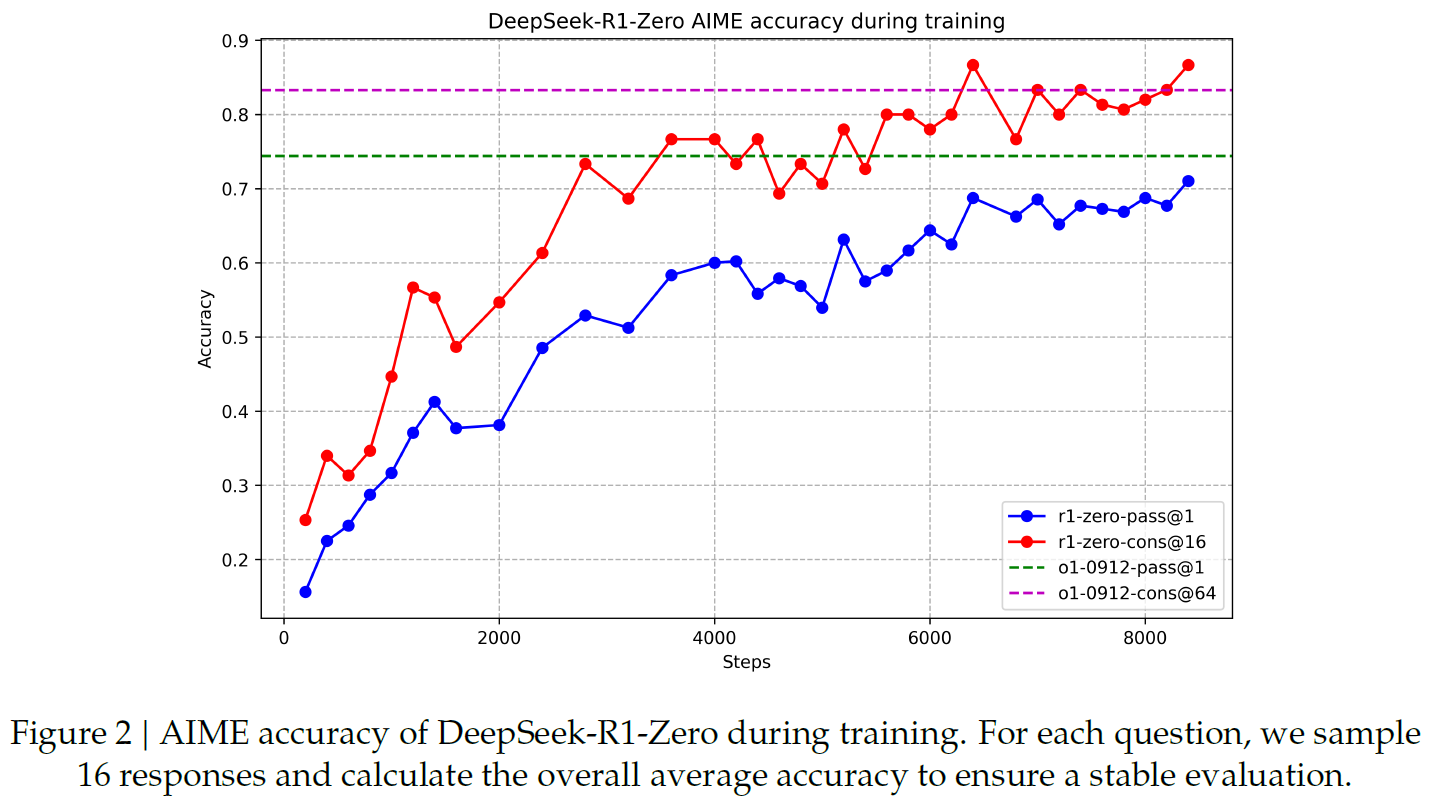
The result is stunning: the model spontaneously invents Chain-of-Thought. Without ever being shown an example of step-by-step reasoning, it discovers on its own that decomposing a problem into steps, verifying each step, and backtracking when stuck is the best strategy for getting the reward.
Without explicit CoT training, the model spontaneously develops: step decomposition, intermediate verification, backtracking, exploring alternatives. Reasoning emerges as the optimal strategy for maximizing reward. It's a powerful demonstration that reasoning doesn't need to be explicitly taught, it can be discovered.
R1-Zero's Problems
The result is intellectually impressive but chaotic in practice:
- Random mixing of languages (French, English, code in the same answer)
- Bizarre and inconsistent formatting
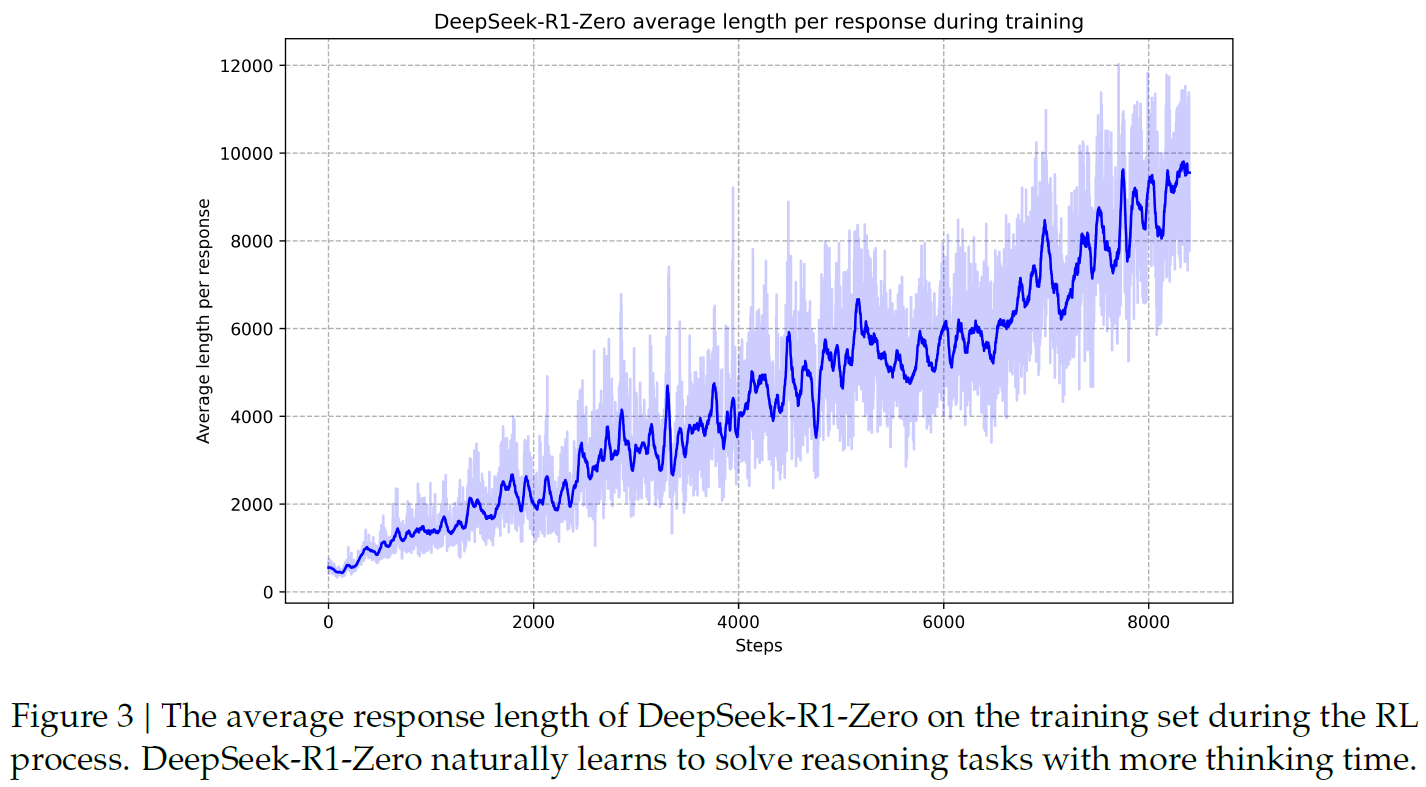
- Excessively long reasoning chains (the model "thinks" way too much)
- Sometimes logical inconsistencies
The reasoning is there, but the form is unusable in production.
Phase 2: Cold Start (Supervised Bootstrapping)
To discipline R1-Zero's wild reasoning:
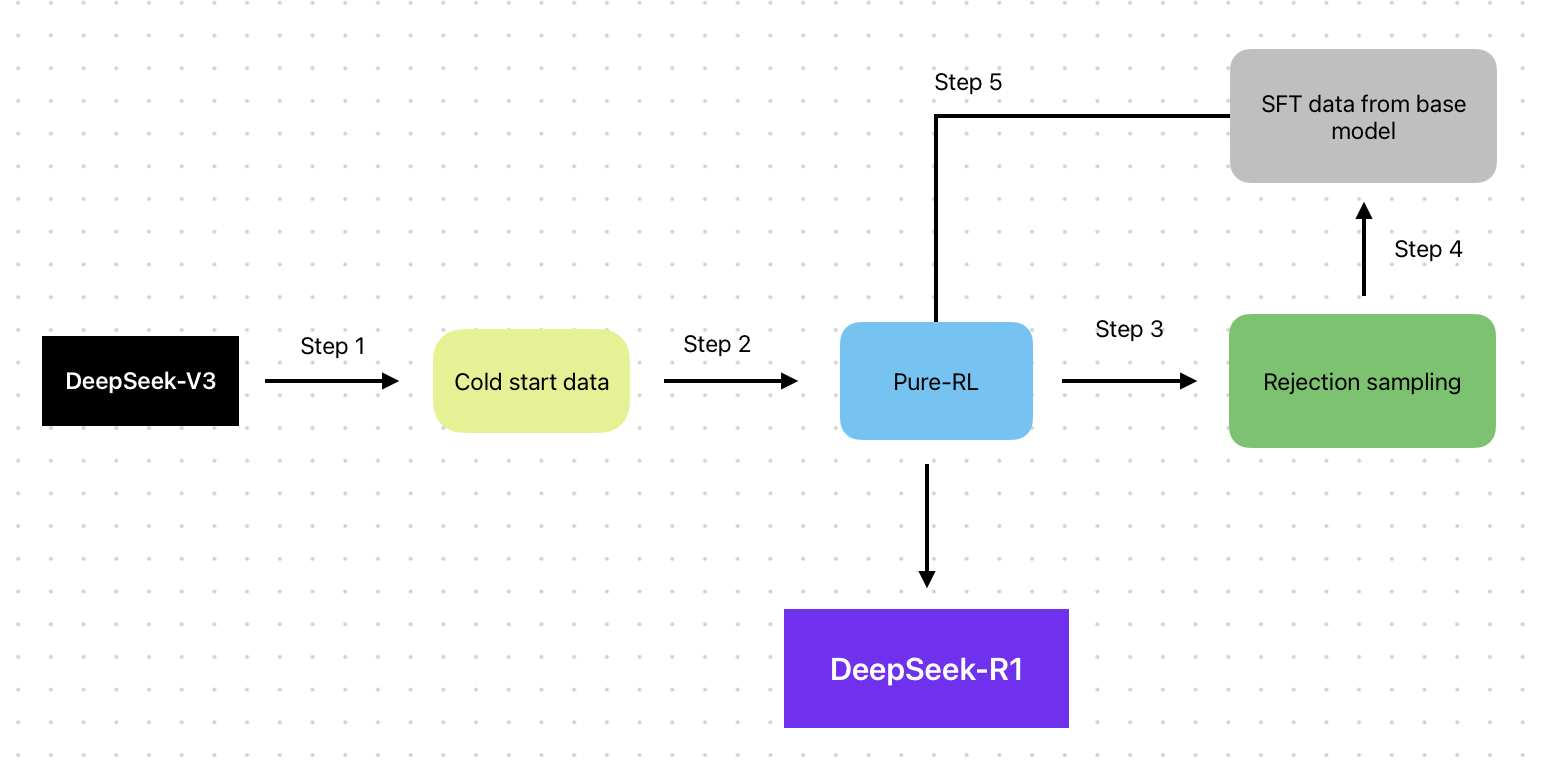
- Collect a few thousand high-quality reasoning examples (the paper describes a mix: reworked R1-Zero outputs, examples obtained by prompting, all cleaned up by human annotators)
- Do SFT (Supervised Fine-Tuning) on these examples to give the model a clean starting point
- Then relaunch RL
It's like giving a few calligraphy lessons to someone who already knows how to write but illegibly. The substance is good, you polish the form.
Phase 3: Large-Scale RL
With this solid starting point, you launch RL on a large set of problems covering different domains:
- Math (automatic answer verification)
- Code (unit test execution)
- Formal logic (symbolic verification)
- Open-ended questions (evaluation by a reward model)
Phase 4: Distillation
You take the quality reasoning outputs produced by R1 (the large 671B model) and use them to train much smaller models via distillation.
| Model | Base | Params | AIME 2024 (pass@1) |
|---|---|---|---|
| R1-Distill-Qwen-1.5B | Qwen 2.5 1.5B | 1.5B | 28.9% |
| R1-Distill-Qwen-7B | Qwen 2.5 7B | 7B | 55.5% |
| R1-Distill-Qwen-32B | Qwen 2.5 32B | 32B | 72.6% |
| R1-Distill-Llama-70B | Llama 3.3 70B | 70B | 70.0% |
Figures from table 5 of the paper, in pass@1 (a single answer per problem, the protocol refresher is here). The number that makes you think: a 7B distilled model reasons better than GPT-4o (9.3% on AIME in the same evaluation). A model that fits on a laptop outperforms one of the best proprietary models in the world on mathematical reasoning.
Technical Corner: GRPO, The Algorithm
GRPO (Group Relative Policy Optimization) is a clever simplification of PPO (Proximal Policy Optimization), the classic RL algorithm.
The central idea: instead of training a separate "critic model" that estimates the value of each answer, you use relative comparison within a group of answers.
For each problem:
- Generate different answers
- Verify each one: correct () or incorrect ()
- Normalize within the group: answers above average are reinforced, those below are penalized
- Update the model
The advantage? More stable than PPO, no need to train and maintain a separate critic model, and simpler to implement. It's this simplicity that enabled the community to reproduce results quickly. The full mechanism is in the GRPO & oDPO lesson, and the flaws discovered in production (with their fixes) in the GRPO variants lesson.
Results: Truly Competitive
| Benchmark | GPT-4o | o1 | DeepSeek-R1 |
|---|---|---|---|
| AIME 2024 | 9.3% | 79.2% | 79.8% |
| MATH-500 | 74.6% | 96.4% | 97.3% |
| Codeforces (Elo) | 759 | 2061 | 2029 |
| GPQA Diamond | 49.9% | 75.7% | 71.5% |
Figures from table 4 of the DeepSeek-R1 paper, all in pass@1 (the evaluated versions are GPT-4o-0513 and o1-1217). Don't be surprised to find different numbers on the o1 page: there, OpenAI's AIME scores are maj@64 (majority vote over 64 attempts) hence an 83.3% that is not comparable to this table. On math and code, o1 and R1 are neck and neck. GPQA Diamond (advanced science questions) remains an area where o1 keeps the edge.
In practice, you won't be working with a 671B parameter model locally. The distilled versions (Qwen-32B, Llama-70B) offer an excellent quality-to-cost ratio: world-class reasoning, runnable on your own machine.
Impact on the Community
Reproducibility
The detailed paper enabled the community to reproduce the results on smaller models, apply GRPO to other architectures (Llama, Mistral, etc.), and experiment with variants. Within weeks, dozens of open-source projects had picked up the recipe.
Technological Sovereignty
Beyond the technical aspects, R1 carries a geopolitical message: advanced reasoning capabilities are not the exclusive privilege of major American laboratories. It's an important signal for global technological sovereignty.
Like o1, R1 generates long reasoning chains. A complex problem can cost 5,000 to 50,000 tokens. Keep an eye on your API consumption. Use reasoning models only when the task truly justifies it.
Key Takeaways
DeepSeek-R1 demonstrated four fundamental things:
- Reproducible: RL is enough, no secret proprietary magic needed
- Open-sourceable: these capabilities can be shared with the entire community
- Democratizable: distilled versions make advanced reasoning accessible
- Competitive: open-source rivals proprietary models
Advanced reasoning is now a public good. The AI landscape has changed irreversibly.
The Sequel: V4 and Hybrid Mode
April 2026, DeepSeek pushes further: V4-Pro (a 1.6T-parameter MoE with 49B active) and V4-Flash (284B / 13B) ship in preview, still open-source. Reasoning is no longer a separate variant (R1 vs V3): it is built into V4 as a "thinking" / "non-thinking" mode toggled by a parameter, as with Claude and Gemini.
On the architecture side, V4 introduces a hybrid CSA + HCA attention (two KV-cache compression mechanisms (the memory of keys and values) that make the 1M-token context economically practical), Manifold-Constrained Hyper-Connections to stabilize the signal across layers, and moves optimization to Muon instead of AdamW. It is the R1 lineage living on, industrialized: the same open-source philosophy, at prices that defy competition (around $0.44 / M input tokens for Pro, $0.14 for Flash, at April 2026 API prices).
1. What makes the R1-Zero experiment such a landmark in the recent history of deep learning?
2. R1-Zero's reasoning was real but unusable in production. What is the « cold start » phase that follows for?
3. What sets GRPO, DeepSeek's RL algorithm, apart from classic PPO?
4. A 7-billion-parameter R1-Distill scores 55.5% on AIME, against 9.3% for GPT-4o. What explains this reversal?