This page covers what distorts a benchmark. Reading an announced score (pass@1 and maj@N protocols, the choice of comparator, model versioning, and a ten-question grid) is covered in How to Read a Benchmark Score.
The Fundamental Problem of Evaluation
We need to evaluate models. So we create standardized tests. The problem? These tests can lie. Not intentionally, but in many subtle ways: training data contamination, targeted score optimization, rapid saturation, and above all, the enormous gap between a benchmark score and real-world performance.
This is a problem that affects the entire AI industry and makes comparing models much harder than it seems.
"When a measure becomes a target, it ceases to be a good measure." (Goodhart's Law). Companies optimize for benchmarks. Models get excellent scores. But are the models really improving in useful skills? Or are they just getting better at taking tests?
Contamination: When the Model Has Already Seen the Exam
Contamination (data leakage) is the most insidious problem. The model has seen the benchmark questions in its training data. It doesn't solve them. It remembers them.
How does this happen in practice?
Massive web scraping. Benchmarks are published publicly (it's necessary for reproducibility). During pre-training, the model absorbs a massive portion of the internet: web pages, forums, blogs, GitHub. The benchmark questions? Probably included somewhere in that mass of data.
Synthetic data. Other LLMs generate training data. They can produce paraphrases or close variants of benchmark questions, without anyone realizing it.
Online discussions. Forums (Reddit, Stack Overflow), data science blogs, and tutorials discuss benchmarks, reproduce questions and answers. These discussions are in the training data.
Concrete result: studies have shown that models perform 10 to 20 percentage points better on questions where contamination can be confirmed than on equivalent but uncontaminated questions. That's a massive difference.
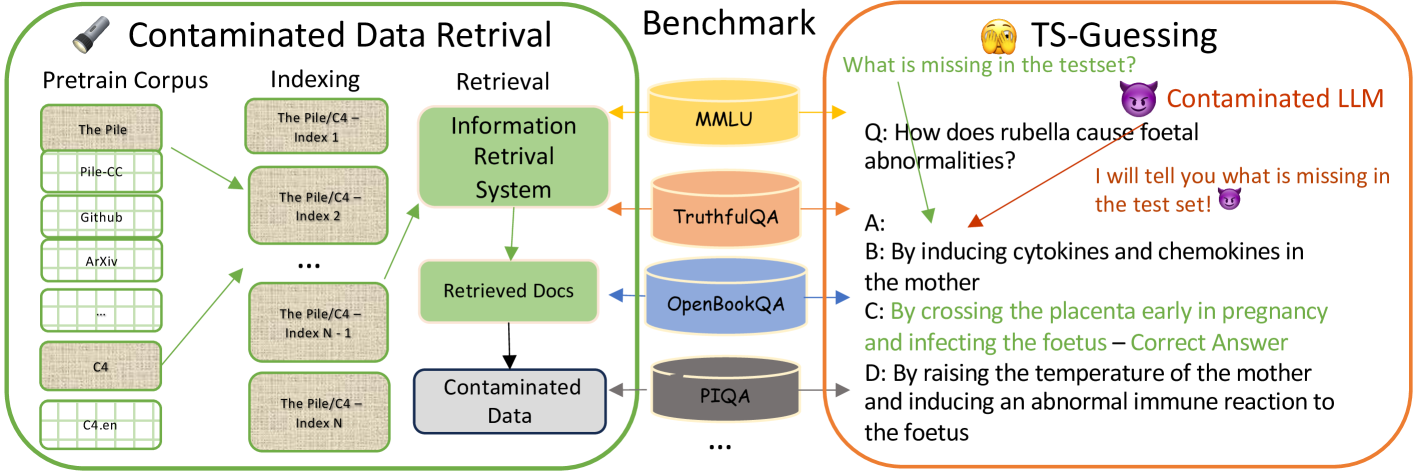
(1) Abnormal perplexity: if a model sees a question for the first time, it should be "surprised" (high perplexity). Abnormally low perplexity suggests memorization.
(2) Paraphrase test: ask the same question rephrased. A contaminated model often fails on the paraphrase (it memorized the exact wording, not the concept).
(3) N-gram search: look for exact benchmark sequences in the training data. If exact matches exist, contamination is confirmed.
Gaming: Optimizing Scores Without Improving the Model
Beyond contamination (often unintentional), there's deliberate score optimization. Not cheating in the strict sense, but practices that inflate numbers.
Best checkpoint selection. You train for 10 days. You save the model every day. Which one do you publish? The one that maximizes benchmark scores. Not necessarily the best model overall.
Targeted prompt engineering. You test 100 different prompt formulations. You find the one that gives the best MMLU score. You publish with that specific prompt. Another team, with a different prompt, gets a different score. The "MMLU score" isn't an absolute value, it's a value conditional on the prompt.
Targeted synthetic data. You generate training data close to the benchmark format (MCQ structure, similar vocabulary, aligned domains) and include it in fine-tuning. The model learns to excel on the test format, not the underlying skill.
Hyperparameter optimization. You tweak temperature, top-p, number of few-shot examples until you get the best result on the leaderboard.
When a company announces "Our model achieves 92.5% on MMLU," it's generally under the most favorable conditions they could find. An independent team evaluating the same model often gets 88-90%. The difference comes from conditions: prompts, temperature, few-shot setup, evaluation version. These details are rarely published transparently.
Saturation: When the Test Loses Its Power
A saturated benchmark is when all recent models score 90%+ and become indistinguishable.
The current state:
- GSM8K (elementary math): 96%+, saturated
- ARC-Challenge (middle school science): 96%+, saturated
- HellaSwag (common sense): 95%+, saturated
- MMLU (general knowledge): 90%+, approaching saturation
A saturated benchmark tells you nothing. Is model A better than model B? Both score 96%, so it's impossible to tell.
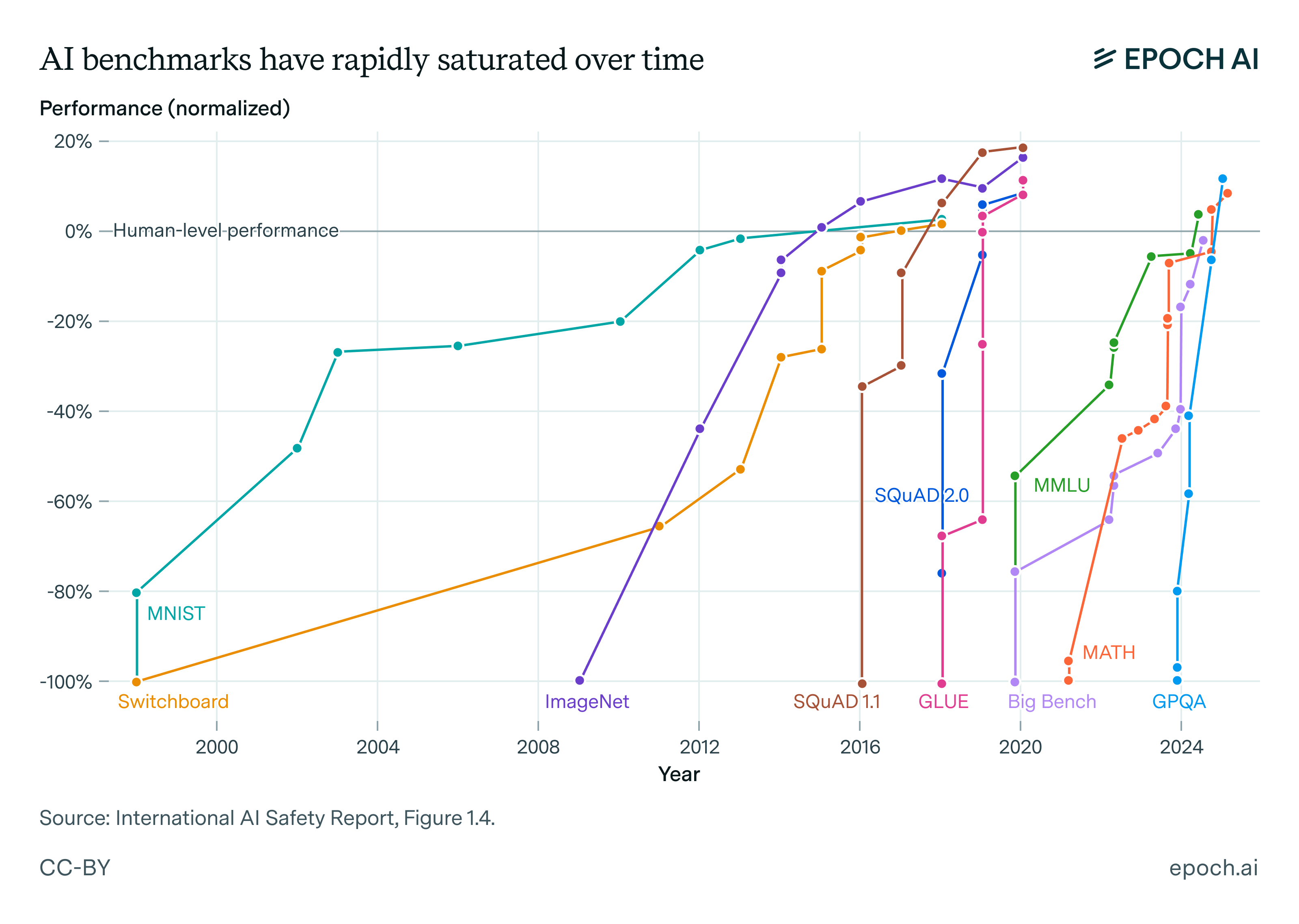
The benchmark cycle has become predictable:
- Creation: "This is really hard!"
- Adoption: everyone uses it as a reference
- Rapid progress: models improve within months
- Saturation: 12-24 months later, all recent models score 90%+
- Obsolescence: the benchmark only serves to check a box
- Replacement: a new "harder" benchmark is created
- Back to step 1
The Benchmark-Reality Gap: The Real Problem
The deepest problem is neither contamination nor saturation. It's that benchmarks don't test what matters in practice.
Extended interaction. Benchmarks test: one question, one answer. Reality: 20-message conversations where context accumulates, instructions evolve, and the model must adapt to clarifications and changes in direction.
Reliability. A model can score 90% on a benchmark and be unreliable. The 10% where it fails is unpredictable. In production, a model that makes unpredictable errors is more dangerous than a slightly worse model whose failures are predictable.
Complex instruction following. An MCQ is simple: four options, pick one. A real professional instruction can have 5 conditions, edge cases, exceptions, and conflicting priorities. Benchmarks don't capture this complexity.
Judgment and nuance. Real situations are ambiguous. "Should I?", "Is this ethical?", "What's the best approach?" Benchmarks test black and white. Reality is in shades of gray.
Hallucinations in production. A model can have excellent scores and hallucinate regularly in real use. Benchmarks don't capture the frequency and severity of hallucinations in free conversation contexts.
Latency and cost. Benchmarks ignore critical production factors: how long for a response? How much does it cost per query? A model that's 3% better but costs 10x more isn't a better choice.
Concrete example: a model excels on MMLU (factual knowledge) but hallucinates continuously in free conversations. Another has an average MMLU score but is much more useful in practice because it better understands context, admits its uncertainty, and produces actionable answers.
Benchmarks like LiveBench (which renews monthly), SWE-bench (solving real bugs in real GitHub repos), and LMArena (direct human votes) represent the direction forward. Composite evaluation (automatic benchmarks + human evaluation + real use cases) is the future. No single number captures a model's quality.
Emerging Solutions
LiveBench: a monthly benchmark that renews itself. Questions change every month, eliminating the risk of long-term contamination. The price: questions must be recreated regularly.
LiveCodeBench: recent code problems from competitions (Codeforces, LeetCode), newer than training data. No contamination possible.
SWE-bench: solving real bugs in real GitHub repos (Django, Flask, scikit-learn). Not an abstract question, a real task: read existing code, locate the problem, write a patch that passes the tests. ~50% for the best agents.
GAIA: questions requiring tools, multi-step reasoning, and real information retrieval. Not just "what do you know?" but "can you find and reason?"
LMArena: direct human votes. Which answer is better? It's subjective, but it's the closest to real user satisfaction.
Systematic red teaming: how many ways can you make the model fail? Finding flaws is as informative as measuring successes.
The solution isn't finding a single super-benchmark that measures everything. It's accepting that you need multiple complementary evaluations: automatic benchmarks (speed, reproducibility), human evaluation (perceived quality, usefulness), real use cases (production reliability), and independent audits (claim verification). A model that shines on all these fronts is probably good. A model that shines on one benchmark but fails elsewhere? The benchmarks are lying.