A Cross-Fertilization: Physics Inspires AI, AI Accelerates Physics
Here's a story of fusion that has lasted for decades. First, physics inspired AI: Boltzmann machines borrow from statistical mechanics, free energy is a thermodynamic concept, and Bayesian networks are rooted in statistical physics. Then AI came back to solve the problems physics found too complex. Today, this dance is bearing extraordinary fruits in both directions.
To understand why, think about the concrete problem. CERN's LHC produces a billion collisions per second. Your computer receives a data deluge so massive that no human can sort through it. How do you know which collision is interesting? AI spots the signal in the noise, like a gold prospector filtering tons of sand to find a nugget. Or you need to solve the Navier-Stokes equations to model fluid turbulence. These equations are so complex that we don't even know if they always have smooth solutions (it's one of the Millennium Prize Problems, worth a million dollars). AI sidesteps the problem: instead of solving analytically, it learns numerical shortcuts.
Three ingredients make physics an ideal playground for AI. First, massive data (the LHC, telescopes, gravitational wave detectors). Second, extremely high-dimensional problems (sometimes a billion variables). Third, the need to find hidden patterns in mountains of noise. AI excels in exactly these three areas.
Particle Physics: Finding the Needle in the Haystack
The Large Hadron Collider (LHC) produces a billion collisions per second, and 99.9999% are uninteresting background noise. Imagine trying to find a specific conversation in the roar of a 100,000-person stadium. AI must identify the relevant signal in real time:
- Trigger systems: neural networks operating in real time that filter interesting collisions from the billions, in microseconds. They're CERN's goalkeepers: they instantly decide what to keep and what to discard
- Reconstruction: tracing particle trajectories through detectors, like reconstructing a bullet's path from the holes it leaves in stacked sheets of paper
- Classification: distinguishing real physical signals from background noise. A CNN can separate a quark jet from a gluon jet with accuracy unattainable by manual methods
- Discovery: detecting anomalies that could signal previously unknown particles
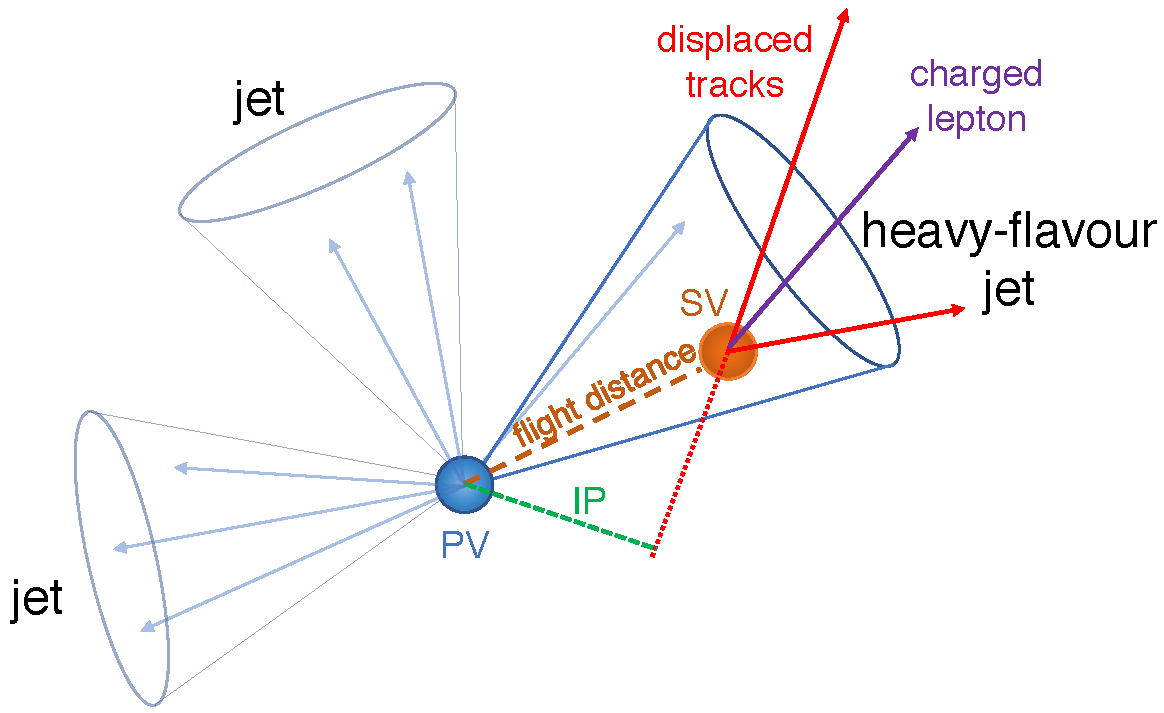
The discovery of the Higgs boson in 2012 already used machine learning techniques to isolate the signal. Today, deep networks provide superhuman sensitivity: they detect rare events that physicists would have missed with traditional methods.
Discovering Physical Laws: AI as Archaeologist
Physicists love elegant equations, what if AI could rediscover them on its own? That's exactly what AI Feynman does. This system rediscovered 100 equations from Feynman's physics lectures directly from numerical data, without being told what the equations should look like.
The principle is symbolic regression through genetic programming: the model proposes candidate mathematical expressions (like or ), tests them against the data, and keeps the best ones to evolve. It's natural selection applied to equations. Over generations, the formulas become more precise and more elegant.
What's fascinating is that the system rediscovers not only the known formulas, but also identifies the symmetries and relevant variables. It automatically distinguishes what matters from what doesn't in a physical dataset.
Physics-Informed Neural Networks (PINNs)
Here's a brilliant idea that marries the best of both worlds. If you know that physics obeys a differential equation (for example, energy conservation or the heat equation), force the neural network to respect that equation in its loss function.
Concretely, a PINN solves a differential equation without a traditional mesh. The network learns a function that simultaneously satisfies the differential equation AND the boundary conditions. It's like learning the rules of a game and letting the network find the optimal strategy within that framework. Physics constrains AI, and AI solves the physics: win-win.
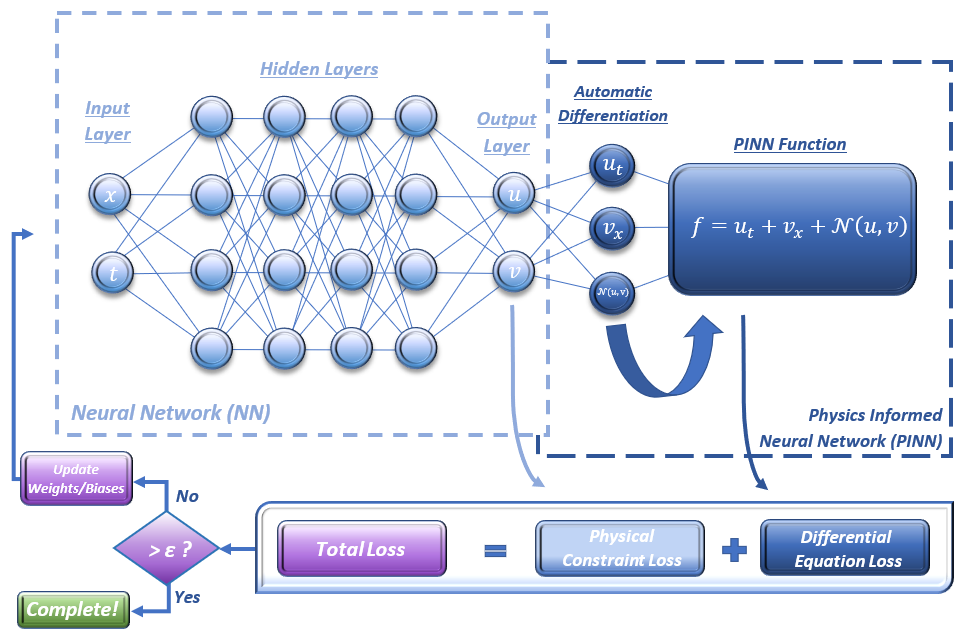
The advantage? Where a classical numerical solver needs a fine mesh (millions of calculation points), the PINN approximates the solution continuously. You can query any point in space-time, not just the mesh nodes.
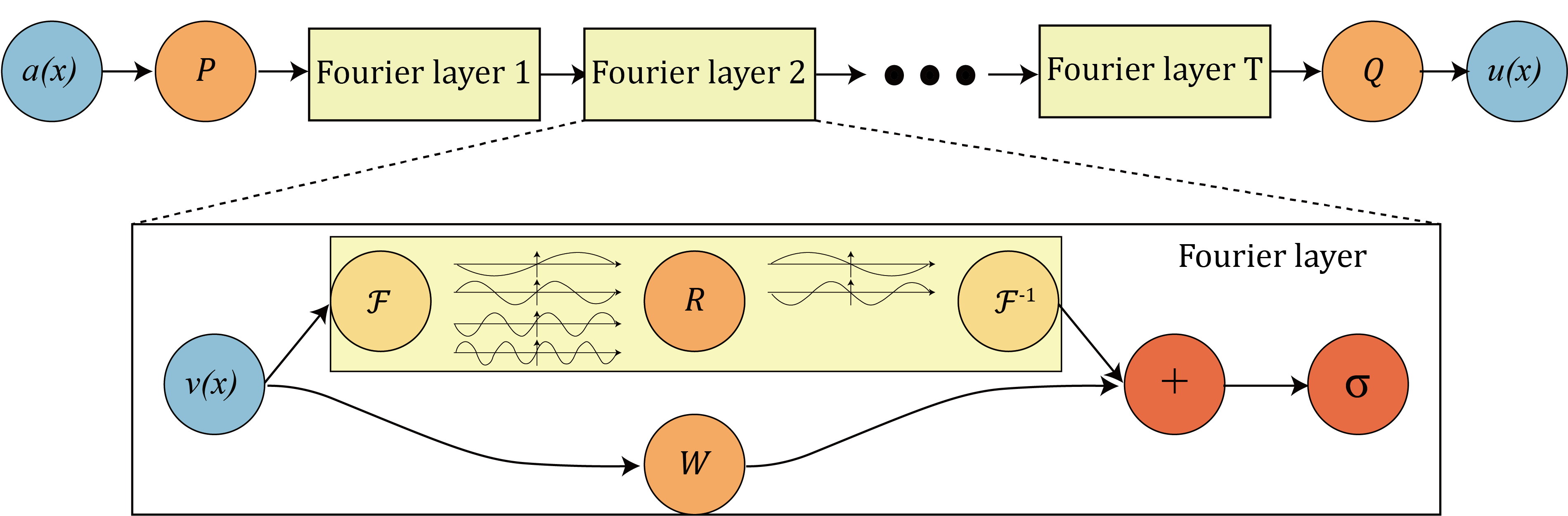
The Fourier Neural Operator (FNO) goes even further. Instead of learning a solution for given initial conditions, it learns an operator that maps any initial conditions to the solution. Result: it solves the Navier-Stokes equations for turbulence 1,000x faster than classical solvers, while maintaining comparable accuracy. This opens the door to real-time simulations that were impossible before.
Cosmology: Listening to the Universe
AI is also transforming our understanding of the universe at large scales. For gravitational waves, AI detects the extremely faint signals captured by LIGO and Virgo, buried in instrumental noise. It's like hearing a whisper at a rock concert. Neural networks identify the signatures of black hole or neutron star mergers in seconds, where classical methods took days.
For gravitational lensing, AI reconstructs the distribution of dark matter (invisible by definition) from the subtle distortion of light from distant galaxies. It's cosmic tomography: reconstructing the invisible from its visible effects.
Cosmological emulators replace astronomically expensive N-body simulations (which simulate the evolution of billions of particles under gravity) with neural networks that give the same result 1,000x faster. A researcher can thus explore thousands of cosmological scenarios in a day instead of one per week.
Condensed Matter and Materials
AI also tackles solid-state physics. It helps identify phase transitions (when a material changes state, like water freezing) from simulation data, sometimes discovering transitions that physicists hadn't noticed. It learns DFT functionals, the crucial mathematical approximations for calculating material electronic properties, making calculations more accurate and faster. And it designs the crystal structures of the future, as with DeepMind's GNoME project that discovered 2.2 million new stable crystals.
Outlook
Physics is experiencing a true methodological revolution. Concepts from AI (symmetries, equivariance, attention) are influencing the design of physical models. In return, physical concepts (conservation laws, locality, gauge invariances) are influencing the design of neural network architectures. This cross-fertilization is only accelerating: the coming years will likely see AI contribute directly to fundamental discoveries in physics, and physics provide the mathematical principles that make AI more efficient and more interpretable.
1. In a Physics-Informed Neural Network, where does the physics actually enter?
2. What does a Fourier Neural Operator learn that a network trained on one simulation does not?
3. Why is LHC collision sorting handed to networks that decide within microseconds, rather than to an analysis run afterwards?
4. How does AI Feynman differ from an ordinary curve fit?