The Ultimate Test: Math Doesn't Forgive
In natural language, a "roughly correct" answer can be acceptable. In math, a false proof is rejected. Period. It's 0 or 100, with no gray zone. Mathematics is the ultimate arena for testing whether an AI truly reasons or simply does sophisticated pattern matching.
The International Mathematical Olympiad (IMO) represents the pinnacle of mathematical difficulty accessible to humans without machines. Six problems, each fiendishly difficult, requiring creativity, intuition, and formal rigor. No automated system had ever succeeded in solving these problems in any significant way. Until the arrival of AlphaGeometry and AlphaProof in 2024.
Solving mathematical problems is often considered a proxy for general intelligence. Olympiad problems require creativity (finding the right approach), intuition (sensing which direction is promising), and rigorous reasoning (every step must be justifiable). No mere pattern matching can suffice here.
AlphaGeometry (2024): Neuro-Symbolic in Action
A typical olympiad geometry problem: you're given a figure with points, lines, and circles, and you're asked to prove a property (equal angles, proportional lengths, collinear points). The difficulty isn't in the deduction itself, but in the auxiliary constructions: you often need to draw an additional line or add a point not in the problem statement to unlock the proof. This is a creative act that even good math students find difficult.
Hybrid neuro-symbolic architecture:
- Symbolic engine: rigorously applies axioms and theorems of Euclidean geometry. It knows that vertically opposite angles are equal, that an angle inscribed in a semicircle is a right angle, etc. It never makes errors in its deductions, but it can get stuck
- Language model: when the symbolic engine is stuck, the LM proposes creative auxiliary constructions. "What if we drew the perpendicular bisector? What if we added the incircle center?"
The cycle is elegant: the symbolic engine deduces everything it rigorously can, then when it's stuck, the LM suggests a creative construction, the engine resumes its deductions with this new element, and so on until the proof is complete.
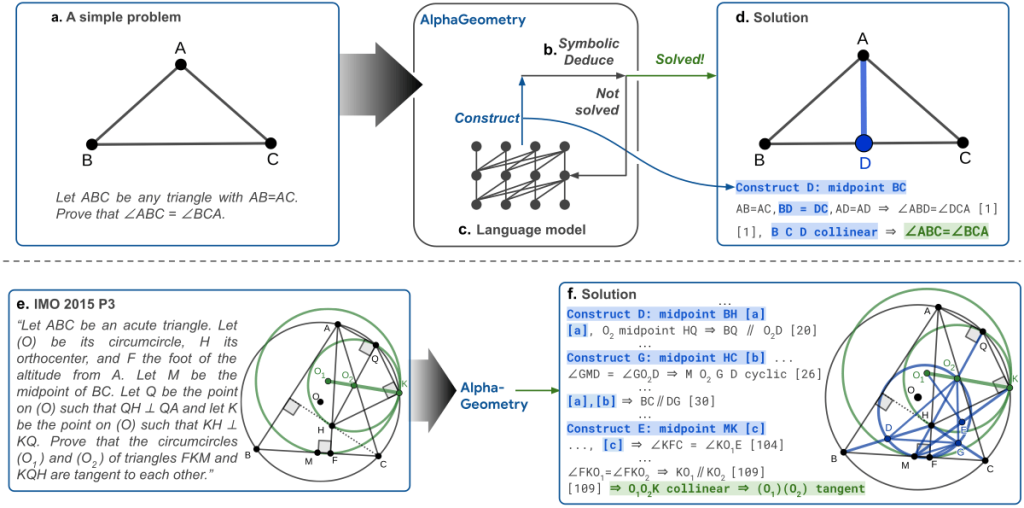
The key innovation is separating two distinct capabilities. Auxiliary constructions are a creative act, the natural domain of the language model (which excels at proposing ideas). Deduction is formal reasoning, the natural domain of the symbolic engine (which never makes errors). By combining the two, you get a system that is both creative and rigorous.
Synthetic Training: Creating Your Own Data
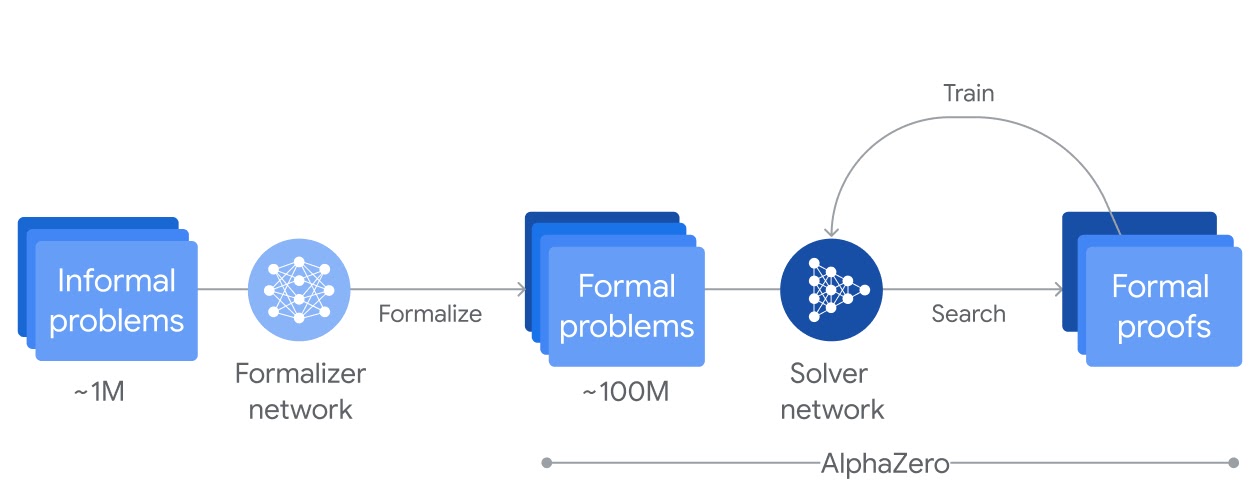
AlphaGeometry wasn't trained on human solutions. It generated its own training data:
- You create a random geometric configuration (a triangle with some notable points)
- The symbolic engine derives all the theorems it can prove in this configuration
- You reverse it: the theorem becomes the problem statement, and the deduction steps become the proof
- 100 million synthetic proofs are generated this way
- The LM is trained on these proofs to learn which auxiliary constructions are useful
Result: 25 of the 30 geometry problems from the IMOs between 2000 and 2024 were solved. This is the performance of a gold medalist in geometry, a level that only a handful of humans achieve each year.
AlphaProof (2024): Beyond Geometry
AlphaGeometry is specialized in geometry. AlphaProof is generalist: it can tackle any mathematical theorem, from algebra to combinatorics to number theory.
Lean 4 language: proofs must be written in Lean 4, a formal proof language. Every step is machine-verifiable. There's no possible ambiguity: either the proof is correct and the machine accepts it, or it's not and the machine rejects it. It's the ultimate guarantee of rigor.
Architecture: AlphaProof combines three components. An AlphaZero-style search (exploring the proof space via Monte Carlo Tree Search), a fine-tuned Gemini (translating mathematical intuition into Lean tactics), and reinforcement learning (learning which proof strategies are most effective long-term).
IMO 2024: First Silver Medal for an AI
AlphaProof + AlphaGeometry 2 were tested on the 6 problems of IMO 2024. Result: 4 of the 6 problems solved. Score of 28/42, corresponding to a silver medal. This is historic.
The most remarkable fact: AlphaProof solved problem 6, considered the most difficult of the competition. Only 5 human contestants out of 609 solved it. However, the system needed 3 days of intensive computation to get there, while humans had 4.5 hours. Brute computational force compensates for human creativity, for now.
AlphaProof solved the hardest problem of IMO 2024, the one only 5 humans out of 609 solved. But it needed 3 days of computation versus 4.5 hours for humans. AI compensates for its lack of intuition with massive computational exploration. The question is: computing power keeps growing, human intuition does not.
The Broader Landscape of Mathematical Reasoning
Generalist LLMs: GPT-4 solved about 40% of problems on the MATH benchmark in 2023. By 2026, GPT-5.4 and reasoning models (heirs to o1/o3) exceed 96% thanks to integrated reasoning. But these models offer no guarantee of correctness: they can be wrong in convincing ways.
Formal proof assistants: Lean 4, Isabelle, and Coq are languages that guarantee proof correctness through automatic verification. AlphaProof uses Lean 4. The difficulty is translating human mathematical intuition into these formal languages.
Automated research: LeanDojo (RL for proof in Lean), LLEMMA (math-specialized LLM), DeepSeek-Prover (dedicated proof model). The ecosystem is developing rapidly.
The Great Debate: Reasoning or Pattern Matching?
Do LLMs truly reason or are they doing sophisticated pattern matching? It's a deep philosophical question. AlphaGeometry and AlphaProof elegantly sidestep it by using formal verifiers that guarantee the correctness of every proof. The neural network proposes leads (potentially through pattern matching), but the formal engine verifies that every step is rigorously correct. The result is guaranteed to be right, regardless of the nature of the internal process. The neural proposes, the formal disposes.
Implications
For mathematics: acceleration of the formalization of mathematical knowledge, potential discovery of new proofs that humans wouldn't have found, and daily assistance to mathematicians in their verification and exploration work.
For AI: validation that the neuro-symbolic approach (combining learning and formal logic) works on extremely difficult problems. Formal mathematical reasoning as a credible proxy for measuring progress toward artificial general intelligence.
Outlook
The short-term objective: a full gold medal at the IMO. Longer term: original contributions to mathematical research, proofs of open conjectures. The growing formalization of mathematics (the Lean Mathematical Library grows every day) provides the needed training data. Rigorous mathematical reasoning remains one of the most difficult and most fascinating challenges for AI.
1. In AlphaGeometry, how is the work split between the language model and the symbolic engine?
2. Where does AlphaGeometry's training data come from?
3. AlphaProof solved problem 6 of IMO 2024, which only five humans out of 609 had solved. What qualifies that result?
4. Why does the question « do these systems really reason? » matter less here than for a general-purpose language model?