The Great Mystery: How a Chain Becomes a Machine
A protein is a chain of amino acids. Imagine a rope made of 300 beads in 20 different colors. This rope spontaneously folds into a complex and precise 3D shape, a true molecular machine capable of cutting DNA, digesting food, or detecting light. Every protein in your body is such a machine, and its function depends entirely on its shape.
The fundamental problem: knowing the rope (the amino acid sequence) doesn't tell you what shape it will take (the 3D structure). Yet it's the shape that determines function. A misfolded protein is a dysfunctional one, which can cause diseases like Alzheimer's, Parkinson's, or cystic fibrosis.
For 50 years, biologists determined protein structures through X-ray crystallography (a lengthy and expensive technique, taking months per protein) or cryo-electron microscopy (faster but requiring equipment worth several million dollars). AlphaFold transformed a process of months into minutes on a computer.
A protein's 3D structure determines everything: how a virus hides from the immune system, why a genetic mutation causes a disease, how to design a drug that fits into the right active site. Predicting structure means understanding biology at its most fundamental level.
AlphaFold 1 (2018): The First Surprise
At the CASP13 competition (Critical Assessment of protein Structure Prediction, the World Cup of structure prediction), AlphaFold arrives and wins with a significant lead over all competitors. It was the first time an AI model showed real promise on this problem. But predictions were still imperfect: useful for guiding experimentalists, but not accurate enough to replace experimental methods.
AlphaFold 2 (2020): The Historic Moment
November 2020. AlphaFold 2 solves CASP14 with a GDT score of 92.4 out of 100, accuracy comparable to experimental methods. The global scientific community is stunned. The consensus: "The protein folding problem is essentially solved." In 2024, Demis Hassabis and John Jumper receive the Nobel Prize in Chemistry for this contribution.
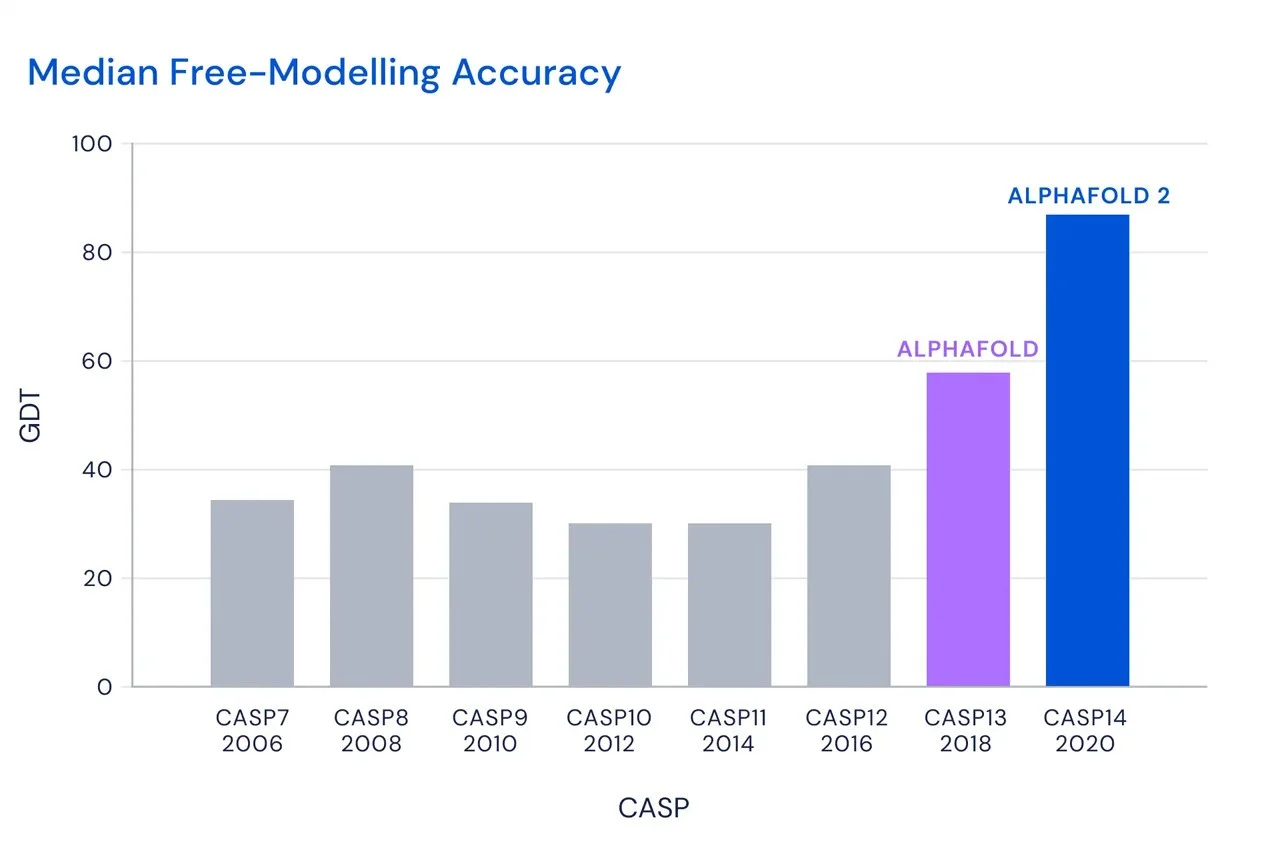
The key innovation: the Evoformer. AlphaFold 2's secret rests on a deep biological insight: homologous sequences. If you have the human protein, look at the monkey version, the mouse version, the worm version, the bacteria version. These natural variants, sculpted by millions of years of evolution, reveal the 3D structure: if two amino acids co-evolve (always or never mutate together), it's because they're close in 3D space. Evolution has encoded structure in the sequences.
AlphaFold 2 reads this evolutionary signature through the Evoformer, a specialized Transformer module that simultaneously processes the multiple sequence alignment (MSA) and a pairwise distance matrix between residues.
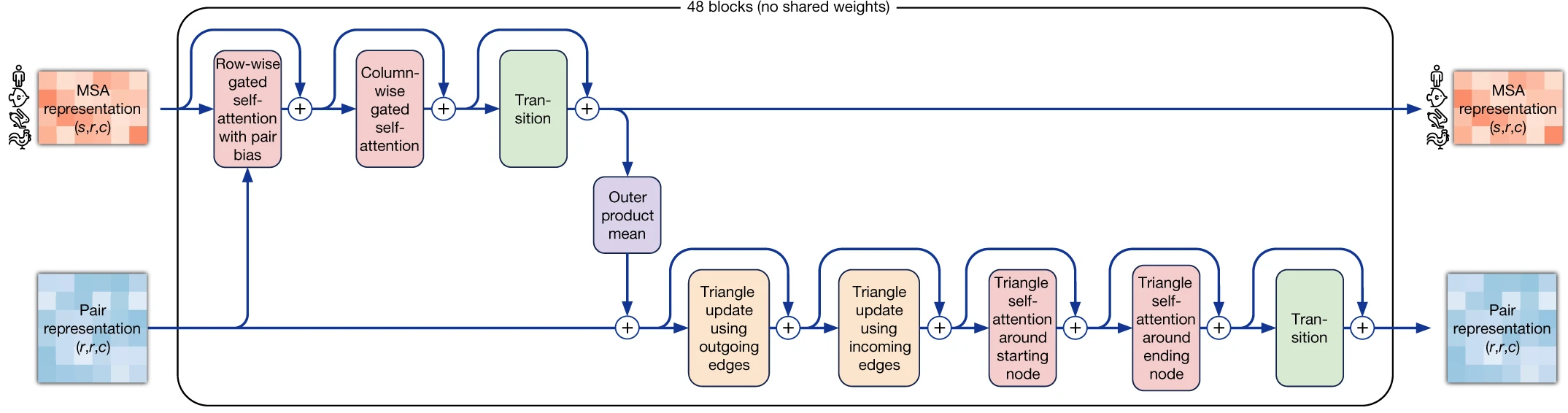
The multiple sequence alignment (MSA) is the key ingredient. Comparing 10,000 variants of a protein across the tree of life reveals evolutionary constraints: every pair of positions that co-evolves corresponds to a physical contact in the 3D structure. AlphaFold 2 transforms these evolutionary clues into structure with remarkable accuracy.
AlphaFold Database: The Largest Biological Structure Database
DeepMind didn't stop at the model. The team predicted the structures of 200 million proteins, covering virtually all known proteins in every sequenced living organism. The database is freely accessible. It's used by over 2 million scientists in 190 countries to understand diseases, design drugs, and create synthetic proteins. It's one of the greatest acts of open science in history.
AlphaFold 3 (2024): Beyond Isolated Proteins
AlphaFold 2 predicted the structure of an isolated protein. But in the cell, proteins are never alone: they constantly interact with each other and with other molecules. AlphaFold 3 predicts these interactions:
- Protein-protein: how two enzymes assemble to work together
- Protein-DNA: how a transcription factor binds to DNA to control gene expression
- Protein-ligand: how a drug inserts into its protein target's active site, the most crucial interaction for drug design
New engine: diffusion. Instead of directly predicting atomic coordinates as the Evoformer did, AlphaFold 3 uses a denoising process: you start from a random cloud of atoms and iteratively refine them until you get a coherent structure. It's more flexible than the Evoformer and allows modeling a greater variety of interactions.
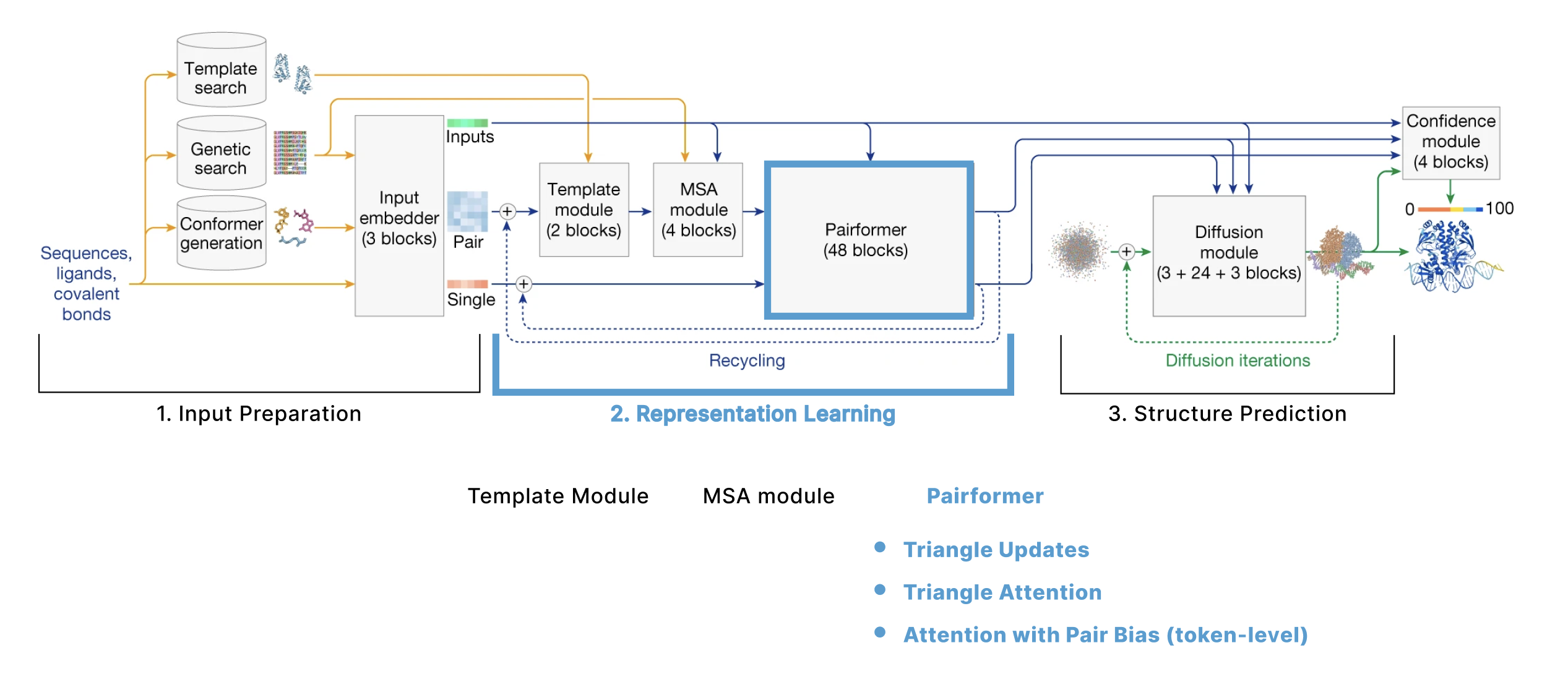
Performance: AlphaFold 3 outperforms specialized tools on every type of interaction, whether predicting protein-protein, protein-DNA, or protein-ligand complexes. It's a generalist model that excels in every specialty.
The Limitations: Not Perfect, But Revolutionary
- Dynamic proteins: AlphaFold predicts a frozen snapshot, not a movie. Yet proteins move, change shape, and these movements are often essential to their function
- Disordered regions: certain portions of proteins have no fixed structure. They're flexible by nature, and AlphaFold predicts them poorly (but it signals this via a low confidence score)
- Mutation effects: the impact of a single mutation on structure isn't always well captured, which limits use for predicting the effects of pathogenic mutations
When the confidence score (pLDDT) is below 70, predictions are speculative and should not be taken at face value. For drug design in particular, experimental validation remains essential. AI provides a brilliant starting point that considerably accelerates the work, but it's the lab experiment that provides the definitive answer.
The Legacy and What Comes Next
AlphaFold has inspired an entire generation of models: ESMFold (Meta, based on protein language models without MSA), RoseTTAFold (David Baker, independent architecture), OpenFold (open-source reimplementation of AlphaFold 2). Competition between these approaches accelerates progress.
The next big goal: simulating an entire cell with atomic precision, with all its proteins, membranes, organelles, and molecular interactions. We're not there yet (the complexity is staggering) but AlphaFold has shown that problems considered unsolvable can fall when the right ideas meet the right computing power.
1. Where does AlphaFold 2 get its 3D information from, when all it is given is a sequence of amino acids?
2. A prediction comes back with a pLDDT confidence score of 55. What does that mean in practice?
3. What genuinely changes between AlphaFold 2 and AlphaFold 3?
4. Why is even an excellent AlphaFold prediction not enough to settle how a protein works?