3 Million Articles per Year: Impossible to Read
Every year, more than 3 million scientific articles are published worldwide. That's about 8,000 per day, or one every 10 seconds. A researcher, even the most devoted, can only read a tiny fraction of their own specialty. Result: discoveries go unnoticed, work is needlessly duplicated, and connections between fields remain invisible.
Scientific LLMs aim to solve this problem by synthesizing, organizing, and making accessible this mountain of knowledge. The idea is compelling: train a model on the entire literature so it can answer questions, summarize articles, and make connections no human could make alone. But as we'll see, the road is full of pitfalls.
Galactica (Meta AI, November 2022)
Galactica was the most ambitious project in scientific LLMs. 120 billion parameters, trained on a massive and carefully curated scientific corpus:
- 106 billion tokens from 48 million scientific articles, textbooks, Wikipedia, and StackExchange
- Structured databases: PDB (protein structures), UniProt (genetic sequences)
- Special and innovative tokenization: amino acid sequences, molecular SMILES formulas, and LaTeX expressions were treated as special tokens, allowing the model to "speak" the language of chemistry, biology, and math
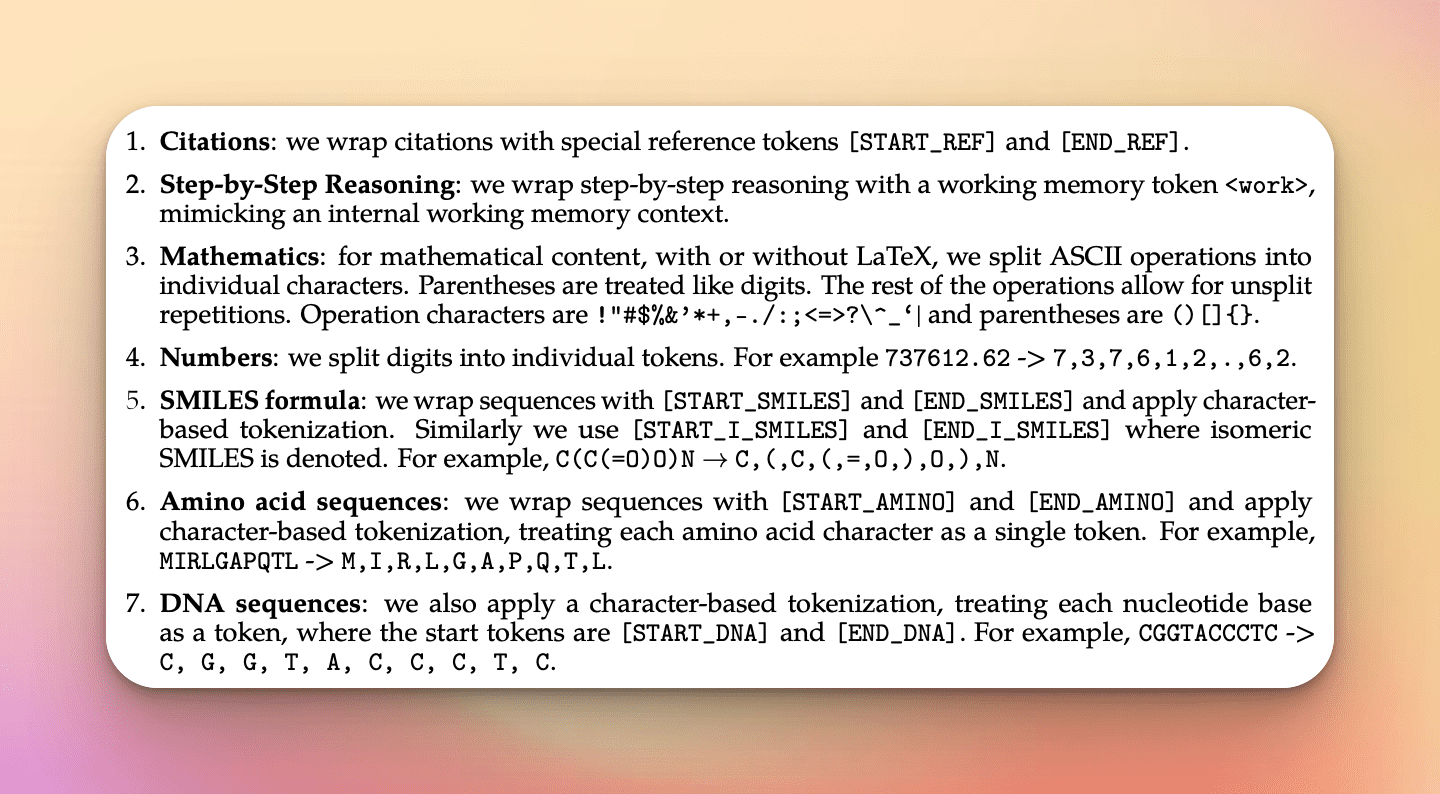
Announced capabilities: article summarization, scientific text generation with citations, molecular property prediction, mathematical reasoning, protein sequence annotation. On paper, it was a universal research assistant.
The Controversy: Pulled in 3 Days
Galactica was pulled from its public demo just 3 days after launch. Why such an abrupt withdrawal? The model generated plausible but factually incorrect scientific content with disconcerting confidence:
- Entirely fabricated articles with a mix of real and fake citations, making verification difficult
- Reproduction and amplification of existing biases in the scientific literature
- Legitimate concerns that the model could facilitate scientific fraud by producing fake content indistinguishable from the real thing
The withdrawal illustrates a fundamental risk: a model that generates fluent, confident scientific text can fool even experts if the factual errors are subtle. Linguistic fluency is not synonymous with scientific accuracy. It's the "eloquent nonsense" problem applied to science, and it's potentially dangerous.
SciBERT and Encoder Models
SciBERT represents a more modest but pragmatic approach: a BERT pre-trained specifically on scientific literature.
- Corpus: 1.14 million Semantic Scholar articles (82% biomedical, 18% computer science)
- Vocabulary: domain-specific WordPiece, allowing it to correctly tokenize terms like "polymerase" or "mitochondria" instead of chopping them into absurd pieces
- Size: BERT-Base (110M parameters), so lightweight and deployable
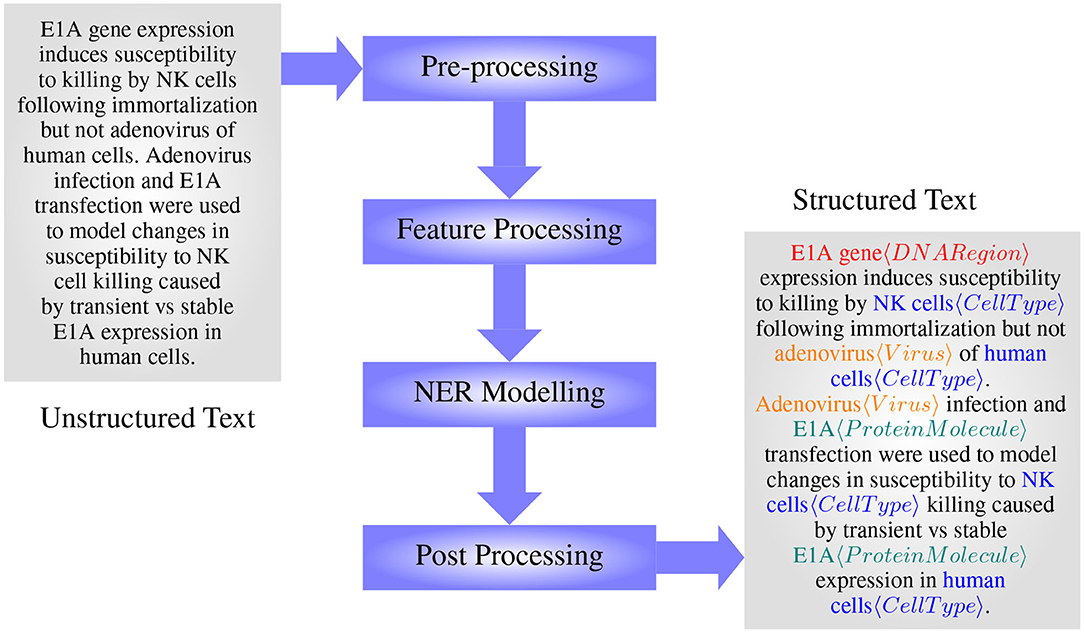
- Applications: scientific NER (identifying genes, proteins, diseases in text), article classification, entity relation extraction
SciBERT outperforms standard BERT on scientific NLP tasks thanks to its adapted vocabulary and contextual representations trained on scientific text. The lesson: sometimes a small, well-specialized model beats a generalist giant.
Specialized variants: PubMedBERT (trained exclusively on PubMed for biomedical applications), BioBERT (biology and medicine), MatSciBERT (materials science), ScholarBERT (75 billion multi-domain tokens). Each excels in its niche.
Encoder models (BERT family) are designed for extraction and classification: identifying named entities, extracting relations, classifying articles by topic. Decoder models (GPT family) are designed for generation: summarizing, answering questions, writing. The choice depends on what you want to do. For structuring existing literature, an encoder often suffices. For generating new content, you need a decoder.
Other Notable Scientific LLMs
LLEMMA (7B/34B parameters): an open-source model specialized in mathematics, based on Code Llama and trained on Proof-Pile-2. It can solve problems, verify proofs, and assist mathematicians.
SciGLM: a bilingual Chinese-English model optimized for scientific reasoning, reflecting the growing internationalization of AI research.
Semantic Scholar (Allen AI): rather than a pure LLM, it's an AI-powered search engine for scientific literature. Its S2ORC dataset (81 million full-text structured articles) is a valuable resource for the community.
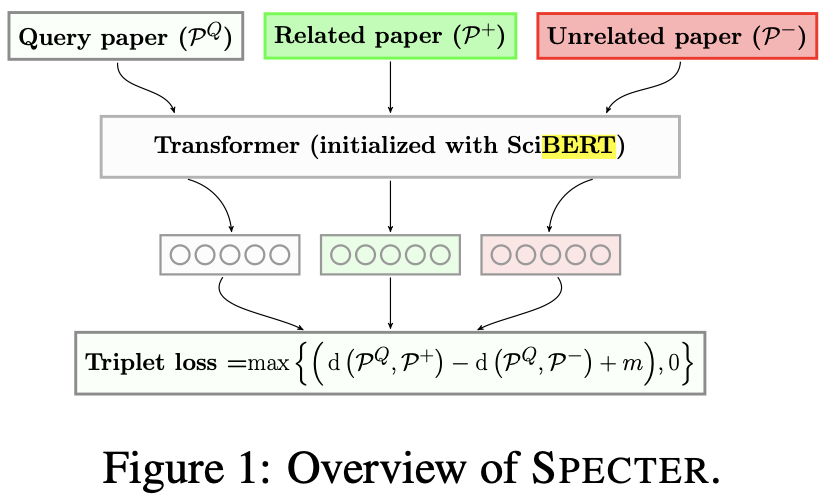
SPECTER: a scientific document embedding system. Each article becomes a vector in a mathematical space, and similar articles are close together. Perfect for recommendation and finding related work.
GPT-5.4 and Claude Sonnet 4.6 in generalist mode: increasingly, researchers use generalist LLMs for writing assistance, literature review, explaining complex concepts, debugging scientific code, and hypothesis generation. Not specialized, but versatile and immediately available.
Concrete Applications
Scientific information extraction: scientific NER automatically identifies genes, proteins, diseases, and chemical compounds in text. Relation extraction builds triplets like "gene X is associated with disease Y" or "molecule Z inhibits protein W." These triplets feed knowledge graphs that map an entire domain's knowledge.
Article recommendation: embedding models enable recommending relevant articles a researcher might have missed, detecting related uncited work (useful for peer review), and identifying gaps in the literature: questions nobody has asked yet.
Assisted peer review: tools are beginning to assist the peer review process by checking the consistency of statistical results, detecting common methodological errors, and suggesting missing references. This isn't a replacement for human reviewers, but an additional safety net.
Using AI in research raises deep questions. Should you disclose the use of an LLM in a paper? Is AI co-written text original? Major journals (Nature, Science) have established guidelines, but the consensus is evolving rapidly. The debate is far from settled, and each field is developing its own norms.
Outlook
Scientific LLMs are evolving toward multimodality: understanding not just text, but also figures, tables, equations, and raw experimental data. The ultimate goal is a true AI research assistant, capable of reading the relevant literature, formulating testable hypotheses, designing experimental protocols, and analyzing results. We're not there yet, but each year brings us closer to this augmented research partner.
1. Why was the public Galactica demo taken down after only three days?
2. SciBERT beats standard BERT on scientific tasks. What makes the difference?
3. A lab wants to spot genes, proteins and diseases automatically across a million papers. Which kind of model fits?
4. How does SPECTER learn to place two related papers close together in its vector space?