Supercomputers vs AI: The Clash
For 50 years, weather forecasting has worked the same way: solving the physics equations of the atmosphere (essentially the Navier-Stokes equations adapted to a rotating sphere) on some of the world's most powerful supercomputers. A global forecast cycle takes hours of computation on machines costing hundreds of millions of dollars.
In 2022-2024, AI models surpassed these systems in both accuracy and speed. The resolution of a 10-day forecast goes from several hours on a supercomputer to under one minute on a single TPU. This is a paradigm shift comparable to the arrival of GPS for navigation: the old system worked, but the new one is so much better and cheaper that it will transform everything.
GraphCast: Learning Skillful Medium-Range Global Weather Forecasting (Lam et al., 2022)Weather forecasting is one of the world's greatest computational challenges. The ECMWF (European Centre), Meteo-France, and NOAA (United States) use massive supercomputers to solve fluid dynamics equations on a grid covering the entire Earth. Each forecast cycle can mobilize thousands of processors for hours.
GraphCast (Google DeepMind)
GraphCast is the model that triggered the revolution. It's a Graph Neural Network (GNN) trained on 40 years of ERA5 reanalysis data (provided by the ECMWF):
- Input: the state of the atmosphere on a 0.25-degree resolution grid (over one million nodes covering the entire planet, each describing temperature, pressure, humidity, and wind at multiple altitude levels)
- Architecture: an encode-process-decode GNN with a multi-resolution graph. The graph connects both nearby and distant points, allowing the model to capture both local phenomena (a thunderstorm) and global ones (an atmospheric front crossing a continent)
- Output: the state of the atmosphere 6 hours later
- Autoregressive: for longer-range forecasts, you iterate: one step's output becomes the next step's input
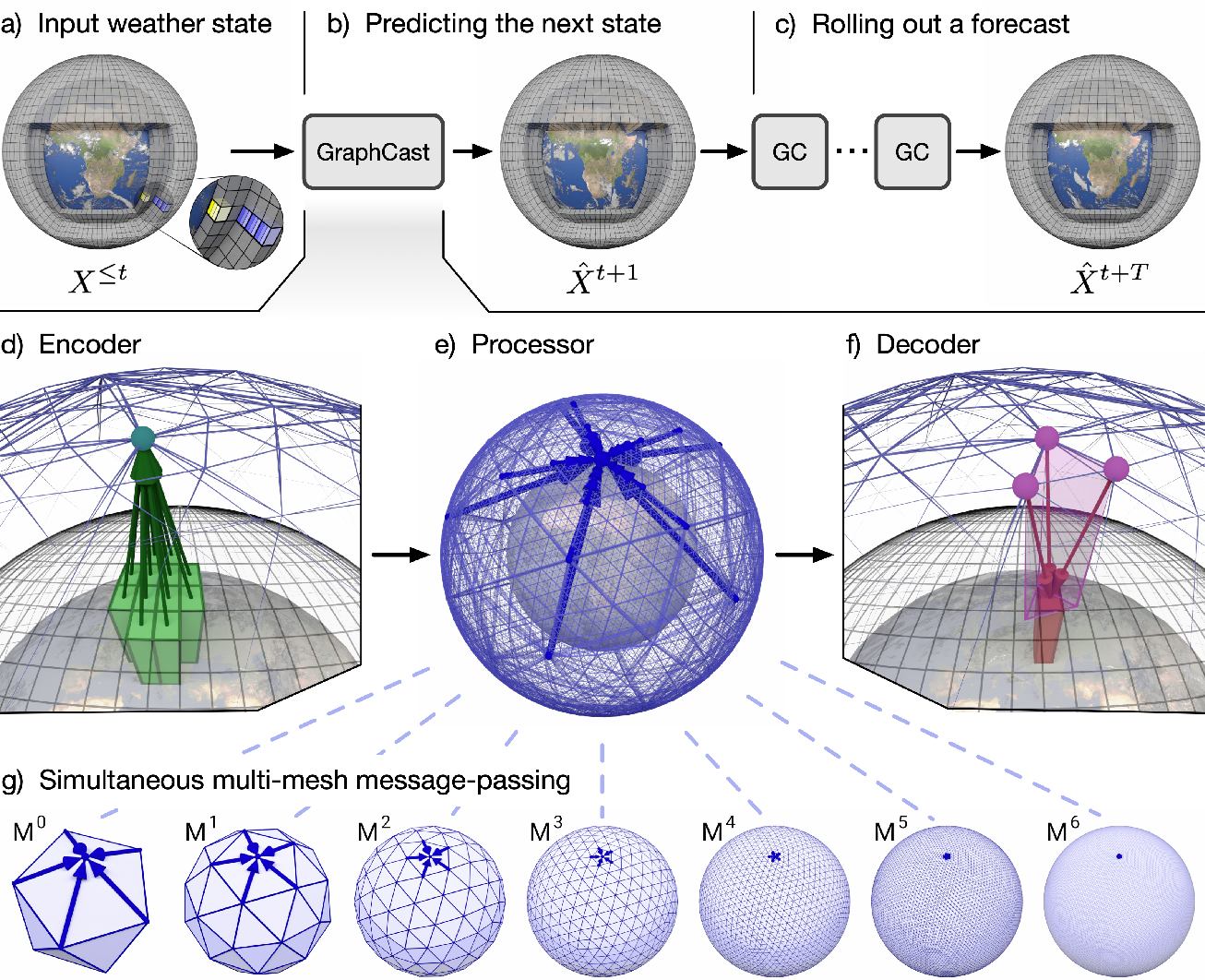
Performance: GraphCast outperforms the operational HRES system from the ECMWF (considered the best forecasting system in the world) on 90% of variables and forecast horizons (up to 10 days):
- Better forecasting of tropical cyclone tracks and intensity
- Better forecasting of surface temperatures and wind
- Execution in under one minute on a single TPU, versus hours on a supercomputer
GraphCast's speed isn't just about saving money. It allows generating thousands of forecasts by slightly varying initial conditions (ensemble forecasts). This gives a much better estimate of uncertainty: instead of saying "it'll be 68 degrees tomorrow," you can say "there's an 80% chance it'll be between 64 and 72 degrees."
GenCast (Google DeepMind)
GenCast is the evolution of GraphCast, using a diffusion model for probabilistic forecasting:
- Generates an ensemble of forecasts (50+ members) capturing weather uncertainty
- Outperforms the operational ENS ensemble from the ECMWF on 97% of evaluated metrics
- Diffusion architecture conditioned on the current atmospheric state: the model starts from noise and progressively refines it into a coherent forecast
Extreme events: this is where GenCast particularly excels. Better forecasting of heat waves and cold spells, more accurate cyclone tracks, and better anticipation of intense precipitation. For human lives, this is potentially the most important aspect: knowing 5 days in advance that a cyclone will hit a coast allows timely evacuation.
Other AI Weather Models
Pangu-Weather (Huawei): the first AI model to outperform operational models. Uses a 3D Vision Transformer trained on ERA5 data, with performance comparable to HRES.
FourCastNet (NVIDIA): uses Adaptive Fourier Neural Operators (AFNO), a particularly fast architecture at 0.25-degree resolution. Fourier operators are natural for weather, where phenomena have well-defined spectral structures.
FuXi (Fudan University): a Transformer with explicit temporal attention, competitive performance with GraphCast, and a particular focus on 15-day forecasts, the current frontier of weather predictability.
The irruption of AI sparked intense debate in the meteorological community. The ECMWF launched its own AIFS (AI/Integrated Forecasting System) to integrate AI into its operational systems. Most major national weather centers are now actively developing AI approaches. It's a historic turn for a field dominated by computational physics for decades.
AI for Climate
Beyond short-term weather, AI is also tackling climate:
Long-term climate projections: AI is used for downscaling (increasing the spatial resolution of coarse climate models), emulators (replacing the most expensive components of general circulation models), and detecting extreme events in satellite data.
Benchmarks: ClimateNet enables detection of atmospheric rivers and cyclones. ClimateBench evaluates general circulation model emulation and sea level rise prediction.
What AI Doesn't Replace (Yet)
- Physical understanding: AI models are black boxes that don't explain phenomena. They predict without explaining why
- Unprecedented events: trained on the past, AI models may fail when facing situations never observed in the training data
- Unobserved variables: the model can only predict what it has seen in the data. If a variable isn't measured, it doesn't exist for AI
Hybrid approaches are the most promising: combining the physical understanding of classical models (the laws of thermodynamics don't change) with AI's learning capability and speed.
AI weather models are trained on past data (1979-2023). But climate change means the future will be different from the past. AI models could be biased toward the historical climate and underestimate extreme events in a warmer climate. Physics-based models, built on fundamental equations, are theoretically more robust to these regime changes. This is a strong argument for hybrid approaches rather than pure replacement.
Outlook
AI will likely become a standard component of operational weather forecasting systems by 2025-2027. The ECMWF and Meteo-France are actively developing hybrid systems. The next frontiers of transformation are nowcasting (0-6 hour forecasts, crucial for storm alerts) and seasonal forecasting (months ahead, crucial for agriculture and water resource management).
1. How does GraphCast produce a ten-day forecast?
2. Going from hours of supercomputer time to under a minute on a single chip: what is the most valuable gain?
3. What does moving to a diffusion model buy GenCast?
4. Why does climate change pose a particular problem for these models?